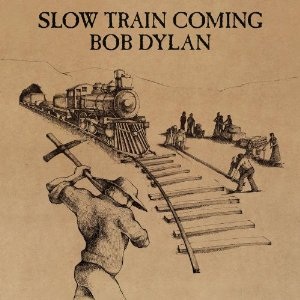
Slow Train Coming

Standard

Bob_Dylan_-_Slow_Train_Coming

I’ll admit it – I was a little bit scared of this album. You hear the stories. The legends of the born again period. The genius lost in confusion. The earnestness of the songs. Dire Straits as the backing band. Well, Slow Train Coming has all that and, you know, it’s not really that bad. Well, maybe the Dire Straits.

The only song that I knew well from this album was “Gotta Serve Somebody”, which was enough of a hit, that it is pretty inescapable as a radio presence. Most of the rest has been new to me this week, and it has been a hit or miss kind of week.

Let’s get rid of the bad right away. “Precious Angel”, as noted, is a song that I’m quite happy to be done with after this week, though I think it probably gets played at some live shows next week as well. Almost done with that one.

The title track, which is actually known as “Slow Train”, is just not very good at all on the album. There are live versions where it is better, but it is still not actually good. The third verse is highly problematic.

All that foreign oil controlling American soil

Look around you, it’s just bound to make you embarrassed

Sheiks walkin’ around like kings

Wearing fancy jewels and nose rings

Deciding America’s future from Amsterdam and to Paris

And there’s a slow, slow train comin’ up around the bend

Really, I could have lived a long time without hearing Dylan sing this kind of nativist bullshit. So that’s another one that I’m looking forward to jettisoning.

“Gonna Change My Way of Thinking” has a lot of power chords, and, really?, is that a cowbell? I think it might actually be a cowbell. Not good. “When You Gonna Wake Up?” is also bad (the “Gonna” songs on this album are all bad….). Lots of Dire Straits touches on that one, and these horrible lyrics:

Counterfeit philosophies have polluted all of your thoughts

Karl Marx has got ya by the throat, Henry Kissinger’s got you tied up in knots

Should probably just leave Kissinger out of your gospel songs, I’m thinking.

“Do Right To Me Baby (Do Unto Others)” is fine, but that’s all it is. Just fine.

So, that’s a pretty bad track record. That said, I do think that there are three songs on here worth keeping.

First, “Man Gave Names to All the Animals”. This one gets a lot of votes for “worst Dylan song ever” (please, “If Dogs Run Free” – end of argument). I don’t see it. It’s a great song to sing around the bonfire at your church camp, or in a Sunday school class. It’s clearly a song for children (a children’s book will even be made out of it somewhere down the line), and that seems to bother some people for some reason that I can’t see. It’s a fun song! I also like the fact that he drops the final line of the last verse:

He saw an animal as smooth as glass

Slithering his way through the grass

Saw him disappear by a tree near a lake . . .

Better, the band doesn’t resolve the song to its opening chord. The first time I heard it (on Sunday) I thought “that’s absolutely brilliant!”. Live, his back-up singers hissed after “a lake”, and that didn’t work nearly as well. The unresolved note is much more powerful.

Second, “I Believe In You” is, frankly, a beautiful song. This is one that Dylan has kept playing live (as recently as 2009). It’s just a great, great love song to God. He performs it well here, and it is simple and it is elegant, and it is great. I love the slide guitar bits. The only thing that keeps this from being the best-late 1970s Dylan song is:

Third, “When He Returns”. This was the shocker for me. Most of the time the final song on any Dylan album has a good chance of being a loser. Not this time. Dylan had actually planned for this to be sung by one of his back-up singers, and to close out the album that way. As it is, it’s Barry Beckett on the piano, a driving, riveting performance, that Dylan sings over. Apparently he did this eight times, and on the eighth he nailed it. Clinton Heylin says that this is his best vocal performance on an album since “Visions of Johanna”. He might be right about that one. This a great Dylan performance, proving that he hadn’t actually lost it, he’d just changed it.

In his interview with Bruce Heiman on KMEX Dylan was asked about separating the songs from the music:

Dylan: Well, they can’t do that. You can’t separate the words from the music. I know people try to do that. But they can’t do that. It’s like separating the foot from the knee.

I know some people won’t like any of these songs because they won’t be able to separate the song from the gospel that informs it. That’s too bad, because at least three of the songs on this album are really quite good. That’s a better number than some of the early-1970s albums.

I’ll admit it – I’m still a little bit scared of Saved.
Saturday Night Live

Standard

bob-dylan-20-october-1979

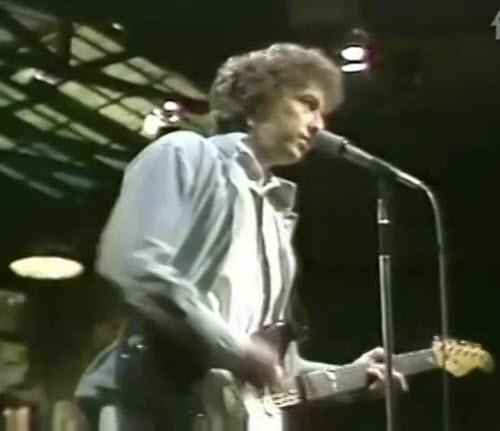
We have definitively arrived at the moment where Bob Dylan became uncool. If you watch Dylan from his earliest appearances on television or on stage at Newport in Murray Lerner’s documentaries or in Dont Look Back (especially!) Dylan seems to have been the coolest man on the planet. Watch the concert scenes in Renaldo and Clara and he was still the coolest man on the planet. Concert for Bangladesh and The Last Waltz? Still unbelievably cool. Now go watch Bob Dylan’s only appearance on Saturday Night Live. As he didn’t sing in Hattie Carroll, “now is the time you’re not cool”.

Bob Dylan appeared as the musical guest in second episode of the fifth season (20 October 1979). A bearded Eric Idle was the host. This was in the Bill Murray, Gilda Radnor, Lorraine Newman era – no Chevy, no Dan, no Belushi. You can watch the entire episode online here.

Watching old SNL is an odd experience. I was ten when this aired, so I didn’t see it then (I didn’t really see SNL until Eddie Murphy was part of the cast). The opening bit is ok, and most of the stuff with Idle isn’t great. The news segment is great. The best part of the whole thing – by miles – is the appearance by Andy Kaufman in his “I wrestle women” phase. He was an unbelievable heat magnet at this point in his career. That is a surreal experience. Most of the skits aren’t bad.

What is bad is Bob Dylan. Dylan does three songs: “Gotta Serve Somebody” (12:24 into the episode), “I Believe in You” (39:02) and “When You Gonna Wake Up?” (59:39). He never looks happy, not even for a second. He stands out there on stage dressed like a dad taking his kids to soccer practice. Gone are the sunglasses and awesome Rolling Thunder hats. Here is a button down shirt and faded denim jacket. He is the embodiment of anti-cool. Look at his band! Off to the side are four back-up singers (three women, one men). They are awesome – all decked out in spangly disco outfits. With Dylan looking like he just stepped out of the minivan.

Dylan_Bob_body

These performances are pretty terrible. That may be a function of the genre. In almost forty years SNL has produced only a handful of truly memorable musical performances (Elvis Costello booting “Less Than Zero” for “Radio Radio” and getting banned; Simon and Garfunkel not looking at each other in the second episode ever; Sinead O’Connor ripping up the pope; Ashlee Simpson trying to lip-sync to the wrong song). In fact, if you google “Best SNL Musical performances” the top picks are Kanye West and Nirvana and Arcade Fire. I had forgotten all of those. As I say, not memorable.

Dylan is unforgettable, for all the wrong reasons. Lifeless, humourless, dour – this is why people hate the Christian period.

Andy Kaufman, though. Hilarious.

Here’s a clip of “Gotta Serve Somebody” that I can’t get to embed right now for some reason.

http://v.youku.com/v_show/id_XMTY4NzgxMDQw.html

“Precious Angel”

Standard

Precious_Angel_cover

It’s weird. I’ve listened to Slow Train Coming about ten times so far this week already, and I was very much under the impression that it moves from songs that are religious but not overtly so towards ones that are more explicit in their Christian point of view. Just now, however, I sat down and actually listened intently to “Precious Angel”, the second song on the album and the second single while reading the lyrics. And, yeah, that theory about gradualism was just shot to pieces.

This is a sort of creepy song. It is the subject of some speculation as to who the “Precious Angel” actually is. In some ways, I feel like this is one of the songs I’d least like to have Dylan sing about me. The whole whispered lyrics things, his phrasing, it’s just generally unenjoyable for me. I haven’t heard a good live version of it yet, but I’ve only dabbled in a couple of his concerts from 1979 (these range from actually pretty good to downright awful – check back in a couple of days).

Sort of a null entity for me. Don’t like it. Don’t have much to say. The end. Just ticking off this box, really.

“Gotta Serve Somebody”

Standard

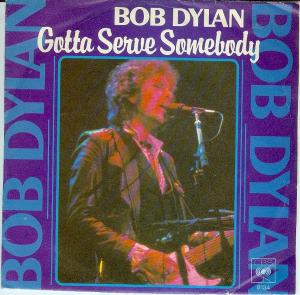
Gotta_Serve_Somebody_cover

Let’s take a moment, shall we, and note for the record: Bob Dylan’s last top forty hit. “Gotta Serve Somebody”, the first of a ridiculous four singles from Slow Train Coming, peaked at #24 in the United States in August 1979. He has not even sniffed the singles pop charts in the intervening three and a half decades.

For such a legendary singer, he never did that well on the pop charts. In fifty-two years of recording, Dylan has never had a #1 hit (in the US), although he had two #2s (“Like a Rolling Stone” and “Rainy Day Women”) and four in the top ten. It’s a pretty meagre success rate, if this is your gold standard.

Slow Train Coming was actually a successful album – peaking at #3 on the album chart. It would be his last success until 2001. It has been suggested that the album brought Dylan to an entirely new audience of right-wing Christians, and maybe that is the case. It’s not too far-fetched as to be unbelievable.

“Gotta Serve Somebody” is one of the better songs on Slow Train Coming, which is an album that I generally am finding not too bad. It has a very 1970s bass line, and Dylan sort of whispers the lyrics into the mic. The back-up singers are also used pretty well here. In 1980 this song will win Dylan his first Grammy – which is not so much a celebration of the quality of this song as it is a complete condemnation of the uselessness of the Grammys, but we’ll deal with that next week.

Lyrically, this song is one of the least direct expressions of Dylan’s new-found Christian faith on the album. It’s a song all about humility, and Dylan includes himself in this. I generally like it up until the fourth minute when we get this verse:

You may call me Terry, you may call me Timmy

You may call me Bobby, you may call me Zimmy

You may call me R.J., you may call me Ray

You may call me anything but no matter what you say

That one bugs me every single time as it seems so out of place.

Wikipedia notes that John Lennon didn’t much like this song, and so shortly before he died he recorded “Serve Yourself”, a goofy paean to self-involvement and selfishness that makes him come across like a complete ass. Here’s the Lennon:

Here’s the great Judy Collins singing the Dylan song. It’s even weirder when she asks to be called “Zimmy”:

At Budokan

Standard

Bob_Dylan-At_Budokan-Frontal

Bob Dylan’s At Budokan, released in April 1979, is a bit of a strange album. Dylan performed 114 live shows on his four-part world tour in 1978. By the time the album came out, it was memorializing a Dylan that didn’t really exist any longer. In a lot of ways, it is the coda to the first part of his career.

The album was recorded at two different shows – February 28 and March 1 – at the famed Budokan Hall in Tokyo, a home for martial and professional wrestling events that became a concert venue as well in 1966 when The Beatles played there. These were the fourth and fifth shows at Budokan (the seventh and eighth of the tour, as Dylan opened his world tour in Tokyo before doing three shows in Hirakata City and then returning to Budokan), and, as almost every critic is obliged to note, the band had not really gelled yet in terms of what they were trying to accomplish on this tour. If Hard Rain, his previous live album, seemed listless because it was recorded at the end of the tour, this one sounds a little spotty because it was recorded too early. You can’t win.

Actually, the album is pretty good – it’s just not as good as some of the better shows from the tour. The sound quality is excellent. When you spend a lot of time listening to audience recordings, it can be surprising to suddenly hear professionally recorded and mixed material (I had the same reaction to the Montreal footage from Renaldo and Clara – the bootleg sounds great, the official recording sounds awesome). Dylan started the tour in Japan and had been told by the promoters that he had to play a large number of his hits. This is what he does, but he provides new arrangements for almost everything. It’s a revisiting of the Dylan catalogue, but in an entirely new way. The songs that carry over from Rolling Thunder, or from the 1974 tour with The Band, are, once again, completely redone.

Many people hated this tour. Dylan was out there with a very large band, and three back-up singers, and a saxophone player. This seemed to be the sound – or one of the sounds – that Dylan had always been going for, but he was roundly knocked for it. With the then-recent passing of Elvis, many people felt that Dylan was seeking to occupy his spot, and the tour was condemned as too “Vegas”. Some of the shows in the US didn’t sell out and were met with mixed reactions.

I like a lot of the material here, but I generally don’t like any of it as much as I like Rolling Thunder or The Band tour, so I can definitely see the argument that there is a decline happening at this point. There were better options for live albums if they had been recorded. The Paris shows from July 1978 are generally held to be vastly superior to the Japanese shows, and the show at Blackbushe Aerodome, one of Dylan’s longest (33 songs), is really fantastic, despite an audience recording where you get to hear every moron in the crowd complain about people standing up in front of them.

The 1978 tour is well worth listening to – there’s a nice six CD bootleg that is very comprehensive and shows off what Dylan was doing better than this does. One of the things that I found most interesting about it was that near the end of the tour Dylan got chatty with the audiences. For more than a decade he hadn’t been one for stage banter, and even in the summer shows in Paris he doesn’t say much more than “Merci!” between songs. Then suddenly in November, everything changed.

On November 13, in Oakland, he introduced “Ballad of a Thin Man” with this spiel (credit to Bjorner for transcribing all of this):

In the Midwest in the fifties, during the fifties in the Midwest, they used to have these carnivals go by. And there always used to be someone in the carnival called a geek. A geek is a man who bit the head off a chicken and ate it, live. Anyway, everybody used to think of him as a freak. I mean if you think you’re funky, this guy was low-down all the way. And he used to think about other people as being freaks. I just wanted to tell you that.”

At the same show, before “One More Cup of Coffee”, he talked about the king of gypsies:

One year on my birthday I went to France where they have a big gypsy festival. All the gypsies from all over the world go there, and they party for a week. It just happens to be on my birthday. Anyway, I met the king of the gypsies a little ways away from there. He had 16 wives and 100 children and he still wasn’t faithful and true. Anyway I did get mixed up with someone over there. I don’t remember what was happening but in the morning they said, “Would you like anything for the road?” And without thinking I just said “one more cup of coffee.” I wasn’t sure if I could say anything else, but it was dangerous territory. 

 He told variants of these two anecdotes pretty much through the rest of the tour (Bjorner has them all transcribed), and on November 17 in San Diego (the same show at which someone threw him a crucifix), he said this before “Señor” (my favourite of the three):

Thank you. I took a train once from Monterey, Chihuahua, up to San Diego. Anyway, this guys was sitting next to me on this train, a man wearing a blanket. He (…..) to know everything. One of them (…..) guys. His eyes were burning up, smoke was coming out of his nostrils. I though I’d talk to him. When I turned around to look at him, he was gone. He’d either got off when the train stopped. (…..) I was hallucinating which I could have been doing too.

For better or for worse, Dylan will keep talking all the way through his 1979 tour, the First Gospel Tour, but there it is almost exclusively proselytizing. For about a month there, at the end of 1978, the crowds got weird chatty Bob up on stage. None of that part of the tour is captured on At Budokan, another reason why it’s only a so-so representation of Dylan’t grandest tour – up until that point in time.

I can’t find anything from this album online to post here, except this utterly bizarre thought experiment which I am sharing because I’m not sure why someone would do it, but it is great. All four bridges from “Simple Twist of Fate” overlaid on top of each other:

Oh Christ, It’s Dylan

Standard

photo copy

Before we begin, a quick note to say that my wife has held onto this button for thirty-five years, apparently in anticipation of someday being married to someone who decides to blog about Bob Dylan’s religious conversion. Our relationship was clearly preordained.

I’ll be wearing this button for the next three weeks.

Converting “Tangled Up in Blue”

Standard

Bob_Dylan_1978

As we open 1979, fair warning: Dylan has become a born again Christian. He will release his first, and best, album in the Christian trilogy, Slow Train Coming, and will go on a tour during which he will play only gospel music and antagonize his fans much more than he ever did at Newport.

So before we begin, I asked myself: How did this happen?

Bjorner’s site has a breakdown for every year of Dylan’s life that opens with “At a Glance”. This has been unbelievably useful to me on this project, helping to signal things that are worth considering and keeping me oriented. Here’s what he writes about the November 17 show in San Diego:

“It is at the same show that someone throws up a little silver cross onto the stage. Dylan picks it up and puts in his pocket. This little incident turns out to be the start of a new chapter in the life and art of Bob Dylan.”

I thought: Really?

I listened to a tape of that show last week and you certainly can’t figure out when the cross was thrown (not that I was expecting it to land with an audible clang). Dylan seems uncomfortable during the show, and even mentions something about food poisoning at one point (it’s not a great tape, so I’m not 100% certain what he says). He does sound a bit laboured. This is how Clinton Heylin reports it:

“Towards the end of the show someone out in the crowd … knew I wasn’t feeling too well,” recalled Dylan in a 1979 interview. “I think they could see that. And they threw a silver cross on the stage. Now usually I don’t pick things up in front of the stage. Once in a while I do. Sometimes I don’t. But I looked down at that cross. I said, ‘I gotta pick that up.’ So I picked up the cross and I put it in my pocket … And I brought it backstage and I brought it with me to the next town, which was out in Arizona … I was feeling even worse than I’d felt when I was in San Diego. I said, ‘Well, I need something tonight.’ I didn’t know what it was. I was used to all kinds of things. I said, ‘I need something tonight that I didn’t have before.’ And I looked in my pocket and I had this cross.”

Ok, so that’s why Bjorner bring it up. Let’s continue with Heylin:

“Dylan believed he had experienced a vision of Christ in his Tucson hotel room. “Jesus did appear to me as King of Kings, and Lord of Lords,” he’d later say. “There was a presence in the room that couldn’t have been anybody but Jesus … Jesus put his hand on me. It was a physical thing. I felt it. I felt it all over me. I felt my whole body tremble. The glory of the Lord knocked me down and picked me up.”

So, that’s a pretty clear conversion story.

The question I then had was “How long did it take to impact his performing?”. I knew from listening to one of the December shows (Charlotte, NC – an unbelievably great show) that Dylan changed the lyrics of “Tangled Up in Blue” to reflect his conversion. This was not new, Dylan changed the lyrics a little bit almost every time that he played the song, but it seemed hugely significant. This morning I tried to figure this out. Here’s what I learned.

At San Diego, the night of the cross thrown onto the stage, he played “Tangled Up in Blue” sixth (this was standard by this point – in each of the shows I’m discussing her TUiB is sixth). In the verse where “She lit a burner on the stove and offered me a pipe”, the “she” is wearing “a dress made out of stars and stripes” (so: “she lit a burner on the stove, wearing a dress made out of stars and stripes”) and then the verse continues roughly the same, with a reading from a “book of poems written by an Italian poet in the thirteenth century”.

At Forth Worth, TX a week later the version is roughly the same. Now “she” is working at The Flamingo Club rather than at a generic topless place, but she still has that dress and poems. At Austin (November 25, in a bootleg with terrible quality) we get that version for the last time.

The conversion of “Tangled Up in Blue” takes place in Houston on November 26. Now when “she” opens a book it is the Bible and the rhyme for “handed it to me” is “Matthew 33”. The next night in Jackson, MS it has shifted to “Jeremiah, verses one and thirty-three”. Three days late in Memphis the dress has become a housecoat of stars and stripes, and the verses are Jeremiah 22:1 and 33. Dylan will continue with Jeremiah through the end of the tour, eventually quoting Jeremiah 31:31 in the liner notes of Saved: ‘Behold, the days come, sayeth the Lord, that I will make a new covenant with the house of Israel, and with the house of Judah’.

So that’s how it happened, and how fast. For the next three weeks I’l be dealing with the fallout.

Here’s the live version from Charlotte, NC (December 10) and someone has even helpfully subtitled it to draw attention to the Biblical version. As I said, great show.

Street Legal

Standard

3992189_198

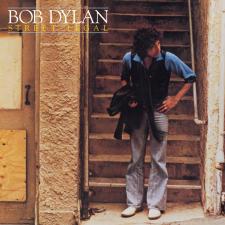
My wife, who has four sisters (and two brothers) tells me that she first heard Street Legal in 1978 when her sister, Louise, brought it home from a record shop. Apparently Louise was ridiculed for this decision by older sister Kate, who pronounced Dylan “lame” and “over”.  I’m not sure if this family rift ever healed – with large families it’s tough to tell.

The fact is that Kate was voicing the critical opinion of the day. Street Legal was greeted with a resounding critical thud. I just read Greil Marcus’s Rolling Stone review this morning and it is, to put it politely, uncharitable. Given the changes in popular music in 1978 – not just punk, of course, but also disco – Dylan with gospel-influence back-up singers and a sax player was another step too far for a lot of his fans. After three straight number one albums, this was the first full-length Dylan album to fail to make the top ten since 1964. He’ll basically have one more hit album (Slow Train Coming) and then nothing close to one for almost thirty years. This is the beginning of the dark period for Dylan.

According to Marcus, actually, the dark period begins with Desire, which he thinks has only a single good song, and that this has none. In fact, he implies that this is worse than Self Portrait. I often find myself disagreeing with Marcus, and in this case my disagreement is strong. I actually think that Street Legal is a good album – not a great album like Blood on the Tracks and Desire, but still quite good. Most of the songs, as songs, are really well done (except, bizarrely the first two singles – “Is Your Love in Vain?” and “Baby Stop Crying”). Many of the songs return to Dylan to the heights of lyrical complexity that he attained in the mid-1960s (Marcus dismisses all of this as faux sophistication, as I say, uncharitable). I’ve already argued that “Changing of the Guards” is a great song, but I will give him credit for “New Pony”, “No Time to Think” (never played live!), “Señor” (one of the highlights of the 1978 tour shows), “True Love Tends to Forget”, and “Where Are You Tonight?”. I actually think these are all well-written songs, and “We Better Talk This Over” is both well-written and well-played here.

The big problem with Street Legal is that, like Desire, it is horribly produced. By all accounts the fault for this one lay with Dylan, who had written most of the material long before the album was recorded, and he just sort of rushed through it. The album was recorded at his rehearsal space, with improper sound baffling that basically eradicated the bass and made the sessions a nightmare for the recording staff. Dylan didn’t care. It’s pretty clear by now that Dylan puts pretty little emphasis on his albums as albums – they are just places that he puts his songs, and his songs are things that he works on in live performance. This seems to upset people like Greil Marcus (or it did at the time), but it doesn’t bother me one bit. (To be fair, I should also note that the version I have, from the Complete Album Collection, is remastered and that apparently the version that Marcus was reviewing was notably worse).

I listened to a lot of live Dylan this week – like thirty hours worth – and a lot of these songs sound great live, or sounded great since he pretty much stopped playing almost all of them at the end of this tour. None of them sound as good on Street Legal as they do live, but Marcus’s inability to hear them as songs is his failing, not Dylan’s. There’s a lot of remarkable material here. Yes, some of it is buried under awful production and annoying sax fills, but that doesn’t take away from the fact that the songs themselves are actually really good.

Nonetheless, 1978 was the beginning of the “dump on Dylan” period. Renaldo and Clara was a bomb, Street Legal was lame, and the tour, though an enormous success, was also critically derided. He had become terminally uncool. Louise never had a chance, but it’s not actually a bad album.

Seriously, if you think that this is a bad Bob Dylan song, you’ve probably come to the wrong blog:

Dylan Scholarship

Standard

cicadas_Dylan_Honorary_400

In other contexts it’s called “scholarship.”” My friend Rusty posted that yesterday in relation to my thoughts on SearchingForAGem.com, the website that breaks down the intricate minutia of Dylan’s recordings in various contexts. Rusty was drawing a distinction between data collection and analysis, and how that analysis necessarily stems from data collection. This segued nicely with a discussion I was having yesterday about a couple of projects that I am working on.

In my day job, as professor of English at the University of Calgary, I write not about popular music but about comic books. My next book is now complete and will be out from Rutgers University Press in about a year (academic publishing schedules being what they are). A post-doctoral fellow that I am supervising and I were discussing the various ways that comics scholarship circulates among comics scholars, and the tendency of some comics scholars to ignore most of the work done in the field, or to read very selectively based on a narrow set of interests so that, for example, scholars interested in superhero comics might not read a book about European comics or manga, and vice versa. This is, of course, not a problem specific to comics. Shakespearians may not read much about Joyce, and Joyceans may not read much about Austen. There’s a lot of scholarship out there, and no one can keep up with it all.

Since my next book is about Archie Comics, we were wondering if it will be read by people who haven’t read Archie Comics. It is certainly designed to be – indeed, that is probably the primary audience. My post-doc asked what I hoped to accomplish with the book, and I noted that it has an implicit critique of the standard methods of doing scholarly work on comics – but that the critique is subtle about that in that it demonstrates its argument rather than proclaiming a new way of doing things. I’m not sure that all of the nuances will be picked up, but we’ll see. When he asked me what that implicit critique was, I suggested that it is (at least in part) an argument for data collection. My book examines eight years of Archie Comics, but to do that I read almost one thousand issues of Archie as the way to begin, because, to my mind, scholarship begins from the broadest possible base of understanding. That is the foundation. I am always struck when I read an article about a comic (or anything, really) and it appears to me that the author is unaware of related materials. I recently spoke to a student who is writing on a well-known mid-century American novel and he explained his approach. I mused that there was a great example of what he was talking about in another novel by the same writer, about five years after the novel he was considered. The student admitted “I haven’t read that”. It baffled me that a PhD student might not have read the five or six significant works by the subjects of one of his chapters. It baffled me that he wouldn’t have read everything, in fact.

To write a book about Archie in the 1960s I read all of the stories – not just the good ones, and not just the ones I thought I would write about, and not just the 1960s material but well into the 1970s and back into the 1940s. How could one do otherwise? This blog is not a scholarly project (yet), but it occurs to me that the same principle has to apply. To study Dylan for a year means listening to things you might not want to listen to (ie. the next month). You don’t pick and choose when you seek to understand, you dive right in and try to get a sense of the whole terrain before digging down. I’ve mentioned that I might want to write something formal about “Tangled Up in Blue”. I just looked at some existing scholarship on that song – and a lot of it deals with the lyrical differences between the version on Blood on the Tracks and Real Live. To me, that would just be scratching the surface. I’m not saying that it is necessary to hear all 1,377 versions of the song that Dylan has played live (imagine that!), but a sample size of two seems somewhat ridiculous to me.

According to the MLA database, there are 258 peer-refereed articles written about Dylan (that number will be low since the MLA database doesn’t cover many non-MLA fields). If I ever do decide to do something scholarly with Dylan, I’ll spend all of 2015 blogging those – one article per day for the entire year. After that, and only after that, I might be able to write something.

Masterpieces

Standard

Bob_Dylan_-_Masterpieces

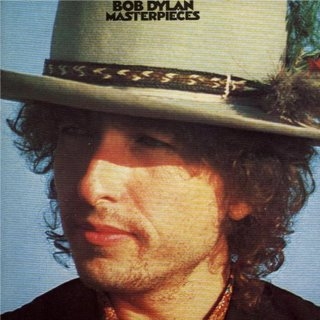
I was going to skip Masterpieces. This is the triple-LP greatest hits collection that Columbia issued in Australia, New Zealand, and Japan in March 1978 in anticipation of his tour there. There’s not much for me to say because I don’t actually own it (I did see a copy in January at a used record store, but I don’t own a turntable and it seemed odd to pay collector’s prices for an album that I can’t play and which I have all the music anyway, so I passed).

What I can say is that it’s a terrific Greatest Hits package in terms of song selection. Thirty-nine tracks, and almost every one a winner. Probably a much better package than the two American Greatest Hits collections, which also amount to three LPs.

Anyway, I was going to pass, but in googling around I was reminded of this site. These people (it can’t be one person, can it?) trace the different versions of everything Dylan has ever done. I mean, ever done. This site is incredible. They have scans and photos of the labels from the various releases. They have pictures of the cassette tapes! This is a level of obsession that I can admire, but that this project hasn’t even come close to touching. This is the work of a lifetime, not a year. This is close, attentive listening to bootlegs and studio outtakes to identify minor technical differences.

MasterpiecesAusCasSide2

Check this: About the version of “Mixed Up Confusion” included here:

R-0145-3 Mixed Up Confusion, 1962 – out-take from The Freewheelin’ Bob Dylanrecorded at Columbia Studios, New York, 1 Nov 1962 (take 10), and overdubbed with different backing, probably on 8 Dec 1964.  It is therefore not Bob’s first single R-0007 (see 1962) as expected, but the alternate take without the first harmonica solo from the Japanese promo LP Mr. D’s Collection # 1 (see 1974) and promo EP, Mr. D’s Collection  #2 (see 1976). This is Side 3, track 1.  As on those other releases, it is a mono mix of the overdub take.

I can’t compete with this. Hell, I can only barely comprehend it!

They have some great trivia here (“Dr. George Christos informs me Masterpieces was once given away by an Australian beer company with a purchase of 24 cans of beer!”)

It’s all a bit too much for me, I’m afraid.