Bob Dylan kicked off 1988 by getting inducted into the Rock and Roll Hall of Fame in Cleveland. He was part of the third class inducted. The first class had been primarily 1950s-era stars (Presley, Holly, Berry, Domino, Little Richard….), while the second class was primarily Motown (The Coasters, Aretha, Marvin Gaye). Dylan was inducted the same year as The Beatles and the Beach Boys, and the Supremes.
I don’t remember watching the show if it was broadcast in Canada. I supposed that it probably was, but I definitely missed it. The Hall itself has uploaded some videos from the evening to YouTube. It seems like they don’t have the broadcast rights, because the videos are all shot from behind, so you can see everyone’s back. They eventually shift to the front, or swish around looking for people in the crowd.
The Dylan segment was kind of painful. Bruce Springsteen, clearly nervous, did the induction. He does, at best, a mixed job of it. I thought it was nice of him to praise Dylan’s contemporary work, but he didn’t really get the point across. He does seem to be at a loss as a public speaker. I’ve certainly seen him do much better later in his career.
Dylan’s speech is a big nothing. He gives what seems to be genuine thanks to Little Richard, makes a jab about, presumably, another speech that went awry, and that’s about all there is to it. It does not seem to have been an important night in the life of Bob Dylan.
At the end of the show they got everyone up on stage and they played “All Along the Watchtower”. Strong contender for worst ever version of this particular song. Just so half-hearted and unprepared.
It seems to me that the Hall of Fame shows eventually got a lot better, but this is pretty much strictly amateur hour. I’ve never been to the Hall of Fame (nor to Cleveland generally). I’m not sure that these clips really help sell me on its importance….
Sometimes you get to the point with something like a Bob Dylan blog where your faith is genuinely tested. Case in point: last night I watched his 1987 film Hearts of Fire. Midway through my wife quite literally begged me to stop watching. No can do. To quote the constant refrain of the characters: “Fuck ‘em if they can’t take a joke”.
I’m going to start by summarizing Hearts of Fire, because it is unlikely that anyone reading this has actually watched it. Filmed in late-summer and early-fall 1986 in London and Hamilton, ON, the film stars Bob Dylan as Billy Parker, a former rock star who has opted to hang it all up and become a chicken farmer. He meets Fiona (billed with only one name), who plays aspiring rock star Molly McGuire and begins to mentor her because he has a creepy sexual attraction to her (she’s 18, he’s 45). Together they go to London where he performs at an oldies concert (alongside Richie Havens, who gets fourth billing but who has only two or three lines). While there they meet James Colt, a reclusive new wave star (his hit single is “Tainted Love”) played by Rupert Everett in a mullet and balloon pants. He takes the same interest in Molly that Billy has, producing her record and sleeping with her. James and Molly go on tour in the US: Chicago, Pittsburgh, Dunston, PA (her home town). At the second show, one of Colt’s mega-fans, a blind woman, kills herself in front of him, ending the tour. Molly goes on to play the final show in her home town alone, but during the first song first Billy and then James join her on stage for her triumphant homecoming since, while they both know that the price of fame isn’t worth it, hey, if she wants, who are we to stand in her way? It’s an odd moment. The film ends with Billy proposing to Molly, who rejects him. He gives her a guitar, but she steals his motorcycle. She then rejects James too, and rides off on the motorcycle into the sunset.
Let’s be clear: this is not a good film. Written by Joe Eszterhas and directed by Richard Marquand (Return of the Jedi), there is almost no drama here. Most of the film is musical performances and a half-hearted love triangle. Characters are almost completely one-dimensional, and some are even less developed than that. It is very slowly paced and pretty dull. There are some interesting touches – the movie theatre when Billy is first hanging out with Molly is showing Pat Garrett and Billy the Kid, and Ron Wood plays the role of an incompetent guitarist at a rehearsal in London. I became inordinately fascinated by the character of Nico, a muscle-bound drummer who looks like the wrestler HHH. Dylan also wears the worst jacket of all time, a denim thing with random patches of fabric sewn to it. I can’t find a picture to share with you – you’ll have to trust me.
(Not the worst Dylan outfit of the film)
The major problem is, as my wife says, “this is the worst part of the 1980s”. The clothes, sure, but the music. Molly is presented as a kind of Bonnie Tyler-esque wannabe, belting out ridiculous lyrics with no subtlety or nuance or charm at all. She’s all Patty Smyth and not one bit Patti Smith. When she sings the title track, I actually cringed.
The film features three Dylan songs. Apparently he was contracted for four, but, you know, Dylan. Actually, one of them isn’t even his. When Molly first meets Billy she tells him she has all of his albums and loves his song “The Usual”, which he then performs with her in a grimy bar the next night. That song, of course, is by John Hiatt. At the throwback concert, Billy introduces “Had a Dream About You, Baby”, a song that he would re-record, and include on his next studio album, Down in the Groove. “Night After Night” is so over-produced and awful that the less said about it the better. He also sings a song titled “A Couple More Years” to Fiona in a hayloft when he is trying to seduce her. It’s not on the soundtrack, but it is, by far, the best thing in the film from a musical perspective. So I guess that’s the fourth song. None of these songs have been released officially by Dylan except on the film soundtrack, which apparently has made the soundtrack somewhat collectible. Trust me, you can live without it. It is interesting, though, that he has completely disowned this material – his contribution to The Wonder Boys soundtrack is on the Complete Album Collection, for example, so this is a very deliberate omission.
It’s a shame that this movie is so bad, because Dylan isn’t that bad in it. He’s not going to win an Oscar, but this is his best screen performance to date. It doesn’t hurt that he’s essentially playing a version of himself – the mysterious, mercurial old musical superstar. There are line that are so clearly written especially for him (“I guess I always knew I was one of those rock and roll singers who was never going to win any Nobel Prize”, which will be excavated and run on the evening news if he ever does win (which I doubt)). The only really good line in the whole film is when Billy is trying to talk Molly out of being a rock star so that she can be chicken farmer with him. Speaking of her infatuation with James Colt, Billy says: “You think he’s a big star, but there’s no such thing as a big star. You look up in the sky, you know you see starlight, that’s all you see. Those stars died a billion years ago. Those stars are dead.” That’s a ridiculously Dylan-esque line and he delivers it in a brilliantly Dylan-esque fashion. Dylan is the only reason to watch this thing, and he’s only in it for about twenty minutes.
The film itself was never released in theatres in the United States, and it had only a two week run in the UK. You can find some foreign-language posters for it on the internet, so it must have played a little bit around Europe. It went straight to VHS in the US, but was never on DVD. iTunes sells it, but since the one time I ever bought a movie from iTunes it crashed and Apple refuses to refund me, I don’t deal with iTunes for anything for any reason. I watched it streaming on this site. It’s there if you want it.
A final note: I remember that my friends and I were all very aware that Dylan was filming this movie in and around Hamilton (whose steel mills allow it to stand in for Pittsburgh) at the time. We even knew where the bar was – though I now forget – and at one time even thought about trying to find Dylan and the crew. We never did though. It was enough to know that he was out there – close by – making a horrible film.
1987 found Dylan back in his sideman role for the first time in quite a while. It is interesting that both in the early-1970s and in the late-1980s when Dylan seemed to have lost a step in terms of songwriting he did two things: a) recorded a large amount of covers, and b) played on other people’s records. Here are three that he did in 1987.
Warren Zevon, “The Factory”
Dylan played harmonica on Warren Zevon’s song, “The Factory”, from the 1987 album, Sentimental Education. You can hear him here at 0:46 and 1:25 in particular. It’s a good performance on a song that I don’t rate that highly. I certainly don’t like the chorus, which is something that demonstrates that Dylan wasn’t the only singer-songwriter making odd choices in production at this point in time. Dylan doesn’t seem to be much more than a hired hand on this one, which is typically Zevon-esque.
Ringo Starr, “Wish I Knew Now (What I Knew Then)
Bjorner lists that as potentially a Dylan written song, given to Ringo Starr and recorded with him in Memphis on April 15, 1987. The song has never been officially released, but here it is on Soundcloud. It is pretty bad. Ringo, never a great singer, gives a lacklustre performance and the Dylan vocals don’t help matters much. This probably would have required a lot of work to get cleaned up enough for release, but lyrically the song doesn’t really merit it at all. The title is clever, but that’s about it. It should’ve been repurposed into a better song. I think that the relationship between Dylan and Starr is kind of interesting – Ringo is just sort of always hanging around, at The Last Waltz and at Dylan shows. They didn’t do much together, particularly relative to Dylan’s relationship to George Harrison, but they did seem to be quite friendly.
U2, “Love Rescue Me”
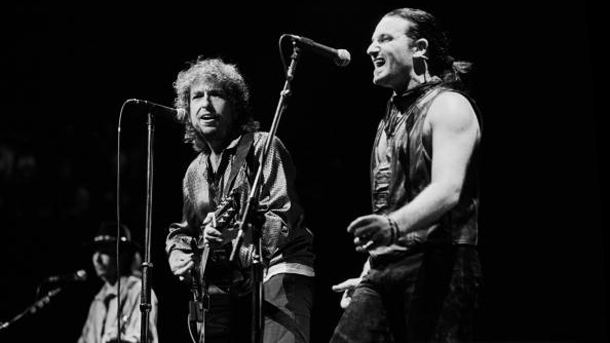
By far the best of the collaborations. Dylan co-wrote and recorded this song with U2 in June 1987, but it was released on U2’s 1988 album Rattle and Hum. Dylan had performed with Bono in Ireland in 1986, and then appeared with the band on stage in Los Angeles on April 20, 1987, performing “I Shall Be Released” and “Knockin’ On Heaven’s Door”. Bjorner lists these as available on half a dozen bootlegs that I don’t have, and I’m sure that they’re on an even greater number of U2 bootlegs, but I don’t have any of those either. If anyone has a lead, I’d be curious to hear that performance.
“Love Rescue Me” is a pretty good song. I really hated Rattle and Hum when it was released. I wasn’t a huge U2 fan prior to that, but that album left me pretty cold. Listening to this now, I kind of like it, and would probably speak up for this one. Dylan performs a role similar to that of B.B. King on “When Love Comes to Town”, certifying and Americanizing the Irish band. That bugged me then, but I’m a lot more sympathetic to it today. It doesn’t hurt that it is a pretty good song.


 LongAndWastedYear