Girl From the North Country

Standard

I’m hoping to set down a few words about every great Bob Dylan song as I make my way through this Long and Wasted Year. “Girl From the North Country”, the second song on Freewheelin’ Bob Dylan, is certainly one of those. A truly heartbreaking song, it has genuine emotional power. Not for nothing did they use it as the emotional centrepiece of Silver Linings Playbook (although they used the Nashville Skyline version – more on that in about six weeks when I’m allowed to listen to it).

It’s a simple song, and a beautiful one. Based on “Scarborough Fair”, which he learned in London at the end of 1962, it has been covered by just about everyone from Johnny Cash and Waylon Jennings to The Waterboys and Eddie Vedder. Rosanne Cash covered it on her album The List, on which she did only songs that her father had recommended to her as essential. Here she is talking about it and singing it:

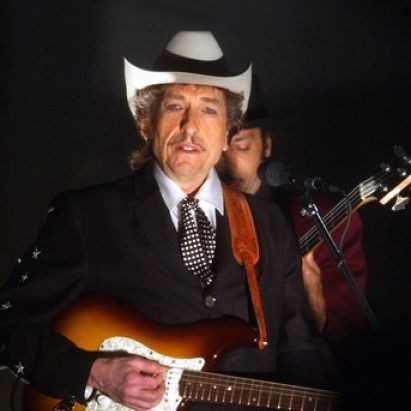
Searching for a good early Dylan version of it on YouTube I ran across this curiosity. I’m pretty sure that this isn’t from 1963, so it’s out of place here, but I’m posting it anyway, because it is awesome:

This is one of the Dylan songs where I don’t think he ever did a bad version of it.

(Sorry to post three things right in a row – long day prevented me from getting things that I’d written up earlier. I’m going to bed to listen to the Carnegie Hall concert again)

The March on Washington

Standard

url

Bob Dylan’s role in the March on Washington (August 28, 1963) was a minor one, though it profoundly shaped the way that he was understood as a singer-songwriter, and as “the voice of a generation”. Without Dylan, the March would still be remembered as one of the key moments in American postwar history for King’s “I Have a Dream” speech and for the enormity of the crowd and the righteousness of their cause. Without the March, Dylan’s image would have been significantly different. Interestingly, however, Dylan only rarely played such politicized events after this one – it does not seem to be something that suited him.

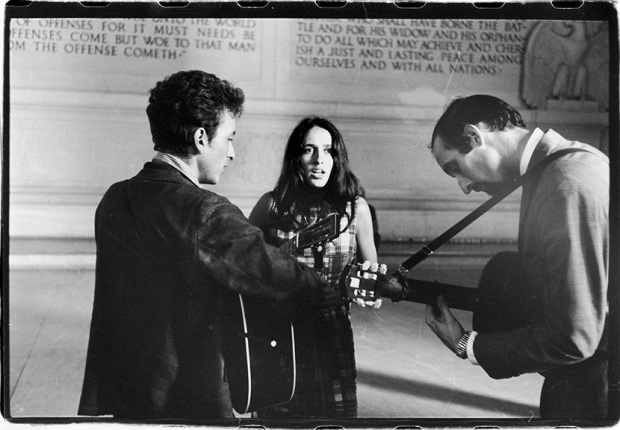
The best that I can tell, the folk song portion of the event was the fourteenth thing on the schedule (King was sixteenth, so Dylan’s performance was near the end of the day). Mahalia Jackson and Marian Anderson both sang, and then Joan Baez, with whom Dylan had been touring during the summer, sang “We Shall Overcome” and “Oh Freedom”. The two of them sang “When the Ship Comes In” and Dylan did “Only a Pawn in Their Game”, which was an interesting choice insofar as the lyrics suggest that Byron de la Beckwith was not the main reason for the death of Medgar Evers. Dylan’s suggestion of a larger social cause – something that he stumbled while explaining to Studs Terkel in their interview – is an awkward fit for the event. Peter, Paul and Mary also played at the event (“If I Had a Hammer” and Dylan’s “Blowin’ in the Wind”), as well as Odetta. The whole folk section of the day’s event ended with Len Chandler leading “Keep Your Eyes on the Prize”, the song that was borrowed as the title for a remarkable PBS documentary about the civil rights movement.

Dylan, Baez, & Stookey In The Lincoln Memorial

Dylan’s place in the history of the event was a minor one, but it helped cement the relationship between the new folk scene and the civil rights movement. For some fans it helped lay the foundation for the sense of betrayal that they would feel as his music began to change by the middle of the next year.

There is a tremendous video on YouTube of the musical performances from that day, plus footage from the crowds. It’s well worth watching in its entirety. Dylan seems nervous in front of the crowd, while Baez is so confident as she strides in to provide harmonies. Do yourself a favour, watch the whole thing:

Studs Terkel and Bob Dylan

Standard

imgres

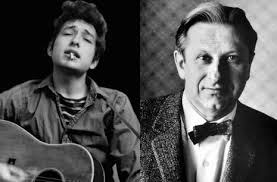
Of all the early interviews that I’ve now listened to with Dylan the best by far was conducted by Studs Terkel. The interview aired on WFMT in Chicago, and was recorded on April 26, 1963, the day after Dylan performed at The Bear. The interview runs for just over an hour, and Dylan performs seven songs. About half the time is taken up by a discussion between the two men, and you can hear the “voice of his generation” rhetoric really beginning to take hold.

Terkel is a very good interviewer for Dylan. He is cognizant of all the things that Dylan is interested in, and more. When Dylan says that he is going to sing “Boots of Spanish Leather”, Terkel immediately assumes he means The Gypsy Davy, a folk song of great note. Dylan’s version borrows a bit from that – and he performs a version of The Gypsy Davy on some of the earlier tapes – but it is a different song. Still, Terkel’s instincts were right, and he is able to talk easily with Dylan about Woody Guthrie and Pete Seeger.

Probably the most interesting segment of the interview is when the two talk about the differences between the politics of the 1930s and the emerging politics of the 1960s, which Terkel identifies as a tendency towards group identification (in the 1930s) as opposed to individualism (in the 1960s), and which the younger Dylan sees as the difference between a politics that assumed a right or wrong, with me or against me logic, and one that sees the world as filled with greys. Dylan gets lost a bit on a tangent trying to present an argument about the root causes of evil, but the whole thing is quite revealing of where he might have been with his thinking at the time.

One thing that is striking about the interview is the off-handed way that it closes – Dylan suggests that he doesn’t really have an appropriate final song to sing, so Terkel says that they’ll just play something from his album (meaning Bob DylanFreewheelin’ wouldn’t be released for another three weeks) and then Dylan remembers that maybe he should play “Blowin’ in the Wind”. It’s a kind of cute moment where the young man seems to think “Oh, wait, I have a single to promote!”.

The other thing that is remarkable about the interview, as with the earlier one conducted by Cynthia Gooding, is how enamoured Dylan’s interviewers are with him. Terkel can’t stop raving about his song-writing, and about how he seems to represent an entirely new way of looking at the world. At one point he reads from a letter that he’s received from an alienated, young man and asks for Dylan’s commentary on it. You can tell that Terkel thinks Dylan is an entirely new kind of being, and Dylan, at this point at least, is not averse to running with it.

This interview is all over the web. Here’s the whole thing on YouTube:

A Hard Rain’s A-Gonna Fall

Standard

dylan1

One couplet makes all the difference.

Despite what Nat Hentoff claims in the liner notes for Freewheelin’ Bob Dylan, the singer wrote A Hard Rain’s A-Gonna Fall in the summer of 1962 – well before the Cuban Missile Crisis erupted in October of that year. Indeed, Hentoff’s claim that the song is a reaction to that crisis is demonstrably false as Dylan performed it on stage for the first time on September 22, 1962.

That performance, part of a hootenanny organized by Pete Seeger, is a fascinating one. Dylan performed all five verses of the song that runs over seven minutes (apparently each of the performers was given only ten minutes of stage time, something that he violated) with some slight variations to the lyrics as they were recorded and are regularly performed. Some of these may be simple errors that come from singing a lengthy song in public for the first time. Dylan says that he has climbed to the “top of six misty mountains” rather than to the “side of twelve”. In the third verse he regularly uses the verb “saw” rather than “heard”. In the final verse he sings “dark forest” rather than “black forest”. As I say, minor stuff.

There are two big differences between the Carnegie Hall performance and the final version of the song. In the third verse, he adds a final line that eventually disappears: “I heard the sound of a one person who cried and was human”. It’s a nice line, but it doesn’t add a whole lot to the verse, and, indeed, seems slightly redundant. The line appears on the version of the song he recorded for the Witmark Demos, but it is gone from Freewheelin’.

The more significant difference, and one that has a huge impact, is the change to the first two lines of every verse. Dylan asks in the first verse: “Oh where have you been, my blue-eyed boy? Oh, where have you been, my baby, my own?”. This is a striking alteration from the familiar version which rhymes “blue-eyed son” with “darling young one”. It’s jarring, not simply because it is unfamiliar, but because the elegance of the rhyming couplet is absent. Dylan seems to have recognized this quickly, as it is only at Carnegie Hall that he seems to have sung it this way – by the time of the Witmark Demo recording it has reached the final version.

The extra line and the change to “son” are interesting examples of Dylan editing his work, and you can see the song evolve over a number of recordings before it crystallizes. In the 1970s (and later) Dylan would begin to tamper dramatically with the structure of his songs (compare this version with the one from the Rolling Thunder tour show at the Montreal Forum that can be found on Bootleg Series 5, which is the most uptempo and fun apocalyptic vision of all time (well, except maybe REM. And Timbuk 3)).

A Hard Rain is my favourite song from Freewheelin’. Unlike Blowin’ in the Wind, there is a lot that can be done with it (again, the Montreal show is a great example of this). Lyrically it’s a remarkably complex song, full of starkly dramatic imagery. A great deal has been made of interpreting Dylan’s symbolism (he does this himself during his 1963 interview with Studs Terkel, telling him that “pellets of poison” are the lies of the news media), which, as a professor of English literature I should probably endorse. But I don’t. I like the song’s images as images and have no desire to nail them down. And more to the point I love the way that Dylan wails “haaaard” on this one like a primal scream. Blowin’ in the Wind is the song that has the simplicity to speak to millions, but I prefer Hard Rain for its ability to show us Dylan in full-on poetic mode, channeling the symbolists. In time this tendency will overwhelm him, but in 1963 it was all so fresh and powerful.

Folk Concert Etiquette

Standard

bobdylans1

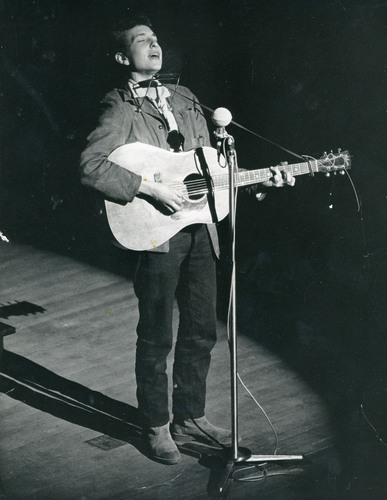
The best thing that I have discovered on this project to date, by a wide margin, is Dylan’s concert at Town Hall on April 12, 1963. A remarkably high quality recording of a tremendously good show, I’ve listened to this one three days in a row. A two set show featuring two dozen songs, and one poetry recital, this deserves an official release in the US (most of it was released in Europe on Bob Dylan 50th Anniversary Collection: 1963, and some of it shows up on the Bootleg Series – including two songs in Scorsese’s No Direction Home).

That’s not what I keep noting though. What I keep noting is the way the audience expresses their love for young Mr. Dylan.

Most obviously, there is the explosive, deep, sustained appreciative applause. These people (Robert Shelton claims an attendance of 900 in a 1200 seat venue) are listening hard, and reacting harder. It is the first “big” Dylan show (and the first where he performed mostly his own songs), and the difference from the clubs (which often sounded as if there were ten people there) is noteworthy.

The second thing that I noticed is the rude fans. Men mostly (okay, men exclusively), their job is to tell Dylan how to do his job. They yell out the names of his older (and newer) songs, demanding them as if he were a jukebox or a trained monkey. At one point Dylan denies a request for Hard Rain, only to play it later (heading into the break – a great way to end the first set). Someone calls for it in the middle of Dylan doing his stage patter, clearly throwing him off (though he recovers beautifully, and wittily). At another time he does accede to a request for Prett Peggy-o. I’m pretty sure that this was politeness, since he’s not doing other traditional songs in his set. He also introduces it by asking somewhat incredulously “You really want to hear that?”.

Third, and most oddly, there are the fans who try to control the rude fans. The Town Hall show has an inordinate amount if shushing. People in the audience call out to Dylan and others (mostly women) quickly shush them. It seems at first to be a reaction to the rudeness but, more importantly, it seems to suggest a crowd that has a strong desire not to miss a single moment, a single aside, even the tuning of a guitar string.

Personally, I hate the song-callers at shows. The best response I’ve ever heard to one came from Billy Bragg, who, denying a request for something or other, said: “That’s easy for you, mate. You just have to remember the title. I have to remember the words, the chords, and the witty banter that introduces it. Which is another way of saying you’re out of luck”.

In a couple of years – at Newport, in Manchester – Dylan will get the rudest of song callers. But that would be getting ahead if myself.

The shushers on the other hand are my kind of people – I’m trying not to miss a moment either.

But here you go, song-caller, wherever you are, A Hard Rain’s A-Gonna Fall at the end of the first set:

Blowin’ in the Wind

Standard

BlowingUnauthorized

Three verses made bob Dylan a superstar.

Written in 1962, Blowin’ in the Wind initially had only two verses. The third (“How many years can a mountain exist…”) was inserted into the middle of the other two. It’s the key verse, the one that ties it to the civil rights movement and the one that helped make Dylan the ‘voice of a generation’. Only a semi-protest song (the questioning rhetorical strategy broadens the appeal by expanding its focus to be too all-inclusive to be properly termed ‘protest’), it is a genuine anthem of the decade that produced it, and it was transformative.

Some sources indicate that Pete Seeger was the first to perform it live, learning the words and lyrics from Dylan backstage in a New York club before showcasing it for the crowd. It was first recorded by The Chad Mitchell Trio but their record company balked at releasing it. When it was snapped up by Peter, Paul and Mary it became a smash hit, selling three hundred thousand copies in its first week of release. Voice of a generation, indeed.

According to my iTunes playlist, I have fifty-one different versions of this song on my phone (many are live versions by Dylan, who has performed it live in concert – according to his website – an astounding 1,190 times). I have to say, it’s not a favorite of mine. It’s groundbreaking, yes, even era-defining, but also a little too dull for me. It’s one of his least variable songs as it only works well in a limited set of tempos and arrangements. I’ve always liked Joan Baez’s versions – it suits her well.

According to Robert Shelton, Blowin’ was a key part of Albert Grossman’s strategy to build the Dylan brand. Grossman also managed Peter, Paul and Mary and his goal for 1963 was big hit, strong word of mouth for Dylan as a songwriter from established folk performers like Seeger and Baez, and a big push at the Newport Folk Festival, where Baez had made her name in 1959. Blowin’ helped both Grossman and Dylan achieve their goals.

The song owes a musical debt to “No More Auction Block For Me”, and it was the subject of a false plagiarism claim that dogged Dylan for a few years, although his subsequent songwriting demonstrated that he had no need to rip off anyone.

As I say, not one of my favourites, but I do like this live version from 1963 – one of Dylan’s earliest television appearances.

Freewheelin’ Bob Dylan

Standard

imgres

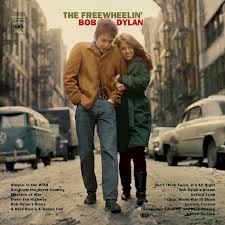
Freewheelin’ Bob Dylan, released on May 27, 1963, would have been one of the all-time great debut albums if Dylan only hadn’t released the self-titled album a year earlier. Featuring thirteen songs, eleven that he wrote, it was the inverse of Bob Dylan, which contained only two originals. While his actual debut finds him still trying to find his performing voice – singing a variety of the songs in styles that he has borrowed from other recordings or from other performers – Freewheelin’ is an extremely accomplished piece of work for a twenty-two year old. The album reached number 22 in the US, and produced one single (Blowin’ In the Wind), but it also featured a number of his best songs (and I hope to write about each this week).

Apparently, the album was almost much worse than it ended up being. Dylan’s biographers agree that on May 12, 1963, two weeks and a day before the album was to be released, Dylan was scheduled to appear on The Ed Sullivan Show. When Dylan told the producers that he would be singing Talkin’ John Birch Paranoid Blues, he was asked to perform something else. Talkin’ John Birch is an anti-anti-communist song (and only a mildly funny one, at least to today’s ears) and it is possible that the censors thought anti-anti-communist was the same as pro-communist. Anyway, Dylan refused to play another number, and he didn’t appear at all. Our loss.

The C in CBS, of course, stands for Columbia, which was Dylan’s label. Biographers differ on the exact chain of events, but Freewheelin’  was definitely the subject of a last minute shake-up. Whether he was ordered to change them or not, the fact is that four songs disappeared from Freewheelin’ and were replaced. To my mind, this improved the album considerably.

Gone were John Birch; Let Me Die in My Footsteps; Rambling Gambling Wille; and Rocks and Gravel. Dylan played all of these many times in 1962 and into 1963, and the first three are on the Witmark Demos. None of them is very good. Rambling Gambling Willie may actually be bad. The best of them is Let Me Die in My Footsteps, another early death song that would have fit better on Bob Dylan.

The four songs that were added were Girl from the North Country, Masters of War, Talkin’ World War III Blues, and Bob Dylan’s Dream. The first two of these are among the best songs that he did, and Girl would be a top contender for absolutely the best thing he ever wrote. The other two are no better – and no worse – than the songs that he replaced. Still, this was a significant upgrade.

Freewheelin’ is by no means a perfect album. Of the final two songs Honey Just Allow Me One More Chance is a dud (he played it live only three times in his career according to the excellent index at BobDylan.com) and I Shall Be Free is even worse. It’s a disappointing ending to an album that opens with the a great trio – Blowin’ in the Wind, Girl from the North Country, and Masters of War. On CD (or MP3) the album has another nice run in the middle with A Hard Rain’s A-Gonna Fall, Don’t Think Twice, It’s Alright, Bob Dylan’s Dream and Oxford Town, although these were split onto two sides on vinyl.

CBS recalled all of the copies of the album with the original sequence of songs, though, of course, some still exist. It is reported that they are among the most valuable albums in the world on the collector market. I checked: mine is just the regular one. Alas.

Madhouse On Castle Street

Standard

20140111-081714.jpg
When I started thinking about this project I anticipated that it would lead in some unexpected directions, and this is the first of them.

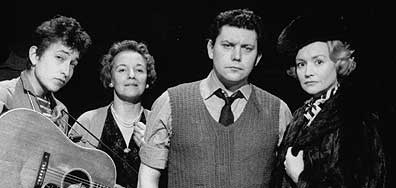
In 1962 Dylan was recruited by Philip Savile to star in a BBC tele-drama, Madhouse on Castle Street. Dylan, along with his manager, Albert Grossman, flew to London to film the show, but Dylan backed out because he couldn’t act. The play was quickly rewritten, with Dylan re-cast as Bobby the Hobo, who wandered about singing, but not performing lines. Dylan performed four songs: The Swan on the River, I Been All Around This World, The Coocoo Bird, and, before it was a hit, Blowin’ In The Wind. The play was recorded at the very end of December and broadcast on January 13, 1963.

While it is unusual that Dylan’s first televised appearance would be on the BBC, it is more unusual that the BBC would have destroyed the only known copy in 1968, at the height of his fame. What survives are television listings, memories, and some poor quality recordings made by placing tape recorders in front of televisions on that Sunday evening in 1963.

I listened to these recordings, as I must, and could hardly recommend them. Swan on the River is a nice, catchy tune, but essentially it’s a few minutes of singing with dialogue over it, recorded as through a door.

When I went to look up some details, however, it turned out that BBC4 did an hour long documentary about the show and the blizzard of 1962. Further, Walrus Video has it streaming on the internet. It’s a bizarre film – about twenty minutes worth of material stretched to an hour. Get past the opening, which ludicrously equates the destruction of the tape with the assassinations of King and Kennedy and the events in Prague, and you’ll get a nice history. One of the highlights is Peggy Seeger recalling meeting Dylan for the first time. There’s not much to the anecdote, but they do show her wonderful banjo picking.

One interesting factoid is that the filming was interrupted by a union dispute so Dylan accompanied Grossman to Rome over the New Years to see Odetta, one of Grossman’s other clients. During that trip he apparently wrote Girl From the North County, based on Scarborough Fair, which he had learned from the London folkies. Maybe it’s even true!

A bizarre excursion to end 1962, and what could’ve been a major piece of Dylanalia lost to history by a BBC cull of old tapes.

Mixed Up Confusion

Standard

20140110-085955.jpg

The thing that has most surprised me about listening to nothing but Bob Dylan’s 1962 recordings this week is that he invented folk rock several years before he invented folk rock.

Folk rock is understood as the combination of folk song traditions and electrified instruments and amplification. It also is indicative of the presence of a band – particularly a drummer. Obviously lots of folk groups existed before folk rock – The Weavers, The Kingston Trio, and so on. Performing as a “band” wasn’t the shift, it was playing with a “band”. This is what Dylan would do in 1965 at Newport that would lead to his excommunication. But then how do we explain “Mixed Up Confusion”?

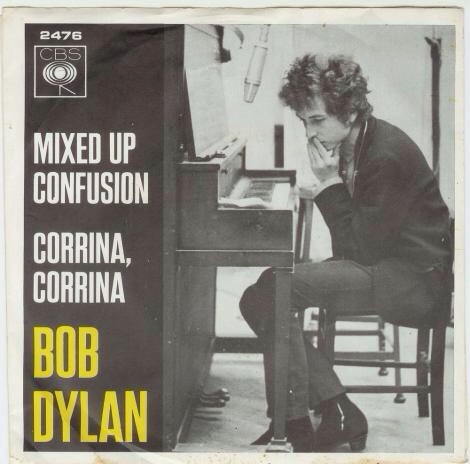
In fall 1962 Dylan had begun recording his second album, Freewheelin’ Bob Dylan. This would be his breakthrough in 1963. Before the end of the year, however, Columbia Records released his first single: Mixed Up Confusion (with Corrina, Corrina as the b-side). Corrina, Corrina made it onto Freewheelin’, and it is the only non-solo acoustic song on that album (it even has a, very subtle, drummer).

Mixed Up Confusion was totally at odds with the rest of the album and it doesn’t appear on it. Allegedly written in a cab on the way to the session, it featured George Barnes and Bruce Langhorne on guitar (one electrified), Dick Wellstood on a prominent, driving piano part, and a rhythm section of Gene Ramsey on bass and Herb Lovelle on drums. Band. Electric guitar. Hard driving rhythm. This was a rock song. A folk rock song three years early.

The single went nowhere. Researching it, I came across this site that breaks down various versions and takes and issues of it. This is too much for me, though I appreciate that there are people out there in the world who do this kind if analysis.

Mixed Up Confusion is an incredible selection for a first Bob Dylan single – almost unbelievable given how he was understood at the time by fans, peers, and media. When I first heard it, on Biograph, as a teenager, I must have placed it much later in his career. I’ve always liked it, and even when I didn’t listen to it for years and years I would still occasionally break out into its memorable opening whine – “I’ve got mixed up confusion, aaaaaand it’s a-killin’ me!”. It was really only this week that I comprehended its place in his development, and it still seems out of place.

A premonition of what was to come, Mixed Up Confusion has a title that seems to define its position in Dylan’s evolution across 1962.

Mixed Up Confusion on YouTube

The Witmark Demos

Standard

The flight from Calgary to Chicago that brought me to the MLA meetings yesterday is about two and a half hours in the air, which, as luck would have it, is the length of The Witmark Demos. I listened to them in their entirety, which meant that it was the first time I skipped ahead in this project – the collection covers 1962 to 1964. Without the liner notes I wasn’t sure where to stop. It’s just as well – the demos play like the great early-Dylan album that Dylan didn’t release.

Dylan initially contracted his song publishing to Leeds Music (hence the bootlegs of that material) but switched later in the year to Witmark. Some of what he recorded in their offices were songs he had no interest in for himself, and which he hoped others would record. Others are him getting down the lyrics and tunes for rights purposes. The recordings are rife with false starts, verses and lines sung multiple times for the sake of clarity, and spoken asides where Dylan says “I’ll write this out for you later”. It’s a very intimate recording, perfect for a plane trip.

Listening to it all, I found myself wondering why I preferred it so strongly to Bob Dylan, the self-titled debut album. I’ve now listened to that album once per day for five days and I like about half of it. Actually, I’d keep exactly seven of the thirteen songs. Not a terrible ratio, but not fantastic.

According to Robert Shelton, Dylan sort of agreed. The five month gap between recording the album and its release meant that he semi-disavowed it by the time it came out – he’d moved on, essentially. So I asked myself, based on his recorded demos and the tapes made after the Bob Dylan sessions and before the album came out, could he have made a stronger debut?

The songs that I’d keep are Talkin’ New York, Man of Constant Sorrow, Pretty Peggy-o, Highway 51, Gospel Plow, Song to Woody, and Baby Let Me Follow You Down. I would put House of the Risin’ Sun on the maybe list – I don’t really care for it, but given Dylan’s debt to Dave Van Ronk it probably should be there.

So what would I have added? More songs by Dylan. The album has only two, but I think he should’ve considered I Was Young When I Left Home, Baby Please Don’t Go, Man on the Street, and Standin’ on the Highway. I’ve already written about I Was Young, which is great and beautiful, and the others are all good. None are overlooked classics, but they’re more interesting than his version of See That My Grave is Kept Clean.

The omission from the debut album that seems strangest in retrospect is Hard Times in New York Town, a very witty and charming song that pops up on a lot of Dylan’s live recordings during the year, but which doesn’t make it onto the album. There was a lot of strong material that fell through the cracks between Bob Dylan and Freewheelin’, some of it sort of mystifying in its lack of release, but none so much as that.

A few explanations seem to suggest themselves for the choices he made: timidity – Dylan, who was incredibly young, may have been reluctant to expose himself to that much scrutiny; traditionalism – other folk artists, like Joan Baez, released albums of standards, so why shouldn’t he?; and, I think most importantly, the fact that the singer-songwriter tradition was not yet so much fixed. It would take Freewheelin’ to make that happen.

20140109-201042.jpg