Infidels Outtakes

Standard

88294541

There are lots of Bob Dylan bootlegs. Indeed, I think that there are literally more than 3,000 of them. You could probably do a project like this one ten times and not exhaust everything that is out there (if you could get your hands on all of it). There are good bootlegs, bad bootlegs, and in-between bootlegs. There are show tapes, compilations of shows, and tour greatest hits. There are bootlegs for only the acoustic material played on tour. And only the electric material. There are studio outtakes, drafts, revisions, and different versions and mixes. There are bootlegs with mono mixes, stereo mixes, and rough cuts. There are bootlegs of vocals only and guitar only. Oh, there are bootlegs.

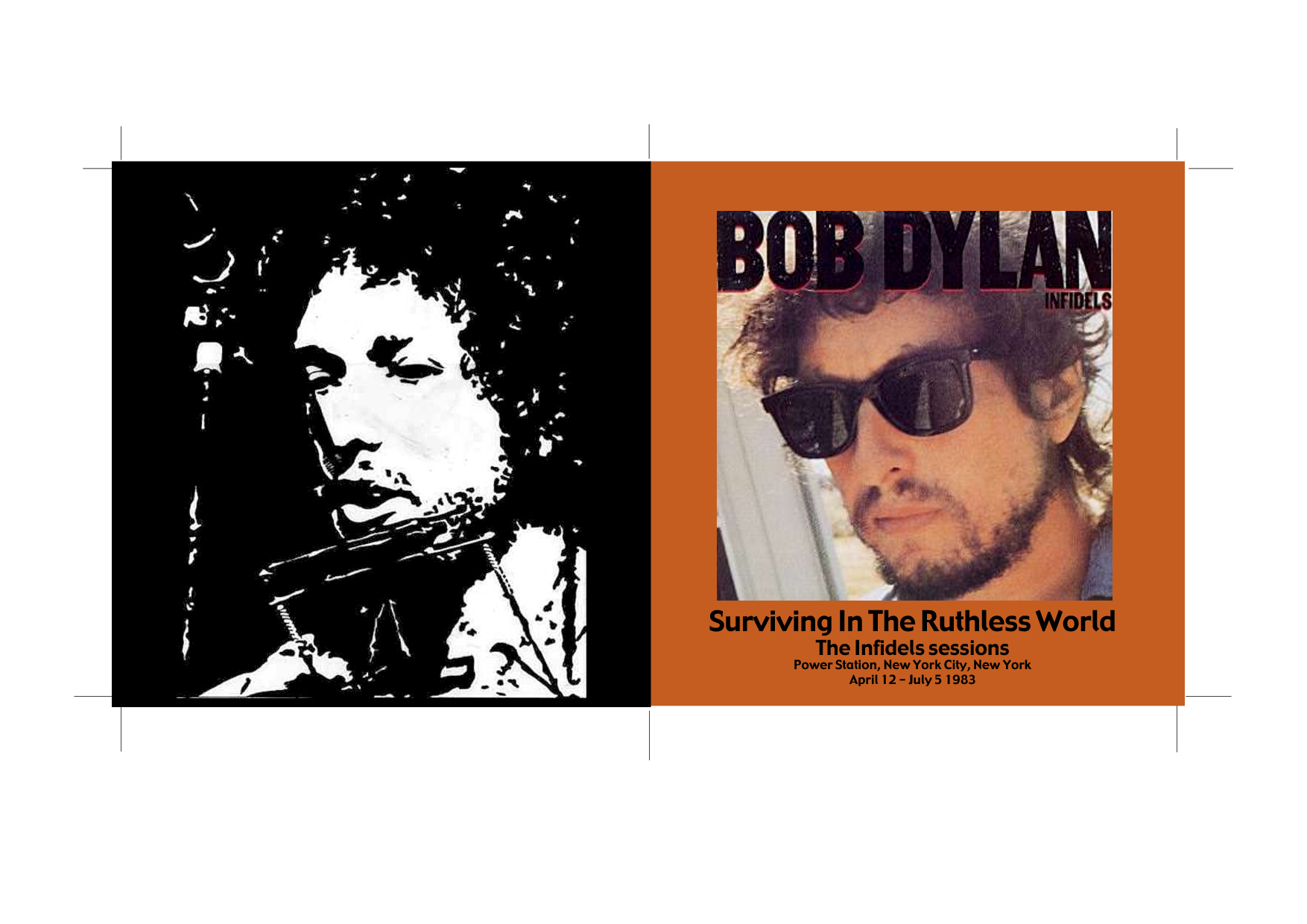
One of the oddest – well, no, definitely the oddest – bootleg that I have listened to so far this year is the second disc of Surviving in the Ruthless World, which is a four disc collection of Infidels outtakes (not to be confused with Surviving in a Ruthless World, which is two discs – “a” versus “the”). This has a sizeable collection of the Infidels material, but it seems that there are at least three additional discs worth. See here for a complete (?) listing of what is available.

So, this disc. It has forty-one tracks, and thirty-eight of them are attempts to record “Sweetheart Like You”. The shortest is 20 seconds long. The longest is 4:32. Seven of them run longer than 3:00 minutes. There are fast versions, slow versions, versions where Dylan forgets the words, and versions where there are no words at all. The album version is 4:34, just for the record.

Listening to this disc is sort of surreal. I can’t say that this is my favourite song on the album, but the outtakes are something that I’ve played a lot this week while working. It is very peaceful and serene, often just the same guitar part over and over and over again. I don’t get a strong sense from it of how Dylan works to build a song, just a lot of different attempts at the same thing. I would be a terrible record producer, because I find it hard to isolate the individual tracks and analyze their strengths and weaknesses. I just sort of like to immerse myself in the whole thing. It’s not like listening to the album cut on repeat at all, but it is slightly hypnotic.

I don’t think that the same effect, or even a similar one, would come from most of the other songs on the album. It’s the slow tempo and lovely guitar playing that works here. A more repetitive song – like “Neighborhood Bully” – would drive me to distraction.

I played this at first just to say that I’d listened to it. Strangely, it became my favourite part of the whole week.

Infidels

Standard

Bob_Dylan_-_Infidels

Infidels is considered by many to be the lone bright spot in the Dylan catalogue of the 1980s (Oh Mercy sneaks in just under the wire at the end of 1989, lending a hand to a decade that many are willing to write off entirely). It’s the first album after the born again trilogy, and it benefits, in the eyes of many, from the absence of testimonial and religious songs, the improved production, and a pretty decent band. Since I’ve come to like all three of the born again albums (to varying degrees), I haven’t found Infidels to be such a substantial upgrade. I think it is quite akin to the those albums, and pretty consistent in particular with Shot of Love. There’s a lot to like here, and a lot not to.

I’m going to skip the first two songs, “Jokerman” and “Sweetheart Like You”, since they were singles in 1984 and I want to deal with them as singles. On preview: “Jokerman” is pretty great now, but I hated it when it came out, and there are better versions of it than the one that made the album. “Sweetheart Like You” still baffles me a bit, but probably is a good song when all is said and done. As for “Union Sundown”, I already wrote about that one.

That leaves only five additional songs.

I noted that “License to Kill” has a strange aversion to the space program, which I now know is common to the evangelical Christian movement of this period. This, and “Jokerman”, are among the early indications that Dylan hasn’t left Christianity behind him, he has simply stopped being so overt about it. This one is filled with Christian overtones and references. Musically, I think it’s one of the more interesting pieces on the album.

“Neighborhood Bully” is the most overtly political song on the album, and it helps further located Dylan’s mood and politics at the time. This is a strong defense of the state of Israel (the bully of the title), from its enemies. For a man whose only performance the previous year was at a peace concert, this is an odd song to be singing – it is blunt in its praise for Israeli militarism and it calls for a greater level of American military intervention into the Middle East. Again, Reagan Democrat. Musically, though, it is the rocking-est song on the whole album. I like the band here, but I can’t get behind it lyrically. It’s funny, in the 1970s Dylan was accused in the music press of funding Israel with his tours and it was a huge issue. By 1983 it didn’t seem to matter that much to his remaining fans.

Probably the most directly religious song on the album is “Man of Peace”. I was listening to this in the car this afternoon with my son as we drove to the mall. He told me “You know, there is also a “Man of War”. I said, “Oh yeah, who’s that?”. Without missing a beat he said, “I’m not sure, but I think it’s a horse”. How do eight year olds learn that? Anyway, this one I straight up enjoy. Dylanesque weirdness abounds (“Well, he can be fascinating, he can be dull / He can ride down Niagara Falls in the barrels of your skull”). Religious Dylan is still good Dylan.

“I and I” is, in many ways, the centrepiece of the whole album. This is a cryptic one – I’ve taken to not only listening to it repeatedly, but to reading along while I do. I’ll admit that it confounds me a bit – I don’t see quite what he’s trying to communicate here, other than something about the dualism of the public/private self. Reading Dylanologists, I was struck by one of the quotes where Dylan claims that no one is even close to understanding what he’s saying with his lyrics, and I’m not even close to getting this one.

Finally, the album concludes with “Don’t Fall Apart on Me Tonight”, the obligatory (by now) closing love song. I sort of hate this one. It’s whiny, and annoying, and sounds like an ersatz Dylan song. It seems to me that he got that partial phrase and tried to build it into a song and it just didn’t work.

Overall, I’d say that this is maybe half a good album, maybe even five good songs out of eight. But that’s mostly as songs. I do have to say that the production still leaves a lot to be desired here. From what I’ve read, Dylan spent the previous summer reconnecting with is son, Jesse, who was sixteen and who was into the new wave and post-punk bands of the period. This exposed Dylan to a lot of new material (Clash, Squeeze, X…). He sought out producers who might take him in a new direction – David Bowie, Elvis Costello, and Frank Zappa (who he met with at the end of December 1982 – wouldn’t that have been something?) In the end he went with Mark Knopfler of The Dire Straits, who he had played with on Slow Train Coming. It’s not exactly the height of cool. Knopfler left for a tour before the final mix was completed, and the album was recut without him. Some of it still sounds a bit rough.

To my mind, the band really under performs on most of the songs. It’s an all-star cast here – Knopfler on guitar, Mick Taylor of The Rolling Stones on guitar and Sly and Robbie as the rhythm section. You would think that it would be great, but, really, I think it is one of Dylan’s least interesting albums musically. In fact, if there’s one thing that drives me nuts on the whole album it is the steady rap of Sly Dunbar’s snare drum on almost every song. There’s a sameness to the production that doesn’t really work for me.

That said, more of the songs are stuck in my head this week than they have been in a while. Even now “License to Kill” is slowly meandering through the back of my skull while I’m typing. It’s a good album, but it should have been a great one. What went wrong? Come back tomorrow and find out.
A Dylan Oddity

Standard

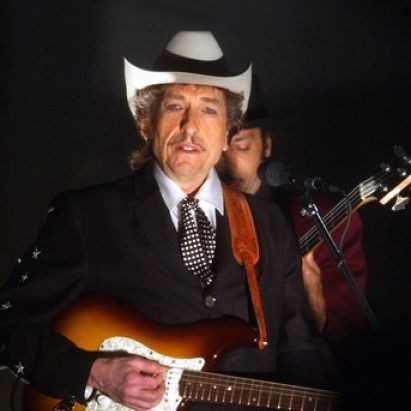
This is one that I haven’t been able to figure out. It is, it appears, a music video for “Don’t Fall Apart On Me Tonight”, the last (and possibly worst) song on Infidels. I’m not sure really what it is though, since the song was never released as a single, and, at least in 1983, videos didn’t much get made for songs that weren’t released as singles.

I have always understood it that Dylan produced his first video in 1984 for “Jokerman” and then for “Sweetheart Like You”, the two American-released singles from Infidels. This seems to predate that because you can see Mark Knopfler and Sly Dunbar and Mick Taylor here, which was the recording band for the album. Given that this wasn’t Dylan’s touring band, it had to have been recorded around the time the album was put together. So why wasn’t it released? What is it doing here on YouTube (which doesn’t even have the “Jokerman” video)? Was there a plan to release this as a video (I hope not, it’s terrible, even by the standards of a period when MTV was only two years old). I can’t tell if it is out of sync because this is a bad copy of a copy or because it was just shoddily made.

I haven’t found any references to this even existing, but here it is. Your leads are gratefully accepted.

“Union Sundown”

Standard

thumbnailImage

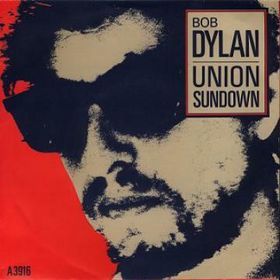
Bob Dylan’s twenty-second studio album, Infidels, was released near the end of October, 1983. It produced three singles, but two of them will be dealt with next week, in 1984, when they were released. The first, “Union Sundown”, seems to have been put out exclusively in Europe. It charted at #90 in the Netherlands and nowhere else at all. It’s a strange song.

For a lot of commentators, this one seems to be a return to the Dylan protest song of the 1960s. That’s a form of wish fulfilment, I think. I previously noted how Dylan’s politics on the three born again albums began to drift into Reagan Democrat territory, with a focus on certain forms of xenophobia, nativism, and American exceptionalism. This song has a lot of the same hallmarks. This is not a union song in the model of Pete Seeger, rather it has an ambivalent “what are you going to do?” tone. The politics here are pretty simple. As the man sings,

Well, it’s sundown on the union

And what’s made in the U.S.A.

Sure was a good idea

’Til greed got in the way

Most of the song is a litany about the off-shoring of American jobs, which is at least an interesting idea for a song.There’s not much solidarity here, but there is some fairly typical Dylanesque finger-pointing:

Well, you know, lots of people complainin’ that there is no work

I say, “Why you say that for

When nothin’ you got is U.S.–made?”

Further, despite the title, it’s not really that much of a pro-union song. For Dylan (and here’s the Reagan Democrat part coming out again), the unions are a big part of the problem:

The unions are big business, friend

And they’re goin’ out like a dinosaur

Finally, the song continues a trend of Dylan being sort of obsessed with human space travel. In “License to Kill”, also on this album, he writes:

Oh, man has invented his doom

First step was touching the moon

While on “Union Sundown” he sings:

They used to grow food in Kansas

Now they want to grow it on the moon and eat it raw

I know I wasn’t that old and sophisticated in 1983, but I have no recollection at all of anyone advocating harvesting crops in outer space. Weird.

Anyway, this is one of the songs on Infidels that I least like. Indeed, there is an outtake version with no lyrics except the chorus, and I greatly prefer that one to the one that can heard on the official release. Indeed, somewhat bizarrely, I find that I prefer the religiously themed songs on Infidels much more than the politically themed ones (this and “Neighborhood Bully”), which is something I never would have guessed at the beginning of this year.

Dylan and Danko and Helm

Standard

120420-levon-dylan

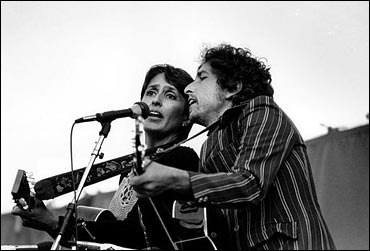
Dylan only performed live one time in 1982 and it was a bit of a disaster at the Peace Concert with Joan Baez. In 1983, he similarly only played live on one occasion and, I’m sad to have to report, it was no better.

On February 16, 1983 showed up at the Lone Star Cafe in New York for a concert by Levon Helm and Rick Danko, both now ex- of The Band. Helm and Danko did about ten old tunes by The Band (“The Weight”, “Don’t Ya Tell Henry”) and then welcomed their friend Bob onto the stage. For some reason this takes absolutely forever – I think Dylan was probably lost backstage somewhere. From the time that he is introduced to the time they begin to play, five long minutes pass.

Let me say one thing about the crowd at this show before I go any further: I hate, hate, HATE this crowd. It basically sounds like a bunch of drunk assholes. They yell, they hoot, they holler, one woman just starts shrieking uncontrollably for what seems to be an eternity. They yell out the names of songs. Boy, these people will make you never want to spend any time at all with anyone who likes the music of The Band. What I’m trying to say is: the tape is really awful, because these people are really awful.

Yet the tape is really awful for other reasons as well. Dylan joins Danko and Helm for five songs. It seems perfectly clear that none of these were rehearsed, or, indeed, even discussed beforehand. They start with “Your Cheatin’ Heart”, which actually sounds mostly like the crowd is singing along to because none of the three of them will take the lead on it. After some more screaming from the crowd they start “Willie and the Hand Jive”. This is a mistake, because it is a request from the crowd and that only emboldens the crowd, who now start yelling out the name of every song The Band ever performed, and many others besides. “Blues Stay Away from Me” is then given the same butcher’s treatment. I’m not one hundred per cent convinced all three of them are playing in the same key, but it hardly matters.

Right now you’re thinking, “Oh, he’s exaggerating for effect”. How bad could it be? Well, listen to this. It’s “Ain’t No More Cane” (ostensibly). This is the best song of the five that they did that night, if you use the standard of “does it actually sort of sound like a song?”. You listen to it, I can’t any more.

For the record, the final song is “Going Down”. From the photos it looks like everyone had a good time. I’m sure that there are people who were there who still tell the story about that epic night in 1983 when Bob Dylan walked onstage at a small bar in New York, and they’ve convinced their friends and neighbours that it was a highlight of their lives. They’re all lying. It was a crap set. And the people who try to tell you otherwise are probably the same ones who spent the whole time screaming “The Night They Drove Old Dixie Down!”

The Dylanologists (2)

Standard

81C7I7J4R2L

I finished reading David Kinney’s new book, The Dylanologists: Adventures in the Land of Bob, yesterday. In some ways it violated the conceit of this blog, because there was a lot of talk about what I think of as “future Bob” or the “Dylan who has yet to be” in terms of this writing project. Overall I think that it’s good, but it’s not essential.

Parts of the book are very appealing. He does a good job with a lot of his material, and Kinney writes well. He jumps around, forward and back, from character to character, and this creates a fair bit of interest and mystery in the volume. If there is a drawback, it probably comes from my own expectations and hopes. By interviewing many of the world’s best known Dylan collectors, for example, I was hoping for more details about the nature of their collections and their processes. There are many hints of this – descriptions about the culture and practice of those who record shows, for example – but I personally would have liked a lot more of it.

Certainly the best chapter in the book is the one about the study of Dylan’s “plagiarism”. This is a complex and vexatious story that I will deal with around the time of Love and Theft and of Chronicles. Long story short: the Dylanologists have demonstrated a remarkable degree of citation in Dylan’s late-period work, and now wonder what it is that he’s trying to communicate. The Daily Beast ran a pretty good overview of the whole thing, if you don’t have time for the book.

The most striking thing for me is the feeling of decline. Kinney is talking to today’s fans, and while many of them seem to have an almost religious attachment and devotion to Dylan, he also talks to many who were once the most rabid Dylan fans, but who have lost their faith. I don’t see much of myself in these people at this point in time. Yes, it is true that I hope Dylan’s current tour will bring him somewhere close enough to me that I will see him perform this year (he has just announced his tour will take him to Australia, that doesn’t help), but it is more out of intellectual curiosity than from a genuine desire or excitement to hear him play again.

So, not yet a Dylanologist. Working on it. I did note a factual error, so maybe there’s hope for me….

Peace Sunday

Standard

BD&Baez82

Bob Dylan did almost nothing for me to write about in 1982. He apparently recorded with Allen Ginsberg, but I don’t have that (I’ll look). He recorded some duets with one of his back-up singers (Clydie King) and this is listed by Bjorner as “not circulating”, which is too bad, because the idea of Dylan doing an album of duets is, well, fascinating.

Here’s what Dylan did in 1982 that I can write about: He appeared at the Rose Bowl in Pasadena on June 6 at the “Peace Sunday” anti-nuke concert during Joan Baez’s set. You can watch his entire performance here (note: the video drops out a couple of times on “With God On Our Side”). You should go watch this whole thing. I’ll wait.

The bootleg of this performance includes the entirety of Baez’s set: “Do Right Woman”, “Warriors of the Sun”, John Lennon’s “Imagine” (which she introduces as a song from the 1960s, which bothers me much more than it has any right to), and “Diamonds and Rust”. She then introduces “Robert” and Dylan sort of belatedly shows up on stage for his only public appearance in 1982. It is good and bad.

On the one hand, here we have Bob Dylan and Joan Baez together on stage again after all these years. It is a beautiful moment for those of us busy tracking their bizarre, decades long friendship. Six years after the Rolling Thunder Revue, about seventeen years after she helped to make him a star, here comes the middle-aged Dylan out to perform with her. His acoustic guitar and harmonica holder (he doesn’t actually play the harmonica). It’s a wonderful moment.

On the other hand, it’s all a bit of a shambles. The tuning of the guitars at the start. Dylan standing too far from the mic (she cedes him some space so that he doesn’t have to crash into her when he leans over). His guitar straps breaks (2:30) and the whole of “With God on Our Side” is sort of derailed. It’s not entirely clear that they are yet on the same page on this song almost twenty years after they were playing it for the first times. I mean, how many times can this duo butcher this song?

On the one hand, I love how happy people seem to be. Skip ahead to 9:34 and watch Joan Baez smile. It’s a great moment. Whatever has gone on in their relationship over two decades, it’s wonderful to see that smile.

On the other hand, she is smiling at the end of a cover of Jimmy Buffet’s “A Pirate Looks at Forty”. Jimmy Buffet. Joan Baez and Bob Dylan are on stage singing a Jimmy Buffet song. Seriously. What’s worse (and you’re wondering, how can it be worse?) they are doing a really, REALLY, bad job of it. Look closely, it is clear that Dylan has the lyrics written on his left sleeve. Watch Baez as she leans over to read them. She is constantly coming in late (she has done this with Dylan forever, possibly because he’s so mercurial in the way he plays things). It is sloppy and actually sort of painful to listen to. Go to 8:50 and you can clearly see both of them reading as they play. Actually, Baez just gives up and starts humming. Oh well.

On the one hand, they do “Blowin’ In the Wind” together, and all is right with the world.

On the other hand, they absolutely murder it. It is terrible. Awful. Horrendous. Look: “Blowin’ in the Wind” has three verses. Three. It is not a complicated song at all. Four chords, three verses. In fact, it’s so uncomplicated that between the first and second verses Baez says to the crowd: “Sing along, you know the words”. Except Dylan doesn’t. As they start the next verse, she sings the first line to the second verse, and he sings the first line of the third. She rolls her eyes and gives way, switching over to match him. It is a THREE VERSE SONG and he can’t get it right. Oh, man.

So, to sum up, in his only 1982 performance, Bob Dylan comes out at a peace rally, sings three songs. On the first his guitar falls off and on the second and third he doesn’t know the words even though one of the songs is the most iconic thing he has ever written. Wow.

On the one hand, the video of this performance is terrible – a dub of a dub of a VHS recording (the audio recording is far superior). On the other hand, just seeing these two people out there trying to do something – and, in particular, seeing Baez’s flustered exasperation, makes me inordinately happy.

That’s it. That’s 1982 in a single post!

The Dylanologists (1)

Standard

81C7I7J4R2L

“Once you own Bob Dylan’s highchair, it becomes easy to rationalize any other purchase”. So writes David Kinney, in his recently released book The Dylanologists. And I suppose it is true.

Last night, at a party at the conference I’m attending, someone asked me if I had become a “huge Dylan fan” while doing this project. I said that I didn’t think that I had, that I still sort of saw this as a research foray rather than a calling or a compulsion. But I had to admit that I can feel the compulsion starting to come on. When I turn the page onto a new week, like 1981 last week, and realize that even though they were all recorded, I’m not going to be able to listen to all those dozens of shows Dylan performed that year. What, I wonder, will it mean if I listen to the wrong one? What if I miss out on the best thing? The sickness lurks in the background.

Kinney’s book looks at the people who have the full-scale sickness. When Zimmy’s, the Dylan-themed restaurant in Hibbing, MN, was put up for sale earlier this year I joked about buying it (to the people on Facebook who thought I was really doing it: I’m sorry!). I haven’t thought about traveling there, and I haven’t thought about going to the Dylan-fest there (this weekend!), but I sort of am starting to get the people who do. After all, I have opinions on which are the good 1981 shows. I really do!

The Dylanologists is great so far, but I’ve only read a very little bit. I’m trying to save it. Savour it. 1982 has so little Bob in it. One concert, only a few songs. I haven’t even listened to that concert yet, because – and this is where I know I’m in trouble – I don’t want to waste the opportunity to listen to it for the first time. The sickness moves closer.

So, I’m going to ration what little Dylan I have for this year. My understanding is that he retreated for a while in the summer of 1982 in an attempt to reconnect with his kids, taking them back to Minnesota, where, every year, people gather at Zimmy’s in the hopes that he’ll come round.


Happy Birthday, Bob Dylan (Song for Bobby)

Standard

9748127_orig

I’m out here at Brock a thousand miles from my home

Listening to scholars tell the things that they know

I’m seeing a new world of people and things

Hearing about poets and the sadness they bring


Hey hey Bobby Dylan I wrote you this blog

Takes a whole year for me, and that’s quite the slog

I’m pausing today from my normal routine

It’s your birthday, and you’re seventy-three!


Hey hey Bobby Dylan I know that you know

All the things that I’m blogging and many times more

I’m typing these facts but I can’t type enough

It’s sometimes hard to come up with this stuff


Here’s to Woody and Joannie and Tom Petty too

And to all the good people that travelled with you

Here’s to the hearts and the hands of the bands

That know the lyrics when the crowd misunderstands


I’m leaving on Thursday but I could leave today

Somewhere in Alberta is the place that I’ll say

The very last blog that I’d like to write

Is the one when you disappear in the night

Dylan70

Live 1981

Standard

url

Were I not traveling this week and in day-long meetings, I might have broken my comments on Dylan’s 1981 tour of Europe and the United States into a series of posts, but I’m going to amalgamate a few things in order to produce a bit of a scatter-shot assessment of the 54-show tour. First off, this seems to be a pretty strong tour. Most of the European tours were recorded by Dylan’s own crew, which means that there are an awful lot of high quality bootlegs out there to choose from. The set list itself is not that much changed from late 1981 – opening with some gospel material before segueing into older material. By mid-July Dylan dropped the show’s opening with the back-up singers performing gospel music on their own. But the singing is still strong and the band is pretty consistently good for the most part.

A few shows seem particularly noteworthy here.

“I’m gonna try to play this”, Dylan tells his Boston audience.

On October 19, in Merriville, IN, Dylan replaced the typical finale (“Knockin’ On Heaven’s Door”) by inviting his childhood friend, Larry Kegan, onto the stage. Kegan, who was in a wheelchair from the age of seventeen on, sang Chuck Berry’s “No Money Down”. If that weren’t unusual enough, Dylan accompanied the performance on the saxophone. He does not play that instrument very well at all. Still, it was such a hit that they repeated it at the next show, two nights later, in Boston. The whole thing is sort of surreal. Dylan and Kegan were apparently friends from summer camp in Minnesota in the 1950s, and Dylan dedicated the album Street Legal to him. That’s a loyal friend. Here they are in Merriville:

larry-kegan-no-money-down

At the November 10 show in New Orleans, from which the live version of “Heart of Mine” on Biograph is taken, Dylan plays his final (?) gospel song, “Thief on the Cross”. This is a song that he performs only this once, and which he never seemingly recorded. Clearly the born again phase is winding down by the end of the year. It’s actually a pretty good song.

Sadly, the last show of the European tour, in Avignon, France, is the most tragic of Dylan’s career. While the band plays the opening song, “Saved”, a fan falls into electrical cables and is electrocuted. With the stadium blacked out, Dylan and the band jam acoustically for a while, but in the darkness a second fan falls from a wall, and she also dies. Dylan apparently was not aware of any of this, as he and the band played a lengthy show after power was restored.

The final show of the tour, in Lakeland, FL on November 21, was one of Dylan’s longest up to that date: 27 songs, six of which were explicitly religious in tone. This would mark the end of Dylan’s touring for more than two years. He would play only one concert in 1982 and one in 1983, both times as guests of other musicians. He returned to the stage with a European tour in 1984 with Carlos Santana, but this is the end of the live bootlegs for a few weeks. Too bad. There are some real good ones here. I sort of became a little obsessed with them, frankly, hence the trivia dump that has been this post….

Here’s four home videos from the tour strung together seemingly randomly. I think the “Mr. Tambourine Man” is from Avignon based on the shirt. I know that the cover of Dave Mason’s “We Just Disagree” is from Merriville, since that was the only time he played it on that tour. I don’t know where the “Watered-Down Love” or “In the Summertime” are from, but I do know that the latter sounds a lot better here than it does on the album.