“Sad-Eyed Lady of the Lowlands”

Standard

sarabob1

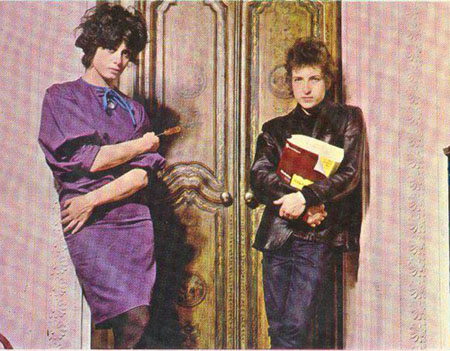
Certainly one of my mental stumbling blocks about Blonde on Blonde has to have been “Sad-Eyed Lady of the Lowlands”, which comprises the entire fourth side. This epic, which is said to have inspired Roger Waters to push Pink Floyd towards album-length songs, is a bit of a slog.

While there is a lot of speculation about who certain of Dylan’s songs are about (Edie Sedgwick seems to be the best guess for several of them!), this one is not in doubt: Dylan had recently married Sara Lownds, her last name is not that dissimilar to Lowlands, and, later in the song “Sara” (from Desire) about their divorce he writes the lyrics “Staying up late in the Chelsea Hotel, writing ‘Sad-Eyed Lady of the Lowlands’ for you”. So that’s pretty clear (Dylan and Lowndes lived in separate rooms in the Chelsea while they were dating to make it even more clear).

Of course, “Sara” is a bit of a stretch of the truth, because all the reports indicate that Dylan wrote this at the keyboard in a studio in Nashville all day while his back-up musicians dozed, smoked, and generally waited around. By his own admission the thing got a little out of control – the lyrics just keep coming and coming and coming.

This is the greatest use of the word “and” in the history of song. Nineteen times the word appears in the verses. He just keeps stringing her characteristics together in a list, one after another. He sure did have a lot to say!

Musically there’s not much to this one in comparison to a lot of the other songs on the album – it’s quite repetitive. This was essentially a one-take recording, the other takes are all rehearsals or interrupted. There doesn’t seem to have been much practice. The drummer noted how the second chorus builds to a crescendo because the band thought they were wrapping, but then there’s six more minutes of song left.

Not his best lyrics, not his best music. He never played this song live. It would have been interesting to see if he could remember all of the words. I do like some of Dylan’s epics – “Desolation Row”, and, as we will see in a few months, “Brownsville Girl” – but this one has its reach exceed its grasp.

What makes this song most interesting to me is the fact that Joan Baez covered it on Any Day Now, her album of Dylan covers. It’s not just that her version is so much better (though it is that), it’s just so bizarre for Dylan’s former lover to be singing the song that he wrote for his wife and the mother of his children. Their relationship continues to confound me.

Here’s Joan:

“I Want You”

Standard

IWantYouBobDylan

This one is for Rebecca.

Bit of crossed purposes: I had a plan to discuss all of Dylan’s singles this year, but then I found that I really didn’t have much of anything to say about “I Want You”, the first single from Blonde on Blonde. For me this was always the closest that Dylan came to writing a boring pop song. The chorus:

I want you, I want you

I want you so bad

Honey, I want you.

Not exactly Shakespeare.

Sure, there are good lines. It starts well: “The guilty undertaker sighs, the lonesome organ grinder cries”, but it’s all downhill from there. I planned to skip it.

But this morning on the drive to work (-27C this morning, you ride your bike) Rebecca noted when it came on that this was one of her favourite Dylan songs. That seems impossible to me, and I asked why.

For Rebecca this isn’t a Dylan song so much as it is a Dylan song that Bruce Springsteen covered at the Main Point in 1975, a bootleg that circulated in her house among the seven children. Rebecca explains that Springsteen understood far better than Dylan that this is not an uptempo number, but a song of desperation.

So for Rebecca and her siblings, here’s The Boss breathing life into one of Dylan’s lesser numbers.

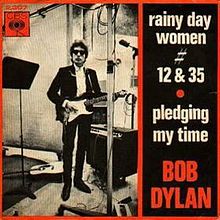
(Also, that single cover is just about the worst photo of Bob Dylan I’ve ever seen – certainly the worst up to this point).

“Visions of Johanna”

Standard

25915444f074ba3aa117674b20b78d743ed7f9da

A strong contender for my choice of best Bob Dylan song of all time is “Visions of Johanna”. The third song on the first side of Blonde on Blonde, it is the first good song on the album. The lead track, “Rainy Day Women #12 & 35” is, as we have already established, just plain awful. The second, “Pledging My Time” is not a whole lot better, truth be told. It is this combo that always made me a little reluctant about this album.

“Visions of Johanna” is a song that I know a lot better from Biograph than from Blonde on Blonde. The Biograph version is a live recording from London in 1966, one of the two last concerts that Dylan performed before his hiatus. I could probably make an argument that it is the peak of public performing in the 1960s if I really wanted to push it – the harmonica solo is tremendous and it is a really pained and soulful rendition of the song.

By contrast, the version on Blonde on Blonde (an album I’ve listened to only sporadically in the past, but a lot in the last couple of days) seems so very different. The key to Blonde on Blonde is that it combined the skill sets of Nashville’s top studio musicians with Dylan’s poetry. For people who think it’s his best album, this is one of the primary selling points. I’m beginning to be won around to this way of thinking. This version of “Johanna” throws me a little, but always in a good way. There are very nice musical fills at the end of a lot of the lines, and it really heightens some of the musical limitations of his earlier recordings.

Poetically, this is, for me, Dylan at his absolute peak. Some of the maniacal nonsense lyrics of Highway 61 Revisited can be grating when he goes too far. Here he’s just a little bit off kilter in his metaphors and they all work so much better. “The ghost of electricity howls in the bones of her face” may be my favourite song lyric of all time, and the following verse is also near perfection for me:

Now, little boy lost, he takes himself so seriously

He brags of his misery, he likes to live dangerously

And when bringing her name up

He speaks of a farewell kiss to me

He’s sure got a lotta gall to be so useless and all

Muttering small talk at the wall while I’m in the hall

Oh, how can I explain ?

It’s so hard to get on

And these visions of Johanna they kept me up past the dawn.

Even over the course of a couple of decades of not actively listening to Dylan, I would still occasionally recall the entirety of this song, and I can get the whole thing stuck in my head rather than just a simple phrase.

This week the line that has been absolutely killing me is: “See the primitive wallflower freeze When the jelly-faced women all sneeze”. There’s just something about the word “jelly-faced” that has set me off every time.

This is a version from Sheffield, a few days before the Biograph version. It’s not far off the quality. It may even be better:

The Child of Marx and Coca-Cola

Standard

Masculinféminin

And since I’m on the subject of Godard, it is apropos to note that 1966 was the year of Masculin Féminin, his ode to French politics and pop stars.

Here’s the great Jean-Pierre Léaud learning about Bob Dylan, Vietnik (with Portuguese sub-titles because, well, why not?):

Eat the Document

Standard

440px-Eatthedocument

Some day Jean-Luc Godard will be held to account for the sins of the filmmakers who followed in his wake. Eat the Document, the never released Bob Dylan tour documentary shot by D. A. Pennebaker but edited by Dylan himself, is one such sin. It leaps and jumps all around the tour, apparently in an effort to provoke. Commissioned by ABC television, it never aired. It would have been impossible for it to air. The opening, with Dylan sort of freaking out while playing piano in a hotel, would probably be enough to make most people turn the channel for good.

Watching Eat the Document, which you can do in its entirety thanks to the glories of YouTube (see below), is like watching someone’s travel home movies, if your friend taking the trip is heavily narcotized and on the verge of a nervous breakdown. The opening minutes are very hard to take – just a lot of footage of Dylan and The Hawks (as they were still called at the time) on buses and trains. Indeed, there may be more footage of trains in this film than of Dylan on stage. There are also many shots of dogs, a parade/protest, and Dylan sitting around sulking.

There are moments in this film that are really rather incredible. The long pan near the end of that features everyone else eating and enjoying themselves, and Dylan looking like death warmed over is so telling. The 1966 tour of Europe was Dylan’s last tour for eight years – indeed, for the rest of the 1960s he only played live on a small handful of occasions. While the shows on the continent seemed to be going alright (it’s hard to tell given how fragmentary the scenes are), it is clear that the shows in England were not. The booing was there. Dylan escapes at one point in his car yelling about one of the fans who he accuses of having booed. Pennebaker shoots a lot of post-concert footage with articulate and bitter young men who explain in great detail why and how Dylan has betrayed them. Scorsese would repurpose a lot of this material for his own documentary.

Dylan turned twenty-five during this tour (at the show in Paris, actually), and he looks much older than that. He is clearly someone who has had it. The stresses have led him to burn out. The most famous scene in the film is the one where Dylan and John Lennon drive through London in the back of a car. Lennon is hilarious: “Do you suffer from sore eyes, groovy forehead, or curly hair? Take Zimdawn!…Come, come, boy, it’s only a film. Pull yourself together.” Dylan just hangs his head in his hands, waiting for it all to be over.

Eat the Document does have some interesting scenes. There are a lot of moments where you want to just say, “Hold it! Stop! Go back! Show me more!”. From out of nowhere there’s Johnny Cash leaning on a piano as the duo sings “I Still Miss Someone” and you think “this is the greatest thing ever!” and then as quick as it started, it’s gone. The same with Lennon. A whole film could be made about that car ride, and we get about ten seconds (come to think of it, Todd Haynes does make a whole film out of that car ride in 2008….).

The concert footage is often good. I’ll have more to say about these shows later this week, but the band was really coming together by the end of this tour. Had Dylan been able to keep it together, they would have done even more amazing things. But it was also clear that he was trapped – “We can’t even leave the hotel” he tells someone. Eat the Document is much the same – it’s a film that can’t leave the hotel, and it can’t leave Dylan’s head either. At some point near the end I found myself thinking “this film is brilliant!” for its depiction of the nervous breakdown of a star from his own perspective. Five minutes later I wasn’t sure. It’s either phenomenally under-rated or a phenomenal waste of time. Probably it’s both.

Here’s the whole film (don’t worry – that annoying clicking goes away immediately, replaced by the annoying film):

Bob Dylan vs The Phone Calls

Standard

radio20f-5-web

I’ve never wanted to meet Bob Dylan. In fact, I think that if I was offered the chance to meet him I would probably decline it because I would be a) too intimidated to say anything meaningful to him and b) too afraid that he would be utterly dismissive of me and I’d leave feeling crushed. That latter feeling, and a bit of the former, were more than confirmed by listening to Dylan’s January 26 appearance on Bob Fass’s late night show on WBAI radio in New York.

Fass is the legendary host of Radio Unmentionable, and he was a friend of Dylan’s from around the time that Dylan first arrived in New York. One night in late January, during the recording sessions for Blonde on Blonde, Dylan appeared on the show late at night (I’m not sure what time, but one woman says she needs to go back to sleep, and another worries that he has to get up by 8:00). He and Fass then proceeded to take calls from listeners for about two hours. Dylan may or may not be chemically altered. Both Bobs sound a little punch drunk, at the very least.

A lot of this is the same sort of thing that you see in Dont Look Back, but unedited. This means that there’s a lot of dead time (“Am I on the air? Is this Bob? I have a question for Bob…”) but there’s also a very anarchic sense to the whole ordeal. Many of the callers ask the most asinine questions that they are almost painful to listen to. How any celebrity can put up with this sort of thing I do not know. In the first half hour the only halfway decent conversation is when a caller asks him for his opinion on The Fugs (he thinks they’re great, he’s met them around New York, he’s never had a chance to see them live, and Fass can’t play them on the radio due to the FCC…). The next caller, realizing that the key to Dylan’s heart is to ask him about music, asks him for his opinion about The Byrds, and Dylan blows him off. That guy had it coming.

The first of the two most interesting exchanges is with a male caller who wants to know why he doesn’t sing about Civil Rights and Vietnam anymore. Dylan tells him that he doesn’t have time for that, and besides, how could he stop a war? It’s a very telling conversation – Dylan initially tries to brush him off, but the caller is able to get a very little bit of honesty out of him and almost a straight answer or two. Dylan, for instance, claims that there was no bravery required for him to participate in the March on Washington, because when there are 300,000 people there that’s not a brave act. There’s some self-reflection happening that is genuinely interesting.

The other bit is maybe only fascinating because I listened to it tonight. Speaking with an insurance adjustor, who he clearly does not like and wants to spar with, Dylan puts the caller down and notes that the caller seems upset to being hearing advertising on the commercial-free listener-supported WBAI. The combination of Dylan’s referencing advertising, and the accusations generally made of him during the show that he has sold out, show how little has changed for the man in fifty years. All day my social networks have been filled with arguments about Dylan’s Chrysler commercial during the Super Bowl (the yogurt one far less so). There’s the occasional sense of betrayal that seems completely at odds with the attitudes of that man that I’ve been listening to for the past couple of weeks. If there’s one thing that I’ve already learned it is that Bob Dylan doesn’t really care that much what you think of him. He’s been called a sell out by larger and more vociferous groups than today’s Twitterers, and he probably will again.

A clip from the interview on YouTube.

It Has Arrived!

Standard

photo


Six weeks into the project, it arrived. The Bob Dylan Complete Album Collection (volume one, it notes – ominously). A 47 CD compilation of his studio albums, including (I believe possibly for the first time on CD, Dylan – the album Columbia released out of spite when he left for Asylum Records). The set doesn’t include the Greatest Hits albums, nor Biograph, but it does contain the songs – like “Mixed-Up Confusion”, “Positively 4th Street”, and “Can You Please Crawl Out Your Window?” – that never appeared on albums, but had been previously found on Biograph or the Greatest Hits albums.

Each little CD case replicates the look of the original albums, complete with teeny-tiny little type on the back of Bob Dylan that I would need a microscope to read. Fortunately there is an accompanying book that collects all of the liner notes, and includes an album by album chronology at the end.

I feel like I’m going to regret buying this thing the second that Dylan puts out another album, though ideally they would just sell it to me in the format that would fit into this box (there is space). I also wish that they had included all of the Bootleg Series albums, because those are indispensable and often better than what was officially released. Still, I’m glad that it has arrived.

I’ll have to listen to these in my car – I don’t actually own a CD player any longer, and even my laptop can’t play them…

“Rainy Day Women #12 and 35”

Standard

220px-RainyDayWomen

I’ve made it a tradition already of starting each Sunday morning with a comment on the new album of the week, or the first of them when there was been two releases. I’m breaking that today because I need to give Blonde on Blonde more time to soak in. You see, despite the fact that Rolling Stone called it the ninth greatest album of all time (one slot behind The Clash’s London Calling, one in front of The Beatles’s White Album), I was never a huge fan. Based on my memories alone, I’d have dumped down around the tenth best Dylan album. So I’m going to take some time to re-appraise.

Why the low regard? I think a lot of it has to do with the lead track and first single, “Rainy Day Women #12 and 35”. Oh how I hated this song when I was young. Oh how I hate this song today. (Actually, though, I wish I did like it so that I could justify buying this t-shirt which is clever where the song is dumb).

rainy_day_women_12_amp_35_tshirt

Hitting number two on the pop charts, it is an epic drudge (though the single version was shorter than the album version, though not really any less dull). What is there to hate about this song? Let’s try everything:

The lyrics. Repetitive, boring nonsense. While fiddling around with the Basement Tapes Dylan would craft a lot of nonsense lyrics, and these anticipate that trend. “Well they’ll stone ya…” ad nauseum, building to the big chorus: “Everybody must get stoned!”. Only a stoned person could care about this song.

The brass band. Tuba, trombone, that damned tambourine. Oh how I can’t stand that tambourine. It’s all played out in a simple F progression in slow motion that drones on and on forever.

The chatter. Oh the sounds of happy cavorting people in the background, mixed low. Awful. Self-indulgent. Repulsive. All the fake laughing and singing and carrying on to remind us all of how fun it is to be stoned. It’s all so forced.

That this song was a hit is, to me, the greatest indictment of the 1960s possible. Seriously, there are a ton of great songs on Blonde on Blonde, but it starts with this and it just puts me in a bad mood every time. I’m thinking of deleting it from the 1966 playlist on my phone in the hopes of not hearing it again this week.

Here, at least on Lester Flatt and Earl Scrugg’s version you get some great banjo picking:

The Playboy Interview

Standard

Dylan_Interview_grande

I read it for the articles.

Dylan’s longest interview to date was conducted by Nat Hentoff, jazz critic for the Village Voice, for Playboy in March 1966. It’s surrealist Dylan at his best, or worst if you don’t like it. He says a few things that seem straight, but most of it is bent. It would be a frustrating read for anyone looking for genuine insight into the man. By this point, just before the birth of his first son, Dylan had erected the entire edifice of obstruction around himself. Lies and obstruction had become his calling cards.

Take this exchange:

PLAYBOY: Do you ever think about marrying, settling down, having a home, maybe living abroad? Are there any luxuries you’d like to have, say, a yacht or a Rolls-Royce?

DYLAN: No, I don’t think about those things. If I felt like buying anything, I’d buy it. What you’re asking me about is the future, my future. I’m the last person in the world to ask about my future.

This is a man who was five months married by the time the interview saw print, and already a father of two (Sara, his first wife, had a daughter from a previous relationship). Dylan kept his marriage from his friends – there was no way that he was sharing it with Playboy readers.

The interview, which can be found here, is worth reading in its entirety. Dylan is in a sparring mode with Hentoff (who wrote the liner notes for Freewheelin’). On Hentoff’s first love, jazz Dylan offers this surreal riff:

DYLAN: I mean, what would some parent say to his kid if the kid came home with a glass eye, a Charlie Mingus record and a pocketful of feathers? He’d say, “Who are you following?” And the poor kid would have to stand there with water in his shoes, a bow tie on his ear and soot pouring out of his belly button and say, “Jazz, Father, I’ve been following jazz.”

At other times, Dylan seems to be speaking honestly (or at least you could read him as doing that). His explanation that he was sick of his folk songs is quoted in almost every biography for its truth content:

DYLAN: Anyway, I was playing a lot of songs I didn’t want to play. I was singing words I didn’t really want to sing. I don’t mean words like “God” and “mother” and “President” and “suicide” and “meat cleaver.” I mean simple little words like “if” and “hope” and “you.” But “Like a Rolling Stone” changed it all.

This seems honest and true simply because you can hear it and see it and judge it for yourself in the videos from Newport and in Dont Look Back. It confirms an assumption, a bias that is already built in. On the booing at Newport and Long Island and elsewhere on his fall tour of the United States:

DYLAN: I was kind of stunned. But I can’t put anybody down for coming and booing: after all, they paid to get in. They could have been maybe a little guieter and not so persistent, though. There were a lot of old people there, too; lots of whole families had driven down from Vermont, lots of nurses and their parents, and well, like they just came to hear some relaxing hoedowns, you know, maybe an Indian polka or two. And just when everything’s going all right, here I come on, and the whole place turns into a beer factory. There were a lot of people there who were very pleased that I got booed. I saw them afterward. I do resent somewhat, though, that everybody that booed said they did it because they were old fans.

On his break from topical songs, Dylan is a cross between honest and mysterious. By the end of 1965 Joan Baez had already opened her school for non-violent resistance and had stopped paying her income taxes to protest against American militarism, but Dylan had firmly broken with the cause:

PLAYBOY: Do you think it’s pointless to dedicate yourself to the cause of peace and racial equality?

DYLAN: Not pointless to dedicate yourself to peace and racial equality, but rather, it’s pointless to dedicate yourself to the cause; that’s really pointless. That’s very unknowing. To say “cause of peace” is just like saying “hunk of butter.” I mean, how can you listen to anybody who wants you to believe he’s dedicated to the hunk and not to the butter?

Yet for all that honesty, Dylan could still be confounding, and hilarious.

DYLAN: do know what my songs are about.

PLAYBOY: And what’s that?

DYLAN: Oh, some are about four minutes; some are about five, and some, believe it or not, are about eleven or twelve.

PLAYBOY: Can’t you be a bit more informative?

DYLAN: Nope.

Poor Nat Hentoff, having to play straight man for all that.

By summer Dylan will have had his motorcycle accident and will retreat from the public eye. After the Royal Albert Hall shows in May (the real ones, not the ones mistakenly labelled as such) there would be no more live performances by Dylan until 1969. Hentoff offers us one of the last glimpses of Dylan before he turns his attention to his family and cuts off the world.

Of Booing and Bootlegs

Standard

image012

When I was thinking about spending all of 2014 listening to nothing but Bob Dylan a few people urged me on. One was my friend Rusty, whose enthusiasm for the idea may have been what sealed the deal for me. The one piece of advice that Rusty had was “I’d be inclined to limit the project to official albums and  find some sort of principle for selecting from the boots.  I mean, “Great White Wonder” or the Broadside stuff is too important historically to leave out, but you don’t want to have to trudge through a bunch of repetitive live shows with dodgy sound, either.”

I should have listened to Rusty (that goes for most things, of course).

Driving to and from Nakiska today I listened to a series of Dylan live performances from the fall of 1965. Specifically, his Long Island show from August, his Hollywood Bowl show in LA from September, and his show in Berkeley in December. Each of these shows was half acoustic and then half electric. The first thing that one notes is that the booing of the electric sets was out of control in the months after Newport. The Long Island crowd is having none of it. The revisionists who try to suggest that the Newport crowd was simply booing the mix are completely out to lunch – these crowds hate hate hated Dylan’s electric performances.

Yet the other thing that you notice is that some of these bootlegs are amazing and some are, charitably, pretty much trash.

The Long Island set is pretty tough to listen to, particularly the electric set because it is taken from a crowd recording, while the Hollywood Bowl show (a soundboard recording) is nearly perfect. The Berkeley show, released as a bootleg titled Long Distance Operator (since it is the first and perhaps only live recording of that song), is a really difficult one to listen to – another crowd recording at a time when the technology really wasn’t there for that.

I’d love to read a good history of the manufacturing and distribution of bootleg albums in the pre-internet days, because the subject is quite fascinating. I’m sure that there must be a Grateful Dead scholar who can explain the whole system and its relationship to head shops, music shops, the underground press, underground comix and all the rest – but I haven’t read it yet. Would absolutely love to.

In the meantime, I’m using Bob’s Boots to guide some of my listening, but even that is proving somewhat problematic – they give a really good score to the Berkeley show, although mostly for the quality of the show itself, not for the recording.

There is a fourteen CD Italian bootleg that covers 1965 really thoroughly. Nick Hornby mentions it in 31 Songs, but I discovered it too late to really be helpful for this week, as I head into 1966 starting in the morning. It seems that I’ve missed the audio recording of the Nat Hentoff Playboy interview (published in February 1966, I’ll read it next week). Oh well, Dont Look Back…

Here’s a copy of “Freeze Out”, the 1965 version of “Visions of Johanna”, that was recorded in New York for Blonde on Blonde. The version on the album was recorded in Nashville in February 1966, as was the vast majority of that album. This is the kind of thing that you get from the bootlegs that makes the hunting so worthwhile. Since this is the best song on Blonde on Blonde, more on this song next week.