“Meet Me In the Morning”

Standard

The opening of “Meet Me In The Morning” is probably the most slurred line in my lyrical repertoire. I know that there is a whole genre of people mishearing Dylan lyrics and singing bizarre phrases (most of which I assume from this site are just made up by people making internet listicles). Nonetheless, I have listened to this song hundreds of times, including possibly a dozen in the past three days. Yet, still, driving home today I sang the opening as:

Meet me in the morning, whaa bah blah bah bah

I may have been doing that for thirty years. It has never occurred to me to find out what he actually sings for some reason (lack of intellectual curiosity…). If this applies to you, hold on! The first (and second) line is:

Meet me in the morning, 56th and Wabasha

Apparently there is a Wabasha in St. Paul, MN but it doesn’t actually intersect with 56th. So it’s not exactly the same as Portage and Main, which Neil Young and Randy Bachman made famous.

The interesting thing about this song, and, indeed the album, is that it could so easily fit with his very early 1960s material (at least until the semi-psychedelia starts at the end). It seems to me that this is the case with so much of Blood on the Tracks: “Idiot Wind” seems very mid-1960s, while “You’re Gonna Make Me Lonesome While You Go” seems early-1970s, and “Shelter From the Storm” seems late-1970s. The whole album is like a history of various Dylan styles.

This is a nothing song, but it’s another one that I like. Dylan basically wrote this off – he’s performed it only once – in Nashville in 2007 with Jack White. I guess if you’re going to only do a song once, there are worse ways to do it. I’ll see if I can dig that up in another thirty-three weeks.

This songs is, extremely unexpectedly, the b-side of Dylan’s most recent single, “Duquesne Whistle”. The b-side is a different version entirely, more spare, more bluesy. This is a much stronger version, really, because it doesn’t have the musical bits that I think detract from it.

Someone has nicely uploaded a recording of a turntable playing it onto YouTube. YouTube is weird, but helpful.

“You’re Gonna Make Me Lonesome When You Go”

Standard

I’m not sure how anyone could actually dislike “You’re Gonna Make Me Lonesome When You Go”. It’s an upbeat, poppy love song that is sort of at odds with the themes of its own lyrics. Insofar as it signals an impending break-up it should be a sad song, but in reality it is one of the most upbeat on the album. It has a playful tone that recalls albums like Nashville Skyline. The really remarkable thing about it is that it was written by the same person who wrote “Idiot Wind”.

Dylan is widely credited with having added lyrical gravitas to the pop song, and this is a great example of that. How many ditties, which is what this is, would include lyrics that include:

Relationships have all been bad

Mine’ve been like Verlaine’s and Rimbaud

Dylan had been working the Rimbaud influence – very self-consciously – for a long time, and it is almost funny that this is the song where he makes the most explicit reference to it.

For my money, the best couplet in the song is:

I’ll look for you in old Honolulu

San Francisco, Ashtabula

Of course, this only works when you hear the recording, as anyone can tell you that Dylan sings it “Honolula” to rhyme it with Ashtabula, Ohio. I know nothing more about Ashtabula than what I just read on Wikipedia, but given that Carl Sandburg included the name in the title of a poem, I might think that is where Dylan borrowed it from.

This is a song that Dylan didn’t play much – a number of times in 1976 and then never again. Too bad, it’s quite charming.

Here’s the country version of Miley Cyrus singing it from a couple of years ago. If you watch and feel the need to make a twerking joke, click on the Amnesty International button and make a donation to atone for the obviousness of your sense of humour.

“Idiot Wind”

Standard

(For Rusty, who doesn’t like it)

There’s a certain value in singing this song with a voice that sounds like you’re being stabbed in the heart. From the plaintive opening line, “Someone’s got in for me, they’re planting stories in the press”, to the first rejoinder, “I can’t help it if I’m lucky” almost everything here depends on the delivery.

“Idiot Wind” is the distressed heart at the centre of Blood on the Tracks. At 7:50, and only the second-longest song on the album, it is the 1970s version of “Like a Rolling Stone” (or, better, “Positively 4th Street”), the putdown song to end all putdown songs. As we listened to it in the car the other day I said to Rebecca, the moral of this song is don’t ever divorce Bob Dylan because he will fuck you up.

This is another song that has two very distinct versions. The album cut, with its band and the organ parts, actually harkens back to the mid-1960s Dylan epics like “Desolation Row”. It has a feel that is akin to the kinds of things that he used to do. The New York version, which is longer (and which can be heard on Bootleg Series 2) features only acoustic guitar and bass. It’s very minimal, but it is also not as pained. It’s not as powerful as a result. The flat-toned singing doesn’t bring any power to it. This is an angry song, and it should be sung that way.

Dylan has repeatedly denied that this song is about him and his wife, from whom he would divorce in a year. That seems improbable. Check this out:

People see me all the time and they just can’t remember how to act

Their minds are filled with big ideas, images and distorted facts

Even you, yesterday you had to ask me where it was at

I couldn’t believe after all these years, you didn’t know me better than that

Sweet lady

It’s almost impossible not to read that as an autobiographical statement of the marital breakup of a very famous man. It’s easy to see why Dylan might disclaim its personal intensity though – this is a rage-filled song if there ever was one:

One day you’ll be in the ditch, flies buzzin’ around your eyes

Blood on your saddle

Ouch. If he wrote that about the mother of his children I just have to repeat: Do not divorce Bob Dylan! He’s not very nice!

The New York version of this song is mostly the same at the beginning, but the final two verses have substantially different lyrics (beginning: “I threw the I-Ching yesterday they said there might be some thunder at the well”) but the meaning is still the same. It also ends with a minute and half long harmonica solo that probably pushes the song too long.

Dylan didn’t perform the song at all in 1975. His website says that he played it fifteen times in 1976, making it a regular staple of the second leg of the Rolling Thunder Revue. An epic version of it closes the Hard Rain live album. Not having listened yet to any of the 1976 tour, I would place the Hard Rain version as my favourite because it is the most pained. It is all in the way that Dylan hits those barbs at the end of every verse. As with a lot of Dylan’s poetry, it’s all in the performance.

Here’s a 1976 live version. I haven’t listened to this yet because I adhere to strict rules, but you can watch.

http://www.liveleak.com/view?i=405_1311641334

“You’re a Big Girl Now”

Standard

75rolling

“I can change I swear, oh, oh / See what you can do”. This is a pretty remarkable break-up song that picks right up from where “Simple Twist of Fate” left off.

“You’re A Big Girl Now” is one hell of a passive aggressive love song. Parts are pure, beautiful mush:

Bird on the horizon, sittin’ on a fence

He’s singin’ his song for me at his own expense

And I’m just like that bird, oh, oh

Singin’ just for you

I hope that you can hear

Hear me singin’ through these tears

While other parts, much less so:

Love is so simple, to quote a phrase

You’ve known it all the time, I’m learnin’ it these days

Oh, I know where I can find you, oh, oh

In somebody’s room

It’s a price I have to pay

You’re a big girl all the way

The New York version of this song can be found on Biograph. It’s much more spare in the opening, and gets richer as the fiddle and organ come in during the third verse (the fourth on the album version, he reverses the order of the verses in this version). The Minneapolis version has fuller guitar, plus the cymbal-playing of the drummer. The guitar playing is quite lovely, but Dylan’s vocals are better of the New York version with a single huge exception – the “oooooohs” on the album version are superior. It’s a conundrum. Hard to pick which one is actually preferable. He didn’t play this live in 1975 at all (it debuted in 1978, but has been played more than 200 times since then), so he doesn’t break the tie. I think if push came to shove, I’d go with the version on Biograph.

Of course, the great thing about the song is just how ridiculously patronizing it is. Try to sing the title of this song to any woman that you’ve ever broken up with and you’re likely to get punched in the face. For those who want to argue that Dylan’s break-up songs convey a touch of misogyny, this is a good one to add to the argument.

Did you know that Lloyd Cole covered this song? I didn’t!

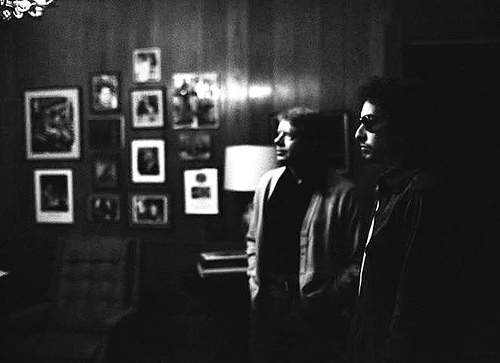
Scary Dylan photo above has nothing to do with the song, but it’s just so great.

“Simple Twist of Fate”

Standard

This album has hit a bit of a nerve. Perhaps it says something about the demographics of my readership, but a skirmish has already broken out on my Facebook page about Blood on the Tracks, with adherents and detractors of individual songs firing their first tentative volleys. There will be Blood on the Net for certain, I’m sure.

This has led me to the conclusion that Blood on the Tracks is just too important an album to write about as a single (“Tangled Up in Blue” was, somewhat surprisingly, the only single from the album) and then a summary post. I’m going to try to write about each of the ten songs on this thing during the week.

So, we might as well do this in order.

“Simple Twist of Fate” is the second song on the album, and the first from the original sessions. Dylan recorded Blood on the Tracks quickly in New York and had the album complete when he took an acetate home to Minneapolis and played it for his brother. His brother convinced him to re-record many of the songs. The reasons for that decision are in some dispute, but he re-cut about half of it. There is a slightly different tone to the works recorded in New York and in Minnesota.

“Simple Twist of Fate” is a great love song. Period. It’s a great song about loss. Period. The image of that simple twist is very potent. The whole song hinges on the switch from the third to the fourth verse, which, on the album version comes after the harmonica solo. In the first half of the song the couple meets and is together, while after that solo they are apart and he endlessly searches for “his twin”. It’s a sad bit:

He woke up, the room was bare

He didn’t see her anywhere

He told himself he didn’t care, pushed the window open wide

Felt an emptiness inside to which he just could not relate

Listen, now, to the live version that can be found on Bootleg Series 5: Live 1975, which Dylan plays acoustic:

He woke up, she was gone

He didn’t see nothing but the dawn

He got out of bed and put his clothes back on, pushed back the blinds

Found a note she’d left behind to which he just could not relate

I’m not really sure which of these verses is actually superior. “Found a note” takes some of the mystery out of it, but it also allows it to a fuller story.

Let’s try the last verse. Album version:

People tell me it’s a sin

To know and feel too much within

I still believe she was my twin, but I lost the ring

She was born in spring, but I was born too late

Live version:

People tell me it’s a crime

To feel too much at any one time

She should have caught me in my prime, she would have stayed with me,

Instead of going off to sea, and leaving me to meditate

The live version is better here.

What amazes me about Dylan is that he wrote and recorded such a great, great song. Then he rewrote it, and he probably made it better – clearer, more painful and more direct. That willingness to keep going with something that was already finished is what makes him so exciting in this period.

Here’s a clip of Dylan playing this on television from late 1975. That’s Emmylou Harris on fiddle. “Simple Twist” begins about 4:30 in. You can listen to “Oh Sister” too if you’d like to. Note that Dylan sings both revised verses here, and also changes some smaller pieces in two of the other verses.

“Tangled Up in Blue”

Standard

Tangled_Up_in_Blue_Cover

1975. Best Dylan album. Best Dylan tour. Best Dylan song

If I’m being honest with myself, “Tangled Up in Blue” is my favourite Bob Dylan song. It’s the only one that I’ve ever wanted to write something “serious” about. For years I have contemplated an article about Dylan’s shifting lyrics for this song without ever coming up with an insight that I thought was worthy enough to fully develop. Essentially, I was never able to answer for myself the question: “He changes the lyrics almost every time he plays this – so what?” beyond the fact that, well, that’s awesome, is what it is.

“Tangled Up in Blue” was released as the first single from Blood on the Tracks, possibly Dylan’s best album. It peaked at #31, which is grave indictment of the 1970s, because it deserved much better than that. Lyrically it might be Dylan’s most sophisticated song, and the version on the album is tremendous. As with “All Along the Watchtower”, Dylan gets a lot of mileage by telling his story in a non-linear fashion. Beyond that, there is the pronoun confusion that makes it all so worth listening to.

Listen to the earlier album version of this song that can be found on Bootleg Series 3 (listen to “Idiot Wind” too, it’s fantastic as well). In that version Dylan uses (primarily) the pronouns “he” and “she” and tells the story of a couple breaking up, and then the “I” gets involved the fourth verse. Dylan completed Blood on the Tracks in New York, and then re-recorded a huge portion of it in Minneapolis, including this song. On the version that appears on the album, he uses a lot more “we” and “I” from the beginning, completely changing the meaning of the song, and making the narrative a lot more difficult to follow. It is the ambiguity of the pronouns (“Then he started into dealing with slaves / And something inside of him died” – who is the “he” in this verse?) that makes the song so fascinating.

Beyond that, Dylan will regularly change the phrasing and the rhymes when he plays this live. He changes the jobs that the characters have or have had. Few songs have been so variable in their live presentation. A large part of me would like to get every live version of this song from 1975 and try to chart it all out. If I do write a post at the end of this week doing that, you’ll know that I’ve vanished down the rabbit hole.

I’m going to come back to this song this week, but I wanted to kick off the greatness of 1975 by giving you this live performance of “Tangled Up in Blue” from the Rolling Thunder Revue. Dylan, acoustic, face-painted, that hat (oh, I love that hat!) changing the lyrics. Watch how great this is. It’s only a year and a half after the tour with The Band, but he’s so much better at playing intimately to the big venue. He’s not reduced to yelling out the lyrics (though he does do that a lot on the tour), he is actually singing. And what a great song he is singing.

Before the Flood

Standard

Bob_Dylan_and_The_Band_-_Before_the_Flood

I’m linking below to a YouTube video that has, inexplicably to me, not been taken down. It’s almost two hours of Dylan and The Band playing in Largo, MD on January 15, 1974 (misidentified as Landover by the uploader). It’s a crowd recording – you can hear people talking about Robbie Robertson before the first chords of “You Go Your Way (And I’ll Go Mine)”. Quality is so-so, but it’s a good show and it gives you a strong sense of how the 1974 tour sounded in its early stages. Dylan played “Wedding Song” at this show (1:13:45), the third time he’s ever play it (he only did so nine times in his life, so it’s pretty rare). This was also the last time on that tour that he played “I Don’t Believe You (She Just Acts Like We Never Have Met)”, which is too bad because I quite like it (starts at 14:20).

I’ve really enjoyed listening to this tour all week – it has completely reinvigorated my enthusiasm for this project, which was never really flagging anyway. The tour has some problems, but it is the arrival of a Dylan sound that I really liked and would have liked to have seen continued even longer. Some shows, obviously, are better than others, and it does tail off a bit at the end. I think that this Largo show is quite good – it is still early enough in the tour that the songs don’t sound over-rehearsed. Dylan powers his way through a lot of the material during a lot of these shows. While he had played very large venues in the past (Isle of Wight, Madison Square Garden for the Concert for Bangladesh) this was still something of a new experience for him. In 1966 he played venues for a few thousand at the most, and here he was playing a lot of arenas. The shows called for power over nuance. A lot of this was technologically dictated – amplification being what it was, and hockey arenas being what they are acoustically – the ability to shape sound in those spaces forty years ago left a lot to be desired (often they still do – the last time I saw Dylan live at the Saddledome in Calgary I thought the sound was terrible, but that’s typical of the Saddledome).

Before the Flood isn’t necessarily the ideal record of the 1974 tour, but it is a very good one. Recorded primarily at the Los Angeles dates at the end of the tour, it may illustrate a certain road-weariness. Dylan is in full yelling mode on a lot of the songs, but the sound mix is really good and the band is very tight. The double-album gives eight tracks to The Band and thirteen to Dylan (most with The Band). It is a genuine collaboration, much as Planet Waves was (which is credited on the cover as Bob Dylan/The Band). It would have been interesting to see where that relationship might have gone had The Band stayed together longer than they did.

0851_154345_Dylan5cBarryFeinstein

As there is a certain sameness to a lot of the tour, I don’t feel a need to track down every bootleg ever (though they are out there). What I would like ideally would be a tour collection that has a good version of every song that he played on the tour (just around fifty), but I’d likely have to curate that myself. Songs like “Hattie Carroll”, “It’s All Over Now, Baby Blue” and “Song to Woody” were played only twice on the whole tour. “To Ramona”, “Desolation Row”, and “Mr Tambourine Man” were played only once.

The big four songs – played at all forty shows – were “Lay Lady Lay”, “All Along the Watchtower”, “Ballad of a Thin Man”, and “Like a Rolling Stone”. “Knockin’ on Heaven’s Door” and “Just Like Tom Thumb’s Blues” were played 39 times each. For some reason “Just Like Tom Thumb” doesn’t end up on Before the Flood, which is a disappointment.

Overall, great tour, and pretty great album. We’re well into the peak Dylan phase. By the way, the proximity of Washington makes the “even the president” pop (1:25:10) exceptionally large in the video below.


Dylan : Nixon : Carter

Standard

tumblr_mm6y51zKjb1soe011o1_500

Listening to recordings of Dylan’s 1974 tour you get to hear a lot of different kinds of clapping and cheering. The first song of any show usually brings a huge ovation, because people are so happy to see him. This was, at the time, the most lucrative concert tour ever put on. It was completely over-subscribed, and fans were ravenous for Dylan and The Band. The early ovation is a cheap and easy one that simply comes from showing up.

Dylan’s acoustic set seems to get bigger applause than the electric stuff, still, and eight years later (all of this, of course, based on semi-dodgy bootlegs so I don’t want to make any definitive claims). Almost every song gets applause at the end of the first line of the lyrics, which is typical of so many concert audiences that clap to say “Yes, we know this one and we approve of you playing it”, and certain songs get huge ovations (“Like a Rolling Stone”) while others gets smaller applause (most of the material from Planet Waves) . So it goes.

What is fascinating, though, is the reaction to one single line.

When Dylan recorded “It’s Alright Ma (I’m Only Bleeding)” on Bringing It All Back Home, it didn’t seem like it would become one of his most important songs. He played it a lot on the 1966 tour, and has played it a lot throughout his career. I gave it a provisional seventh on my list of his “best of all time”, and it is one of my favourites. It’s chock full of aphorisms – it’s Dylan’s Hamlet, endlessly spinning off catchphrases:

While others say don’t hate nothing at all / Except hatred

or

While money doesn’t talk, it swears

Obscenity, who really cares

Propaganda, all is phoney

or

It is not he or she or them or it / That you belong to

But live in 1974 there is the one line that gets the huge reaction – after a couple of shows the performers even stretch the pause to accommodate it the way that a comedian leaves space for the peals of laughter:

Even the president of the United States / Sometimes must have to stand naked

With the Nixon presidency crashing down – he will resign before the end of the year – this phrase is the greatest punchline possible for the Dylan audience. Listen to it on Before the Flood – it literally brings the house down.

One of the most curious things I’ve read about the ’74 tour this week, is this article in Rolling Stone about Dylan visiting the Governor’s mansion in Georgia after playing in Atlanta (possibly my favourite show from the tour that I’ve listened to, but there’s a lot of them I haven’t heard). Jimmy Carter had sixteen tickets for this show, and then hosted a party for Dylan afterward. They ate grits (actually, Dylan didn’t). It’s just so bizarre. By far the best part of the article is the bit where Gregg Allman shows up late and Carter greets him at the door in jeans to tell him the party is over. I would so love a video of that.

Picture-12

The Dylan/Carter relationship is an interesting one, apparently pushed by Carter’s son. It would have been fascinating to hear them speaking. Carter was touted in the article as a possible vice-presidential candidate, but, of course, he would go much further than that two years later. At his speech accepting the Democratic nomination, Carter quoted this line from the song:

He not busy being born is busy dying

It’s a super-quotable line – maybe Dylan’s best aphorism. It would make a good tattoo. I just can’t shake the image of Carter hearing it at the Omni on that January night, contemplating his future. Maybe it’s why he put on the jeans to greet the late-arriving Allman…

Here’s an earlier version that may have escaped the wrath of Dylan’s lawyers simply because of the special pleading:

“Most Likely You Go Your Way (And I’ll Go Mine)”

Standard

2704658

More than almost any other musician, Bob Dylan has constantly reinvented his songs for live performance. If you read interviews with people who have performed as part of his band on his Never Ending Tour, for example, they talk about Dylan playing songs in a different key and with a different tempo every night of a tour, just to see if the band can keep up. I’ve seen Dylan audiences completely mystified about what song might be being played until he sings the first lines that are recognizable. Hell, I’ve been mystified.

While the 1966 featured a lot of new versions of old songs (mostly acoustic songs turned into electric ones), it was the 1974 tour with The Band where he really began to transform his repertoire. Listening to one of his Madison Square Garden shows on the walk home today I was struck by how hard it would have been for me to sing along to a song like “Lay Lady Lay”, where his phrasing was totally transformed, to the point that certain words actually change lines.

One of the best examples of Dylan’s approach to the tour was “Most Likely You Go Your Way (And I’ll Go Mine)”, the first song on the third side of Blonde on Blonde. Listen again to that version. It’s a quaint little song that has a bit of swing to it. Dylan eases the lyrics out. It’s soft-spoken, and a just a touch goofy because of the trombone.

Dylan used this as his encore of the first show on the 1974 tour in Chicago, after The Band had done “The Weight” as an encore. After some early experimentation, the 1974 tour found a reasonably familiar format: Dylan and The Band together for a half dozen songs, The Band without Dylan for five, Dylan’s return for three, intermission, solo Dylan, Dylan and The Band again, Dylan leaves again, Dylan returns again, encore. Anyway, for the first show “Most Likely You Go Your Way” was the final song. Then it drifted away, returning to the encore in Philadelphia, and then to the opening slot in Toronto. By Montreal (January 11) it had the unusual position of both opening and closing the show. Dylan played it with such great energy, that it launched the show on a strong note and then closed it down on that same note.

I have to say, that’s a new one to me. I have, on very rare occasions, seen bands play the same song twice because the audience response was so strong and they’d run out of material. This wasn’t the case with Dylan, who had rehearsed eighty songs for the tour, and played dozens of different songs as things were rotated in and out. The vast majority of shows on the tour (maybe thirty – I didn’t bother to count) featured two versions of this song, most frequently as the opener and in the encore (some shows follow this in the encore with “Blowin’ in the Wind”, but most don’t).

I rate this song very highly, and it is because of this tour. Had Dylan never done this after Blonde and Blonde it is not likely that I would recall it at all, but it is powerful as done here. The version that is included in Before the Flood (as the opening song on the two-LP set, and also released as a single that didn’t fare very well) is the opening song from the final stop on the tour, at The Forum in Inglewood on Valentine’s Day. It seems to be typical of the way that the song was being played on the tour, if a little faster than the versions from early on. They’ve turned into a hard-charging anthem. It’s a really great rendition of a fairly forgettable Dylan song, turned into something far better than what had been imagined eight years earlier.

Kicking Off the 1974 Tour

Standard

Just an excuse to post this video, which is largely unintelligible and clearly out of sync with the audio. Bob Dylan opened his 1974 concert tour with two shows in Chicago, and at both of them he led off the evening with “Hero Blues”, a truly obscure number that only appears (legally) on Bootleg Series 9: The Witmark Demos. He dropped the song after Chicago and has never played it live again according to his website.

As we launch into this tour, check out the very first moments: