Renaldo and Clara

Standard

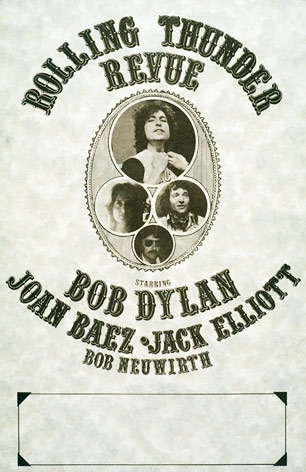
Poster_of_the_movie_Renaldo_and_Clara

I can’t in all good conscience tell you that Renaldo and Clara is a good film, but I have to be honest with you: there was more stuff in the movie that I liked than I disliked, and even at four hours, I never felt it was too long. Indeed, parts of it I wish had been much, much longer.

I’m not even sure where to begin with this thing. I guess the idea that Dylan thought that this was a good idea to make a film like this is probably the logical starting point. In his interview with Rolling Stone he makes it pretty clear that the main reason to do the Rolling Thunder Revue was to finance this movie – and certainly the second leg, in 1976, may have been exclusively about that. After receiving a lot of Hollywood offers, he opted to go independent, self-finance the film, produced, star and direct in it so that it would be his vision. He hoped to change cinema the way that he had changed popular music more than a decade earlier. And, well, that certainly did not happen. Check this exchange in Playboy:

PLAYBOY: How much of your money are you risking?

DYLAN: I’d rather not say. It is quite a bit, but I didn’t go into the bank. The budget was like $600,000, but it went over that.

Add into this the fact that he built an expensive house in Malibu and that he lost half his income from the previous decade to his ex-wife and you start to see why he started touring incessantly in 1978….

renaldo-and-clara-3

Since we’ve started there, let’s start with some words from Dylan himself:

PLAYBOY: Do you really feel it’s an accessible movie?

DYLAN: Oh, perfectly. Very open movie.

PLAYBOY: Even though Mr. Bob Dylan and Mrs. Bob Dylan are played by different people….

DYLAN: Oh, yeah.

PLAYBOY: And you don’t know for sure which one he is?

DYLAN: Sure. We could make a movie and you could be Bob Dylan. It wouldn’t matter.

PLAYBOY: But if there are two Bob Dylans in the film and Renaldo is always changing….

DYLAN: Well, it could be worse. It could be three or four. Basically, it’s a simple movie.

So, okay. Dylan lies in interviews. Maybe he is lying here when he says that he believes this is an accessible film. I mean, there is really no way on earth that he could have been alive on planet Earth in 1978 and thought that this was an “accessible” movie. It is four hours long. It is composed in kind of equal parts of live concert footage, tour documentary, and horribly acted scenes in which musicians (plus, inexplicably, Harry Dean Stanton) act out improvisational scenes that look like they come straight out of Boogie Nights. There is no definition of “accessible” that could possibly apply to this. But, here’s the key, maybe that’s not Bob’s fault, it’s yours!

(from Rolling Stone):

Renaldo and Clara has certain similarities to the recent films of Jacques Rivette. Do you know his work?

I don’t. But I wish they’d do it in this country. I’d feel a lot safer. I mean I wouldn’t get so much resistance and hostility. I can’t believe that people think that four hours is too long for a film. As if people had so much to do. You can see an hour movie that seems like 10 hours. I think the vision is strong enough to cut through all of that. But we may be kicked right out of Hollywood after this film is released and have to go to Bolivia. In India, they show 12-hour movies. Americans are spoiled, they expect art to be like wallpaper with no effort, just to be there.

Here’s the weird part! I agree, it actually doesn’t seem too long at four hours – in parts. As I say, there are parts of this that I would have watched for days.

rjbneve

The concert footage is easily the most watchable part. I listened to the Montreal show a lot a couple of weeks ago, but a good percentage of the footage here is from that show (other parts are from Boston and Providence). Seeing it live makes it so much more vivid. I was enraptured by the whole thing – such a magnetic, bizarre performance, with the white face make-up and the powerful vocals. Most of the concert footage is shot super-tight on Dylan – you only occasionally get to see the rest of the band. It’s almost as if you are sitting at the feet of the master here. I would have watched endless, endless hours of live Dylan footage from this tour and been happy. (Long circulating rumours are that the next Bootleg Series set will be to Blood on the Tracks what Another Self Portrait was to Self Portrait, and that they will cobble together a lot of this concert footage. We’ll see. I hope they do that, but we’ll see).

The documentary footage I could probably even watch. One of the very first scenes in the film is a backstage scene with Larry Sloman demanding a per diem and more access, just like he says that he did in his book. I had a weird sense of deja vu watching this scene, because Sloman is so good about reporting it. There are all kinds of other weird documentary moments – at the native reserve, at Kerouac’s grave – and all of that could have made a good film like Dont Look Back or Eat the Document. But Dylan doesn’t seem to think so.

renaldo-and-clara-1

Here’s Dylan again from Rolling Stone:

“The Death Mother is represented in the film, but I don’t know what I should say or can say or shouldn’t say about who is who in the movie. I mean who is the old woman everyone calls Mamma — the woman who sings, plays guitar and reads palms? She reads Allen’s palm, saying: “You’ve been married twice.” And me, later on I’m looking at the gravestone marked HUSBAND; Ginsberg asks: “Is that going to happen to you?” And I say: “I want an unmarked grave.” But of course I’m saying this as Renaldo.”

Seriously – What. The. Fuck? For Dylan to claim that he is “Renaldo” in that scene makes no real sense, partly because Renaldo is a total non-character. As an alter-ego, Renaldo is a total non-starter. And this is where the film goes horribly awry. Dylan seems to honestly think that he is making a movie about “The Death Mother”, but there is no sense that any thought at all has gone into any of this. Indeed, the Sloman book pretty much indicates that none did. When you read that book you get a strong sense of the way that Dylan worked, which was, essentially, show up somewhere and tell people what role they were suddenly playing and then begin improvising. Sam Shepard was around to help put the script together (in one of the concert scenes there is a great moment where he is glowering at the stage…), but that doesn’t seem to have actually gone anywhere (I just learned the other day that Shepard published a book about his experience – I’ve ordered it, but it hasn’t arrived yet).

Here’s Dylan explaining his vision of the Renaldo parts:

“Yeah, way back then I was thinking of this film. I’ve had this picture in mind for a long time — years and years. Too many years . . . Renaldo is oppressed. He’s oppressed because he’s born. We don’t really know who Renaldo is. We just know what he isn’t. He isn’t the Masked Tortilla. Renaldo is the one with the hat, but he’s not wearing a hat. I’ll tell you what this movie is: It’s like life exactly, but not an imitation of it. It transcends life, and it’s not like life.”

Again, seriously: What. The. FUCK?!?! “He isn’t the Masked Tortilla”. Unh huh. Got it. He’s not Bob Dylan, because Ronnie Hawkins is playing Bob Dylan. He’s the one with the hat that isn’t wearing a hat, but Renaldo is mostly wearing hats in the film. Seriously, you can’t make this stuff up.

Here’s the biggest Bob Dylan lie of the whole thing:

“It has nothing to do with the breakup of my marriage. My marriage is over. I’m divorced. This film is a film.”

The best “scripted” scene in the whole film, by a country mile, is the scene with Dylan, his wife Sara, and Joan Baez. It is positively charged with dramatic tension. When each asks him “Do you love her?” it is an incredible scene. But not about the breakup of his marriage. Dylan, please. When Baez, as “The Woman in White”, arrives for that climactic scene Dylan cuts to himself – or Renaldo? – performing “Sara” at the Montreal Forum. Not about his marriage, nope, not one bit. The whole thing is really incredible, particularly for the way that they layer in Dylan and Baez singing “Water is Wide” in the background, an incredibly poignant:

The water is wide,
And I can’t cross over,
And neither have I wings to fly.
Build me a boat
That can carry two
And both shall row, my love and I.

Basically everything with Baez in this film is great. When she says “What would have happened if we’d got married back then?” it is one of the most amazing things I have ever seen. I’ve already noted that the Dylan/Baez relationship is an incredibly fascinating one, and Baez really lets it all hang out here. Maybe all this ridiculous improv is worthwhile just for its ability to generate those kinds of moments.

renaldo-and-clara-1977-001-talking-in-room_1000x750

Here’s what I loved about Renaldo and Clara:

Dylan’t long fingernails as he plays guitar in the motorcycle garage

Gordon Lightfoot singing “Ballad in Plain D” as Dylan walks the streets

The Montreal performances. If this had just been a concert film, it might have been the greatest of all time.

The roadies setting up the stage. Why is this here? What can it possibly have to do with the rest of the film? Why does it go on so long?

Dylan driving his RV. Awesome.

Joan Baez with “Mamma”.

The chanting at the sea – the most 1970s thing ever.

Contemplating David Cross playing Allen Ginsberg in a biopic.

When it suddenly becomes a documentary about Rubin Carter and an exploration of black rage about the justice system in New Jersey – very raw.

Harry Dean Stanton!

But as a film – it makes no sense at all. There are parts that are interminable and seemingly pointless (the cabaret!). This isn’t a “so bad, it’s good” film. It’s a “so good, despite the fact that it has about two hours of awful in it because the other two hours are awesome”. If you get what I mean.

I’ll watch it again, of that I can be certain.

http://vimeo.com/84513008

“Changing of the Guards”

Standard

Changing_of_the_Guards_cover

“Sixteen years”. Those are the emphatic words that open “Changing of the Guards”, the third and final single from Street Legal. Released in 1978, it was exactly sixteen years since his debut album, and, for me, sixteen weeks into this one-year-one-week trek through Dylan’s life.

I have to say it: I love this song. I mean, I really adore it. Seriously, today I would put it among the top ten songs that he’s ever written. It’s the lead song on an album that most people don’t like. It has all the elements that people deride – the back-up singers, the sax between every verse – and that might be a problem with the way that the song was recorded. But as a song, I think it’s one of the best things that he’s ever done. It’s a full on and complete return to the lyrical complexity that marked his best mid-1960s material. The song, to me, is an absolute triumph.

It’s almost impossible not to read this one in autobiographical terms. Apart from the opening declaration, there is, for example, this verse:

Fortune calls

I stepped forth from the shadows, to the marketplace

Merchants and thieves, hungry for power, my last deal gone down

She’s smelling sweet like the meadows where she was born

On midsummer’s eve, near the tower

The whole thing plays out as a reminiscence on his career to date, and also on his relationship to his now ex-wife, Sara. The lyrics are vague, mystical, and quasi-religious, filled with mythical elements (“She was torn between Jupiter and Apollo”). Lyrically, it is a superior piece of work.

What really puts this one over for me are the live performances of it. This is the third straight non-charting single that Dylan would only ever play on his epic 1978 world tour, but he played it incredibly well. It was frequently in the encore, and it was the rousing anthem that was used to send the crowd home happy. Dylan punches those short first lines (“Sixteen years”, “Fortune calls”, and my personal favourite, “They shave her head” (such a bizarre way to begin a verse in any song)) and often creates beautiful segues out of the sax part. I’ve been listening to a lot of the 1978 tour this week already, and this has quickly become the major discovery of the year for me.

The version that is found on Street Legal is far from the ideal way to listen to this song. Here’s Dylan performing it in Nashville (the sound starts after ten seconds or so):

Here’s another way to do it – the inimitable Patti Smith:

“Baby, Stop Crying”

Standard

url

“Baby Stop Crying”, the second single from Street Legal, was also the second mis-step. This is one of only two songs on the album that weren’t written well in advance of the four days of recording that put the whole thing together. It has a bit of a feeling of a last minute fill-in.

The central aspect of this song is the thing that most people seem to hate about Street Legal: the bluesy back-up singers. It was clear from Desire and the Rolling Thunder Revue that Dylan was desperately looking for a band that would give him the Phil Spector “wall of sound” vibe, and he put it together for his 1978 world tour. It was with this band that he recorded this album, replete with tenor sax and a power trio of back-up singers (one of whom, Carolyn Dennis, he would marry 8 years later).

It seems like that the vast majority of this song is its chorus, with its endlessly repeated phrase, “stop crying”. It just sort of goes on and on and on in this one. The lyrics to the verses are terribly unmemorable. It is testament to their forgeability that I’ve heard this songs dozens of times, and I still had to read the lyrics to remember that it includes the threatening line: “Go get me my pistol, babe / Honey, I can’t tell right from wrong”.

The whole thing is very slight. The second verse amounts to almost nothing:

Go down to the river, babe

Honey, I will meet you there

Go down to the river, babe

Honey, I will pay your fare

This is yet another Dylan single that he gave up on. Performed about three dozen times on his 1978 tour, he never bothered to do it again.

It’s amazing to me that Dylan and Columbia seemed to have picked the two worst songs on Street Legal as the first two singles. Neither charted in the US, but this made it to number 13 in the UK and to number 5 in Ireland.

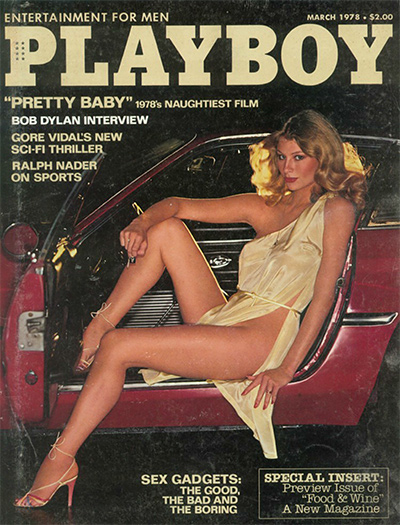
The Playboy Interview (1978)

Standard

1345491405_playboy-march-1978

January 1978 saw the release of Bob Dylan’s second major interview in Playboy (cover dated March), this time with Ron Rosenbaum. This is a vastly, vastly superior interview to the one the Jonathan Cott published in Rolling Stone (you can read a transcript here). Dylan is far less cagey, though there are certainly moments, and he reflects a little bit on his past experiences while also discussing Renaldo and Clara.

It is clear from the interview, and the questions that Rosenbaum raises, that Dylan is still regarded as a figure of the 1960s even by the late-1970s. While it is clear that the interviewer is knowledgeable about the changes that Dylan made to his songs during his tours in 1974 and 1975/6, it is still the Village scene of the early-60s that draws his questions. Dylan isn’t that forthcoming about any of it, really. Reading his interviews is always a frustrating experience because of that.

There are plenty of good moments here, including a discussion of the accessibility of Renaldo and Clara that seems a little off the mark. Dylan also discusses his thoughts on Christianity, and I will return to that when he fully turns his attention to the Gospel period. It was clear, however, that at the time of this interview (late 1977) that he was still a skeptic.

The late-1970s highlights of the piece is the discussion of President Carter, who Dylan had met in 1974, and then this question:

PLAYBOY: Would you say you still have a rebellious, or punk, quality toward the rest of the world?

DYLAN: Punk quality?

PLAYBOY: Well, you’re still wearing dark sunglasses, right?

DYLAN: Yeah.

PLAYBOY: Is that so people won’t see your eyes?

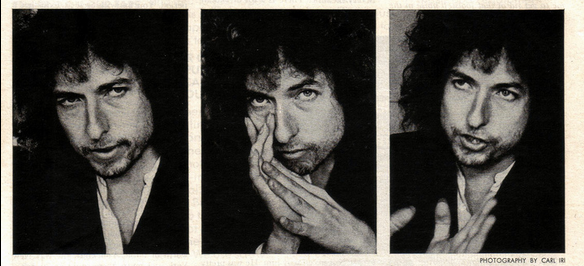
DYLAN: Actually, it’s just habit-forming after a while, I still do wear dark sunglasses. There is no profound reason for it, I guess. Some kind of insecurity, I don’t know: I like dark sunglasses. Have I had these on through every interview session?

PLAYBOY: Yes. We haven’t seen your eyes yet.

Screen Shot 2014-04-28 at 12.42.10 PM

I’m not sure if Dylan and Rosenbaum are talking about “punk” in the way that we assume most musicians in 1978 would be thinking through that term. I take Rosenbaum to mean it that way in the question – in asking about the New York scene and its vitality elsewhere in the interview Dylan claims that the New York scene is dead, and Rosenbaum seems to be sticking up for the new scene in the East Village without actually identifying it as such – but it doesn’t seem that Dylan gets the reference – he segues into talking about Elvis and James Dean.

I think a lot of critics and interviewers wanted to get Dylan’s take on CBGBs and The Ramones, Patti Smith and Talking Heads. Rolling Stone asked him about the new wave bands, he blew them all off, and Playboy seems to sidle up to it without actually asking. Obviously, those bands owe a great debt to Dylan even if they were rejecting what he was all about, but no one seems to be able to nail Dylan down on the topic. It’s likely he just wasn’t very aware of it – he says in this interview that he mostly listens to bluegrass, after all.

“Is Your Love in Vain?”

Standard

Bob-Dylan-Is-Your-Love-In-V-54642

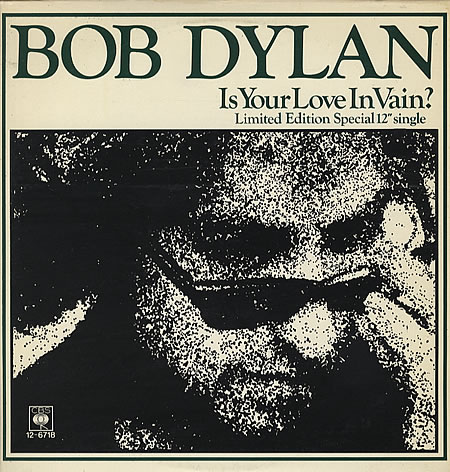
The first of three singles from Street Legal was “Is Your Love in Vain”. Greil Marcus accused this one of sexism, which is kind of funny given how many more of Dylan songs evince a greater distrust for women. Sexist or not, it’s not really that much of a song, and it actually might be the least interesting thing on the album.

Dylan performed this for the first time on February 28, 1978 at one of his Budokan concerts (it makes it onto 1979’s At Budokan from one of those shows). Like a lot of the material on Street Legal, it was written before the Australasian tour at the beginning of the year, and then recorded in the break before the European leg of the tour. It didn’t really survive past the tour either: Dylan played it 31 times in 1978 (out of more than 110 shows) and then never again. It’s another in a long list of Dylan singles that Dylan seemed to lose interest in.

It’s not a terrible song, but it’s too slow and too deliberate, so it comes off as a bit of drudgery. The lines:

I have dined with kings, I’ve been offered wings

And I’ve never been too impressed

Seem sort of like an early attempt at a humbelbrag.

Some live Dylan starting to crop on YouTube in this era for some reason. Here are two very different vocal performances of the same song, the first from Goteborg, Sweden from July 1978 and the second from Toronto in October of the same year.


The Rolling Stone Interview (1978)

Standard

20130401-bob-dylan-rolling-stone-306x-1364849901

Rebecca asked me yesterday “What weird thing are you going to blog about next year?” and I said “I’ll probably write about Bob Dylan again, but try to do a better job of it”. As we near the point where we’ve passed a third of the year, and a third of Dylan’s career, I find that I miss him when he’s not around. Last week was the slowest one for this blog all year, because Dylan did almost nothing: he got divorced from his first wife, Sara, and fought a protracted custody battle for his children, and he edited hundreds of hours of film into the four hour epic, Renaldo and Clara, which would become one of the biggest mis-steps of his entire career.

The year 1978 is a return for Dylan. He will do three tours – Japan (with Australia and New Zealand), Europe, and the United States and play an astonishing 114 concerts during the calendar year. He releases Street Legal, one of his worst received albums, and three singles that go nowhere. He may or may not become a born again Christian this year (his first Gospel Tour begins in November 1979). There’s a lot going on again all of a sudden, and I find myself looking forward to all of it. I also find myself happy to note that there are only a few remaining “dead spots” in Dylan’s career, like 1982, coming up.

To kick off the year, Dylan sat down for a long interview with Jonathan Cott in Rolling Stone (actually conducted at the very end of 1977) dealing with Renaldo and Clara. Since I haven’t yet watched that film, I’ll save the comments about it until I have. The interview is one of the worst Dylan has ever given. I’m not sure that he’s actively trying to be difficult, as he was in the 1960s, or if this is just the way that he really is. I think that there is a general consensus that Dylan’s interviews are mostly put-ons, but reading this one I started to think that maybe he is just really like this all the time. I mean, read Tarantula – his brain seems to fire off in atypical directions.

On the other hand, Cott doesn’t bring much to the whole thing. He has a ton of Dylan quotes laid out in front of him, and some Jewish mysticism and the whole thing just comes across as the worst excesses of the 1970s. For instance, on the death of Jesus (at this point, you have to be attentive to any Dylan Christian references):

“[Jesus was killed] Because he’s a healer. Jesus is a healer. So he goes to India, finds out how to be a healer and becomes one. But see, I believe that he overstepped his duties a little bit. He accepted and took on the bad karma of all the people he healed. And he was filled with so much bad karma that the only way out was to burn him up.”

So, if Dylan was born again by the end of 1977, it was in a particularly strange form of Christianity.

Anyway, it’s a terrible interview. Long and boring and tedious. I imagine it would have made me wary of seeing the film (I’m still wary now…) because the way that these two talk about it is absolutely mind-numbing:

Cott: The poet Robert Bly has written about the image of the Great Mother as a union of four force fields, consisting of the nurturing mother, like Isis (though your Isis seems more ambiguous); the Death Mother (like the woman in “It’s All Over Now, Baby Blue”); the Ecstatic Mother (like the girl in “Spanish Harlem Incident”); and the Stone Mother who drives you mad (like Sweet Melinda who leaves you howling at the moon in “Just like Tom Thumb’s Blues “). Traces of these women seem to be in this film as well.

Dylan:  The Death Mother is represented in the film, but I don’t know what I should say or can say or shouldn’t say about who is who in the movie. I mean who is the old woman everyone calls Mamma — the woman who sings, plays guitar and reads palms? She reads Allen’s palm, saying: “You’ve been married twice.” And me, later on I’m looking at the gravestone marked HUSBAND; Ginsberg asks: “Is that going to happen to you?” And I say: “I want an unmarked grave.” But of course I’m saying this as Renaldo.

Uh huh. Right. Listen, I think we’re going to go see The Bad News Bears Go to Japan instead….

But I don’t think this is a put-on anymore.

“Rita May”

Standard

CBS4859FR2

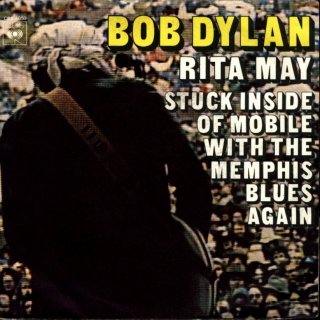
One of the few things Dylan did in 1977 was release “Rita May”, a song recorded during the Desire sessions but left off the album. The song itself is a silly 1950s style rock and roll tune that was covered by Jerry Lee Lewis in 1979, appropriately because it sounds like something Jerry would have sung a quarter century earlier. There’s not much to this one. It is exactly as it promises to be, and that’s about it. Not very Dylanish.

Rita_May-Memphis_Blues_cover

It’s a bit of a poser for me. The cover for the single (above) clearly indicates that it is the b-side of the live version (shortened) of “Stuck Inside of Mobile With the Memphis Blues Again” excerpted from Hard Rain. The UK single cover (below) indicates the same thing, slightly more explicitly.

Bob-Dylan-Rita-May-478479

However, wikipedia insists that this was a non-album single (not a b-side) and there is this single sleeve that would seem to indicate that. So I’m not sure. One of the things that I find a bit odd about researching Dylan, given the vast mountains of information there is on the web about him, is how contradictory so much of this. Obviously, I could spend some time and figure this a-side/b-side thing out for my own, but it’s not like the song really merits the work. It is a useful reminder of not to trust much of anything that you read on the internet (or elsewhere) for face value, to check and double-check. It is also a good reminder of how much more obscure this kind of thing becomes as you move back in time – this is only thirty-five years ago and it’s not immediately clear, so imagine if it was 350 years.

Speaking of not trusting what you read, wikipedia offers these weasel words: “Some listeners believe that the lyrics of the song refer to writer Rita Mae Brown, who had complained of the lack of opportunities for casual lesbian sex.” To their credit they actually cite Dylan Who’s Who for that insightful bit of guesswork. The fact that a) it’s not spelled “Rita Mae” and b) there is nothing in it to suggest that it is about a militant lesbian. I can’t imagine that Dylan ever thought, as Brown did, that heterosexuality was the root of all oppression. I can believe that he’d sing:

Rita May, Rita May

Laying in a stack of hay

Do you remember where you been?

What’s that crazy place you’re in?

I’m gonna have to go to college

’Cause you are the book of knowledge

Rita May

Dylan’s site says that he only performed this once, in New Orleans in 1976. It’s a good performance, but it’s not on video. So here’s The Killer instead:

The Last Waltz

Standard

54475_10151216041018872_217811581_o

Martin Scorsese is probably something of a genius. Maybe you already believe that, but given his recent run of films it is something that I think must be very much up in the air. Back in the 1970s, though, his genius-ness was not really in doubt, and The Last Waltz is a very nice piece of proof.

The Last Waltz took place on Thanksgiving 1976, which makes it last week’s subject, and the film was released in 1978, which makes it next week’s subject. I’m splitting the difference and writing about this week (1977) because otherwise I almost have to let the blog go silent for a week. Check out Bjorner’s page for 1977. Actually, don’t bother, here is the whole thing:

March     Sara Dylan files for divorce.

March     Dylan provides back-up vocals for Leonard Cohen

September   Dylan leases Rundown Studios in Malibu

October    Allen Ginsberg interviews Dylan

December   Jonathan Cott interviews Dylan

December  Rehearsals for the 1978 world tour start

That’s not much for blogging. So I’m putting The Last Waltz in here even though it’s against the rules. Sue me.

Let’s start with the Dylan section, since this is his blog. Dylan came out and did six songs at the end of the show: “Baby Let Me Follow You Down”, “Hazel”, “I Don’t Believe You”, “Forever Young”, “Baby Let Me Follow You Down” (again), and “I Shall Be Released”. It was a logical series of songs to play. “Baby” and “I Don’t Believe You” were staples of the Dylan/Hawks tour in 1966, and are seemingly required to be here. “Hazel”, from Planet Waves, is one of the least played Dylan/Band collaborations. Indeed, Dylan’s own site lists him performing it only seven times ever (in 2004 and 2005), but doesn’t list this version for some reason. “Forever Young” is the sort of thing that you probably have to play at a show like this, and “I Shall Be Released”, as the great big group sing-a-long, has an aura of inevitability.

url

Of these six, only the final three make it into the film. Apparently there were backstage negotiations about whether or not Dylan’s performance was even going to be recorded. He thought it would compete with Renaldo and Clara, and so didn’t want the footage shot. They compromised on half with the agreement that the film would only be released after Renaldo and Clara. Of course, Dylan’s film was a complete bomb, and The Band’s film is hailed as one of the most important concert documentaries ever. Probably because Scorsese is something of a genius.

Sticking with Bob just a moment longer, it is a shame that the whole twenty-five minutes couldn’t have been in the film. He and The Band were on fire here. The first version of “Baby” is better than the second, and it bleeds directly into “Hazel” without even allowing a time for the audience to applaud. Dylan strides around the stage full of confidence, and looks like he’s having a great time. This is months after the end of Rolling Thunder, and he is a different performer than he ever had been with The Band before. The universal sense is that he was considerably more comfortable on RTR than on the 1974 tour, and he evinces a lot of that confidence here. The Dylan section is one of the highlights of the whole thing. Even despite the hat.

bob-dylan-last-waltz-1976

A lot of the rest of the film also has highlights. There’s a great deal to like in this film. Greil Marcus’s review of the concert had not been very positive, but his review of the film was effusive. Listening to the bootlegs, it does seem that a lot of the crap in the five hour plus show was jettisoned, because Scorsese is something of a genius. Among the highest points for me are Joni Mitchell doing “Coyote”, a song that she was writing and re-writing on the Rolling Thunder Revue, so one that I had just read a lot about in Sloman’s tour diary. “The Weight” with the Staples Singers during rehearsals, which seems to be just about one of the most profound pop songs ever in that recording. Neil Young, stoned out of his head (apparently they had to rotoscope a chunk of cocaine out of his nostril – now you can do that digitally) looking like he’s going to fall over and then hitting a perfect “Helpless”. Eric Clapton breaking his guitar strap during a solo and having Robbie Robertson effortlessly step in to continue it (my favourite moment in the whole film). And, of course, Van Morrison singing “Caravan” in that ill-fitting jumpsuit and then karate-kicking his way off stage. I could watch that for years. Morrison wrote that song in Woodstock, where Dylan and The Band had lived, and it opens up the mental possibility that he and The Band could have been as productive together as they were with Dylan. Probably the great missed opportunity of the 1970s would have been a Van Morrison/The Band album and world tour.

The Last Waltz was a great idea – perform a final show at the venue where you first performed (under the name), intercut with interviews reflecting on sixteen years together. The show itself opened with ballroom dancing at 5:00 and a turkey dinner served to the crowd. A five hour show followed, including the inevitable superstar extended jam session (cut from the film – Robertson announces it, but the film mercifully ends before they get started). Those things are always awful if you’re not playing in them, and it sounds like Scorsese was a genius for getting rid of that footage.

I hadn’t watched The Last Waltz since high school. For some reason one of my high school English teachers played it for us. He was an aging hippy, which might have been reason enough. He used to talk about his relationship to The Band a lot. Here is the story of The Band and my high school:

Back in the day, when they were The Hawks, Levon Helm used to come to my high school every day to pick up his girlfriend, Cathy Smith. Smith had a relationship with Helm and also with Rick Danko. Sometime a bit later Richard Manuel asked Smith to marry him, and at one point she was pregnant with “The Band Baby” since no one had any idea who might have been the father. After leaving the orbit of The Band she had an extended affair with Gordon Lightfoot. By the mid-1970s she became the drug dealer supplying Ron Wood and Keith Richards. When The Band played SNL in 1976, she met John Belushi. Six years later she would inject him with the speedball that killed him, and would do time for it. Aldershot High, everyone. I studied under the same man who taught John Belushi’s killer. And also Jim Carrey, but that has nothing to do with The Band.

Anyway, given that happy story, we watched The Last Waltz in class. I remember being somewhat unimpressed by it. Watching it again this weekend, I could see all of its merits, and how much influence it has on every rock doc that ever followed it. It’s far from perfect, but Scorsese’s cutting from interview segments to ironic or insightful song performances that are shaded by the preceding commentary is very effective. It’s a really strong film of what seemed to be only a pretty good concert. Some sort of genius.

The Band planned to continue recording but not touring (like the Beatles a decade before them – Ringo was even there, setting a slow tempo for “I Shall Be Released”) but it didn’t work out that way. Robertson went on to have the greatest personal fame, and he seems to have caught the blame from Helm and others. The Band, without Robertson, resumed touring in 1983. I would say that this is a mark against the film, but then I also recall the night that The Who played their final ever show in Toronto and they toured again endlessly too. It’s rock and roll, who’re you going to believe?

Hey! The entire film is available online here!

Here’s “Baby Let Me Follow You Down”

RIP Rubin “Hurricane” Carter

Standard

hc-16c

I woke up this morning to learn that Rubin “Hurricane” Carter had passed away after a lengthy fight with prostate cancer. I wrote about Dylan’s song, “Hurricane”, two weeks ago. One of the striking things about reading the obituary in the Globe and Mail this morning is how much the first few pages read like an outline for the song – the facts of the case has become codified by the way that Dylan and Levy reported it.

Bob-Dylan-and-Muhammad-Ali

The final show on Dylan’s 1975 leg of the Rolling Thunder Revue was the Carter benefit show on December 8 at Madison Square Garden. Muhammad Ali acted as host, stumping more for a politician than for Carter. Carter spoke to the crowd by phone hook-up, and listened to the show from his cell. Robbie Robertson joined Dylan onstage for his set. Joan Baez performed dressed as Dylan, which must have given their duets a strange(r) feeling. It’s not the best show on the first leg of the tour, but it is close enough.

joan-baez-and-Bob-Dylan

One of the things that was interesting about the obituary was the note that none of Carter’s celebrity defenders came to see him after he was convicted a second time. I’d be curious to know what kind of relationship (if any) Dylan had to Carter after he was released. Larry Sloman’s tour diary does have the two speaking by phone frequently in 1975.

Carter’s story is a depressing one, and still all too common. It’s heartening that he dedicated so much of his time after his release to fighting for the rights of others who had been falsely accused. He was clearly a man with many issues – Sloman’s book is quite hostile to him in a lot of ways, much of that voiced by Joni Mitchell’s criticisms of his egotism, and he struggled with alcoholism after his release, but what happened to him was inexcusable.

Here’s Dylan performing “Hurricane” live in 1975 (can’t get it to embed, click through)

The Rolling Thunder Revue

Standard

121612-sponsored-bob-dylan-16-306-1355690553

This is going to be a bit of a jumble.

The whole Rolling Thunder Revue period has really played a bit of havoc on my one year per week system, not the least because the tour itself ran from October 30 to December 8, 1975, and then again from April 12 to May 25, 1976. In some ways it is two distinct tours supporting Desire, and in some ways it is all of a kind. Basically, I’ve just been a little bit overwhelmed by the immensity of the whole thing, and going away for five days in the middle of it didn’t help.

Here’s what we need to sort out, the remnants of the RTR:

Desire

Hard Rain

Bootleg Series 5: Live 1975

A whole ton of bootlegs

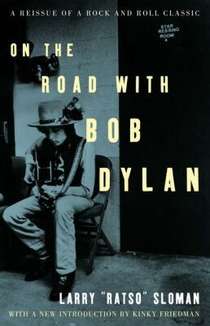
Larry Sloman’s book, On the Road with Bob Dylan

Fortunately, we do not have to address Renaldo and Clara for another two weeks, because it wasn’t released until 1978, but that will bring us right back into this chaos.

Since I’ve already dealt with Desire, I’m going to start with Larry Sloman.

lsloman-210-Bob_dylan

Let me start by saying that other than the autobiographical Chronicles volume 1, this is the best book that I have read so far this year about Dylan (caveat: I have only read one chapter of Sean Wilentz’s book, and I think it is going to be better in the end). Sloman was a music industry hanger-on, friend of Roger McGuinn and Rubin Carter who was fortunately placed to be around Dylan when the tour was just initially coming together. He then covered the tour for Rolling Stone for a few weeks. He wrote this article, and then another that was substantially rewritten by the editors. Dylan’s contempt for Rolling Stone is one of the themes of the book. Eventually Rolling Stone cut him off, but he continues on the tour as basically an employee, supporting the filming of Renaldo and Clara and interviewing people.

The book is a diary for the most part. It’s not much about Dylan – you get very little sense of Dylan from the book – but it is about the chaos of the tour. The RTR employed seventy people, from musicians to technicians, and basically rolled into towns with only a few weeks notice and set up camp and ran shows in venues large and small. The sense of chaos that oozes from every page of Sloman’s book is both intoxicating and invigorating. Characters move in and out. Joan Baez is a somewhat minor character – she teasingly renames Sloman “Ratso”, a nickname from Midnight Cowboy that sticks with him to such a degree that Sloman stops writing the book in the first person at that point, and switches to third person. It’s a very effective moment. Joni Mitchell is more prominent, mostly because of a fight she and Sloman have about gender and songwriting. McGuinn isn’t much there, nor T-Bone Burnett, nor Ronee Blakley. Sara Dylan appears midway through and is an interesting figure, as is Dylan’s mother, Beattie.

The whole thing is written in the Hunter Thompson gonzo style of paranoia, drugs and rock and roll. It’s exhausting just reading about this tour, where everyone got a cold that basically never went away but they also never seem to go to bed. Sloman seems to have had his tape recorder going at all times, so there are great interviews here with the supporting players, but never much with Dylan, with whom he has only occasional contact.

One of the things that Sloman is great about is covering Dylan’s earliest interactions with some of the performers who were influenced by him and who come in the generation after him. He details Dylan’s first meetings with Patti Smith, and her hanging around the rehearsals before the tour began. He writes about Dylan and Lou Reed, and Reed’s disinterest in what they were trying to do. He writes about Bruce Springsteen’s first meeting with Dylan at a show in New York, and Springsteen being essentially dragged out of the backstage area: “He looked so fine at first but left looking just like a ghost”.

The coverage of the filming is probably the most interesting part of the book, and makes it sound completely out of control. Sloman was regularly dispatched to find locations and extras, and then the crew would just never show up. They’d plan to shoot Joni Mitchell performing in the streets of Quebec, and then forget about it. They’d write things as they were shooting and between takes. Sam Shepard appears briefly, hired to bring some order to the script, but I’m not even sure if he stuck around. He’s at a party on page 419, but I don’t know if he had left and then come back or he’d been there all along. It’s possible that even Sloman didn’t know.

Anyway, it’s a great book. It’s probably too long at 460 fairly dense pages, but I was riveted by it because this is the one tour in the history of popular music that I am most fascinated by.

bob-dylan-hard-rain

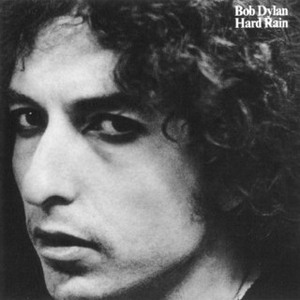
You can’t see that from Hard Rain, the official live album from this tour. Hard Rain was recorded mostly at the May 23, 1976 show at Fort Collins, Colorado (with some stuff taken from the May 16 show). Unfortunately, this was one of the worst shows on the tour. In Sloman’s book, he quotes Robbie Robertson (visiting the tour for the Hurricane Carter benefit show at Madison Square Garden that ended the first half) as saying about touring with Dylan: “It gets better. I don’t think it gets worse, I don’t think you lose it, I think it gets better”. That seems logical, but in the case of the RTR it is clearly not true. The live album came when the show had run out of gas. It’s not for nothing that everything on this album seems to be in slow motion.

Bob Dylan TV Guide

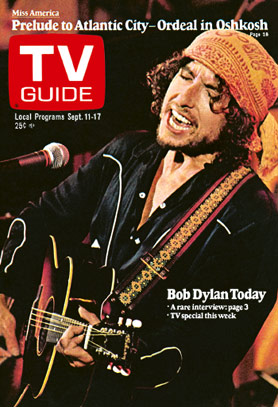
I’ve listened to a lot of bootlegs from this tour, and as late as the New Orleans shows three weeks before the end the shows are really good. By this point Sara was truly gone, and the love songs were replaced by things like “Idiot Wind”. Dylan was heading into his breakdown period (in 1977 there is virtually nothing at all to write about – he basically hides from the world again). The tour begins to slowly spiral out of control, losing its initial enthusiasm as it heads across the south and into Texas. If you listen to a lot of shows, you can definitely hear it petering out. Hard Rain was also a television special, but I was unable to get a copy of that. Someone put it on YouTube a few years ago, but Columbia has had it expunged. I don’t really want to see it, other than for the principle of the thing. The other main problem with Hard Rain was that it was a single album. Unlike Before the Flood, which included songs by The Band and gave some sense of how the actual shows were, Hard Rain does none of that. Good-bye Joan, Roger, and everyone else. RTR was most assuredly not just a Dylan show, and Hard Rain does nothing to try to capture that.

Live_1975_-_Front

Much better is Bootleg Series 5, the live album that they should have done in the 1970s. Most of the material is taken from the shows in Boston, at Harvard, and in Montreal. Those are some truly great shows. Montreal might be my absolute favourite, and they could have done a great album just by releasing the whole show. Again, it doesn’t give the sense of a complete RTR show, but it does give much more vital performances than Hard Rain did.

Though I’ve now reached the end of 1976, I am certain that this is the period that I will come back to again. I almost feel like next year I’d like to write a blog about this tour and try to listen to every show. Sadly, they don’t all exist. The bootleg of the tour’s stop at the Clinton Correctional Institute, where they played for Carter live, includes only three songs (“Blowin’ in the Wind”, “Hurricane”, and “Knockin’ on Heaven’s Door”) but Sloman argues that Dylan’s “Hattie Carroll” was the best version of it that he ever did – but it seems to be lost to history, alas. Also, the convicts booing Joni Mitchell off the stage. Also, Roberta Flack’s performance.

I feel like I have spent two weeks thinking about this tour and still have many more questions than I have answers here. I’ve only scratched the surface, I’m sure.  I still don’t really know for sure why he was painting his face white…

Here he is in Clearwater, FL from the second part of the tour: