“Series of Dreams”

Standard

Bob_Dylan_Series_of_Dreams

Here’s one that leaves me a bit befuddled, largely because Dylan and Columbia can be so comprehensive about wiping the web of Dylan videos.

The major Dylan output of 1991 was the triple-CD, Bootleg Series 1-3: 1961-1991, a major opening of the vaults that led to a re-examination of Dylan’s legacy. I’m going to write more on that album later this week. To promote the album, a single was released: “Series of Dreams”. This was a song recorded in New Orleans for Oh Mercy, but which was left off the final album. It’s difficult to see why that was, since it was better than a lot of the material on that album. Apparently producer Daniel Lanois thought that it should be the lead track, but Dylan overruled (Lanois’s support may stem from the fact that the song has more Lanois-ish touches than most of the rest of the album). I think that this is a really strong song. It also appears on Greatest Hits v3 and Bootleg Series 8. Not too shabby for an almost unreleased song!

In support of the single and the album, a video was made. I never saw it when it came out, and now I’m not 100% certain that this link (Vimeo and WordPress don’t get along – click through) is the actual video I think it is, and I’m going to write under the presumption that it is.

Anyway, it’s the best Bob Dylan music video to date. It’s a pretty simple concept – they simply edited a whole bunch of old footage from Dont Look Back, Eat the Document, Renaldo and Clara and elsewhere and then process it with a whole bunch of effects. It sounds awful, but it’s not.

You can see the video without any effects here, so this is what they started with:

That’s all fine and well, but the effects add a great deal. The insertion of old photos makes it a lot more visually interesting and dynamic. There are nice little touches – my favourite comes at 3:43 when Dylan is in a cab and they superimpose the face of Lenny Bruce on the other passenger, a nice nod to this piece of lyrics from the song “Lenny Bruce”:

I rode with him in a taxi once

Only for a mile and a half, seemed like it took a couple of months

Anyway, this was the first Dylan video to completely capture my attention and imagination. It is both a good song and an interesting video. Recommended!

“This Old Man”

Standard

MI0001593778

Did I mention that 1991, the Dylan week that we’re doing right now, happens to have included his fiftieth birthday? Well, it did!

How did Dylan celebrate that occasion? I have no idea. Not with a public event of any kind. He didn’t play a concert – his second 1991 tour ended on May 12, and his third tour of the year opened in Rome on June 6. Maybe he was on a tropical island somewhere?

Dylan did release a song that would allow writers to piggy-back onto his half-century birthday though, and it was a good one! He contributed a version of “This Old Man” to the For Our Children benefit album in support of the Pediatric AIDS Foundation (others lending a hand included Sting, Paul McCartney (“Mary Had a Little Lamb”!), Bruce Springsteen, Bette Midler, Elton John, and Barbra Streisand). Despite its all-star cast of artists, I have absolutely no memory of this album being released, probably because it is a collection of songs for children, and I didn’t have any at that point.

Here’s the Dylan song:

This is a good version of this, and makes good use of middle-aged Dylan. The harmonica playing is nice, and musically it is quite minimal. I wish he would do more things along these lines (I am currently listening to a compilation of acoustic songs from his 1991 London concerts and loving it in all the ways that I am hating his current live work when he is backed by a full band).

One other video worth sharing at lunch is this one by Loudon Wainwright III, which celebrates Dylan’s fiftieth by noting the large shadow that he cast on singer-songwriters like Wainwright and Springsteen. I went a little Wainwright nuts a couple of years back when I was building a deck – just put him on endless repeat until I couldn’t take him any longer. This is a cute song, as many of his are:

Spy Magazine Interview

Standard

Screen Shot 2014-07-27 at 11.27.59 AM

Sometimes in life you spend seven months writing about a blog about Bob Dylan, and then you read a single magazine article and think “Well, damn, that was exactly what I was hoping to say, only better”. It’s a despairing moment.

In 1991 columnist and essayist Joe Queenan set out to do an interview with Bob Dylan on the occasion of the singer’s fiftieth birthday. After jumping through a number of hoops (hilariously detailed in the piece itself), he gets a ludicrously mono-syllabic interview with Dylan. When he writes it up for The New York Times, the paper of record rejects it (probably with good reason), and the piece winds up running in the late, great Spy Magazine.

A quick word about Spy: I adored this magazine for a few years at the end of the 1980s and the beginning of the 1990s. There eventually came a moment when they completely lost their way editorially and became a pale shadow of what they once had been, but until that time they were an astonishing culture industry wrecking ball, spewing bile on celebrity culture of all kinds. There are pieces from that magazine that I still recall with total clarity a quarter of a century later (on David Mamet as a playwright for wealthy Americans with short attention spans; the pieces on Donald Trump; an astonishingly great piece covering the rescue of those whales that were trapped in ice that still causes me to laugh years later just thinking about it). At its height, Spy was awesome.

Queenan fits the Spy mold pretty darn well. There are passages in the piece that are just brilliant, and I can’t recommend it to you enough. You should wander over to Google, which has now archived all of Spy, and read it yourself (hopefully this link works, if not it is in the August 1991 issue, beginning on page 54).

Queenan’s take on Dylan is remarkably simpatico with mine, right down to this list of albums post-motorcycle crash: One that is equal to Blonde on Blonde (Blood on the Tracks), three worth buying (John Wesley Harding, Desire, Slow Train Coming), and three worth thinking about buying (Shot of Love, Infidels, Oh Mercy). That final phrase, I wish I had written that. (Although, he underrates Desire).

I don’t want to just plagiarize all of his good bits – seriously, you should go read the piece. But I will note that it sheds some light on a couple of posts from last week.

First, on the West Point show: Dylan is hilarious here. Queenan opens the piece with that show, and all of its incongruities. He makes a huge deal out of it. Then, when he talks to Dylan, the singer actually says “Uh, the West Point show … was that before New York?”. He can’t be nailed down on the oddness of playing that venue, and he just keeps insisting that his recollection was that it was an enthusiastic crowd and there were problems with the set-up. He completely no sells the collective trauma that a certain generation of fans, including Queenan, seemed to have had with that show.

Second, on the Grammys. Dylan simply explains away the performance by suggesting “the flu greeted me that morning in a big way. All my drainpipes were stopped up. Those kinds of things just happen to me….”. And why that particular song, “Masters of War”? Dylan: “We just did that one… You know, war going on and all that”. Sure. And all that.

As an interview, it is one of Dylan’s worst. As a piece of snark, it is nearly unparalleled. Check it out!

Screen Shot 2014-07-27 at 11.29.34 AM

Lifetime Achievement Grammy

Standard

Despite it all, I still think it’s the best award acceptance speech I’ve ever seen. I’m not kidding.

Bob Dylan received the Lifetime Achievement Award from the Grammy’s on February 20, 1991. I remember that my university was on spring break, and that I was at the home of parents for the week (possibly working for my father to cover a vacationing employee?) and that we watched this show, or at least the Dylan portion, together. I never watch the Grammys at all – there’s barely an award that I care less about – so I must have been specifically watching to see Dylan. It was a memorable night. You can watch the entire segment here, transferred from a VHS tape that pops a couple of times:

A few thoughts. First: Jack Nicholson is awesome. That’s a great tuxedo, and he gives a great speech. While I doubt that he wrote it, whomever did deserves all kinds of credit. The paradox part is as good a description of Dylan as you could imagine for an award show, and will be demonstrated just a few minutes down the line. Nicholson is just the best at these sorts of things. Compare his performance here to Bruce Springsteen’s at the Rock and Roll Hall of Fame, for example. Total pro.

Second: We certainly have moved forward in the editing of retrospective career videos. These are a staple of these shows, but this one is really quite bad. It leaps around, mixing sound and images from different sources, jumping out of historical order and just generally making a hash of it. This is one of the worst examples of the tribute genre that I’ve ever seen.

Third: “Masters of War”. As a song selection, it was incredible. Not long after having played the song for the cadets at West Point, here he is playing it for a national audience in the middle of Operation Desert Storm. I don’t recall anyone else on that show voicing much or any anti-war sentiment, so this was a thrilling selection for me.

Fourth: “Masters of War”. I remember my father asking “What the hell was that?”. Ok, Dylan’s strident anti-war message was perhaps a bit lost by the fact that he mumbled a lot of the words, and the band was pretty terrible. This was a loose, almost aimless version of the song that has been pilloried over the years. Rewatching it now, it wasn’t as bad as I recalled. That said, my tolerance level for mumbled Dylan is way up because I’ve been listening to a lot of bootlegs. I’m here to tell you: it wasn’t that bad. Still, another great example of Dylan on a national or international stage (like LiveAid) failing to live up to the legend that is Bob Dylan.

Fifth: The speech. I like it, partly because I dislike the Grammys, so anyone who moreorless craps on them while receiving their highest honour is alright in my book. Here’s the speech:

Thank You … well … alright … yeah, well, my daddy he didn’t leave me too much … you know he was a very simple man and he didn’t leave me a lot but what he told me was this … what he did say was … son … he said uh …. (long pause) … he said so many things ya know ….. he said you know it’s possible to become so defiled in this world that your own mother and father will abandon you, and if that happen God will always believe in your own ability to mend your ways. Thank you.

When he finally gets right down to it, his statement on defilement and faith in God seems very significant, if a bit paradoxical. I recall that I used to quote this a lot in the early-1990s, just to be annoying.

And that’s it.

Dylan’s performance as not well received at all – another one of the endless numbers of nails in his coffin. On that week’s Saturday Night Live, Dana Carvey absolutely nailed him – the costume, the twitching, the nasal whine. You can watch that here (WordPress doesn’t want to embed it for some reason).

So, another memorable miss.

Toad’s Place (1990)

Standard

Sometimes my wife thinks I’m deliberately torturing her with this project. That was the case this morning when I played, for the second time this week, a single Bob Dylan bootleg from 1990. It wasn’t that the show wasn’t good (actually, it was quite good), but that it was long. How long? More than four hours long. Some people have limits.

Dylan’s first concert of 1990 took place at Toad’s Place, a nightclub in New Haven, CT with a capacity of about 750 people (according to Wikipedia). Dylan and his band, who would do 92 more shows in 1990, were, as Dylan twice told the crowd “just working on the song endings” that night. Essentially, it was a live rehearsal in a bar with a very enthusiastic crowd. The show consisted of four sets totalling almost exactly four hours and fifty songs (the four CD bootleg that I have runs four hours and four minutes). I’m not sure how long the breaks were, but I’m sure that the audience was probably there around five hours or so. They were energetic all the way through.

It’s an interesting show. For one thing, Dylan takes requests. For another, the crowd is super amped (I’m sure the beer helped). When he plays “Stuck Inside of Mobile”, for example, the crowd enthusiastically sings along, even before he himself has started singing the words. He does a large number of traditional songs and covers of Leadbelly and Hank Williams and Kris Kristofferson. It just seemed like a really fun evening, and the type of show that, if you had been there, you would have talked about for a long time.

Dylan isn’t really known for his long shows. He certainly has done some back in the 1970s, but by this time he was also consistently running shows around ninety minutes long, so this was quite the exception. I remember back around this time, and earlier, my non-Dylan friends who were into Bruce Springsteen (someone who I never listened to at all) preaching the gospel of Bruce because his shows were so long and epic. I googled “Longest Springsteen Show” and it turns out that they seem to be citing his effort from Helsinki in 2012, which ran four hours and six minutes (33 songs). I would have guessed that he’d gone longer than that, and it seems like Dylan had him beat for almost twenty-two years. Not sure what to make of that.

Interestingly, Dylan actually covered Springsteen at the Toad’s Place show. If you’re going to go more than three hours, it’s probably obligatory to do Springsteen. He did a not very convincing version of “Dancing in the Dark”, which I’ve included below for its novelty value. There is something more substantial to be written about Dylan and Springsteen. Dylan is clearly a hero to Springsteen, but I’ve always sort of wondered about the relationship in the other direction. You could probably read way too much into Dylan’s half-hearted “Thanks, Bruce” after the man from Jersey inducted him into the Rock and Roll Hall of Fame, and there are great anecdotes of Springsteen overwhelmed at meeting Dylan for the first time on the Rolling Thunder Revue. I dunno. I don’t think I’m the one with the knowledge or interest in Springsteen to write that piece.

Anyway, great show. Very loose and with a chatty version of Dylan. They sound just like a bar band, which was a good thing on this night.

Traveling Wilburys Volume 3

Standard

TravWilb3Cover

I’m not sure that quickly following Under the Red Sky with Traveling Wiburys v3 was such a good idea. The two albums were released within a month of each other at the end of 1990, and each was, in its own way, a disappointment relative to the album that preceded it. Just as Under the Red Sky paled in comparison to the near masterpiece that was Oh Mercy, Traveling Wilburys v3 was flat in comparison to the Volume 1 (there is, of course, no Volume 2. Some say that this was a George Harrison joke, others claim that Dylan and the band considered the widely circulating bootlegs to be Volume 2).

Traveling Wilburys Volume 3 demonstrates with absolute precision how great Roy Orbison was. Without Orbison there the band is fundamentally changed. As Orbison wasn’t primarily known as a song-writer, you can see that the songs themselves aren’t in decline here, but the presentation of them is. Jeff Lynne’s production tricks are all the same, the musicianship is rock solid, but the whole thing is just missing that one little thing, and that thing is Orbison’s voice. If you concentrate on a song like “Where Were You Last Night?” you can sort of will yourself into hearing where it should have gone.

To my ears, none of the songs on Volume 3 are as good as the best songs (the singles) from Volume 1. Some of the songs are actually pretty dreadful (“Cool Dry Place”) and others use production and musicianship to paper over ridiculously stupid lyrics. Here is the, I don’t know, ecological fable? that is “The Devil’s Been Busy”:

While you’re strolling down the fairway

Showing no remorse

Glowing from the poisons

They’ve sprayed on your golf course

While you’re busy sinking birdies

And keeping your scorecard

The devil’s been busy in your back yard

It’s no “Desolation Row”, that’s for sure. I do think that it’s funny that an album whose largest potential audience segment was middle-aged, middle-class white guys has an anti-golf song, I guess.

In general, this is an inoffensive album. I can’t imagine mustering the energy necessary to deride it, but there aren’t really any high points either. A song like “New Blue Moon” could have probably been amazing with Orbison singing it (it is really good without him). As Rebecca just noted to me, it sounds as if this is the backing track to the great Roy Orbison song that was never sung – it is missing the crucial piece, and when Dylan steps in to handle the lyrics, well, Dylan is no Orbison, as I’m sure he’d be the first to tell you.

It’s just sort of an unremarkable way to call it quits on the Traveling Wilburys idea.

Here’s “New Blue Moon”, which I think is the best thing on the album:

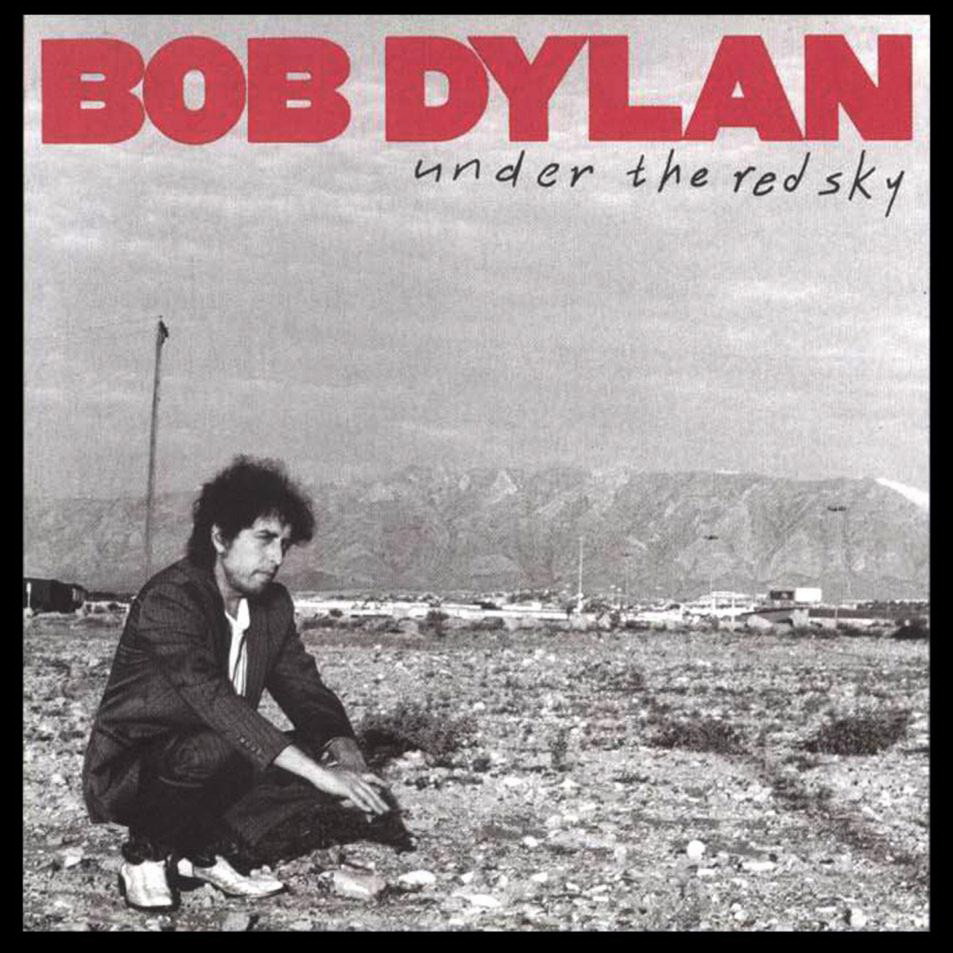
Under the Red Sky

Standard

bob-dylan-under-the-red-sky

I own a copy of Under the Red Sky on vinyl. It is the most recent album that I can say that about. I have no idea how or why I have this – I think that it was probably given to me by someone. It has all the marks of having never ever been played.

Under the Red Sky is commonly regarded as the astonishing crash back to earth after Oh Mercy – the return of the half-assed Dylan who is just sort of hacking stuff out for no good reason. I don’t think that the album is awful, but it is true that it really isn’t any better than Knocked Out Loaded or Down in the Groove. There are a couple of worthwhile efforts here, but for the most part it is completely forgettable.

If I had been paying attention to Dylan at this point, I’m sure I would have shared in the disappointment of this album. It is chock full o’ guest stars (George Harrison, Stevie Ray Vaughan, David Crosby, Elton John, Slash….) and was produced by Don Was, who was a hot commodity at the time (working with Elton John, Iggy Pop, Bonnie Raitt, and the B-52s). Some critics, notably Robert Christgau, really liked this album. One thing I have learned so far this year is that if Christgau says something is white, I’m positive that it’s black – we could not disagree more fundamentally on Dylan (I just watched a documentary about Dylan’s career in the 1980s and Christgau is in it and every single time he said something I disagreed with it).

Two of the songs here – “Born in Time” and “God Knows” – were left-overs from Oh Mercy. Not surprisingly, I would argue that they are two of the three good songs on this ten song misfire. Let’s take a look:

  1. “Wiggle Wiggle”. This is the song that regularly winds up at the top of “Worst Dylan Song Ever” listicles. It isn’t that – it isn’t even the worst song on this album – but it isn’t really very good either. Dylan dedicated this album to his young daughter, and “Wiggle Wiggle” is sort of a children’s song (only sort of, though) and, well, it seems few people want that from Dylan. Especially as the lead song on the album. I think that this would receive a lot less hate if it occupied, for instance, the spot “Handy Dandy” does. Which is to say that by the time people got to the song, they’d already mentally quit on the album. Slash plays guitar on this and he later covered it.
  2. “Under the Red Sky”. Also, I think, a children’s song. Dylan repeats the first two lines of each verse in a kind of nod to traditional songs, and the lyrics are very straightforward and fairy-tale like, including the old man in the moon: “Let the wind blow low, let the wind blow high / One day the little boy and the little girl were both baked in a pie”. To me this song doesn’t amount to much. George Harrison plays the slide guitar here.
  3. “Unbelievable”. I wrote about this the other day. I think that this is the best song on the album, but it’s not a great song. Nice little piece of boogie boogie blues and that’s about it.
  4. “Born in Time”. Bruce Hornsby is on the piano on this one. I think this is alright. It would probably have fit better on Oh Mercy, and that might have played up its gravitas a little better.
  5. “TV Talking Song”. I can’t stand this. Dylan singing about the evils of television. I hate it musically, lyrically, ideologically. Whatever. This is the worst song on the album – it’s the only one that I immediately hit skip on when it comes on. Dreadful.
  6. “10,000 Men”. This is the song with Stevie Ray Vaughan playing guitar. I don’t think that I get this song or what it’s really trying to accomplish. Dylan has played it live only once (in 2000) and it is just sort of a blank for me.
  7. “2 x 2”. This is the song with Elton John on piano. Apparently I was there for the last time he ever played this live (in 1992 at Massey Hall in Toronto), so that is somewhat cool. I feel like this may be a great forgotten Dylan song. It’s a simple counting song, which, of course, go back centuries. It has religious overtones (“Two by two, they stepped into the ark”) but it is very elusive. I feel like this is a song that a lot of people probably like a lot more than I do.
  8. “God Knows”. Stevie Ray Vaughan is also on this one. I like this, but I don’t love it. I think it should probably be more aggressive musically. It is a classic Dylan fake-out song. The first lyric is “God knows you ain’t pretty”, which sets you up for an anti-love song, but it then turns out to be a fairly straightforward return to Religious Dylan from the late-1970s.
  9. “Handy Dandy”. Rebecca’s choice for worst song on the album, because it gets stuck in her head like an ear worm. It’s true, this is garbage. I have no proof, but this sounds to me like a rejected Wilburys song – it has that lighthearted goofy Americana tone, but it just doesn’t make anything from it. The problem with this song is that the “Handy Dandy” of the title is actually supposed to be a person….
  10. “Cats in the Well”. A very slight nothing to wrap it all up. If on Monday, when I’ve moved on to 1991, you ask me: “Hey, did Dylan ever do a song called “Cat’s in the Well”?” I’ll tell you no, he didn’t, because there is nothing to remember about this song as well. Wallpaper

It’s not his worst album by any stretch of the imagination, but it is half-assed. A genuine retreat from what he accomplished only a year ago with Oh Mercy.

Roy Orbison Tribute Show

Standard

In February 1990, a little over a year since he had passed away from a heart attack, a tribute was held for Roy Orbison. While rumours of a live Traveling Wilbury’s appearance turned out to be unfounded, Bob Dylan did appear at the show in (in a white jacket) to join a re-assembled version of The Byrds on two songs, “Mr. Tambourine Man” and “He Was a Friend of Mine”.

Rolling Stone has a good short article here on the state of The Byrds at this time, which was a history that I knew nothing about at all. They describe the version of “Mr. Tambourine Man” as the most noteworthy part of the show. Certainly the crowd goes a little crazy when he strolls on out. You can watch that here:

This is another in a seemingly endless series of videos featuring people collaborating with Dylan where they are not all on the same page. It looks to me that they thought he was going to take over singing the song there, but it just didn’t happen – he’s happy to stand with David Crosby and harmonize. Awkward.

I don’t have a video of “He Was a Friend of Mine”. Dylan doesn’t sing on it, just played guitar.

Finally, he appears in the big group sing of “Only the Lonely” that ended the show. This is, as is typical of that kind of thing, a bit of a debacle. Too many cooks… Bjorner lists the singers on this as “Cindy Bullens, Gary Busey, Joe Ely, Chris Frantz, John Fogerty, Larry Gatlin, Emmylou Harris, Jerry Harrison, Levon Helm, John Hiatt, John Lee Hooker, Chris Isaak, Booker T, B. B. King, Al Kooper, Michael McDonald, Slim Jim Phantom, Iggy Pop, BonnieRaitt, Lee Rocker, Brian Setzer, Ricky Skaggs, Harry Dean Stanton, Syd Straw, Don Was, David Was, Tina Weymouth, Dwight Yoakam and others”. Sort of sad that Iggy Pop made it to this show but none of the Wilburys but Dylan….

That whole mess is available here:

Serenading the Masters of War

Standard

bob-306x414-1355526995

If you’re Bob Dylan and it’s 1990 and you want to get a lot of attention for your 66th concert of the year, what should you do? How about play the Eisenhower Theatre at West Point?

When Dylan and his band took the stage on October 13 for a show at the most famous military academy in the United States people sort of lost their minds. Just hours upstate from New York City, and not far from his old stomping grounds in Woodstock, the show attracted three audiences: fresh scrubbed cadets with crewcuts, ageing hippies in tie-dye, and New York based reporters with their mouths hanging open.

Rolling Stone wrote about the show. The New York Times wrote about the show. According to Bjorner newspapers in Sweden wrote about the show. Here he was, the voice of anti-war protest singing at the United States Military Academy. It had to be some kind of signal about the end of the world. I highly recommend both of these articles for their descriptions of the show.

Interestingly, because the show was bootlegged, you can check the facts on these live reports. Alan Light of Rolling Stone suggests that Dylan was tentative to open the show, but I don’t hear that at all – it sounds like any other Dylan show from 1990.

I have to say, I grabbed a copy of this show mostly hear to the high irony: the fourth show of the evening was “Masters of War”. Would, I wondered, Bob Dylan really go to the United States Military Academy and sing “I hope that you die / And your death’ll come soon” right to their faces? Apparently, yes. Yes, he did. It’s a rollicking version too. Light suggests that he swallowed the lyrics. No, no he did not – they’re as clear as anything else he sang on that night. He also suggests that the song didn’t go over well with the cadets up front. Possibly, but the cheers are no less loud for this than they are for anything else.

The other odd moment of the show is in the encore, where the crowd – including, presumably, the cadets – sings along to “Blowin’ In the Wind”. These were young men training for the then inevitable first American incursion into Iraq, and here they were singing “Blowin’ in the Wind”. It’s an odd world.

PS. Dylan wrote in Chronicles about his desire to go to West Point:

I asked my father how to get into West Point and he seemed shocked, said that my name didn’t begin with a “De” or a “Von” and that you needed connections and proper credentials to get in there. His advice was that we should concentrate on how to acquire them. My uncle was even less forthcoming. He said to me, “You don’t want to have to work for the government. A soldier is a housewife, a guinea pig. Go to work in the mines.”

I’m glad that he finally made it!

(He’ll also return to the same venue in 1994. No “Masters of War” that time)

“Unbelievable”

Standard

The first, and only, single from Bob Dylan’s 1990 album Under the Red Sky, is “Unbelievable”. It’s a pretty decent song, certainly one of the best or even the best on an otherwise weak album. It rocks, it rolls, it could have been a Traveling Wilbury’s song.

The video, seen here in a YouTube clip that looks like it was filmed through gauze, is one of Dylan’s most interesting in years. He himself just sort of floats around in it in a limousine driver’s hat. The narrative is carried by some handsome young man (seriously, I don’t know who that is) and his affair with the sexy version of Molly Ringwald, no longer the John Hughes teen queen.

This is nearing the end of Ringwald’s run with fame. Her huge successes were from 1984 to 1986 with her John Hughes trilogy. By 1990 she was transitioning to “mature” roles and she went off the rails with films like Betsy’s Wedding. She did get to work with Jean-Luc Godard, though. Here she doesn’t work with Dylan, or at least they’re not on screen together. Molly is the femme fatale who steals the handsome hero’s money and car and drives away. I guess that’s supposed to be unbelievable.

The video would be accused of being a very direct inversion and rip-off of Thelma & Louise, where Brad Pitt sleeps with Geena Davis and then takes her money (but not the car), except that film came out a year later. Must have been something in the air for Dylan and Ridley Scott to be working the same side of the street.

This is probably the best Dylan music video to date – partly, I suppose, because he plays such a minor role. He’ll do similar things – handing off the heavy lifting in the videos – for a number of his other singles in the years to come.

Ringwald is now an author and a singer with her own albums. Maybe Dylan will be in one of her videos?