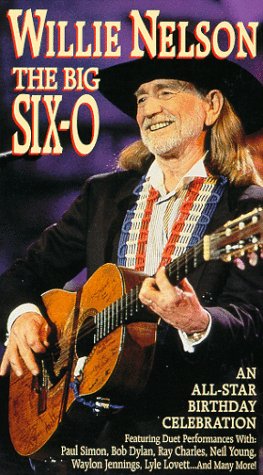
With Willie Nelson

Standard

willie-six

l was camping last weekend with five other fathers and a total of nine children between the ages of four and eight. At night we would drink, play cards, and listen to music from a bluetooth speaker connected to an iPhone, because this is the twenty-first century, and that’s what you do now. Since nobody wanted to listen to more Bob Dylan (seriously, none of these guys – all friends of mine – even read this blog! One didn’t even know I was writing it!), we settled on Willie Nelson. When you are camping with a bunch of guys, everyone is in favour of Willie.

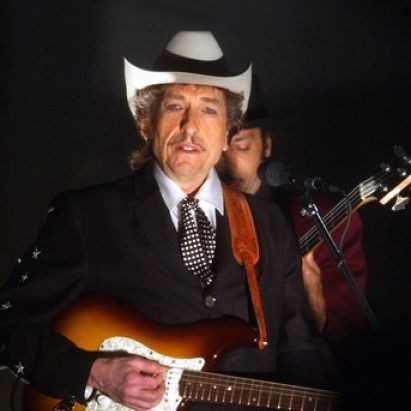
The relationship of Dylan and Willie Nelson goes back a long way, and is clearly a close one. Nelson started Farm Aid because of an inappropriate Dylan quip, and he played at the Thirtieth Anniversary Concert Celebration. A few months later Dylan returned the favour, playing at Nelson’s sixtieth birthday party celebration. You can watch the entire show online (Waylon Jennings! Kris Kristofferson! Ray Charles! BB King! Bonnie Raitt! Lyle Lovett! Paul Simon! – seriously, it’s good!), or you can skip right to the two Dylan songs. Here (skip ahead to 5:25) he and Nelson do a pretty good version of “Pancho and Lefty”.

Here (starts right at the beginning) Dylan does a version of “Hard Times Come No More” by himself. Also pretty good.

I have a lot of Willie Nelson on my phone, more than enough for a camping trip. I was surprised, though, to learn that his first album, And Then I Wrote, came out in 1962, the same year as Dylan’s debut. I was not as surprised to learn that he has recorded more than sixty studio albums – an incredible number. Nelson is almost as much a legend as Dylan – more, in certain circles – but even though he has a huge body of work (thirty films in addition to all those albums), I don’t think I could write about him for a year. Nelson has a totally different kind of celebrity, one that is built around his incredible consistency. Listening to Nelson sing at his sixtieth birthday doesn’t sound that much different than he did at forty. He is smooth and professional, but he’s not the change agent that Dylan is. Dylan has higher highs than Nelson (not trying to pun off Willie’s famous taste for marijuana) but also lower lows. Nelson may have created the genre of “outlaw country” with Waylon Jennings, but he never re-invented himself the way that Dylan consistently. It’s hard to imagine Nelson confounding his audience in the same way. That’s both a good thing and a bad thing.

The other night I was talking about Nelson at the birthday party of a friend (also not a reader of this blog!) and my friend Derek (who is a reader, thankfully) asked me if I was going to write about Red Headed Stranger. I had to admit that I didn’t know that album at all, and then Derek got excited and then he got me excited about the first ever country music concept album (“Better than The Wall!”, he exclaimed). That was an interesting moment, because it recast Nelson a bit in my mind’s eye. I had an image of him as someone who didn’t aspire to the sorts of things that Dylan attempted, and so I was pleased to learn about this album. I’m happy to have my assumptions proven wrong, when it’s for the better.

I read a great line from Dylan in the past couple of weeks about Nelson, but for the life of me I can’t find it now. In response to critics who said one of his recent albums was a disappointment (probably Under the Red Sky) Dylan wondered why no one gave Willie Nelson crap for putting out a disappointing album. He noted that Nelson put out two or three albums a year (in 1994 he put out three, for example) and no one expected them to redefine the art form every time. Why, Dylan moaned, couldn’t people just let him be like Willie Nelson? That, of course, is the key to the difference between the two men.

One final note: The last time Dylan performed in Calgary, Rebecca and I went to see him. One of the reasons that we went was the Willie Nelson was the opening act. Unfortunately, Nelson didn’t play the Canadian dates, and there was no opening act. That was a greater disappointment than the relatively poor Dylan set.

Maybe I should do a Nelson blog next year, though it is an awful lot of made-for-tv westerns….

PS. Despite having played 66 concerts in Texas, Dylan has never played Luckenbach.

Clinton Inauguration

Standard

770286

Ladies and gentlemen, let’s help Bob Dylan usher in the Clinton era! Oh, what a wonderful fit. The election of America’s first baby boom president, the draft-dodging, pot-not-inhaling policy wonk from Arkansas and the mercurial legend from Minnesota.  Clinton’s first inauguration, January 20, 1993, featured a veritable who’s who from the 1960s (Bill’s people) and the 1990s (to prove that he was with it): Aretha Franklin, Tony Bennett, Diana Ross, and, um, Michael Bolton, and, er, LL Cool J. Look, maybe we can blame the transition team for a couple of those names. Or Chelsea.

Dylan did one song at the inauguration celebration on the mall, “Chimes of Freedom”. His performance, which you can see in full above, raises a few distinct questions, not the least of which is: Where can I get one of those jackets? That thing is incredible.

The video is goofy as hell. Clinton himself jumps around in his seat with an air of excited glee when Dylan comes out, sort of pretending to be surprised. Every time the camera shows the Clintons and Gores you are struck by how phoney the whole thing is – they have to play the role of audience for this show because they know that they may be on camera at any moment. Clinton does a terrible job of it, frankly.

Dylan isn’t doing such a great job either. First, even though “Chimes of Freedom” may in fact be the fastest rising song in my estimation this year (going from a song I cared little about, to one that I think is close to the best thing he ever wrote), it is a somewhat odd choice for such an occasion, because it is elliptical and not entirely on point. But it sounds upbeat, particularly if Dylan garbles the lyrics. And garble he does! I can’t even imagine what this would have sounded like at the back of the mall with 100,000 people and tinny speakers. I watched it four times this morning with the lyrics open in front of me and I still struggled to make out what he was saying.

For the record, “Chimes of Freedom” is a six verse song. Dylan comes out and sings the first verse, half of the second combined with half of the third, half of the fourth combined with half of the second, and then the sixth. It is a mystery. I’m not sure you could really fully say you understand anything other than the title of the song.

Regardless, here we have Dylan donning the mantle of voice of a generation for the first time in a quarter century, as his generation takes its place at the centre of the universe. The last time Dylan sang from that location he was in the company of Martin Luther King, Jr., and now here he was singing for a president who in three years would sign into law a welfare reform that King would have fought with all of his might.

Oh well, baby boomers.

Dylan also performed at the Arkansas party later that night. He did “To Be Alone With You” backed by Steven Stills and The Band. I don’t have video for that one, but here is a picture.

danko_dylan_1993

Cool jacket, bro.

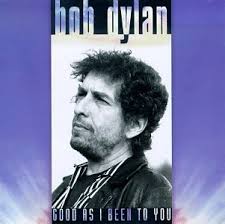
Good As I Been To You

Standard

imgres-1

When it came out in 1992 I think I listened to Good As I Been To You, Bob Dylan’s twenty-eighth album once or twice. I was twenty-three and it had absolutely nothing of interest to me and I quickly and decisively disposed of it.

In retrospect, this is a very interesting Dylan project, if not necessarily a really good one. Dylan’s first all acoustic album since Another Side of Bob Dylan way back in 1964, it is also only his second to contain no songs that he himself wrote (and the other, Dylan, was a collection of warm-up pieces released by Columbia out of spite, rather than by Dylan’s choice). Coming as it did almost immediately on the heels of the Thirtieth Anniversary Concert Celebration, it probably should have been a bigger hit than it was.

I think that if this album were released today the music press would have a way to deal with it. A songwriter like Dylan returning to classic country songs and folk tunes from the past would have an obvious hook – a return to the roots – that would be a much more obvious selling point. Think of the reaction to Springsteen’s album of Pete Seeger covers, for example (both that album and this one include “Froggie Went a-Courtin’”, not that that is a good thing). This Dylan album was a disappointment both commercially and critically (it peaked at #51 in the US and spawned no singles). It seems like an album that few people even bother to have an opinion about.

One thing is certain: Dylan went in this direction deliberately. In May and June 1992 he recorded a number of tracks in Chicago with David Bromberg. Some (though apparently not all) of these circulate among collectors, and two were included on Bootleg Series 8 (the traditional song “Duncan and Brady” and the Jimmie Rodgers song “Miss the Mississippi and You”). Here Dylan was doing standards, but with a full band. To my ears it didn’t sound like much.

All of Good As I Been To You was recorded by Dylan in his garage studio in July 1992. He originally intended to add a few solo songs to the full band covers that he recorded with Bromberg, but the project morphed in a new direction. This was the most minimal Dylan in almost three decades. There is no accompaniment other than his own guitar playing and harmonica, and there are nothing really in the way of effects. It is stripped down, spare, and intimate.

I do have to say, after having criticized Dylan’s recent guitar playing in a few posts, that he is quite good here. Often on Dylan albums and at live shows you can’t tell what Dylan is doing on guitar – he frequently delegates the guitar to Mark Knopfler or Mick Taylor or GE Smith or whomever. On this album you can really pay attention to what it is that he’s doing. There is a lot of very lovely playing on this album. So, sorry for suggesting you were losing it! (though I still don’t get that Kinky Friedman thing….)

As for the album itself, well, I’m a lot more sympathetic to it now than I was two decades ago. Since taking up the banjo myself I find that I listen to almost nothing but this kind of music – so this is right in my contemporary wheelhouse. If anything, the album falters for me when the songs are ones that I now know far too well (“Blackjack Davey”, or “Sittin’ On Top of the World”) because I hear other, often better, versions in the back of my mind.

I think that my judgment on this one is that there is not a single song on that I dislike – which is a first for me since, I don’t know, probably Desire. By the same token, however, there is no song on here that I actually love. Nothing that I will rush back to listen to again in the future. The whole thing is sort of beige noise. The songs have a samey feeling to them and there is not much variety in terms of key or pace. A slow, bluesy, folksy finger-picking style. It’s nice, but you don’t need to go back for any of it. There is nothing memorable here at all. It’s elevator music, essentially.

Of all the Dylan albums so far, this is the one that I sort of wanted to will myself into liking. It so closely aligns with my current musical tastes that I hoped it would be a revelation. As it turns out, however, it just reminds me that I have a dozen versions of “Blackjack Davey” on my phone, and I like almost all of them better than this one. Heck, I can play that song myself, and I like that better too…

Here’s a version I have on my phone, by Almeda Riddle. Now this is a great version of this song:

http://www.youtube.com/watch?v=ubSUG4qR5SY

Thirtieth Anniversary Concert Celebration

Standard

Knockin-on-Heavens-Door

Things like the Thirtieth Anniversary Concert Celebration are confusing to me. If you go to the Wikipedia page you get a listing for it as a double-album. Even this is a bit of a disaster (two different songs are listed as the sixteenth song, for example), but I think it is an accurate ordering of the tracks. If you watch the broadcast (recently re-released) you see that the album does not sequence the tracks in the order that they were played on the night of 16 October 1992 in Madison Square Garden. Bjorner notes that John Hammond was to play “I’ll Be Your Baby Tonight” but that the song was scooped from him by Kris Kristofferson, so Hammond did “See That My Grave is Kept Clean” (which Dylan recorded, but did not write). That doesn’t appear on the album nor on the video. Bjorner also lists Dylan as doing five songs, where he does four on the video. Missing is “Song to Woody”, which is probably the song I would have most wanted to hear him perform on that night. Aargh! Now I will need to hunt that down….

I absolutely remember watching this show live on television. I don’t know who aired it in Canada (also sources note that it was aired by a wide range of channels – it wasn’t like an NBC special or anything). I guess probably MuchMusic up here, but that’s just a guess. I also remember liking it, and, of course, for more than twenty years I have recalled the Sinead O’Connor segment and how angry it made me at the time – how much I hated that New York audience, how much I respected Kristofferson and O’Connor, and how I was sad that Dylan didn’t acknowledge the incident. The mythical Bob Dylan that was stuck in my twenty-three year old mind would have done something to that audience, but it didn’t happen.

Let’s start with Sinead.

I was an enormous fan of Sinead O’Connor from the time I was twenty years old. I can recall with absolute total clarity the first time I heard her sing. I was driving down the QEW with my friend Marc towards Toronto and we were listening to CFNY (the new wave station in Toronto) and they played “Mandinka” from her first album. We thought it was just the greatest thing ever. When the song ended the deejay, Alan Cross I am almost positive, literally picked up the needle and put it back at the start of the song and said something to the effect of “nothing we’re going to play here today is going to be better than that, so we might as well do it again”. I know that I bought the single later that day.

O’Connor appeared on Saturday Night Live on October 3, 1992, two weeks before what Neil Young termed “Bobfest”. During that performance she sang Bob Marley’s “War”, announced “Fight the real enemy” and tore a picture of Pope John Paul II in half. I remember watching that live and thinking “Wow, that was really great”. Of course, the conservative press went bonkers. SNL behaved rather shamedly, with Joe Pesci threatening her with physical violence on the following week’s monologue. Madonna later ripped up a picture of Joey Buttafuoco on an episode (young people, look that up) because even then she was afraid of seeming washed up. I remember that was one of the first times that I thought Madonna was getting pathetic.

Anyhoo, so when O’Connor came out to sing “I Believe In You”, one of Dylan’s most touching Christian songs, the New York crowd was pretty split between people who cheered her and those who booed her. The booing part of the crowd persisted longer, and eventually it becomes clear that a beautiful, quiet song like this one is not going to go off as scheduled. Kris Kristofferson then comes out and tells her “Don’t let them get you down” and she defiantly says “I’m not down”. She thens waves off the band and does “War” again.

I thought it was great. I also thought, this ridiculous crowd. These were the same people who booed at Newport. Of all the things to be booing, and at all the venues. Well, it seemed very very wrong to me at the time, and it bothers me even more now. At the time I was sad that Dylan let it pass unremarked upon. Today I realize that a) he might not have even noticed; and b) he probably didn’t care any more. The Dylan of 1992 was not the Dylan of 1964, not by a long shot. It was her battle, and I probably shouldn’t have expected anything from him at all.

Rewatching the concert over the past two days (it is soooo long) I was struck by how great most of these songs are as songs. Listening to this much Dylan all in a row, you get a sense of decline. Last week I listened to Bootleg Series 1-3 as a 1991 release but ran out of time to write it up. Too long didn’t read version: It is remarkable to go back in time to listen to the Dylan that had all the promise in the world. To realize again how great he was so fast. I can still find things to like in 1990s Dylan, but even his cast-offs in the 1960s and 1970s were so much stronger. Following the Ottawa concert in August with a show like this where Shawn Colvin, Mary Chapin Carpenter and Roseanne Cash just kill a song like “You Ain’t Going Nowhere” is almost unfair. That’s a song I’ve never really thought was that good, but last night I thought it was one of the greatest things ever written because they just brought such joy and life to it and made the goofball lyrics breathe. And then you recall that a young Dylan probably wrote than in ten minutes while stoned in a basement. Wow.

The Thirtieth Anniversary Concert Celebration is almost all like that. The O’Jays doing “Emotionally Yours”. Stevie Wonder doing “Blowin’ in the Wind”. So great. There are moments where songs are elevated well past what Dylan ever did with them. The best example, undoubtedly, is Lou Reed doing “Foot of Pride”, a lyrically brilliant Dylan piece from the 1980s that he himself doesn’t do justice to. Reed has to read the lyrics off the teleprompter, but if you listen to the CD that isn’t apparent. It’s a great piece.

There are a lot of likeable moments on the show. Eric Clapton, who I generally don’t like, does two songs (“Love Minus Zero/No Limit”, which is not on the album, and “Don’t Think Twice, It’s Alright”, which is) but then pays a lovely homage to The Band when he introduces them. They appear with two accordions (!) but no Robbie Robertson, who is one of the most notable absences (Elvis Costello, who often guested at Dylan shows, and Van Morrison, even more so, were both scheduled no-shows – wonder what the issues were?). Nothing is a disaster, at least nothing that made it to the album or to the video. GE Smith is back leading the band for the night, and I will say that I need to give him credit: he does a remarkable job. If you just watch him leading the multiple singers and guitarists through “My Back Pages” alone you’ll recognize that he has a great relationship with Dylan, and his time on SNL made him comfortable directing musical superstars. I still don’t think that highly of his tours with Dylan, but he comes across really well on this night.

1394474466_002b73ca

As for Dylan, well I haven’t heard his “Song to Woody”. His “It’s Alright Ma (I’m Only Bleeding)” is more than fine. It’s not a disaster like the Grammy show or the Letterman 10th Anniversary show. His voice seems limited, but he acquits himself real well. He plays the song solo acoustic, and his guitar-playing is right there, so I don’t know what was the problem with some of his recent debacles on that instrument. He does “My Back Pages” with Roger McGuinn, Tom Petty, Clapton, Neil Young and George Harrison – it works well and the crowd is super into that. “Knockin’ on Heaven’s Door”, with the whole ensemble, is sort of blah, the way these huge group things always are. Sinead stands on stage with her arms crossed and scowling – seems like they did get her down. Finally, everyone leaves and Dylan does a solo acoustic “Girl from the North Country”. It’s great. If that had been the last time anyone ever saw him onstage it would be legendary. Of course, there was no chance of that! Dylan immediately went back on the road again. This show just a one-off distraction.

The whole thing was quite good, really. Hard to imagine that it could have been much better(the low light for me would be the guys from Pearl Jam and Vedder’s one-note singing on “Masters of War”). It did a fantastic job of establishing Dylan as the legendary artist to a new generation after a series of recent misfires like Live Aid. For a brief moment Dylan might have even been cool again.

Dylan in Ottawa (1992)

Standard

Screen Shot 2014-08-09 at 10.01.41 AM

1992 was the year of my brief re-interest in the career of Bob Dylan. According to the information provided by Bjorner’s site, this brief interest must have last about ten weeks. I’m going to put each in a separate post, but here’s the timeline:

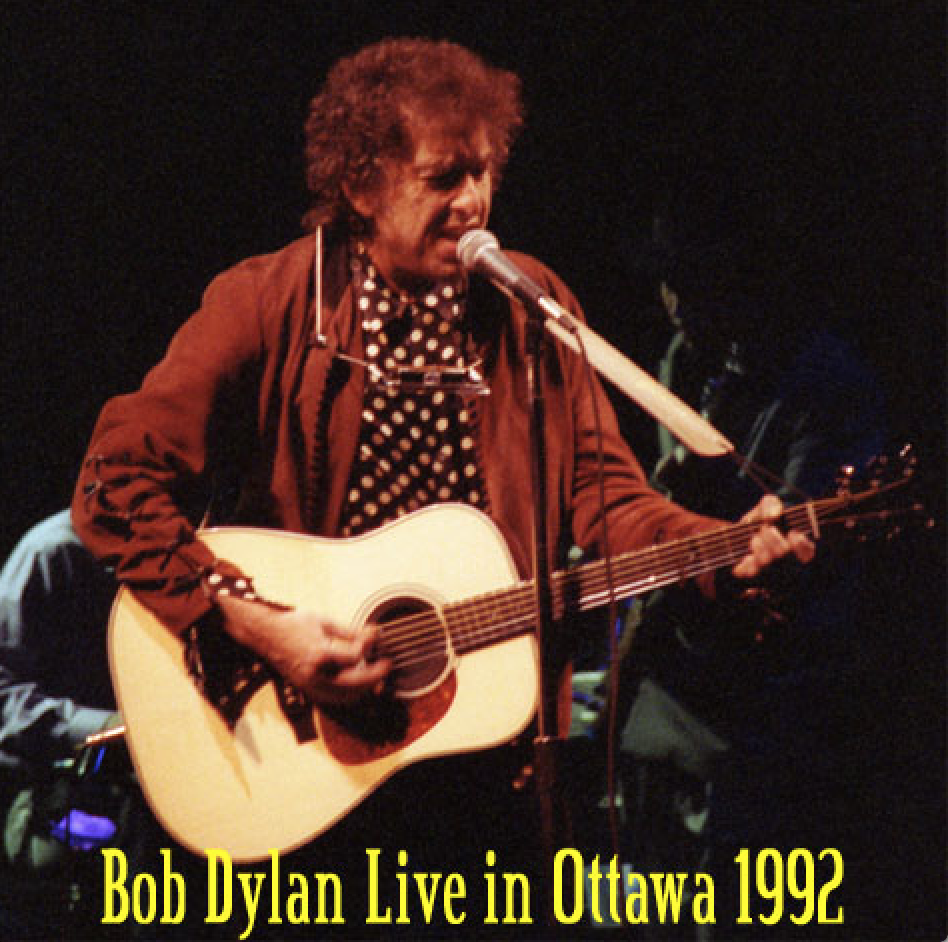
August 22. I, and my girlfriend of the time (but I think no one else that I knew) attend Dylan’s show in Ottawa at the absolutely dreadful Landsdowne Stadium. This was a nostalgic venture for me.

October 16. The Thirtieth Anniversary Concert Celebration is broadcast. I remember watching this at my apartment, though I don’t remember who else was there, but I know that people were.

October 30. The release of Good As I Been To You. I probably received this before its release date because one of my good friends worked at a local record store and they received promotional cassettes in advance of albums coming out to help with sales and ordering. Occasionally he would give me some of these and, miraculously, I still have this copy of this tape. I think I listened to it once. Love affair over again.

So let’s start with the concert in Ottawa. This one actually gets mentioned on Bjorner’s Dylan timeline because it was the live debut of “Unbelievable”, the only single from Under the Red Sky. I had no idea at the time that it was so momentous! In actuality, it’s not much of a performance of that song.

I was able to get a bootleg copy of this show, and it seems as bad as I remembered it. To be fair, that might not have all been Dylan’s fault. Bjorner lists the previous show, in my home town of Hamilton, as one of the best of the tour, and I had I been a super-fan I suppose I might have even traveled to that. The Ottawa show had little hope of being good. Landsdowne is an outdoor open-ended football stadium used by a successive series of bankrupt CFL teams. It is an absolutely terrible live music venue, even by the low standards of football stadiums as live music venues. I lived in Ottawa for two years, and this is the only show that I ever saw there. The acoustics were mind-boggling awful. I really don’t remember anything more about it than that, and the recording didn’t bring back any memories either.

To be fair, the concerts in 1992 are better than they have been in a few years. Dylan has started mixing in a lot of covers and traditional songs (hence, Good As I Been To You at the end of October). At this show he did “Pretty Peggy-O” (which he had been doing for thirty years) and “Little Moses”. This was not a greatest hits show (the three biggest songs on the show would be “Watchtower”, “Maggie’s Farm” and “Times”). Material was taken from across the full range of his career. I wish it had been better.

I know that I left this show, like a lot of people, disappointed. Not just by the sound, but by the fact that I was so unfamiliar with so much of the music. I hadn’t been doing my homework, hadn’t kept up. I wasn’t thrilled by any stretch of the imagination. Pretty much a disappointment. I had sense that Dylan was about to quit it all, I do remember that.

Chabad – Now with Video!

Standard

Yesterday I was talking about this blog with one of my colleagues who I had no idea was reading it, and he mentioned that he had seen video of the Chabad telethon where Dylan plays with Harry Dean Stanton and his son-in-law, Peter Himmelman. When I wrote about that performance I noted that I couldn’t find any such thing.

As fate would have it, this morning a friend sent me a link to this Open Culture article on the evolution of Dylan’s faith. I don’t fully agree with this article, but it is worth reading (I think it overstates his return to Judaism, but, frankly, it’s all just guess work on this issue anyway). The post has a video from the Chabad telethon of the trio playing “Hava Nagila”. Dylan plays harmonica here, rather than the flute that he played on the other two songs.

I normally don’t update past posts, but it is clear that the universe conspired in the past twenty-four hours so that I would bring this to you. Click through, because WordPress and Daily Motion don’t see eye-to-eye on embedding.

“Desolation Row” 1992

Standard

melbourne_1992_06_bromberg_front

Now you would not think to look at him

But he was famous long ago

For playing the electric violin

On Desolation Row

That’s the end of the “Einstein” verse from one of Bob Dylan’s best songs, “Desolation Row”. It is also the place that he fell apart on stage twice in 1992.

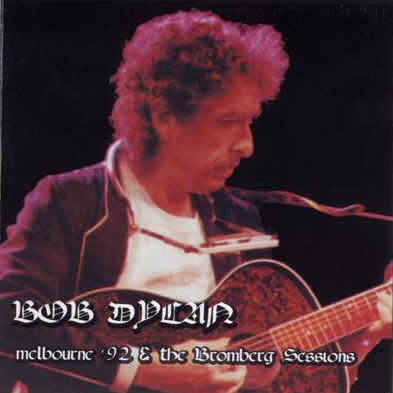
On April 5, 1992, while performing in Melbourne, Dylan begins to choke up at the end of this verse, stumbling to spit out the words. On the audio that I have, he simply disappears for two minutes, and the band continues to play the instrumental part of the song as if this were a planned break. According to reports of people who were there, Dylan began crying and moved to the back of the stage. He returned to finish the song, but skipped several of the verses. This in itself was not that exceptional, as he had already altered the order of the verses before he took the timeout.

Nine days later, this time in Sydney, Dylan broke down again on stage, and again at the same place in the song. Here he loses his composure even more noticeably, but for a shorter period of time – he returns to the song after only a minute away.

Ultimately, this is what you get reduced to on a project like this one. Listening to the nth version of “Desolation Row” for the signs of a man having a possible emotional break-down. It’s not unlike gawking at a car crash – we’re only interested because someone else is in distress of some kind.

This is a weird incident, and the Dylan message boards are all over it. If you google it you get all kinds of readings of it. This thread, for example, indicates that the stoppage comes in the “Ophelia” verse, but that is clearly not the case. It offers a long explanation about one of Dylan’s ex-lovers, but given that it gets the fundamental facts wrong, I’m not sure how far we can go with this.

This old message board thread attributes Dylan’s emotions to the death of his father, but that event occurred almost twenty years earlier, so that seems incredibly unlikely.

Of course, no one really knows. But it is fascinating nonetheless. I had to track these shows down when I learned that they existed, just to hear them for myself. They offer unusual moments in a sea of Dylan shows that are otherwise fairly common, and so even though I knew they would offer nothing of real interest, I cranked my neck and stared out the window at the pieces of wreckage on the side of the road…

Letterman 10th Anniversary Show

Standard

Bob Dylan’s first concert appearance in 1992 was on the tenth anniversary celebration for David Letterman’s show, Late Night. Recorded on January 18 and airing on February 6, Dylan was the only musical performer to appear on the show. He is backed by Paul Schaefer and the World’s Most Dangerous Band (including drummer Anton Fig, who appeared on both Empire Burlesque and Knocked Out Loaded), and a collection of back-up singers that included Roseanne Cash, Nancy Griffith, Emmylou Harris, Michelle Shocked, and Mavis Staples, as he plays “Like a Rolling Stone”. Two versions of this song were recorded that day, and it says something about the other version that they went with this one.

What a difference eight years makes. During Dylan’s only other performance on Late Night he looked like one of the most exciting legendary performers in the world, doing new wave versions of songs from Infidels. It was a riveting appearance, and one of the most exciting things that I have seen from him this year. Here he seems old and lost. The wall of sound (two drummers, horn section (including Doc Severenson from Carson’s band), piano and organ, the back-up singers, is all fine, but Dylan’s voice is overwhelmed by it and he disappoints (again).

I’ve really come to see that by week thirty of this project, you’re kind of restricted to looking for something less than great shows, or even great versions of songs that you like, but to the occasional phrase. Dylan seems to perk up a bit in this version at the beginning of the fourth and final verse. I thought, well, great – big finish. But no. He tails off again almost immediately and actually blows the lyrics of the final line (he forgets “You’re invisible now”, so sings it “You got no secrets, you got no secrets to conceal”). It is a bit of a shambles on his part.

In his autobiography, Paul Schaefer notes that Dylan didn’t even bother to sing during the rehearsals and actually walked out. He didn’t want to do this song, nor did he want the all-star band, arguing that he didn’t need it. He writes that Dylan gave about 70% effort on the song, which seems about right. Afterward, well, here’s Paul quoting Dylan:

“Lemme be honest with you, Paul. When I’m in the hotel room at night, I flip on the show only to catch a glimpse of Larry ‘Bud’ (Melman) . I’ve never really keyed in on you. But tonight, man, I saw that you know what you’re doing. If I had realized this could have been something, I would have given more.”

What a way to work! Most everyone is else is good. Mavis Staples is awesome. They should have had Mavis sing this thing.

It is clear that Letterman (born six years after Dylan) is an enormous, genuine fan of Dylan’s (and of sixties music generally – watch his interview with Led Zepplin, for example; he gushes). This is no surprise given that he was a teen when Dylan was at his peak. I hope he was thrilled to have him, rather than disappointed that Dylan was unable to deliver the goods on the big (prime time) show. Letterman doesn’t seem to care about anniversaries (he didn’t even note the twentieth anniversary of his CBS show), so he probably wasn’t as bothered about this as I was.

I do remember watching this show and being somewhat dismayed by it. To me it was everything that Late Night wasn’t – big, brash, flashy (Radio City Music Hall!). They did familiar bits for a new audience, rather than catering to their fan base. In retrospect, it looks like the audition for the 11:30 show that he has, and that he wanted before, well, Leno. Everything about this show was something I wanted to like better than I did, so maybe the Dylan performance fit right in.

Dylan Live (1991)

Standard

bob-dylan-sevilla-1991

Bob Dylan performed 101 shows in 1991. I don’t think that many of them were particularly acclaimed. He did tours of Europe twice, of the US three times, and of South America (his second trip to that continent). I didn’t listen to an awful lot of this music but I did want to highlight two things.

First, on 17 October he played at the “Leyendas de la Guitarra” shows in Seville, Spain. These were a series of five shows intended to hype Seville’s Expo 1992 the next year. The shows were held over five consecutive nights, and featured the talents of BB King, Les Paul, Robbie Robertson, Steve Jones and many others. The idea of Bob Dylan playing this show, particularly after that performance with Kinky Friedman, is utterly bizarre. Dylan was always a competent to good guitarist. He can get things done, but he clearly knows his own limitations. If you watch him play live, he doesn’t do an awful lot, and he leaves things to Mick Taylor or Robertson or GE Smith to carry the heavy load on guitar. By 1991, it seems, his skills seemed to be in decline.

It is clear that Dylan was actually invited note as a guitar legend, which he is not, but to play with those legends. Joe Cocker and Rickie Lee Jones also appeared as vocalists. I guess most people can’t handle all that guitar without some singing.

The show itself was odd. It was done in a relay fashion, with people moving on and off the stage. Dylan played “All Along the Watchtower” with Phil Manzanera and Richard Thompson, then Manzanera left. Dylan and Thompson played “Boots of Spanish Leather” (terrible), “Across the Borderline”, and “Answer Me” (none too good), before Thompson left the stage and was replaced by Keith Richards. They did “Shake, Rattle, and Roll” (you don’t want to know) and then Dylan left and Richards continued.

It’s not a show worth catching (for the Dylan part, at least). Apparently it was broadcast in hundreds of countries, but I don’t think that I ever heard anything about it.

Second, Dylan performed eight shows at the Hammersmith Odeon in London in February. This was the second year in a row that Dylan had done a residency in London, and it was one time too many. He had a new band this year, and the shows were not well received. I have an interesting single CD bootleg that contains a selection of the songs that Dylan performed acoustically during those shows (mostly not solo, acoustic with a backing band). These aren’t so bad, for the most part – there are a couple of real clangers. Listening to it I found myself wishing that Dylan would just have gone in this direction. It is the acoustic material that gets the best reaction, and, to my ears, they were the strongest performances. He never did that, really, though. There will be some gestures in that direction to come – including MTV Unplugged – that will win him some acclaim, but he never gives up the idea that he should be leading a big, raucous rock band. Too bad.

Here’s a live acoustic “It Ain’t Me, Babe” from Linz in 1991. It’s pretty good.

Chabad Telethon (again)

Standard

This video represents the nadir of this blogging project, so far. Click play to see what I think is the single worst Bob Dylan appearance to date, his guitar accompaniment to Kinky Friedman’s performance of “Sold American”.

The place was the 1991 telethon for Chabad. Two years earlier Dylan had shown up on this event with Harry Dean Stanton and Peter Himmelman to perform three songs on the flute. I called it “Dylan’s most bizarre concert appearance (so far)”. This one doesn’t top that in terms of bizarreness, but does blow it out of the water in terms of sheer incompetence.

Ok, hit play on this YouTube video:

To my ears, this is almost completely unlistenable. It causes me stress and anxiety. I had trouble making it all the way to the end one time. If you focus on Dylan’s electric guitar noodling, it is even worse (go to about 52 seconds in and try to listen for the next twenty seconds). Not only does it seem like Dylan doesn’t know the chords to the (simple) song, but he occasionally looks at his fret board of his guitar as if he doesn’t know what it is. He picks out some random chords, and often slides down to other chords. There are a number of just plain bum notes (“jazz notes”, in the words of my banjo teacher, “It’s never a mistake! It’s just jazz!”). Dylan just sort of frowns and seems lost. Friedman, for his part, just ignores Dylan, bravely trying to get through the song.

Kinky Friedman is a great minor character in Larry Sloman’s book about the Rolling Thunder Revue. Sloman and Freidman are friends, and Sloman was always trying to get Friedman involved with the tour. Friedman seemed to think – according to Sloman – that Dylan didn’t like him, so he was reluctant. He does show up in a very memorable scene, but it doesn’t really work out for the best (Sloman seemed to have been losing his mind and drifting into Hunter S. Thompson territory around that time, which didn’t help matters). So I was kind of thrilled to learn that the two teamed up a decade and a half later. Not anymore.

There is something about this telethon that seems to push Dylan to do as much damage to his image as he possibly can. The flute was certainly a misstep, but this is just sort of a tragic image. If I didn’t know any better I would have thought that this was a formerly great musician lost to the temptations of drugs. I think, though, he was simply lost.

This is a highly ironic performance given the topic of my next blog entry…