Jason Lazarus’s photo, “Standing at the Grave of Emmett Till, Day of Exhumation, June 1st 2005”, on display at The Museum of Contemporary Art in Chicago.
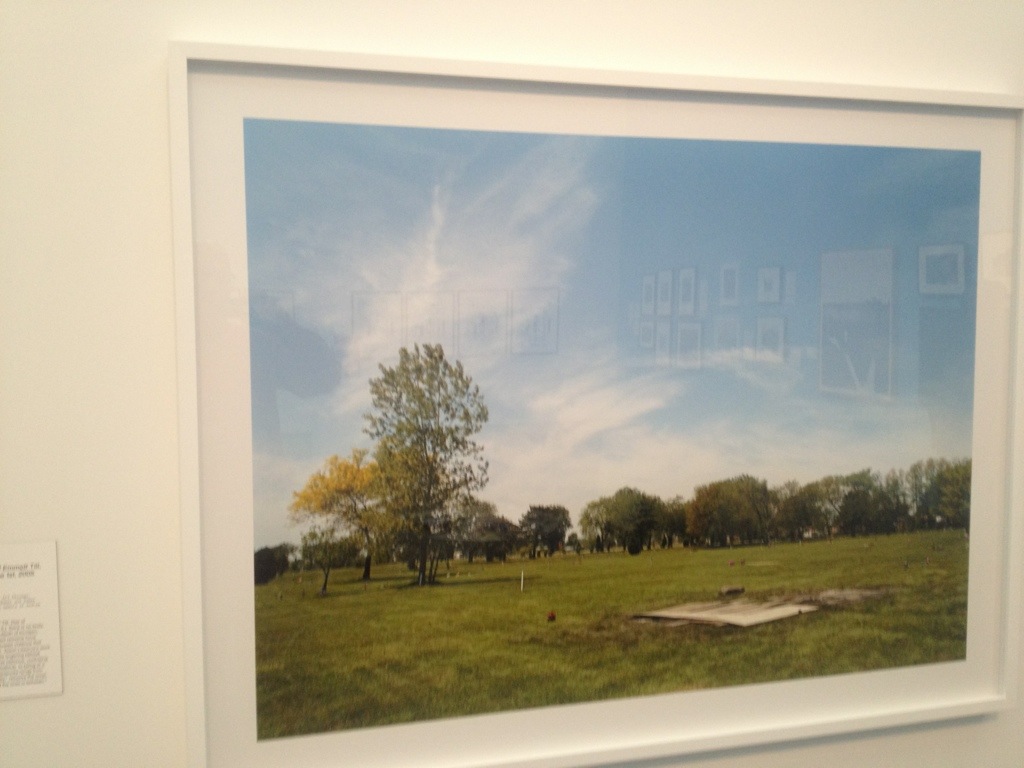
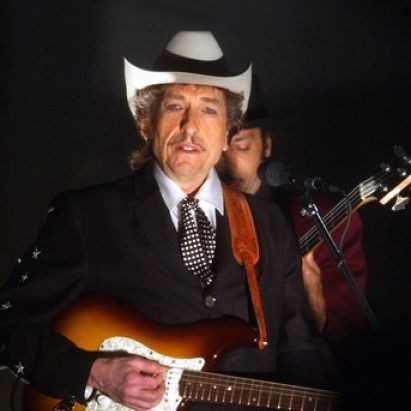

Jason Lazarus’s photo, “Standing at the Grave of Emmett Till, Day of Exhumation, June 1st 2005”, on display at The Museum of Contemporary Art in Chicago.

I’ve happily spent a good amount of time this week immersed in old issues of Broadside (the entire run can be found on the website of Sing Out!), reading about this history of topical songs in the United States and trying to come to terms with the development of Bob Dylan’s song-writing in 1962.
A word about Broadside. While topical songs had a long tradition in the United States (listen to anything by the Almanac Singers from the 1940s, for example), Pete Seeger was apparently of the idea by 1960 that the tradition had been allowed to die out. On tour in the UK in 1961, he was reportedly struck by the number of topical songs (many about the threat of nuclear war) that he was hearing, and he hopes to put some life into the movement in the US. Working with Sis Cunningham and Gordon Friesen, Broadside was born as a mimeographed pamphlet collected contemporary topical songs by folksingers from Greenwich Village, including Phil Ochs, Malvina Reynolds, Tom Paxton, Len Chandler, Bonnie Dobson, Pete Seeger, and, of course, Bob Dylan. The musicians would gather in the apartment of Cunningham and Friesen where they would be recorded on a reel to reel provided by Seeger and then the songs would be transcribed and printed. Many of the songs, including those by Dylan (like “Emmett Till” and “Blowin’ In the Wind”) were based on the melodies of older songs, while others were entirely original.
About two years ago I decided that I no longer needed music CDs in my life, so I burned everything that I wanted to hard drives and sold them all to a used record store (for a truly pathetic sum). I kept only two CDs. One of them was the five disc collection The Best of Broadside (1962-1988), a truly remarkable collection of material with a tremendously informative book about the magazine, the singers, and the songs. Can’t recommend it highly enough.
Dylan was involved with Broadside for its first two years, regularly contributing and recording songs for them (since he was exclusive to Columbia, and since Broadside’s records were released by Folkways, Dylan used the pseudonym Blind Boy Grunt). He was initially listed as a contributor, and his song “Talking John Birch” was included in the first issue. In 1962, with which we are concerned here, he contributed seven songs to the magazine, including “Blowin’ in the Wind” (issue six), and he would place nine more there in 1963 (including “Masters of War” and “Fare Thee Well”, which is used at the end of Inside Llewyn Davis) before his increasing fame made his contributions more sporadic. In the January 1964 issue (#38) he contributed a letter to Sis and Gordon, and then gradually drifted away.
The topical song is not necessarily the same thing as the protest song. A song like “Oxford Town”, about James Meredith attempting to enrol at the University of Mississippi, is inspired by those events, but deals with the topic only indirectly and obliquely, while “Masters of War” is much more directly a scathing indictment of militarism and war-profiteering. Dylan’s earliest songwriting was almost all based on existing tunes and on the Talking Blues, and he continues that for a while in 1962, before segueing strongly towards writing his own tunes.
Dylan is commonly credited with making protest music – or topical music – mainstream, but when you read Broadside it is clear that he was only one (strong) voice of many. Certainly things broke for Dylan in a way that they never did for a more militant songwriter like Phil Ochs (who never had a top forty hit), but it would be simply wrong to suggest that others were following his lead. In topical songs, Dylan found a way to transition away from the Guthrie covers and traditional music, while still staying faithful to the Guthrie tradition (who was more topical than Woody? No one, that’s who). In retrospect, of course, the movement seems entirely natural and inevitable, but reading the history of Broadside makes it abundantly clear how much work was involved.
Dylan’s recordings for Broadside, which include more than a dozen songs done at the apartment, plus an appearance on WBAI-FM in May 1962, are a great record of the development of his songwriting over a very short, but extremely productive, period in 1962. While the Leeds and Witmark Demos include a wider range of material – including blues numbers – the Broadside tapes are much more socially engaged, such as the great anti-war song “John Brown”.
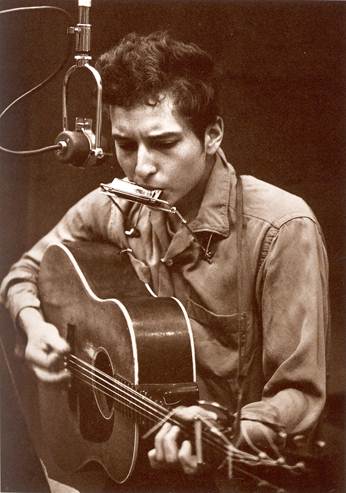
Bob Dylan’s live performance at the Finjan Club in Montreal from 2 July 1962 is named a “must have” by a number of bootleg sites. One of Dylan’s earliest post-debut album concerts, the sound quality is exceptional – you can actually hear a stage assistant rummaging through his guitar case looking for a capo. (Here’s a sample of Emmett Till from a German website that illustrates the outstanding sound quality). The show itself? A bit of a mixed bag. There seemed to have been about a dozen people there, and Dylan spends half his time tuning his guitar and starting and restarting songs. Sound quality can only take you so far…
For me, listening to a playlist set to present everything chronologically it has the remarkable moment of hearing Dylan introduce a song he wrote that he calls “How Many Roads Must A Man Walk Down?” Wikipedia says that there is an earlier recording of “Blowin’ In The Wind” known to collectors, but I haven’t heard it. This version differs a bit from his mega-hit, and not just in title, but I want to save that for 1963, since I’m trying not to skip ahead. I should note, though, that Dylan recorded the version of “Blowin'” that appears on Freewheelin’ exactly one week after he played it in Montreal.
For me, listening to this set, I was interested in the Finjan Club. I did my graduate work at McGill University in Montreal from 1993 to 1999, a time when the Finjan was long gone. Apparently it was on Victoria Street, a small street just immediately south of McGill. When I was a student there I certainly never knew Dylan had played so close to campus thirty years earlier.
Indeed, according to the records on BobDylan.com, Dylan performed twice in Montreal while I lived there. In 1996 he played at the Verdun Auditorium and the next year he had a show at DuMaurier Stadium. I attended neither of these. I don’t remember hearing about them, or wanting to go. I asked Rebecca if she recalled us considering them, and she didn’t. I don’t think I thought about Dylan at all during that entire six years I lived there.
What I recall about music in Montreal is that it wasn’t that important to me. I had all my vinyl but my record player was broken and I don’t think I ever got it fixed. I was pretty anti-CD at the time, and, besides, living on a student stipend I had no money for them. I certainly wasn’t willing to rebuy things I had on vinyl, so I just didn’t listen to Dylan. I think I owned Biograph on CD and so that I probably played on occasion, but that was it. For the most part, Dylan became something I had listened to in high school, and, to a lesser degree, during my undergrad years. I maintained a residual interest in folk – I bought the O Brother soundtrack when everyone else did – but Dylan was not part of my Montreal experience any more than the Finjan Club was.
My parents lived in Montreal in 1962, with my mother at nursing school just up the hill from the Finjan. Neither of them claim to like Dylan though (Elvis fans), so I doubt they were there. From the thin applause I think few people were there to see the man with the poor selling debut album offering an early take on a song that would help transform popular music.
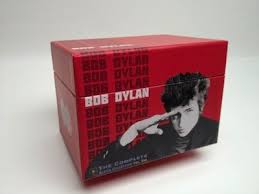
When I decided to do this project I already had all of Dylan’s albums – either as MP3s, on CD, on vinyl, or, in many cases, all of the above. I also realized that I was going to be writing about things that Columbia hasn’t released, and to resolve some of my ethical guilt about that, I decided to give Bob Dylan and Columbia some more money, by buying the huge career-spanning all-the-CDs-in-one-box set that was released at the end of 2013.
Fine. Ordered it.
I just want to say that I still haven’t received it, that there’s no ship date for it yet, and that I have never seen it for sale. Over the past few weeks I’ve been in a number of malls, electronic stores, and other places that sell CDs and I have never ever seen a copy of this set.
Way to go CD sellers both online and brick and mortar!
By the way, I don’t even own a CD player any longer, except in my car. Yes, I am buying this set just for the liner notes (which are online already) and for the sheer karma of purchasing music that I’m blogging about but that I don’t actually need. And they won’t sell it to me!
A few caveats about the Coen Brothers before I write about Inside Llewyen Davis. When I used to teach Film Studies at the University of Calgary, there were two courses that I particularly excelled at: one was my survey of the Coen Brothers, which I taught three times, and which is the closest I’ve come to a class with mythical status (students used to bring their friends to class because “Oh, man, we love Fargo!”). The other was a course on The Big Lebowski, where students would watch that film every week of the term and we’d talk about it every week. I only taught that twice, but at the end of the term the second time the students threw a party and brought all their friends to watch Lebowski together a final time. It was like something out of Community.
What I mean by telling you this is that I have never seen a Coens film that I didn’t like. I’m the guy who thinks Ladykillers is underrated and that Intolerable Cruelty was one of the best films of that year. I can’t do those lists where you rank the Coens films relative to each other because I tend to give them all A+. The combination of the Coens plus Greenwich Village folk scene for Inside Llewyen Davis is, as my friend Donna noted, “quite the collision of overlapping interests” for me.
Between work, the holidays, and an eight year old son, I couldn’t get to Inside Llewyn Davis before last night. I went in expecting it to be the greatest thing ever, and I was not disappointed. I loved every single frame of this film. I wished I could pause it and walk around in it, and look at the copies of Sing Out! on the walls to see which precise ones they were. I wanted to loll in the Gorfein’s apartment and read their books. I wanted to ride in that car. I wanted Llewyn so badly to take that cat.
Watching Inside Llewyn Davis is a lot like reading the first and last chapters of Dylan’s Chronicles. Dylan didn’t have an apartment in New York the first year that he lived there – like Llewyn he couch-surfed, often staying with wealthy patrons like the Gorfeins. Dylan’s full-throated endorsement of serious literature, history and philosophy in that book (and elsewhere) is one of the more convincing arguments I’ve ever read for the canon (essentially: reading the great works of western literature made me the singer I am, you should do it too), and watching Davis pass up those opportunities is the first signal that he’s not going to become Dylan by the end of this film, just as Llewyn visiting his father in the film recalls Dylan’s visits to Guthrie – but Hugh Davis and Woody Guthrie are very different father figures and influences.
Everything about the film is incredibly well done. The performances are great. The cinematography, which captures that slushy Freewheelin’ Bob Dylan album cover aesthetic so perfectly, is wonderful. The set design and costumes are spot on. At one point Llewyn walks past Kettle of Fish, the bar beside The Gaslight. He never goes in, but just the attention to detail to bother to put that there is remarkable.
The film uses Dylan, of course, as a counterpoint to Llewyn, as it would have to. Another of the Coens retellings of The Odyssey – the only real question in the film is whether the cat will be revealed as Ulysses or Odysseus – complete with a gate of polished horn, through which one can pass to make your dreams come true, the film develops its travel motifs to the fullest. When Dylan arrives he performs “Farewell”, a song that he recorded on The Witmark Demos in late 1962. It’s one of the many anachronisms that dot the film (the poster for The Incredible Journey is two years too early; The Gaslight didn’t serve alcohol; Dylan didn’t play The Gaslight in early-1961 – indeed, in Chronicles he writes about how difficult it was and how important it was to him to crack that club), but, as with most of the Coens films, it is the anachronisms that give the film its logic (The Incredible Journey poster is maybe the best moment in the entire film).
It has to be Dylan’s Farewell to Llewyn that is his hello to The Gaslight. The lyrics are spot on:
Oh the weather is against me and the wind blows hard
And the rains she’s a-turnin’ into hail
I still might strike it lucky on a highway goin’ west
Though I’m travelling’ on a path beaten trail
So it’s fare thee well my one true love
We’ll meet another day, another time
It ain’t the leavin’
That’s a-greavin’ me
But my true love who’s bound to stay behind
The choice of a Dylan song that is too late for the scene is not an error, of course, it’s just another part of the Dylan myth. If Dylan can lie to Cynthia Gooding about working the carnivals for six years, why can’t the Coens fudge the truth on the time of authorship for one of his songs? Especially when it is in the service of a greater truth?
Llewyn’s true love is the scene that is about to be shaken to its core by the arrival of Dylan, and his pitiable “Au revoir” is the gesture of a defeated man. The Coens build their portrait of the failed artist so economically – how little we know about Llewyn’s former partner Mike, but how clear they make what happened – that we know everything we need to about Llewyn after spending a week with him. It’s a heartbreaking film – more sentimental filmmakers would have milked that final shot for tears – and a convincing portrait of the artist in search of his muse.

“When you’re rich and famous,” radio host Cynthia Gooding asked Bob Dylan, “are you gonna wear the hat too?”
“Oh, I’m never gonna become rich and famous”.
That’s just one of the lies that Dylan told Gooding on the morning of 11 March 1962. Appearing live in the studios of WBAI-FM, a listener-supported radio station in New York, Dylan performed eleven songs in an hour long interview, just before his self-titled album was released. The recordings, collected as Folksinger’s Choice (which, it seems, was the name of Gooding’s radio program) are excellent quality, as you can hear in these clips found on YouTube. Dylan performed only one song from his forthcoming album (Fixin’ To Die), a number of traditional pieces, and two originals: Hard Times in New York and The Death of Emmett Till.
Emmett Till, which has only been commercially released on Bootleg Series 9: The Witmark Demos, is introduced as a song that he wrote about a week before. The story of a fourteen year old black boy who was tortured and killed in Mississippi in 1955, the song is one of Dylan’s earliest protest songs. A bit rougher and less polished than some of the others he would shortly write (The Lonesome Death of Hattie Carroll) it nonetheless demonstrates Dylan’s earliest forays into writing topical songs. I mentioned yesterday that Dylan credited Tom Paxton and Len Chandler with showing him a route towards song-writing that used established melodies, and he notes to Gooding after playing this that Len Chandler will recognize this melody (it is based on his song “Bus Driver”), once again demonstrating his technique and his indebtedness.
Dylan’s turn towards topical songs like Emmett Till was the key to his development as an artist, and I want to talk about that in a couple of days when I’ve read more of the early issues of Broadside. It’s worth noting, though, Gooding’s enthusiastic response to the song (“It’s one of the greatest contemporary ballads I’ve ever heard. It’s tremendous!”). Gooding is effusive about everything Dylan does during the hour, but she saves a special enthusiasm for the two songs that he wrote.
Where the interview can be very hard to take is the section after Dylan plays “Standing on the Highway”. He tells Gooding that “I learned that from the carnival” and then goes on to insist that, though he was only twenty-one now, he had worked for the carnival “off and on for about six years”. While she doesn’t seem to completely buy this lie, she is also too polite to call him on it. Two songs later she is sort of forced to ask “At the carnival, did you learn songs?” with a straight face.
The self-mythologizing Dylan who obscured his own background by lying about where he’d been and what he’d done is a central part of the early Dylan, but it is also one of the most annoying things about him. Listening to him talk about freak shows and working the ferris wheel is almost painful at times, particularly after listening to an early version of something like “Emmett Till”.
All through 1962, Dylan seems to have been torn between a simple desire to speak the truth (which can be seen in his Broadside work) and the equally powerful desire to tell lies. With Gooding he does both, and we get to see both the devil and the angel of his nature.

Bob Dylan, the singer’s self-titled debut album, was released on 19 March 1962. Of the thirteen songs on the album, only two were written by Dylan, with the rest being traditional folk and blues songs. Some of those covers are really great (Highway 51; Baby, Let Me Follow You Down) and some seem like bizarrely inappropriate choices for a twenty year old to be singing (In My Time of Dyin’; Fixin’ to Die; See That My Grave is Kept Clean). The album has a certain death drive to it that makes me think that the young Dylan thought all these dark songs about dying would lend the album a gravitas that it might otherwise lack. He sings them that way – trying to sound as old and as world-weary as he possibly can. Listening to this album again today, too much of it seems forced to me. There’s a self-mythologizing going on that will become central to the Dylan persona, but which doesn’t serve the album that well. Some of these songs were ones that Dylan hadn’t included in his set lists prior to recording them here, and he didn’t add them afterward – they seem like trial balloons for a different singer that he might have become had things worked out differently.
The one song about death and dying on the album that sounds the most genuine is the one that he wrote: Song to Woody.
In Chronicles, his 2004 autobiography, Dylan writes: “The first song I’d wind up writing of any substantial importance was written for Woody Guthrie”. The legend is that Dylan came to New York to meet Guthrie, who was hospitalized at the time and would remain so until his death in 1967. He would visit his idol numerous times, building a relationship with him, while at the same time he was gradually reducing his reliance on Guthrie material and moving towards writing his own songs.
In one of the better passages in Chronicles (which is a simply superlative autobiography), Dylan writes about meeting the great Mike Seeger, and how Seeger just seemed to know the entire history of folk music in the core of his being. He realizes that to be the best, he’d have to know the material even more thoroughly than Seeger did, which seemed impossible, or he’d have to write folk songs that Seeger didn’t know yet. Obviously, he went in the latter direction.
From Chronicles again:
“Greenwich Village was full of folk cubs, bars and coffeehouses, and those of us who played them all played the old-timer folk songs, rural blues and dance tunes. There were a few who wrote their own songs, like Tom Paxton and Len Chandler, and because they used old melodies with new words they were pretty much accepted.”
I found this one of the most important passages in the first part of that book, because it provides a glimpse of how fixed the folk revival was in its earliest form. Dylan is writing about the period immediately before the formation of Peter, Paul and Mary. The Kingston Trio were already a commercial success, and Joan Baez was emerging as one. At another point he talks about all the young women with gut-strung guitars singing Pastures of Plenty. It was a scene ripe for change, even if it didn’t know it yet.
Dylan’s earliest songs – the Talking songs or I Was Young When I Left Home – are ones that put new lyrics on top of well-established tunes, in just the way Paxton and Chandler did it. Not songwriting so much as re-writing or adaptation. Over-writing. It’s the half-step towards writing something like Blowin’ In the Wind (which he would do in 1962), where you craft lyrics that are your own long before you craft a tune that is your own.
I wasn’t really conscious of this development in the early Dylan until this week, but it makes a ton of sense. Using established traditions as a template is one of the ways that we teach creativity, and it is fascinating to listen to him pass through this phase – something that he does incredibly quickly. Rebecca and I have been talking about this blogging project, and she has noted that I don’t yet have a clear sense of what it entails. Part of me now thinks I should just overwrite a successful one, changing Julia Child and cooking every time to Bob Dylan and singing. It’s how we learn.
Recorded in just two takes, Song to Woody sounds like a Guthrie song, but is a Dylan song. Maybe the first “real” Dylan song. Musically based on Guthrie’s 1913 Massacre, Song to Woody is a lament for an idol laid low in a hospital bed. It is a song that acknowledges a tremendous debt that can never be paid, and a song that is fundamentally humble and hopeful about the future. Dylan sings it beautifully, and it seems like the most genuine thing on the album. It sounds like the birth of a new talent, one who has shed the cocoon of his influences, the very men he is now celebrating as he embarks on his own path.

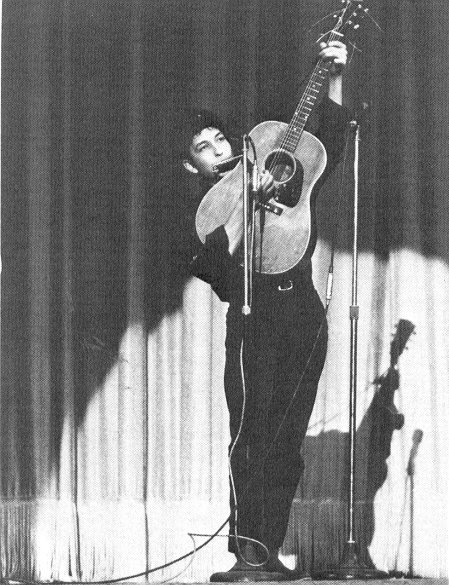
A couple of months ago, when I was first contemplating this project, I thought “I should buy a Bob Dylan poster and put it in my office!” So then I googled Bob Dylan Posters and, it turns out, I pretty much hate them all. All but one – the very spare and austere poster for the Carnegie Chapter Hall concert from November 4, 1961. I didn’t buy a copy, but if I do buy a poster it will be that one. The image of Dylan with his corduroy cap and harmonica is completely iconic, and I like the fact that’s it is so clearly a mimeographed handbill that has been typeset on a typewriter.
Robert Shelton’s biography says that fifty-three people attended Dylan’s first ever non-coffee house New York concert (in a room that sat one hundred). Apparently he performed twenty-two songs that night, the vast majority of them covers and traditional songs (four written by Woody Guthrie). He would record Bob Dylan less than three weeks later, so it is not surprising that nine of the songs he recorded at those sessions (and seven that made it onto his debut album) were performed that night.
Martin Scorsese chose to use the version of Guthrie’s “This Land Is Your Land” on No Direction Home. I can understand the impulse to connect Dylan’s Guthrie period directly to his best-known song, but I don’t like Dylan’s version of this. He does a good enough version on 1960’s Karen Wallace Tapes, but in the fall of 1961 he was doing a very slow, dour, and positively joyless version of the song (the same can be heard on the First McKenzie Tape), and that’s what he plays here. It seems like a totally wrong interpretation. Fifteen years later Dylan closed the Rolling Thunder shows with raucous group performances of “This Land”, and those are the complete opposite of this, which sounds like a 45 RPM record played at 33 RPM. Dylan essentially speaks the lyrics here. The guitar part works, but not much else about it.
I can’t find that version online, but here is an earlier version from the Minnesota Party Tape. This is a little bit more up tempo than the Carnegie version:
There is a cd release of this show Canada and the UK (Carnegie Chapter Hall 1961) but in the US it seems to be only available as an import, so I’m not exactly certain about its legal status. It seems that either a third of this show was never recorded or that the tapes were lost or that someone is simply sitting on them. They shouldn’t – it’s a great show that would make a good addition to the official Bootleg Series aside from its obvious historical importance.
One note about Dylanology: I’ve been using Bob’s Boots to sort out some of the historical confusion that (for me) surrounds these pre-Columbia releases, but now I’ve found Olof Bjorner’s incredibly detailed chronologies of Dylan’s life and recordings and have bookmarked that. I’ll be using this as my primary fact site until further notice. It has a level of obsessive detail that is incredible and it is incredibly well organized.
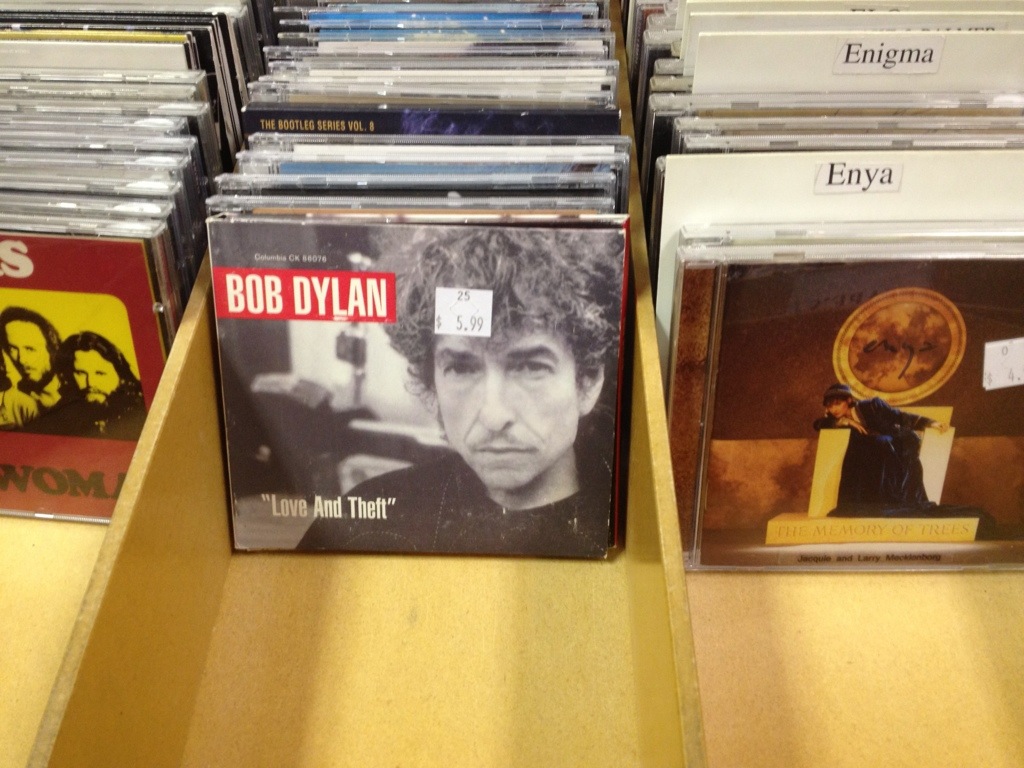
So I’m standing in line for a flu shot – since children can only get them at clinics and we have an H1N1 outbreak – and there is a record store here. I was drawn to the vinyl Dylan albums on the wall -New Morning, Blood on the Tracks – and wandered in. Flipping through the CDs I found the special edition of Love and Theft (which I don’t own) and, upon opening it, learned that “I Was Young When I Left Home” is, as I always thought, traditional!
Now I’m wondering why BobDylan.com credits it to him?
My previous comments about how great it is stand, but I’m no longer impressed that he wrote it!
This has been the first of approximately two hundred errors I will make this year on this project.
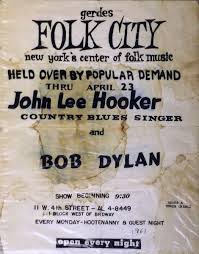
Dylan left quite a large collection of recordings in 1961, even before he signed with Columbia. His biography indicates that he left university in Minneapolis in December 1960, and arrived in New York shortly after, but that he didn’t make his way down to Greenwich Village until February 1961 (something that he says onstage at Carnegie Hall later in the year). Robert Shelton’s biography, No Direction Home, is quite interesting about this period (Shelton was there, writing for the New York Times about the folk scene), and particularly good on the subject of Dave Van Ronk and Jack Elliott as influences and mentors who helped broaden Dylan’s influences.
The Gleason Tape, recorded in Februrary 1961, is a remarkable document. Dylan was only nineteen years old at the time, and he sings a collection of folk standards, but even more Woody Guthrie songs. Obviously, Dylan’s debt to Guthrie is enormous, but the extent of it here is really striking. The Beecher Tape, from a trip back to Minnesota and Wisconsin in May, is better, but is similar. Dylan worked the coffee houses and at Gerdes Folk City in the interim, and his craft shows a great deal of improvement. His repertoire is expanded and the performances are generally stronger, but there is still a ton of Guthrie here, including Car Car, which is a fun song to play but makes me cringe whenever I have to listen to it. More than half of the Beecher tape is Guthrie covers.
Robert Shelton writes: “The latter half of 1961 changed Dylan from a provincial folknik into a music professional”. This seems clear from the recordings. I have scattered songs from the WRVR Hootenanny Special and from the Gaslight Cafe, and almost everything from the second half of the year is stronger than from the first. Having only recently turned twenty, the speed with which he was professionalizing himself was remarkable. By the time he recorded “The First McKenzie Tape” in November, he’d played Carnegie (Chapter) Hall and signed to Columbia – he has begun segueing into the performer that will release his first album, and he plays a lot of the same material. That’s for next week, though.
The song that kills me from this period is “I Was Young When I Left Home”, which was part of the Minnesota Hotel Tape (and was released as a bonus track on Love and Theft and also on the No Direction Home soundtrack). I first heard this as a teenager because the Minnesota Hotel Tape was included on the ten-album Zimmerman: Ten of Swords bootleg. I thought that this was the best thing on those first few disks, and I still do. I am pretty sure that I always thought that this was a traditional folk song (it was only when I started learning the banjo twenty years later that I realized that it’s based on “900 Miles”). Listening to it now it is almost unbelievable to me that it was written by someone only twenty years old. Its use of the past tense, and Dylan’s haunting vocals, make it seem like it has been around forever. It’s one of my absolute favourite Dylan pieces – possibly due to the droning of the steel strings that he’s finger-picking (sounds a bit like a banjo tune!). It’s the most wizened song you’re ever going to hear from someone so young, and the earliest recording that I’d put on my own “Best of” collection. I couldn’t quickly find a copy of it on the web, but here is Marcus Mumford covering it from the great documentary Another Day, Another Time, which is available on Netflix (at least in Canada), and which presents a concert at Town Hall in support of the Coen Brothers’s film, Inside Llewyn Davis:
When I think about where I was when I was that age, and the skill set that was required for him to write a song like that, well, I can’t relate!
 LongAndWastedYear