Since I go to BobDylan.com every day at least once now, I may be the first to have noticed that Columbia is releasing a new two dvd/two cd version of the Thirtieth Anniversary Concert. I plan to pre-order it, but as I am STILL waiting on the copy of the Complete Album Collection that I ordered in December, I have no faith that it will actually ever arrive. That said, I can’t watch it until 1992, which is some time around August so there’s plenty of time.
I do remember watching this show on television when it aired, though the only thing that sticks in my memory is Sinead O’Connor being booed off the stage following her Pope-ripping incident on Saturday Night Live, and Kris Kristofferson coming out to speak to her (“Don’t let the bastards get you down”). There’s a lot to be said about the relation of that to Dylan’s own Judas moment, but it will have to wait for a few months.
My self-imposed rules don’t allow me to skip ahead to show you a Dylan clip from this show, but nothing stops me from linking to a Bob Marley cover:
The best song on The Times They Are A-Changin’ is “The Lonesome Death of Hattie Carroll”, the strongest topical song that Dylan ever wrote.
In Chronicles, Dylan notes that this song was a major change in his writing, and that it was influenced by the work of Bertolt Brecht and Kurt Weill, in particular “Pirate Jenny” which he wrote out the lyrics for in an effort to understand how it was constructed.
The story was literally ripped from the headlines, as William Zantzinger killed Hattie Carroll in Baltimore on February 9, 1963 and the song was recorded in October of that year. The story is, in some ways, even more disturbing than the song presents it – Zantzinger actually assaulted three staff people at the hotel and his own wife in a drunken rage. The indictment of the Maryland legal system is thorough and well merited, and the song has all the hallmarks of a great tragedy.
The NBC tv show, Homicide: Life on the Streets, which did more to talk about race than probably any show on network television before or since, actually based a three-part series of episodes at the beginning of their sixth season around this song – modernizing the class issues for the 1990s – that was among the best material that that show ever produced (which is saying something given how many great episodes that series produced).
“Hattie Carroll” is a testament to the blunt, direct reportage of the topical song. It takes its power from its truth, and its truth is particularly galling.
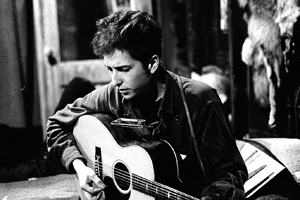
The oddest Dylan piece that I have come across so far is undoubtedly the episode of the CBC’s Quest that aired in February 1964. It is the most complete video of Dylan at the tail end of his folksinger phase that exists. Airing literally a few weeks before the Beatles took over the United States, Dylan still has the Woody Guthrie clothing to go with hisharmonica holder. By March Dylan would have transformed his looks and rented his first electric guitar. This is a true time capsule piece.
A half-hour show airing Sunday nights at 10:30, Quest was intended to showcase cutting edge performers and performances. To today’s eyes it is unquestionably a bizarre show. No announcers, no interviewers, just Dylan performing on a set designed to look like a bunkhouse or a fishing cabin, with a group of men gathered around mostly smoking and ignoring him. You might have thought that someone on the set would have suggested that maybe the singer would look like a bigger deal if, you know, the people there actually seemed interested in him. But, no.
This is an intimate Dylan set. He performs six songs, four of which are (I would argue) major ones. It’s the best opportunity that I have had to see – rather than listen – to him sing and play so far. It’s remarkable how much younger he looks than he sounds.
Most of the performances here hew pretty closely to their recorded versions. “Restless Farewell”, the final song, is probably the most interesting given that it’s one of his least performed songs. He doesn’t belt out the “hards” in “A Hard Rain” like he was doing in concert at that time (not that it would have been appropriate in the setting). The sense of sitting in the room with the performer is palpable. This is probably as close as one can imagine being in one the coffeehouses of Greenwich Village.
YouTube has bits and pieces, but I found the complete thing here. I tried to link to the CBC’s own version (which might not have the annoying time stamp) but, well, I couldn’t get their site to work….
The only good thing about Zack Snyder’s Watchmen movie is the opening credits sequence which is set to “The Times They Are A-Changin’”. If the movie had continued to be that good, it would be classic. Instead, it’s Watchmen.
Snyder uses a ton of shortcuts in that sequence, and the shortest of them all is the song selection. There may be no more anthemic song of the entire decade, but that doesn’t make it any less great. This is Dylan self-consciously adopting the mantle of “voice of a generation”, something that he would almost immediately attempt to cast off. It’s the song that his audience needed him to write.
With the Biblical overtones, its generation gap rhetoric, its address to “senators and congressmen”, and its skilfully crafted couplets this is a song that begs to be used in a variety of contexts. Yet it is not simply useful, it is actually quite beautiful. It’s a minor masterpiece of crafting, and is a song that plays well in a variety of arrangements.
Wikipedia reminded me that in 2010 the hand-written lyrics for the song were sold at auction for more than $400,000 to a hedge fund manager. So, maybe not so much change after all.
I guess I find it necessary to address my teenaged self. When I was sixteen or seventeen I thought “With God On Our Side” was one of the great Bob Dylan songs. Today? Not so much.
Here’s why I don’t like it. It is sort of droningly repetitive. It is dull and predictable. It is musically inert and lifeless. It goes on way too long. There seems to be very little that can be done with it to improve it. It has one of the all-time worst Dylan rhymes (on the Holocaust, he says of six million dead “In the ovens they fried” – hey, there are only so many things that rhyme with “side” and he’d already used ‘pride’, ‘hide’ and ‘died’). I have to say that it’s semi-embarrassing that I ever touted this as a great anti-war anthem.
Here’s why I did like it. It marched through the history of American war exploits as a lament, and in a mid-1980s Cold War atmosphere filled with fractionally talented punk rock lyricists, this seemed like poetry in comparison to more contemporary bands that I was listening to. The song has a profundity that probably seems most profound to the young.
Here’s what I still like about it: the penultimate verse, about the betrayal of Christ. That’s still a good piece of writing for a pop song.
Dylan did a great version of this at Town Hall, where he first performed it, but the most interesting version to my ear is the Carnegie Hall show in October 1963. During that rendition, the crowd applauds on a couple of occasions at the conclusion of verses, including the one about the Second World War and the fact that “we forgave the Germans, and then we were friends”. It’s a really telling moment for me, indicative of certain attitudes about that war among the young people of the 1960s that have been obscured over time.
Listening to it now, I find versions are better or worse depending on what Dylan puts into it vocally. With its minimalist instrumentation, it’s a good showcase for his lamenting voice when he lets it be. Overall, a song that’s fallen a great deal in my estimation, but once upon a time it was a favourite.
The image at the top is from its release as a single in France. Here he is singing it on the BBC in 1964:
Released fifty years ago this month (January 13, 1964), The Times They Are A-Changin’ marks the end of the second phase of Dylan’s career. His first phase, the Woody Guthrie acolyte who sings traditional folk songs, carried him through 1962. The second phase, the great writer and singer of topical and political songs, made him a star, but was also incredibly short-lived. After this album, Dylan only very rarely recorded the kind of directly political songs about injustice that can be heard here (“Hurricane”, is an extremely notable 1970s version of a song like “The Lonesome Death of Hattie Carroll”). By mid-1964 Dylan would move in an entirely new direction, marking the third period of his very young career.
The Times They Are A-Changin’ came into this project as one of my favourite of his albums, and that hasn’t changed. As a teenager, I listened to Dylan over and over in the basement of my parents’ house while playing pool. We had a turntable there and a pair of speakers. This is the album that I played to death, and I can probably still sing most of these songs by heart. I hate to say it but the teenaged me liked the militant Dylan – and I probably would have been one of the people booing him in 1965.
The album was recorded in August and October 1963, combining several songs that Dylan had been playing live for a while with some all new compositions. The album (his first to contain only his own songs) has a large number of ballads, and very little humour. It is as dour as the black and white photo of him that graces its cover. Perhaps not surprisingly, the songs that have survived the longest are also some of the least topical and the least tied to their moment.
The album opens with the eponymous title track, a song that was deliberately written to be an anthem of its time – now it gets played over the montage that opens every single documentary about the legacy of the 1960s. It’s still a great song, no matter what the filmmakers have done to it. “Ballad of Hollis Brown” had been around a while, and is a darkly grim tale of despair: “There’s seven people dead on a South Dakota farm…”. “One Too Many Mornings” is another great song, though this arrangement doesn’t particularly show it – Dylan retooled it later on to make a better live version. “North Country Blues” is actually a really good song about outsourcing and the economic decline of mining, but he never really used it (his website indicates that it was played live only twice). “Boots of Spanish Leather” has persisted as one of the best folk songs that he ever wrote, and “Lonesome Death of Hattie Carroll” is, by far, the best topical song of his career.
Interestingly, Times marked the conclusion of a lot of these songs. Dylan played “With God on Our Side” for the first at the Town Hall show, but he rarely played it subsequently (only thirty times in his career), and “Only a Pawn in Their Game”, which he played at the March on Washington” he only played nine times live.
Times continues a run where Dylan ended his albums with pretty weak material. “Restless Farewell” was added late. Dylan recorded nine takes of this at the last session for the album on Halloween 1963. Robert Shelton sees the song as a direct response to the unfavourable Newsweek article about him. Dylan only played it live twice – it seems that classic songs are rarely written as angry responses to Newsweek.
Here’s “Restless Farewell” from the CBC show Quest in 1964.
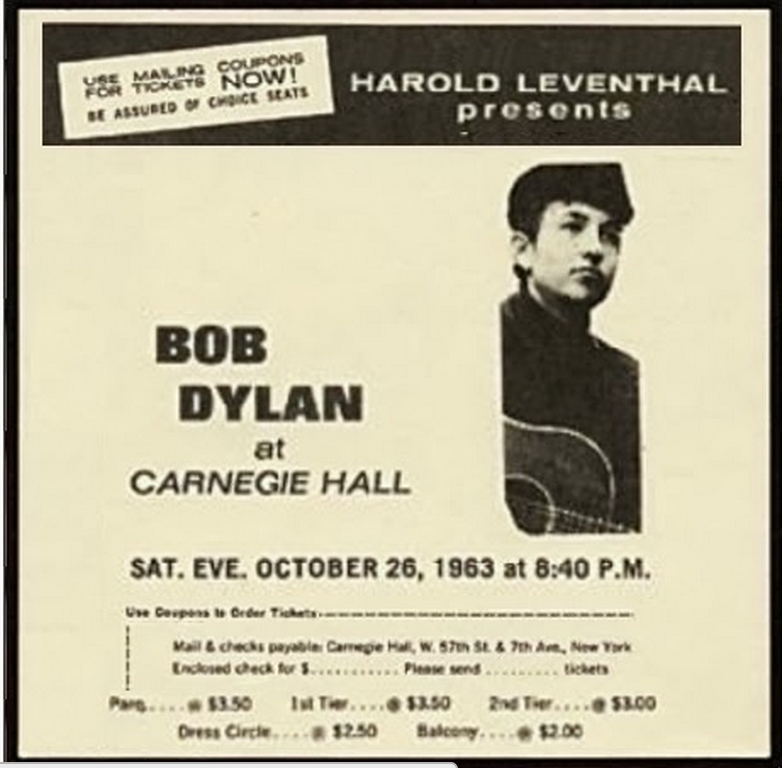
Dylan’s last major concert of 1963 was at Carnegie Hall on October 26. It was the first time that his parents had seen him perform live since he had left Minnesota. It was a good show, but not as strong as the Town Hall show from earlier in the year. It is clear from the crowd reactions that he was now drawing a different, younger crowd to his concerts. Dylan-mania was taking off. No folk crowd “shushing” on this one.
The show came in the middle of the recording sessions for The Times They Are A-Changin’, and that is the song with which he kicked off the show. I’m quite interested in the way that Dylan incorporated new songs into his sets, often months before they were recorded and released on albums. He seems to have shed his early songs quite quickly, and was constantly moving on to the next thing whether the audience was ready for it or not. It makes this year by year approach to listening to him occasionally odd, as when an album comes along I’ve already heard about a half dozen live versions or demo versions of many (but not all) of the songs.
The Carnegie Hall show was originally intended to be released as a live album (Bob Dylan in Concert), but that never came to fruition. Columbia has done a rather confusing job of releasing this material. Two songs (“Who Killed Davey Moore” and “Talking John Birch”) were released on the first Bootleg Series. Scorsese used “Hard Rain” and “When the Ship Comes In” so they are on Bootleg Series 7. Six songs were released on the Live at Carnegie Hall EP in 2005, which means that ten of the nineteen songs are legally available in the US. The other nine were released in Europe for copyright reasons on the 50th Anniversary Collection. If you want to listen to the concert straight through you have to assemble it for yourself, and, worse, the applause is faded out so there is a sense that you’re missing something. Ideally this concert would be given a much better presentation.
Dylan would have a rupture with his family around this time because of their participation with an unflattering article on him in Newsweek in which they contradicted a lot of the self-mythology that had built up around him. In November, of course, John F. Kennedy would be assassinated, and this would have a major impact on Dylan – and the rest of the folk community – and seems to have helped push him further away from political songwriting. He would emerge in 1964 with two new studio albums rather than this as a live album, and they would mark the end of the second phase of Dylan’s career, and the beginning of the third. The mutations just came faster and faster.
The last great song on Freewheelin’ Bob Dylan is “Don’t Think Twice, It’s Alright”. The first track on the second side, it could almost actually be the best thing on the whole album (it’s not, but it’s close), which is saying quite a lot. Dylan will go on to write a whole raft of break-up songs, but this is the template for all the rest of them. These are the cool lyrics, with an undercurrent of hurt, and with the false veneer that says ‘nothing really bothers me’. This is the kind of song that most people wish they could sing when they getting dumped, but few of them actually can.
In the summer of 1963 Dylan was seeing both Joan Baez and Suze Rotolo (his longtime on-again off-again girlfriend who is hugging his arm on the cover of Freewheelin’). Baez performed this song during her set at the Newport Folk Festival, and introduced it, with Rotolo in the audience, thusly: “Here’s another Bobby song. This is a song about a love affair that has lasted too long”. Rotolo, of course, walked out. Some day someone is going to make the great Bob Dylan romance film, and it’s going to be all about the summer of 1963. I have to say, my mental of image of Baez is so gauzy and clouded with her semi-saintliness that I just can’t imagine her being cruel to someone. I probably need to snap out of that.
I should note that I haven’t written about Dylan’s break-out performance at Newport this week because I haven’t been able to watch The Other Side of the Mirror, the documentary about his three Newport performances. I ordered a copy from Amazon, and it looks now like it will arrive next week. I may wait and just review all three years of Newport shows at once in two weeks time. There’s a lot of material on YouTube, of course, but it seems preferable to just watch the film.
Back to the topic at hand: “Don’t Think Twice” is a major accomplishment for the young Dylan, an inspired and hauntingly emotional song that helps establish his range.
Having listened to Freewheelin’ every day for a week, this is how I’ve got it broken down:
Girl From the North Country
A Hard Rain’s A-Gonna Fall
Don’t Think Twice, It’s Alright
Blowin’ in the Wind
Oxford Town
Masters of War
Bob Dylan’s Dream
The rest of the album is fine, but not particularly memorable in the grand scheme of things.
Here’s Joan, but not from Newport. Still a great version though:
If I can skip ahead for a moment, I’ll note that I remember watching Bob Dylan sing “Masters of War” on the Grammy’s in the dying days of the first Gulf War in 1991. It must have been spring break, because I was at the home of my parents. They thought that the performance, to celebrate his lifetime achievement award, was awful – mumbling and incoherent. I remember thinking that it was great that he would use that stage to sing a thirty year old indictment of war profiteering at the moment in American history. I’ll listen to that performance again sometime around September and re-judge for myself.
In the mean time, here’s Dylan singing it in 1963 at Carnegie Hall:
“Masters of War”, the third song on Freewheelin’, is extremely different from “Blowin’ in the Wind”. It’s an angry, bitter protest song that pulls no punches whatsoever. While Dylan often sings it as a dirge with repetitive guitar strumming, it can also be sung as a howl. It’s unflinching.
I think that the one of the peaks of my early interest in Dylan came when I was in high school and the book Lyrics 1962-1985 was published. I still have this book – it has survived many purgings of my library at various times. I remember reading it in high school English classes, but also while on vacation with my family in Los Angeles (possibly where I bought it), and, in particular, reading those lyrics while driving up Highway 1. At sixteen, and listening increasingly to punk bands, I thought that this was a pretty great song. Today I find the song itself a bit repetitive and tiresome, even while I still admire the sentiments.
It’s interesting to note that Odetta’s version – which makes it both longer and slower – dropped the final verse, which is the most bitter part of the whole thing. When I was young I thought that she just didn’t get it, but now I’m starting to think she was on to something. It’s an angry, angry tune – the only question is how biting you want to make it.
Rebecca wants me to tell you that Joan Baez made Bob Dylan’s career. She may well even have a point. While it’s true that Dylan received incredible support from the folk acts of the early-1960s (Pete Seeger; Peter, Paul and Mary, many others) who recorded, performed and endorsed his songs and his skills, it was Baez that pushed him to the next level.
Baez broke onto the folk scene about three years earlier than Dylan, with her performance at the 1959 Newport Folk Festival. By the time Dylan was playing coffee houses in New York, she was already a successful performer who could be found on television. Dylan writes in Chronicles that he fell in love with her the first time he saw her on television (who wouldn’t have?), and though the two met at a show in New York very early in his career, it wasn’t until 1963 that they became a couple and performed together frequently on stage.
They seem to have met at the Monterey Folk Festival, where they sang a duet, “With God on Our Side”, on May 18, 1963 (nine days before the release of Freewheelin’). For much of May and June, apparently, Dylan lived with Baez at her home in Carmel. All through August of that year Dylan appeared at Baez’s live concerts as a special guest, performing a half dozen songs, while about half of her set was comprised of things that he had written (Robert Shelton reports that he was actually paid more for his supporting role on her tour than she was – nice to know that outrageous gender pay disparities existed even in the progressive folk scene of the day). Shelton indicates that he wasn’t that well received at the early shows on the tour, but audience reactions grew better over time.
Certainly Baez put Dylan over as a star by performing so much of this music on her tour, but more than that, and this is Rebecca’s point, it was her voice that helped him. Baez is one of the very few people who can convincingly duet with Dylan, who has significant limitations as a singer. Basically, you need to work around Dylan – there doesn’t seem to be much chance that he is going to harmonize with you. At the March on Washington, for example, she fills in the gaps around his voice. Her contributions to the singing are always more musically nuanced, and the strength and clarity of her voice take the rough edges off his. While there was a strong “hillbilly” tendency in American folk that would allow the scenesters to appreciate solo Dylan, for the vast mainstream of American music fans, folk meant the clear tones of Baez and Seeger, not the regional twang of Dylan. By lending her voice to his, Baez made him more credible as a solo singer for the pop world at a time when he might otherwise have just become a songwriter.
I don’t have a great deal of Baez and Dylan singing together from 1963, which is too bad because what I do have is so great. Here’s the one that I think you should listen to, “Troubled and I Don’t Know Why”, from Forest Hills Stadium (August 17, 1963). I had never heard this song before this week. I believe that Dylan wrote it, but am not exactly sure of it. His website seems to indicate it, and it also suggests that this is the only time he played it live. It’s a perfect example of Baez smoothing off Dylan’s rough edges and making him palatable. Plus it’s quite the foot stomper of a song – three chords and power right through. I’m going to learn it on my banjo!






 LongAndWastedYear