“Rainy Day Women #12 and 35”

Standard

220px-RainyDayWomen

I’ve made it a tradition already of starting each Sunday morning with a comment on the new album of the week, or the first of them when there was been two releases. I’m breaking that today because I need to give Blonde on Blonde more time to soak in. You see, despite the fact that Rolling Stone called it the ninth greatest album of all time (one slot behind The Clash’s London Calling, one in front of The Beatles’s White Album), I was never a huge fan. Based on my memories alone, I’d have dumped down around the tenth best Dylan album. So I’m going to take some time to re-appraise.

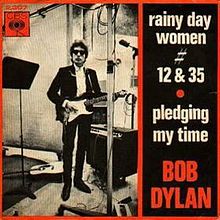
Why the low regard? I think a lot of it has to do with the lead track and first single, “Rainy Day Women #12 and 35”. Oh how I hated this song when I was young. Oh how I hate this song today. (Actually, though, I wish I did like it so that I could justify buying this t-shirt which is clever where the song is dumb).

rainy_day_women_12_amp_35_tshirt

Hitting number two on the pop charts, it is an epic drudge (though the single version was shorter than the album version, though not really any less dull). What is there to hate about this song? Let’s try everything:

The lyrics. Repetitive, boring nonsense. While fiddling around with the Basement Tapes Dylan would craft a lot of nonsense lyrics, and these anticipate that trend. “Well they’ll stone ya…” ad nauseum, building to the big chorus: “Everybody must get stoned!”. Only a stoned person could care about this song.

The brass band. Tuba, trombone, that damned tambourine. Oh how I can’t stand that tambourine. It’s all played out in a simple F progression in slow motion that drones on and on forever.

The chatter. Oh the sounds of happy cavorting people in the background, mixed low. Awful. Self-indulgent. Repulsive. All the fake laughing and singing and carrying on to remind us all of how fun it is to be stoned. It’s all so forced.

That this song was a hit is, to me, the greatest indictment of the 1960s possible. Seriously, there are a ton of great songs on Blonde on Blonde, but it starts with this and it just puts me in a bad mood every time. I’m thinking of deleting it from the 1966 playlist on my phone in the hopes of not hearing it again this week.

Here, at least on Lester Flatt and Earl Scrugg’s version you get some great banjo picking:

The Playboy Interview

Standard

Dylan_Interview_grande

I read it for the articles.

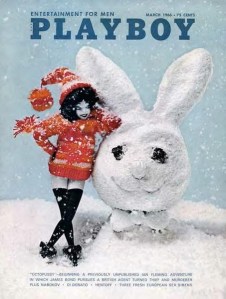
Dylan’s longest interview to date was conducted by Nat Hentoff, jazz critic for the Village Voice, for Playboy in March 1966. It’s surrealist Dylan at his best, or worst if you don’t like it. He says a few things that seem straight, but most of it is bent. It would be a frustrating read for anyone looking for genuine insight into the man. By this point, just before the birth of his first son, Dylan had erected the entire edifice of obstruction around himself. Lies and obstruction had become his calling cards.

Take this exchange:

PLAYBOY: Do you ever think about marrying, settling down, having a home, maybe living abroad? Are there any luxuries you’d like to have, say, a yacht or a Rolls-Royce?

DYLAN: No, I don’t think about those things. If I felt like buying anything, I’d buy it. What you’re asking me about is the future, my future. I’m the last person in the world to ask about my future.

This is a man who was five months married by the time the interview saw print, and already a father of two (Sara, his first wife, had a daughter from a previous relationship). Dylan kept his marriage from his friends – there was no way that he was sharing it with Playboy readers.

The interview, which can be found here, is worth reading in its entirety. Dylan is in a sparring mode with Hentoff (who wrote the liner notes for Freewheelin’). On Hentoff’s first love, jazz Dylan offers this surreal riff:

DYLAN: I mean, what would some parent say to his kid if the kid came home with a glass eye, a Charlie Mingus record and a pocketful of feathers? He’d say, “Who are you following?” And the poor kid would have to stand there with water in his shoes, a bow tie on his ear and soot pouring out of his belly button and say, “Jazz, Father, I’ve been following jazz.”

At other times, Dylan seems to be speaking honestly (or at least you could read him as doing that). His explanation that he was sick of his folk songs is quoted in almost every biography for its truth content:

DYLAN: Anyway, I was playing a lot of songs I didn’t want to play. I was singing words I didn’t really want to sing. I don’t mean words like “God” and “mother” and “President” and “suicide” and “meat cleaver.” I mean simple little words like “if” and “hope” and “you.” But “Like a Rolling Stone” changed it all.

This seems honest and true simply because you can hear it and see it and judge it for yourself in the videos from Newport and in Dont Look Back. It confirms an assumption, a bias that is already built in. On the booing at Newport and Long Island and elsewhere on his fall tour of the United States:

DYLAN: I was kind of stunned. But I can’t put anybody down for coming and booing: after all, they paid to get in. They could have been maybe a little guieter and not so persistent, though. There were a lot of old people there, too; lots of whole families had driven down from Vermont, lots of nurses and their parents, and well, like they just came to hear some relaxing hoedowns, you know, maybe an Indian polka or two. And just when everything’s going all right, here I come on, and the whole place turns into a beer factory. There were a lot of people there who were very pleased that I got booed. I saw them afterward. I do resent somewhat, though, that everybody that booed said they did it because they were old fans.

On his break from topical songs, Dylan is a cross between honest and mysterious. By the end of 1965 Joan Baez had already opened her school for non-violent resistance and had stopped paying her income taxes to protest against American militarism, but Dylan had firmly broken with the cause:

PLAYBOY: Do you think it’s pointless to dedicate yourself to the cause of peace and racial equality?

DYLAN: Not pointless to dedicate yourself to peace and racial equality, but rather, it’s pointless to dedicate yourself to the cause; that’s really pointless. That’s very unknowing. To say “cause of peace” is just like saying “hunk of butter.” I mean, how can you listen to anybody who wants you to believe he’s dedicated to the hunk and not to the butter?

Yet for all that honesty, Dylan could still be confounding, and hilarious.

DYLAN: do know what my songs are about.

PLAYBOY: And what’s that?

DYLAN: Oh, some are about four minutes; some are about five, and some, believe it or not, are about eleven or twelve.

PLAYBOY: Can’t you be a bit more informative?

DYLAN: Nope.

Poor Nat Hentoff, having to play straight man for all that.

By summer Dylan will have had his motorcycle accident and will retreat from the public eye. After the Royal Albert Hall shows in May (the real ones, not the ones mistakenly labelled as such) there would be no more live performances by Dylan until 1969. Hentoff offers us one of the last glimpses of Dylan before he turns his attention to his family and cuts off the world.
Of Booing and Bootlegs

Standard

image012

When I was thinking about spending all of 2014 listening to nothing but Bob Dylan a few people urged me on. One was my friend Rusty, whose enthusiasm for the idea may have been what sealed the deal for me. The one piece of advice that Rusty had was “I’d be inclined to limit the project to official albums and  find some sort of principle for selecting from the boots.  I mean, “Great White Wonder” or the Broadside stuff is too important historically to leave out, but you don’t want to have to trudge through a bunch of repetitive live shows with dodgy sound, either.”

I should have listened to Rusty (that goes for most things, of course).

Driving to and from Nakiska today I listened to a series of Dylan live performances from the fall of 1965. Specifically, his Long Island show from August, his Hollywood Bowl show in LA from September, and his show in Berkeley in December. Each of these shows was half acoustic and then half electric. The first thing that one notes is that the booing of the electric sets was out of control in the months after Newport. The Long Island crowd is having none of it. The revisionists who try to suggest that the Newport crowd was simply booing the mix are completely out to lunch – these crowds hate hate hated Dylan’s electric performances.

Yet the other thing that you notice is that some of these bootlegs are amazing and some are, charitably, pretty much trash.

The Long Island set is pretty tough to listen to, particularly the electric set because it is taken from a crowd recording, while the Hollywood Bowl show (a soundboard recording) is nearly perfect. The Berkeley show, released as a bootleg titled Long Distance Operator (since it is the first and perhaps only live recording of that song), is a really difficult one to listen to – another crowd recording at a time when the technology really wasn’t there for that.

I’d love to read a good history of the manufacturing and distribution of bootleg albums in the pre-internet days, because the subject is quite fascinating. I’m sure that there must be a Grateful Dead scholar who can explain the whole system and its relationship to head shops, music shops, the underground press, underground comix and all the rest – but I haven’t read it yet. Would absolutely love to.

In the meantime, I’m using Bob’s Boots to guide some of my listening, but even that is proving somewhat problematic – they give a really good score to the Berkeley show, although mostly for the quality of the show itself, not for the recording.

There is a fourteen CD Italian bootleg that covers 1965 really thoroughly. Nick Hornby mentions it in 31 Songs, but I discovered it too late to really be helpful for this week, as I head into 1966 starting in the morning. It seems that I’ve missed the audio recording of the Nat Hentoff Playboy interview (published in February 1966, I’ll read it next week). Oh well, Dont Look Back…

Here’s a copy of “Freeze Out”, the 1965 version of “Visions of Johanna”, that was recorded in New York for Blonde on Blonde. The version on the album was recorded in Nashville in February 1966, as was the vast majority of that album. This is the kind of thing that you get from the bootlegs that makes the hunting so worthwhile. Since this is the best song on Blonde on Blonde, more on this song next week.


“Like a Rolling Stone”

Standard

bd_like_a_rolling_stone

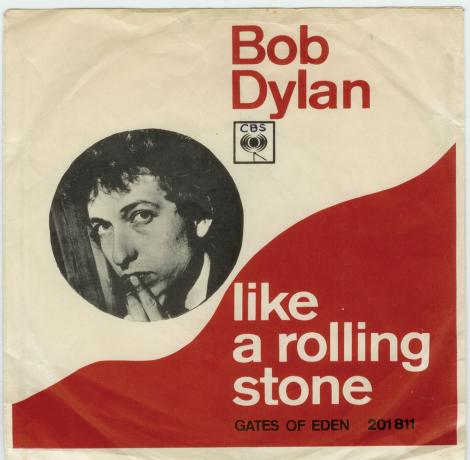
Rolling Stone called it the greatest song of all time (Pitchfork called it number four). Greil Marcus wrote a 200+ page book about it. How can I sum up “Like A Rolling Stone” in a single blog post?

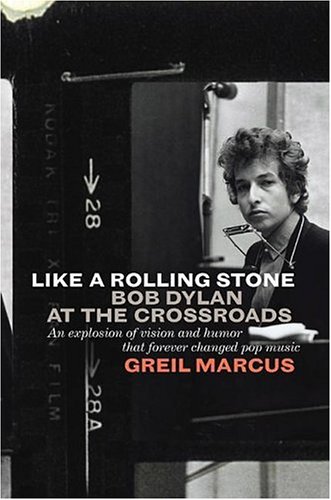
I’m not even sure what to say about it, frankly. I read the Marcus book this morning and he does a great job talking in tremendous detail about the shifts in musicality across its six minutes, the subtle differences in each verse, and the huge impact that the song had on American pop music. But even the great Greil Marcus is left in the end noting that the whole thing was a fluke. If Al Kooper hadn’t shown up… If he hadn’t been too intimidated by Mike Bloomfield to play guitar… If producer Tom Wilson had thrown him out of the studio…. If Kooper actually knew how to play organ… So much random chance coming together to produce the greatest song of all time.

All the key parts are well known. Dylan “vomiting” out the lyrics at the typewriter, more than twenty pages and then culling from that something usable. The improvised organ playing of guitarist Al Kooper. The snare snap that announces the song’s arrival like a bullet.

What I didn’t know is that the single was released dual sided: split in half. Marcus notes that this wasn’t the first six minute pop song (he cites Ray Charles’s “What’d I Say” and the Isley Brothers’s “Shout”), but it was the first to be such a success at that length. DJs initially played only the first side, but because that side ended after the first line of the third verse, listeners could tell that they were missing out on something, and demanded the whole version. The song was released at a time when The Beatles and Rolling Stones were escalating the pop music stakes, with Dylan arriving to trump them both. Decades later, of course, the Stones would even have to take their shot at covering it.

Greil Marcus’s Like a Rolling Stone: Bob Dylan at the Crossroads is good, but not great. His digressions are often the best material in the book, and they are frequent. Marcus noted one of the things that I had noted myself, but since he wrote it first I can’t plagiarize him: Dylan was 24 when he wrote this song, and by that age he had written every song that will be mentioned in the first paragraph of his New York Times obituary (“Blowin’ in the Wind”, “The Times They Are a-Changin'”, and “Like a Rolling Stone”, probably in that order). Nothing that he would ever do after would ever be as important. That must be quite the thing to have to live with.

1586482548.01._SCLZZZZZZZ_

One of the amazing things about the song is that no one else does it justice. There were lots of contemporary covers (Marcus reports that Dylan and Al Kooper would buy them to listen and laugh at them) and they were all terrible. There are better versions of a lot of Dylan’s songs than Dylan’s versions, but that’s not the case for “Like A Rolling Stone”. It’s simply the perfect mesh of singer and song.

The music video from last year is awesome, by the way. If you haven’t seen it you really need to. I don’t think I can embed it, so click on the link.


“Can You Please Crawl Out Your Window?”

Standard

220px-CanYouPleaseCrawlOutYourWindow

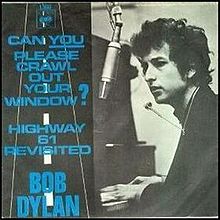
Since we’re on the subject of non-album Dylan singles from 1965, there’s also “Can You Please Crawl Out Your Window?”. Released at the end of November 1965 as a single, although not faring nearly as well as “Like A Rolling Stone” or “Positively 4th Street”, this is almost a forgotten Dylan single like “Mixed Up Confusion” – his website indicates that he played it only once in concert.

Musically, the best part of the song is the drumming. The backing band is The Hawks (later to be known as The Band), and it sounds a bit more like a precursor to Blonde on Blonde than a song for Highway 61. Apparently they did twenty-two takes of this one trying to get it right. Here’s an alternate version (the drumming is slightly different, as is the guitar):

The whole thing is a bit forgettable, really. An inessential single. Nick Hornby wrote about it in his book 31 Songs. While saying that he isn’t a Dylan fan (though he owns twenty of his CDs), he notes that “Can You Please” is “a minor Dylan track, one of his snarly (and less than poetic) put-downs, but it is from my favourite period (electric, with that crisp, clean organ sound), and I haven’t heard it a million times times before, so it sneaks its way on to car tapes now”. I can’t really improve on that.

Jimi Hendrix also recorded this for the BBC, before he’d make “All Along the Watchtower” his very own. It’s worth a listen.

“Positively 4th Street”

Standard

220px-Positively_4th_Street

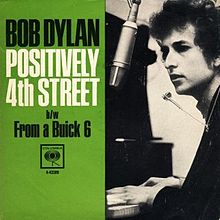
One of my all-time favourite songs, not just favourite Dylan songs, is “Positively 4th Street”. Recorded in the sessions for Highway 61 Revisited, the song was not included on that album, but was released as a stand-alone single in September 1965 (with “From a Buick 6” as the b-side). Dylan never placed it on an album, though it appears on Greatest Hits and Biograph.

All my life I took this to be a sort of generalized fuck you song. One of the most bitter things ever to crack the top ten of the pop charts, I always assumed that it was about someone specifically, but to me it never mattered who it was. It was not until December of last year that I think I twigged to the fact that it was actually about the Greenwich Village folk scene. A review of Inside Llewyn Davis in the Boston Globe concluded by mentioning this particular interpretation of the song, and it all suddenly made sense: how could I have been so blind?

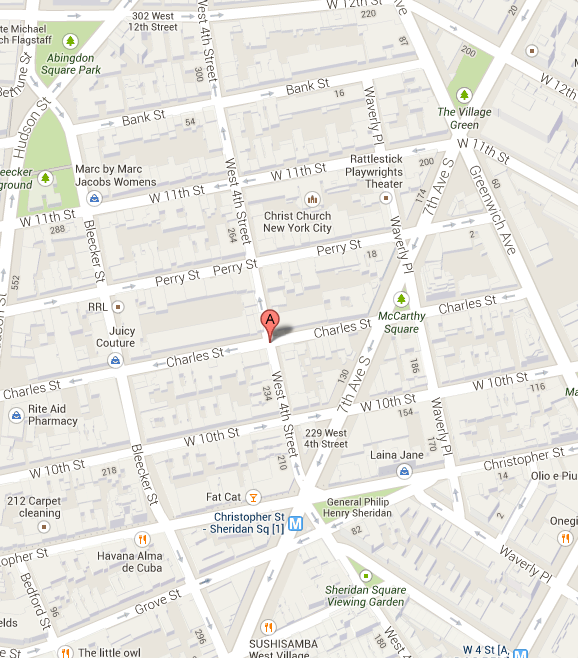
Certainly in late July 1965, when the song was recorded, Dylan had had it with the folkies. His UK tour had come to an end, and he had played the fateful Newport electric show – his connections with the Greenwich Village scene were being severed. 4th Street in New York was the home of Geerde’s Folk City, and the cover of Freewheelin’ was photographed on that street. The specificity of the title, and the time of its recording, make the target of the attacks clear.

Screen Shot 2014-01-31 at 3.42.46 PM

It has been suggested, of course, that the target of Dylan’s ire was even more specific. Izzy Young, who ran the Folklore Centre, is rumoured to have been the “You” of the song, as has been Irwin Silber of Sing Out!. Both were quite critical of Dylan’s development as an artist, the turn away from tradition, and the decision to go electric. Dylan began singing it live in October 1965, logically because it was a hit single by then, but it also served as an announcement of his new intentions.

To me, it doesn’t matter who it is about. It’s just such a great song to be sung at the top of your lungs when you’re feeling bitter. It’s the original song about haters. The lyrics are fantastic:

And now I know you’re dissatisfied

With your position and your place

Don’t you understand

It’s not my problem

But beyond the lyrics, it’s Dylan’s tone and phrasing that are so powerful. It’s the way that he punches the final short phrase of every verse, spitting out the venom every time. The song is just such an unrelenting bellowing of anger and spite, and it never lets up. The final verse:

Yes, I wish that for just one time

You could stand inside my shoes

You’d know what a drag it is

To see you

Well, I’d hate for someone to be singing that about me. Although, maybe a few people already have….

Here’s Lucinda Williams. She’s bitter too!

Dont Look Back

Standard

OLYMPUS DIGITAL CAMERA

“Give the anarchist a cigarette”, Dylan says as he drives away from his concert at The Royal Albert Hall in London on May 9, 1965. Basking in the post-performance glow of the penultimate show of his eight concert tour of England, Dylan is told by his manager, Albert Grossman, that the UK papers have taken to calling him an anarchist, because the protest singer is unable to offer any solutions to the problems he enumerates. Of course the papers don’t know it yet, but Dylan is no longer a folk singer. When D. A. Pennebaker’s cameras caught this conversation in the documentary Dont Look Back, Dylan would perform only one last folk concert, the next night in the same London venue. After that his next stop would be an electric set at Newport, and then a tour with The Hawks, rock star style.

It’s been almost thirty years since I’ve watched Dont Look Back. Parts of it I remembered so clearly I barely needed to see them again. Other parts made sense to me now in a way that they never would have when I was a teenager (the moment when the reporter from BBC Africa Service talks to him about Madhouse on Castle Street is only sensible because I recently watched what’s left of that BBC drama). It is still a tremendous film – the template for so very many other rock documentaries – and a very real glimpse into the private life of a certain version of Bob Dylan.

Most striking to me on this watching was Dylan’s treatment of the press. I’ve been listening to “Ballad of a Thin Man” in various versions all day, so it was definitely on my mind tonight. The initial press conferences when Dylan arrives in the UK is really oppressive. The questions are just so inane that you can immediately understand why Dylan would respond by simply toying with the reporters. His verbal sparring with Terry Ellis is a really uncomfortable scene, with a bullying side of Dylan emerging that is unpleasant to watch (that Ellis would go on to found Chrysalis Records and become one of the most important figures in British rock during the 1970s is one of those great things that maybe you only learn by reading Wikipedia after you finish watching a film like this one; it made me go back and rewatch the scene all over again). The final interview, with Horace Freeland Judson of Time Magazine is just brutal to watch. You can see how fed up Dylan has become, how bitter and uncompromising. Not surprising at all that only a few months later he would write one of the nastiest and orneriest songs ever recorded.

The other moments of great interest, of course, is the way that Dylan deals with other singers in his orbit. His relationship with Joan Baez was souring by the time of this tour, and it ended in the midst of it. She walks out the door one night while he’s typing, and while we see her one more time in the film, that was that. We never see Dylan react to her departure – or perhaps that’s all the reaction that he gave to her leaving. Hard to know. Dylan’s questioning of Alan Price (“Why’d you leave The Animals?”) comes out of nowhere, and seems to put Price in his place when Dylan tires of toying with Ellis. Finally, the scenes with Donovan. Well, amazing. Dylan’s quest to find him and learn about him, Baez’s knowing laughter when the press accuses Donovan of having betrayed his fans (“He’s only been around for three months”, she’s told), Dylan’s appreciation of Donovan in the hotel room, and then his complete and utter mastery of the room when he takes Donovan’s guitar and plays “It’s All Over Now, Baby Blue”. The hierarchies of stardom have never seemed more clear.

For years when I was teaching Film Studies regularly I thought of teaching a course on rock documentaries: Madonna: Truth of Dare. Metallica: Some Kind of Monster. Shut Up and Sing. Spinal Tap. Dig! Needless to say, Dont Look Back is the one that unlocks them all. Everything else owes such a debt to Pennebaker that it can be hard to even see the film for how great it is. The beautiful flashback when the reporter asks Dylan how he got started and Pennebaker cuts to Dylan in 1963 singing “Only A Pawn in Their Game” in Greenwood, Mississippi. Less than two years had passed, and Dylan was a completely different singer – Pennebaker shows that so effortlessly. It really is masterful.

Today, the film is best known for its relentlessly ripped off opening, the proto-music video for “Subterranean Homesick Blues”, even though that’s maybe the most gimmicky part of the whole thing. It’s too bad, because there is so very much more in there, even if we never do learn who threw the glass out on the street….

Desolation Row

Standard

desolation row

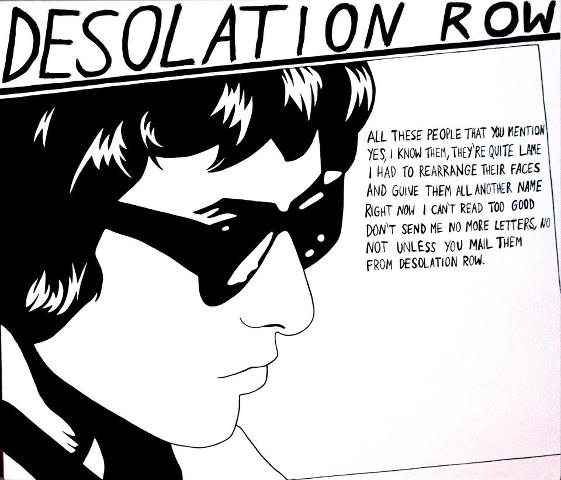
You learn all kinds of strange things doing a project like this one. For instance, today at lunch I learned that “Desolation Row” is funny. I certainly never knew that before. I always considered it the dark, brooding, beating heart at the end of Highway 61 Revisited – a typical Dylan apocalypse straight out of a Dutch painting.

To the earliest crowds hearing the song, however, it was a laugh riot.

Dylan started playing “Desolation Row” as part of his tour of the United States with The Hawks in the fall of 1965. On that tour, he would open with seven or eight songs sung alone and acoustic (almost all from his more recent albums – the protest stuff, even “Blowin’ In the Wind”, was gone at this point), and then after intermission he would return to the stage with The Hawks and play most of Highway 61 Revisited. “Desolation Row”, having been done acoustic on the album, was played that way live (an electric version of the song was recorded for Highway 61 and can be found on Bootleg Series 7 – it’s not a whole lot different, but in some ways it may be better than the album version).

I only have two bootlegs with “Desolation Row” from 1965. The first is a poor quality recording (likely from the crowd) of his show at the Forest Hills Tennis Stadium in New York. The crowd laughs – loud and long – after virtually every single line of the song. This crowd thinks that this song is hilarious. “They’re selling postcards of the hanging…” and they laugh. I always thought that was a pretty sombre image, myself, but what do I know?

The far better recording I have is of his Hollywood Bowl concert in August. This is a high quality version, and just before “Desolation Row” Dylan tells the audience he can’t hear them (presumably in response to a song request). Even here, though, from a soundboard recording, you can hear the audience laughing – though not as clearly.

It seems to me that Dylan’s obscure non-sequiturs – which comprise such a huge percentage of the lyrics on Highway 61 put the crowd at a loss. How to take this protest singer, whose language had once been so clear and direct, now that he has embarked into this uncharted new territory? Dylan’s audiences would be negotiating that right through his UK tour of 1966. I guess I knew that they found him frustrating – I just never knew that they found him funny.


Highway 61 Revisited

Standard

Highway+61+Revisited+Bob+Dylan++Highway+61+Revisite

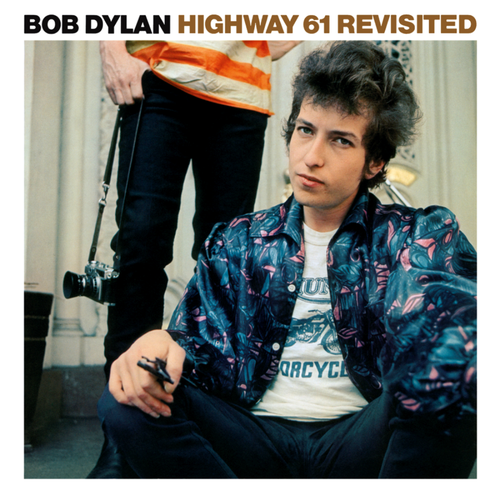
Rolling Stone magazine named it only the fourth greatest album of all time, even though they were named (in part) after its first track. Bob Dylan’s Highway 61 Revisited is that seminal piece – the combination of bluesy rock and roll with the fiercely poetic lyrics that would redefine the face of rock music. To me it unquestionably Dylan’s best album, and it is the one I have listened to the most times, by a wide margin.

I can remember being in the ninth or tenth grade and coming home from school for lunch and listening to Highway 61 day after day after day. The length of the album plus the walk to and from school was precisely the length of my break. When I’d hear the opening phrases of “Desolation Row” (“They’re selling postcards of the hanging….”), I knew it was time to pack up and get ready to head back to class. For probably weeks on end I listened to this album day and night.

And why not? There’s not a single bad song on it, and quite a few (“Like A Rolling Stone”; “Ballad of a Thin Man”; “Queen Jane Approximately”, and the aforementioned “Desolation Row”) are strong contenders for ‘best thing he ever did’. Dylan recorded “Like A Rolling Stone” in mid-June 1965 (it was released as a single, with “Chimes of Freedom” the next month), and then Dylan got booed off the stage at Newport. The electric material that he played there was mostly from Bringing It All Back Home, but the experience seemed to have steeled his determination. Four days after Newport he recorded “It Takes A Lot To Laugh, It Takes A Train To Cry”, “Tombstone Blues”, and, most importantly, his defiant blow-off to the folk scene: “Positively 4th Street” (left off the album, and about which more in a day or two).

Over the course of only four recording sessions Dylan would bring his masterpiece together. Many of the songs are rough and ragged, the result of constant tinkering and experimentation. There is a howling rage to a song like “Ballad of a Thin Man”, in which Dylan is writing protest music – by his protests are personal: he doesn’t like the way that he himself is being treated now. This is an album that very much announces the birth of a brand new version of Bob Dylan, one that is beholden to no one.

Up to this point, Dylan had mostly ended his albums with songs of farewell, and this one is no exception. “Desolation Row”, at almost eleven minutes in length, is the sole acoustic song on the album. A classic anti-folk song on an album of rock material, it is a nightmarish parody of the songwriting that Dylan had seemingly grown tired of. Late in the song Dylan writes:

Praise be to Nero’s Neptune

The Titanic sails at dawn

And everybody’s shouting

‘Which side are you on?’

It seems a pretty clear indictment of the politics and the commitments of the folk scene that he was placing in his rear view mirror: what purpose is there to take sides on a sinking ship? Dylan knew his own ship wasn’t sinking – it was a rocketship, and this album would head him towards the stratosphere.

I’m still not tired of this album – I’ve been looking forward to this week, and I’ve listened to it every day so far.

Oh, by the way, the three albums that Rolling Stone placed ahead of this one: Revolver by The Beatles, Pet Sounds by The Beach Boys, and Sgt. Pepper’s by The Beatles. I’m not going to bother to argue that. But I will note that Dylan has eleven albums on the top 500 list, one more than each of The Beatles and The Rolling Stones. And, on a separate but related list, the number one song. But more on that another day.

My copy of “Highway 61 Revisited” has these same pops in it. Played it too much!

Dylan News Bits

Standard

fWcev406eCaS0yBYoLwqIo3B-bryMVMzp5P-Yk_XlPzAdyF6vT2GPOJh-EgPI2hRMM1ks1mY2bIyrh-9a33gaB5B1W6SfxLMIp7fHiFeoVE9bUos0-d-e1-ft

Yeah, of course I have a Google news alert set. How could I not?

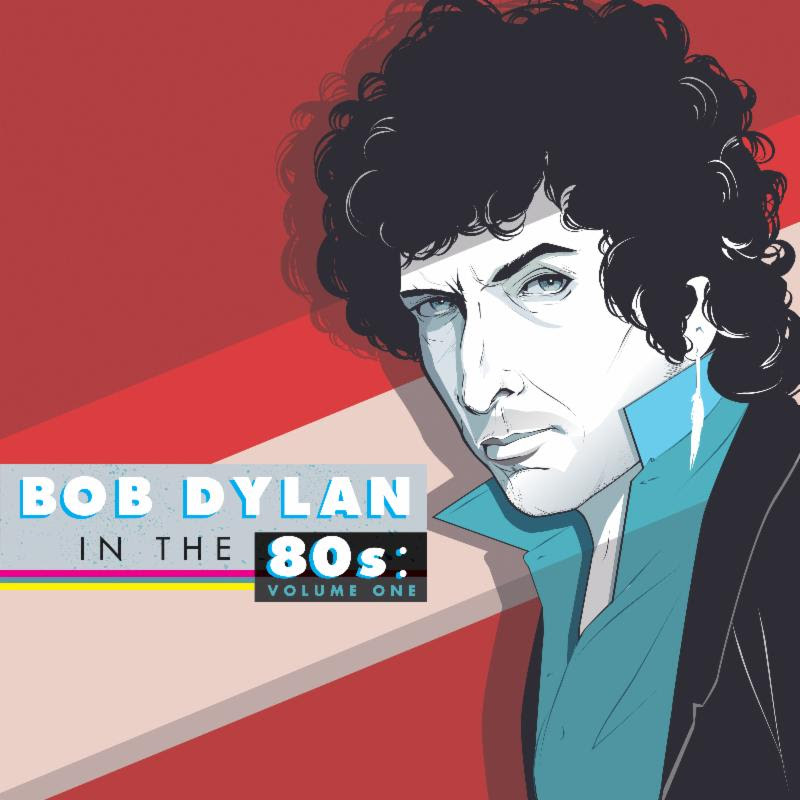
First, possibly best but possibly worst, an album of covers is coming out in March: Bob Dylan in the 80s. Could be an interesting project. I haven’t quite figured out how to deal with covers during this project yet, but I will likely buy the album, if only for the liner notes by Jonathan Lethem.

Second, apparently Dylan will be in a SuperBowl ad for Chrysler. I can’t deal with 2014 Dylan until the last week of December, so I may not watch it. He has also licensed “I Want You” to Chobani, which I have just learned is a yogurt company. Given the reality of simultaneous substitution in Canada, there’s an excellent chance that the Chobani ad won’t even air up here. Chrysler will likely buy time in Canada though. The Chobani ad is in the linked article, but I’m not watching it until December.

Finally, I got a notification that my Bob Dylan Complete Album Collection has shipped. Hooray. Just six weeks after I ordered it. Should be here next week, maybe Friday if I’m lucky.

Oh, and BobDylan.com has gone weird – the page opens with an ad for a pre-order of the album that came out last August. That’s just strange.