
Bootlegging

Standard

Bob_Dylan_-_Great_White_Wonder

1968. Bob Dylan has gone quiet. No tour. No album. Only one single – “All Along the Watchtower” – from a 1967 album.

The quiet seemed to drive his fans a little crazy. Dylan had actually spent a large part of 1967 recording The Basement Tapes with The Band. They produced well over one hundred songs of extremely varying quality. I’ve been listening to these over the past few days wondering when I’m allowed to write about them.

Here’s the thing: I’ve written about Dylan’s live performances in the years that they occurred rather than in the years that they were released (and many of them haven’t been) on the assumption that some Dylan fans heard them at that time. But for things that were recorded in studio, I’ve waited until the year that they were actually released. The Times They Are A-Changin’ was recorded in the fall of 1963, but it was a January 1964 release, and that’s where I put it. So where do I put The Basement Tapes?

They were recorded mostly in 1967, but no one outside of Dylan and The Band and whomever else was there would have heard them. They were circulating in 1968, because Rolling Stone reviewed them that year (it’s a review well worth taking the time to read). A very small portion of them became available as Great White Wonder in 1969.They were released, edited and over-dubbed, by Columbia in 1975. It’s a mess. I’m putting them here. Just not today. (Oh, and I’ll talk about the Columbia version in two months time).

619705

What I have been doing today is reading up on the history of the bootleg album. Clinton Heylin’s Bootleg: The Secret History of the Other Recording Industry is not a very good book. It’s confusingly written, with a lot of acronyms. Players in the industry are introduced with very little detail. It’s mostly an amalgamation of facts, poorly put together and somewhat scattershot. But it is an interesting read.

Heylin is a big Dylan fan. He’s written a lot about him, including authoring the new booklet that accompanies The Complete Album Collection. If you look on ExpectingRain.com you can see that he’s a controversial figure, although I don’t know enough about the posters on that site to know who’s full of it (those people are professional Dylan fans, I’m still strictly amateur). Anyway, Heylin identifies the root of the entire bootleg industry with Dylan. Specifically with The Basement Tapes.

The way he tells it, and it sounds convincing to me, Dylan upset the applecart with the release of John Wesley Harding. The break from Highway 61 Revisited and Blonde on Blonde was just too severe, and fans had trouble processing it. When word began to leak out that there were all kinds of recordings of Dylan and The Band with a sound that bridged the gap. Worse, word got out that the material might even be better than John Wesley Harding.

The recordings for The Basement Tapes range in quality considerably. Some are absolutely dreadful, and they sound as if they were recorded on a reel to reel while someone holds the microphone under their armpit. Some sound roughly professional. Some of the songs are disastrous butcherings of classical folk songs by people who might have been too altered by alcohol or chemicals to know any better. Others are demos for songs that would be sold to other bands. It was this last group that circulated to agents and record companies as acetates, and then got ripped off.

Great White Wonder, the first bootleg album, was a double album released in July 1969. It was a mix of items. Sides one and three were from the Minnesota Hotel Tape from December 1961. Side two had four studio outtakes and two Basement Tapes recordings, and side four was all Basement Tapes. It was a sensation, and it ignited an entire industry.

I’ve only read about a third of Heylin’s book so far, and I’m hoping that it will provide me with some more answers. Among the things that I’ve learned so far is that the earliest bootlegging at the end of the 1960s and beginning of the 1970s focussed on the Big Three (Dylan, The Beatles, The Rolling Stones) before branching into Led Zeppelin and then other bands. That they existed in a quasi-legal limbo because of the weakness of copyright law at the time (that would change dramatically in 1976, when the copyright laws in the US were dramatically reformed). For instance, it is not entirely clear that in 1969 a recording of the Minnesota Hotel Tapes were illegal since most of the songs were in the public domain, and it was recorded before Dylan signed to Columbia. Live bootlegs, like the “Royal Albert Hall” show, became a big thing quickly. Bootleggers regularly ripped off other bootleggers, and Canadian bootleggers benefitted from even more lax copyright laws than the US, but had few pressing plants to work with.

The whole thing is super-fascinating. I know that I’m going to get to the end of this book and a) wish that I knew more about this, and b) had more of these items, even as I know that the quality isn’t really there.

Here’s a bootleg copy of “Nothing Was Delivered”. It sounds awful, but there is something about the crackling sound that makes it all that much more illicit, more appealing….

“All Along the Watchtower”

Standard

Bob_Dylan_All_Along_the_Watchtower_single_cover

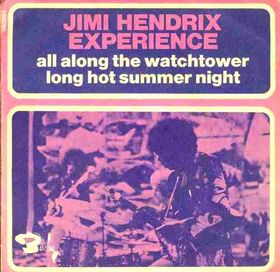
Although it was initially released on John Wesley Harding at the end of 1967, I can write about “All Along the Watchtower” as a 1968 release because it was the sole Bob Dylan contribution from that year. Dylan released this as a single in November 1968, somewhat redundantly since The Jimi Hendrix Experience had released the definitive version in September of that same year.

There are a large number of Dylan songs that are better known in their cover version than in the Dylan version – songs by The Byrds and by Peter, Paul and Mary – but this one is an absolute blowout. Indeed, there must be a large number of people in the world who think of this as a Hendrix song that Dylan has covered. And indeed he has. His website shows that this is the song that he has performed most frequently in concert (2, 186 times – that is a mind-boggling number no matter how you slice it). Dylan didn’t start performing it live until 1974, and he has always leaned more towards the Hendrix version than to his own album cut.

All_Along_the_Watchtower_single_cover

The Hendrix version is absolutely iconic – you can recognize it easily from the opening notes. It is positively anthemic. Dylan’s version is hard to hear in retrospect – you’re always comparing it to its better known cousin, which has that much more energy. Dylan’s version isn’t a bad one, it’s just that Hendrix’s is a great one.

Lyrically, it’s a vexing song. Check out the way people grapple with it on various websites. Some see it as a reference to the Book of Isaiah, but that mostly stems from the image of the watchtower. Others read it as a class war statement. Some see Jesus in the Joker. It is certainly highly fatalistic and mystical.

On the remake of Battlestar Galactica, “All Along the Watchtower” holds the key to all of human understanding. That’s a lot of weight to put onto a pop song, but if you’re going to explain your entire series that way, this is probably one of your better choices. It’s a cyclical song that fits strongly with the themes of that show.

Given how frequently Dylan has performed it, I’ve often wondered if it is his “favourite” among his songs. “Like A Rolling Stone” is the only song that he has performed 2,000 times (and fewer than “Watchtower”), and only a small handful of others cross the 1,000 performances mark. To me, it sounds like the first song that signifies the fully mature Dylan sound, but even then it is filtered through the Hendrix sensibility and not the Nashville sound that you find on John Wesley Harding. It’s such a short, cryptic song – it has all the spare elements that Dylan seemed to be looking for at that point in his life.

Here’s the Battlestar Galactic version:

Bob Dylan and Watchmen

Standard

watchmen-bob_00382287

Whatever else its relative strengths and faults, Watchmen, the revisionist superhero series that helped redefine the genre in the 1980s, is a masterpiece of craft. Writer Alan Moore and artist Dave Gibbons conspire to control even the most minor of details, painstakingly crafting a superhero epic that rewards – even demands – the close attention of re-reading. One of the hallmarks of the series was that in each of the twelve chapters, the title would, in the last panel, be revealed to have been part of a larger quotation that serves as the epigraph for the piece as a whole. Moore chose these citations carefully and smartly, quoting poets like William Blake and Percy Shelley, philosophers like Friedrich Nietzche, and scientists like Albert Einstein. Twice he cited Bob Dylan.

Dylan is an important presence in Watchmen. Indeed, the very first chapter is titled “At Midnight All the Agents”, a quote from “Desolation Row”, his bleak 1965 epic:

Now at midnight all the agents

And the superhuman crew

Come out and round up everyone

That knows more than they do

Then they bring them to the factory

Where the heart-attack machine

Is strapped across their shoulders

And then the kerosene

Is brought down from the castles

By insurance men who go

Check to see that nobody is escaping

To Desolation Row

watchmen_dylan

This is an ideal citation for Watchmen, the story of superheroes run amok and a United States that is drifting increasingly towards the fascist politics of a surveillance state. Moore and Gibbons invoke the darkness of Dylan’s vision from the word go, borrowing a bleak and nasty sensibility that serves as the important undercurrent in a story that has no hero, only an increasing numbers of villains and by-standers. Desolation is clearly the order of the day when you create a character called The Comedian who is both a rapist and mass murderer.

Chapter Ten, “Two Riders Were Approaching”, quotes from Dylan’s 1967 hit, “All Along the Watchtower”. Not so much a thematic cue as a description of the events that lead to the climactic confrontation between Ozymandia, Nite Owl and Rorschach, the quotation is not as compelling as the one from “Desolation Row”, though it does nicely tie into the comic’s Biblical themes (Chapter Three quotes from Genesis).

It is striking to me that Moore and Gibbons use two quotes from only a single writer, and that both would be mid-1960s Bob Dylan. Just as Dylan used poetry to elevate the status of pop music, so too do Moore and Gibbons use it to raise the public’s perception of comic books generally and the superhero genre specifically. Dylan is the perfect role model for artists looking to turn a non-serious art form into an estimable one. His is the road map that one would want to follow.

Interestingly, the other commonalities in the chapter titles come from Romantic poetry (Blake, who is used to frame the most audacious chapter – the completely symmetrical Chapter Five, and Shelley, who evens lends a name and a tragedy to the ostensible villain (though perhaps the hero) of the piece). The connection between Dylan and the Romantics is certainly a strong one, particularly given Dylan’s own strong interests in the writing of that period.

26520993

Watchmen, the comic book, uses music somewhat sparingly. One notable moment is when a crowd is calmed by Nite Owl broadcasting Billie Holiday’s “You’re My Thrill” from his airship. The execrable film version uses three Dylan songs (and also the Holiday song), the two from the book (though not Dylan’s versions) and “The Times They Are A-Changin’” over the opening credits. For the film, in the talentless hands of director Zack Snyder, Dylan is the voice of a generation rendered ironic. For Moore and Gibbons, it is clear that Dylan was the guiding light in the darkness, an artist who modelled a completely different way of doing things.

From the film, here’s My Chemical Romance proving themselves absolutely not up to the challenge of performing three of Dylan’s ten verses:


“Drifter’s Escape”

Standard

Drifter's_Escape_cover

John Wesley Harding produced two singles and Jimi Hendrix covered both of them. The better known – by a country mile – is “All Along the Watchtower”, which Hendrix completely transformed, turning it into one of Dylan’s best known songs. Far less known is his cover of the first single, “Drifter’s Escape”, which he recorded in 1970, and which was released on one of his posthumous albums, Loose Ends. Hendrix’s version of this song isn’t radically different than the one Dylan recorded.

The song itself makes only a bit of sense lyrically. A man is accused of a crime, but he doesn’t know why. He eventually escapes from the false accusations when lightning hits the courthouse and he slips away. Not much of a story, then the end.

“Drifter’s Escape” has been interpreted as revealing Dylan’s persecution complex, which would make sense given his experiences of the previous year while on tour in the UK. If that’s the case, and I’m not really so sure that it is, it’s hardly the same kind of rumination that “Positively 4th Street” is. Perhaps he’d mellowed.

The song has an odd history because even though it was released as a single Dylan almost never performed it live – though admittedly he wasn’t touring at the time it came out, or even for the next few years. The first live performance, according to his website, was in Oregon in 1992, the day after the Rodney King verdict. The lyrics:

The trial was bad enough

But this is ten times worse

Certainly took on an additional resonance given that context. Since that time Dylan has increasingly integrated the song into his sets.

Here’s the Hendrix version:

The Beatles and JWH

Standard

sgt-pepper_bob_dylan

I don’t have anything really to add to this, but I wanted to bring it up. You should just read this article here.

Short version: The Beatles put a picture of Dylan on the cover of Sgt Pepper’s Lonely Hearts Club Band, and so he put a picture of them on John Wesley Harding. Only you really really need to look for them.

They’re up here in the tree:

bob_dylan_john_wesley_harding_the_beatles_faces

And they’re upside down:

the_beatles_faces_bob_dylan_john_wesley_harding_tree

And that’s that.

The men on the cover with Dylan, by the way, were Luxman and Purna Das, visiting South Asian musicians, and Charlie Joy, a local carpenter. Dylan is also wearing the same jacket he wore on the cover of Blonde on Blonde.

John Wesley Harding

Standard

Bob_Dylan_-_John_Wesley_Harding

(Hey! The internet is back!)

John Wesley Harding is not an album that I had listened to before this week, and so there are a number of songs on it that I had never heard. My friend Rusty said, in the comments the other day, that I’m not allowed to spend the rest of the year proclaiming “Not as good as the great albums of 1964-1966”, so I’m not going to do that. I will note that John Wesley Harding was greeted by the rock crowd of 1967 as a sell-out – a retrograde album – because it wasn’t psychedelic like Their Satanic Majesties Request by The Rolling Stones or After Bathing at Baxter’s by Jefferson Airplane (thank God, since I don’t particularly like either of those albums). The irony that magazines like Creem felt that Dylan had somehow betrayed them a year after he betrayed the Sing Out! crowd is, of course, absolutely hilarious.

John Wesely Harding is probably the birth of Bob Dylan v.4. Recorded, like his first album, extremely quickly, it is mellow and relaxed. He has given up much of the lyrical playfulness that marked his work since Bringing It All Back Home, and the lyrics are simplified. I read something this week in which Allen Ginsberg said that Dylan made a conscious choice not to simply write lines to find another rhyme, but wanted every line of every song to contribute something overall. This is only occasionally the case.

The album is a short one – twelve short songs. After the third time through it became eleven for me, as I started skipping “The Ballad of Frankie Lee and Judas Priest” every time it came on – and that’s the longest song on the album. “Frankie Lee” sounds to me just like the poetry I wrote in grade seven because I had to fulfill an English assignment. I couldn’t get the hang of meter, and then finally got the ba-dum ba-DUM ba-dum ba-DUM down and just wrote out some endless nonsense story poem (I remember writing it but have no clue what it was about). That’s this song: simplistic and simple-minded, it sounds like it is being written as it was being sung. The rest of the album avoids these kinds of disasters.

The title song doesn’t really work for me. It’s charming that Dylan misspelled the name of John Wesley Hardin, adding the G that he dropped from so many earlier titles, but it’s only an okay song. “Jesse James” is a great song in this genre, but “Harding” tries to work the same territory, and it isn’t very successful. From what I’ve read about Hardin, Dylan gets pretty much every single fact wrong, but that’s probably part of the genre too.

“As I Went Out One Morning” isn’t a whole lot better. I’ve listened to this about twenty times this week and I’m still not sure what it’s meant to be about. “I Dreamed I Saw St. Augustine” lifts the opening and the music of “I Dreamed I Saw Joe Hill”, which, again, is a better song. Lots of Biblical material here – presaging his born again period by a decade. Some Dylanologists even see the JWH of the title as a reference to Yaweh. I don’t know about that. “All Along the Watchtower” also has overt Biblical themes. I’ll come back to that song in another post.

“Drifter’s Escape” is not bad, a swinging little nothing. It has my favourite moment on the album, the incredible way that Dylan sings “loo-oong” in the first verse like it gets caught coming out of his nose. I stop and listen for it every time.

The second side opens with “Dear Landlord”, another song that people want to know who it’s about (consensus being Albert Grossman). I think that one is a keeper. “I Am a Lonesome Hobo” and “I Pity The Poor Immigrant” aren’t that good, and the lyrics to the latter make almost no sense to me at all. I’m not sure that it’s supposed to be an anti-immigrant song, but I’m also not sure what he was going for. That immigrant sure is not someone that I’d want to know, that’s for sure.

In a lot of ways, the unexpected highlight of the album for me is “The Wicked Messenger”, which is one of the best kind of songs that Dylan was recording with The Band around this time as The Basement Tapes. Lovely little harmonica bits, and a short, direct and slightly mysterious song. This was one I didn’t know, but it’s a keeper. “Down Along the Cove” is also pretty good, another exceptionally slight song that is done well. This has a touch of the late-1950s pop that was an influence on Dylan before he heard Woody Guthrie. Finally, “I’ll Be Your Baby Tonight” is, if not a classic, a truly great romantic Dylan song. It’s the first of his songs to have a slide guitar in it, so it gives it a sound that blends it into Nashville Skyline nicely. He’s done a million great versions of this song, but this one is really nice.

So, overall, it’s a pretty good album. About half of it is well worth keeping. It was dumped into the market at the end of 1967 with almost no hype, but it did rise as far as #2 on the American album charts. As much a break from what he had been doing as the electric material had been before it, it was very much the album of a man who didn’t seem to much care any longer what people wanted from him.

Here’s Patti Smith doing “Drifter’s Escape”. Awesome.

Merch

Standard

I wrote a long post about John Wesley Harding but our Internet is out (thanks, Shaw Cable, for the awesome service!) so I can’t post it or send it to my phone.

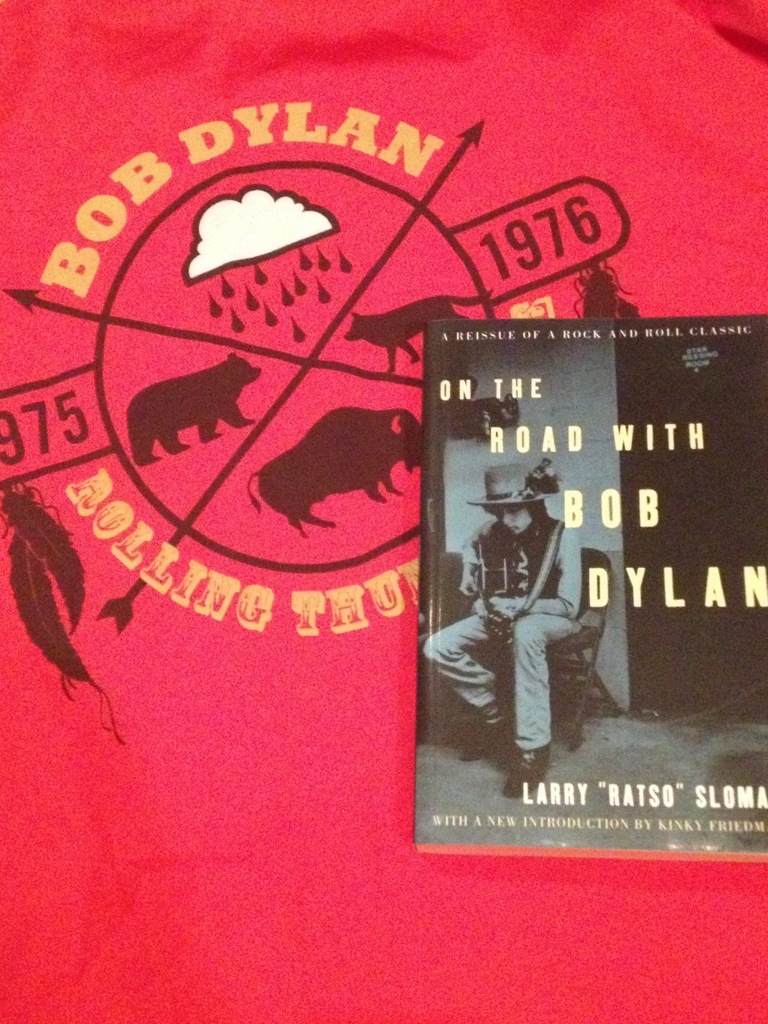
While you wait, this is today’s merchandise. A t-shirt from the Rolling Thunder Revue and a book about that same tour. I can’t read/wear either for eight weeks, but it pays to think ahead.

Listening to A Tree With Roots through my phone speaker because my sound system runs through wifi. 21st century problems….

20140213-200514.jpg

Bob Dylan’s Greatest Hits

Standard

51qGoISkU7L

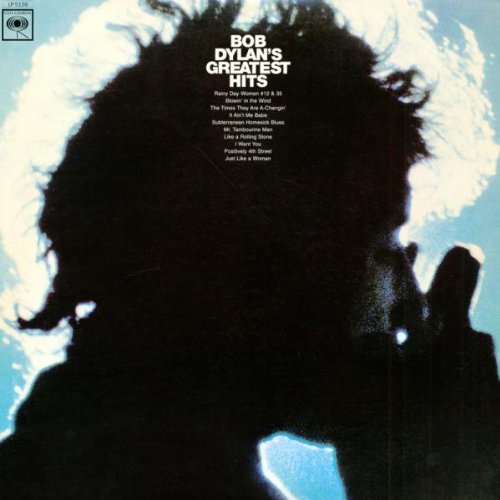
Bob Dylan’s Greatest Hits was released in March 1967. I wasn’t really going to talk about this album, since I’ve written about just about everything that can be found on it, but it seems that this is the only Dylan album that I have two vinyl copies of, which deserves comment.

At the time I was buying Dylan on vinyl, I really didn’t have much use for this album since I had everything else one way or another. The exception was “Positively 4th Street”, which was not on any of the studio albums, but which I did have on Biograph. I did actually buy a copy in a used record store for $5 (the sticker is still on it), probably just for the sake of having it. It is a perfectly good collection. It has most of Dylan’s singles up to that point in time. I can’t quite figure out the thinking that went in to the ordering of the songs (it starts with “Rainy Day Women” and then moves to “Blowin’ in the Wind”, so it is neither chronological nor arranged in terms of impact, since side one ends with “Like a Rolling Stone”).

Greatest Hits albums like this one generally leave me cold. Almost any performer that I’m interested in has songs that I greatly prefer to the “hits”. Biograph does a much better job (and given that it has five vinyl albums, that should obviously be the case) of mixing hits with important non-hits in a curated way. If I made a list of my top ten Dylan songs up to 1967, about half of them wouldn’t appear here.

Two of the most recent live shows I’ve been to have been all hits – nostalgia shows. Last year I saw Prince at the Saddledome and he basically told us it would be an all hit show. Indeed, at one point in the (great) show he yelled “Calgary! We have so many hits we’re going to be here all night!”. It was true. He did about twenty songs, and they were all familiar. We were all middle-aged and happy to hear them, so it was great. Similarly, The Dixie Chicks, who are not really together any longer, did a show at the Saddledome in October where they announced that they were doing all of their hits in chronological order. People were happy, but they have a lot of stuff that I’d have rather heard.

By the time Dylan’s Greatest Hits came out he wasn’t singing all of them any longer. He’d given up on “Blowin’ in the Wind” and “The Times They Are A-Changin’” on the 1966 tour. The album, bizarrely, doesn’t contain “A Hard Rain’s A-Gonna Fall”, which was not a single, but would be the most notable song left off. He would come back to all of this material in the 1970s, but in an entirely different way.

The fact that I have two vinyl copies of this album is indicative of the fact that it is the only Dylan album that Rebecca brought into our relationship when our record collections merged. Recently rifling through those boxes, it was interesting to note the places where we had two copies of things – all the early Patti Smith albums, The Waterboys (Rebecca’s favourite band back in the day), REM… Rebecca had the Dylan because you sort of had to have it, which is what that album is for.

“Leopard-Skin Pill-Box Hat”

Standard

Leopard-Skin_Pill-Box_Hat_(Bob_Dylan_single_-_cover_art)

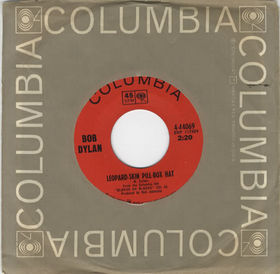
Nobody writes spiteful songs as well as Bob Dylan. One of his better ones is “Leopard-Skin Pill-Box Hat”, a rare pop song with two hyphenated words in its title. Recorded in 1966 for Blonde on Blonde, the song was released as a single in March 1967, a few weeks before the release of his first Greatest Hits album (which doesn’t include this song – strange marketing, that).

url

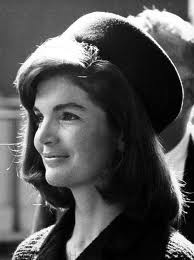
The song combines an interest in the already then out-of-style pill-box hat made famous by Jackie Kennedy, with leopard-skin, which was no more classy in 1967 than it is today. It’s a classic Dylan put down song:

Well, I see you got a new boyfriend

You know, I never seen him before

Well, I saw him

Makin’ love to you

You forgot to close the garage door

You might think he loves you for your money

But I know what he really loves you for

It’s your brand new leopard-skin pill-box hat

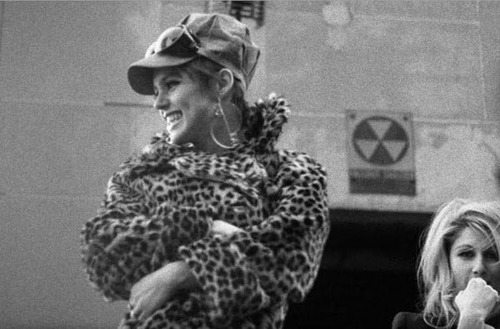
Wikipedia and other sources claim that the song is about Edie Sedgwick. Could be – I couldn’t tell you. That claim is part of a larger concern among Dylanologists to determine what every reference in every lyric could possibly mean. I have to say, these concerns are not generally mine. I don’t really care who Dylan was singing about – I don’t even care if it was a single person that inspired a song like this one. For me it’s much more the fact of the vitriol, and even if this song is a pale shade of something like “Positively 4th Street”, I am still amused by the bitterness that Dylan enabled to fill the pop charts.

edie-fur1

This was Dylan’s only single released in the US in 1967. John Wesley Harding came out in the last week of December, and its singles (“Drifter’s Escape” and “All Along the Watchtower” came out in 1968). It’s a pretty minor effort all things considered.

Here’s a good version from London at the end of the 1966 tour:

Zimmerman: Ten of Swords

Standard

url-2

I’ll be moving on tomorrow with 1967 in Bob Dylan weeks – a year that saw the release of his first Greatest Hits collection, the studio album John Wesley Harding, and the recording of dozens of songs that came to be known as the Basement Tapes. This is a whole new era for me – I never owned a copy of John Wesley Harding, and so I only know a few of the songs. I listened to it twice today, and it’s too early for me to say much about it (though I already hate one of the songs – stay tuned!). Basically, all of the albums between Blonde on Blonde and Blood on the Tracks are a bit of a blank slate for me, so it will be an interesting couple of months

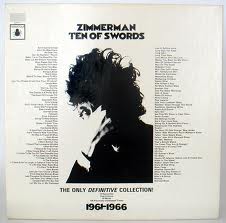
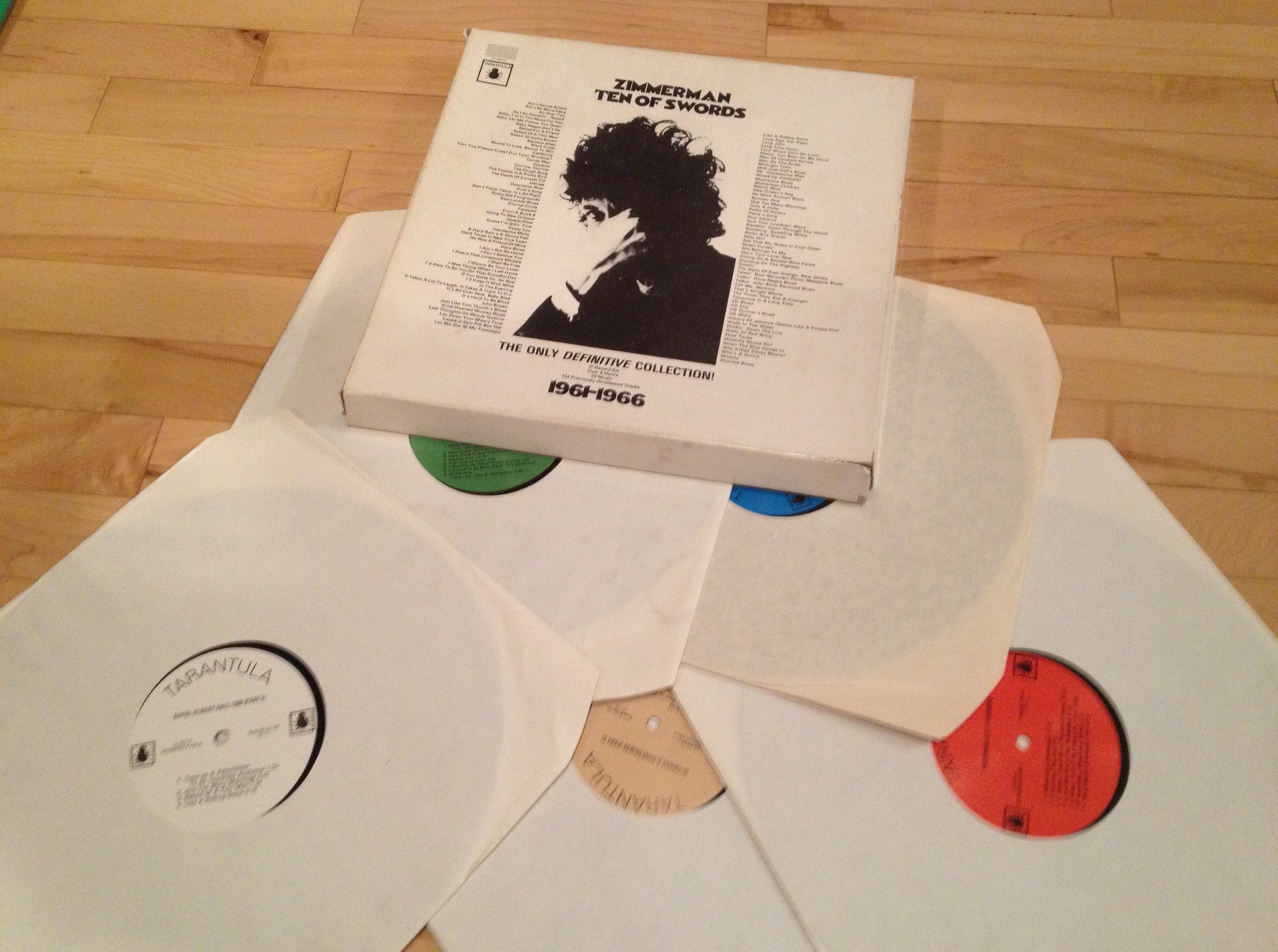
Today, though, I just wanted to say good-bye to Zimmerman: Ten of Swords. I’ve been reading a bit about that bootleg today and trying to retrace my own Dylan steps. It seems that it was released in 1985. Here’s a review of it from the Philadelphia Inquirer in 1986. It’s a well-curated collection of material from a wide variety of sources: The Witmark Demos, the Minnesota Hotel tapes, the Gaslight, Town Hall, and the “Royal Albert Hall” concert among them. All ten of the discs were pressed on very high quality vinyl, with professionally produced labels. Released by Tarantula Records, whose label cleverly mimics that of Columbia Records.

photo

I asked the other day if anyone knew any good histories of album bootlegging, and I got an email referring me to Clinton Heylin’s book Bootleg. I haven’t started reading it yet (probably next week, actually) but it looks interesting.

I know that I first discovered bootlegs at a record store in Hamilton, Ontario on King Street. It was a used record store, across from the Silver Snail comics shop. For the life of me I cannot pull the name from the recesses of my memory. They had some vinyl bootlegs on the wall behind the cash and a lot of tapes with handmade covers (on construction paper!) that they sold for $10. That was quite a racket, because I assume he was just recording the bootleg vinyl that he was selling to create a secondary market. I still have those tapes somewhere and am going to try to dig them out.

Learning about bootlegs was a big game changer for me. It seemed very illicit, very adult. It wasn’t like buying drugs, but there was certainly a sense that it was against the law. More importantly, it was difficult to know what was going to be good and what was going to be bad in those pre-internet days. I now know that there existed a large network of fans who traded this information through fanzines and printed guides, but at fifteen or sixteen I had no clue at all. The guy would say “that’s a good one” and I’d look at the track list, and I’d take a shot. I guess it was sort of like buying drugs.

The ethics of bootlegging were also interesting. Dylan, of course, has long been critical of them – this caused a rift when he toured with the Grateful Dead – and this is one reason that I’ve been reluctant to actually post any here. I’ve been half-assing it by linking to other people posting them. Probably ethically dubious, but I sleep nights. That said, I have a lot of Dylan on my desk at the moment, including every album he ever put out in a nice new box, and if Columbia doesn’t want this stuff bootlegged they can always release it. I’m certain that Bootleg Series 4 killed the market for the “Royal Albert Hall” bootlegs absolutely dead.

I see now that the bootleg itself has become valuable. Here’s one copy that sold for $549 some time ago. Mine isn’t in as good shape. The discs are probably near mint, but the box got stepped on and so all four corners need to be repaired. I do have the booklet, but it’s not mint any longer.

Zimmerman: Ten of Swords was an album that I listened to over and over for years. I think that if I were to sell all my albums, I would probably keep it (well, for $549 you can probably have it). I bought it at a store in Burlington, Ontario – on the east side of Brant, not too far up from Lakeshore, across from City Hall moreorless, also don’t remember the name of that store and I don’t think it lasted all that long. A friend told me that they had it, and I spent my Christmas money on it. December 1985, probably. Maybe 1986. The appeal of “The Only Definitive Collection” was too much for me – I had to have it. It covered the period that I thought was key – 1961 to 1966 – and so I just ignored everything after it. I skipped John Wesley Harding, Nashville Skyline, Self Portrait, New Morning, Pat Garret & Billy the Kid, Dylan, and Planet Waves. Strangely I then owned a run of his next six albums from Blood on the Tracks through At Budokan. Then another gap (Christian period) and then some of the 1980s material.

The gap was probably the combination of three things: I knew that this was supposed to be the fallow period, and I didn’t know which were the actually good albums (if any); Biograph covered the most important songs from albums like John Wesley Harding (“Dear Landlord”, “I’ll Be Your Baby Tonight”, “All Along the Watchtower”), and, most importantly, Zimmerman: Ten of Swords taught me that this was the essential, undiluted stuff. It was literally era defining. Released twenty-five years into his career, it told me all I needed to know: the only great years were the first six.

Now I’m trying to find out if they lied to be all along, which, I guess, is the whole point of this blog.