Dylan : Nixon : Carter

Standard

tumblr_mm6y51zKjb1soe011o1_500

Listening to recordings of Dylan’s 1974 tour you get to hear a lot of different kinds of clapping and cheering. The first song of any show usually brings a huge ovation, because people are so happy to see him. This was, at the time, the most lucrative concert tour ever put on. It was completely over-subscribed, and fans were ravenous for Dylan and The Band. The early ovation is a cheap and easy one that simply comes from showing up.

Dylan’s acoustic set seems to get bigger applause than the electric stuff, still, and eight years later (all of this, of course, based on semi-dodgy bootlegs so I don’t want to make any definitive claims). Almost every song gets applause at the end of the first line of the lyrics, which is typical of so many concert audiences that clap to say “Yes, we know this one and we approve of you playing it”, and certain songs get huge ovations (“Like a Rolling Stone”) while others gets smaller applause (most of the material from Planet Waves) . So it goes.

What is fascinating, though, is the reaction to one single line.

When Dylan recorded “It’s Alright Ma (I’m Only Bleeding)” on Bringing It All Back Home, it didn’t seem like it would become one of his most important songs. He played it a lot on the 1966 tour, and has played it a lot throughout his career. I gave it a provisional seventh on my list of his “best of all time”, and it is one of my favourites. It’s chock full of aphorisms – it’s Dylan’s Hamlet, endlessly spinning off catchphrases:

While others say don’t hate nothing at all / Except hatred

or

While money doesn’t talk, it swears

Obscenity, who really cares

Propaganda, all is phoney

or

It is not he or she or them or it / That you belong to

But live in 1974 there is the one line that gets the huge reaction – after a couple of shows the performers even stretch the pause to accommodate it the way that a comedian leaves space for the peals of laughter:

Even the president of the United States / Sometimes must have to stand naked

With the Nixon presidency crashing down – he will resign before the end of the year – this phrase is the greatest punchline possible for the Dylan audience. Listen to it on Before the Flood – it literally brings the house down.

One of the most curious things I’ve read about the ’74 tour this week, is this article in Rolling Stone about Dylan visiting the Governor’s mansion in Georgia after playing in Atlanta (possibly my favourite show from the tour that I’ve listened to, but there’s a lot of them I haven’t heard). Jimmy Carter had sixteen tickets for this show, and then hosted a party for Dylan afterward. They ate grits (actually, Dylan didn’t). It’s just so bizarre. By far the best part of the article is the bit where Gregg Allman shows up late and Carter greets him at the door in jeans to tell him the party is over. I would so love a video of that.

Picture-12

The Dylan/Carter relationship is an interesting one, apparently pushed by Carter’s son. It would have been fascinating to hear them speaking. Carter was touted in the article as a possible vice-presidential candidate, but, of course, he would go much further than that two years later. At his speech accepting the Democratic nomination, Carter quoted this line from the song:

He not busy being born is busy dying

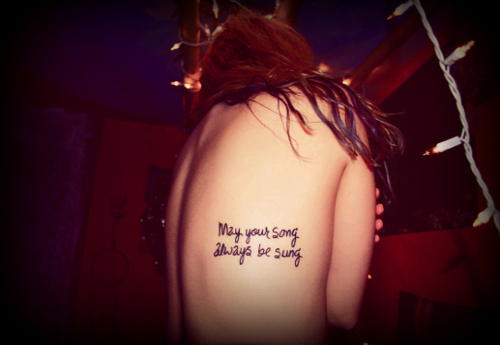
It’s a super-quotable line – maybe Dylan’s best aphorism. It would make a good tattoo. I just can’t shake the image of Carter hearing it at the Omni on that January night, contemplating his future. Maybe it’s why he put on the jeans to greet the late-arriving Allman…

Here’s an earlier version that may have escaped the wrath of Dylan’s lawyers simply because of the special pleading:

“Most Likely You Go Your Way (And I’ll Go Mine)”

Standard

2704658

More than almost any other musician, Bob Dylan has constantly reinvented his songs for live performance. If you read interviews with people who have performed as part of his band on his Never Ending Tour, for example, they talk about Dylan playing songs in a different key and with a different tempo every night of a tour, just to see if the band can keep up. I’ve seen Dylan audiences completely mystified about what song might be being played until he sings the first lines that are recognizable. Hell, I’ve been mystified.

While the 1966 featured a lot of new versions of old songs (mostly acoustic songs turned into electric ones), it was the 1974 tour with The Band where he really began to transform his repertoire. Listening to one of his Madison Square Garden shows on the walk home today I was struck by how hard it would have been for me to sing along to a song like “Lay Lady Lay”, where his phrasing was totally transformed, to the point that certain words actually change lines.

One of the best examples of Dylan’s approach to the tour was “Most Likely You Go Your Way (And I’ll Go Mine)”, the first song on the third side of Blonde on Blonde. Listen again to that version. It’s a quaint little song that has a bit of swing to it. Dylan eases the lyrics out. It’s soft-spoken, and a just a touch goofy because of the trombone.

Dylan used this as his encore of the first show on the 1974 tour in Chicago, after The Band had done “The Weight” as an encore. After some early experimentation, the 1974 tour found a reasonably familiar format: Dylan and The Band together for a half dozen songs, The Band without Dylan for five, Dylan’s return for three, intermission, solo Dylan, Dylan and The Band again, Dylan leaves again, Dylan returns again, encore. Anyway, for the first show “Most Likely You Go Your Way” was the final song. Then it drifted away, returning to the encore in Philadelphia, and then to the opening slot in Toronto. By Montreal (January 11) it had the unusual position of both opening and closing the show. Dylan played it with such great energy, that it launched the show on a strong note and then closed it down on that same note.

I have to say, that’s a new one to me. I have, on very rare occasions, seen bands play the same song twice because the audience response was so strong and they’d run out of material. This wasn’t the case with Dylan, who had rehearsed eighty songs for the tour, and played dozens of different songs as things were rotated in and out. The vast majority of shows on the tour (maybe thirty – I didn’t bother to count) featured two versions of this song, most frequently as the opener and in the encore (some shows follow this in the encore with “Blowin’ in the Wind”, but most don’t).

I rate this song very highly, and it is because of this tour. Had Dylan never done this after Blonde and Blonde it is not likely that I would recall it at all, but it is powerful as done here. The version that is included in Before the Flood (as the opening song on the two-LP set, and also released as a single that didn’t fare very well) is the opening song from the final stop on the tour, at The Forum in Inglewood on Valentine’s Day. It seems to be typical of the way that the song was being played on the tour, if a little faster than the versions from early on. They’ve turned into a hard-charging anthem. It’s a really great rendition of a fairly forgettable Dylan song, turned into something far better than what had been imagined eight years earlier.

Kicking Off the 1974 Tour

Standard

Just an excuse to post this video, which is largely unintelligible and clearly out of sync with the audio. Bob Dylan opened his 1974 concert tour with two shows in Chicago, and at both of them he led off the evening with “Hero Blues”, a truly obscure number that only appears (legally) on Bootleg Series 9: The Witmark Demos. He dropped the song after Chicago and has never played it live again according to his website.

As we launch into this tour, check out the very first moments:

Planet Waves

Standard

PlanetWaves

Is it possible that we’re now looking at peak Dylan? Most observers would scoff. They would point to 1964-1966 and the five album run from Times They Are a-Changin’ through Blonde on Blonde, to going electric, and the epic tour with The Hawks. That is peak Dylan. That’s where all his greatest songs appeared. When he dies, the first paragraphs of his obituary will be all about the period when he revolutionized popular music. What they’ll say about the mid-1970s is that he staged a comeback.

But what if this is actually the peak? What if this same span of years a decade later – 1974-1976 – is actually better? Planet Waves, Before the Flood, Blood on the Tracks, Desire, Hard Rain. Can that five album run compare to the heights of the 1960s? The epic tour with The Band basically replacing the tour with The Hawks (let’s face it, it is almost the exact same band, only ten years better), and then the Rolling Thunder Revue.

I mean, it’s a notion.

Now that we’re three months into this twelve-month wasted year, it seems pretty clear to me that I’m going to go all the way with this. That’s a good thing. It also seems like my self-imposed constraint is going to frustrate the hell out of me. After a few weeks of very little to listen to (literally, straining to pick out Dylan’s voice as he sings back-up vocals for other singers…), suddenly I’m awash with riches. 1974 features two albums, one of them a double album, that I have to get through, plus the enormity of his first tour in almost a decade. Plus the fact that it is a really great tour!

I have to say: these are the weeks that I’ve been waiting for. I knew what to expect from the 1960s peak, but this period is much more mysterious to me. Sure, I’ve played Blood on the Tracks and Desire so often in my life that I’m sure the grooves are worn away, but the rest of it is mostly new.

I’ve listened to Planet Waves about five times per day for the past three days, but I’m afraid that I already have to move on. There’s too much ground to cover. I’m not going to listen to forty Dylan and The Band shows from 1974 (Clinton Heylin, in Bootleg, offers that this tour was likely the first in which ever single show was recorded by a bootlegger in the audience, so it would be possible), but this is the first time that I wish that I had the time to do so. It will only get worse next year/week.

So. Planet Waves. I may have listened to this album once or twice in my whole life before this week. I know I never heard it when I was a teen. I always associated it with the tale end of his “bad period” rather than the start of the rebirth phase. More late Self Portrait than early Blood on the Tracks. Also, it has the absolute worst hippy dippy title (and the word “moonglow” written on the cover!), so I never really even gave it a chance. Moonglow!

I’m so sorry about that now. I mean, I could’ve been listening to this album for the past thirty years!

Recorded, like his early albums, quickly (just three days) and released in January 1974 (Dylan will release albums in January of 1974, 1975, and 1976, making this project seem so logical), this was the first Dylan album to hit number one on the album charts. Part of that is the marketing push from Asylum, part is the lack of The Beatles hogging spaces as they were in the mid-1960s, part is that it is a really good album!

I think that this album is mostly recalled for its light pop songs (“On a Night Like This”, “You Angel You”) and its two hymnal versions of “Forever Young”. It seems soft and domestic, like New Morning at those moments. Happily married Bob, at home with his five kids. But there is a real dark undertone to this album. “Going, Going Gone” is positively suicidal. Most of that darkness comes from the relationship songs that hint at the beginning of the dissolution of his marriage. “Dirge” and “Wedding Song” were two of the last songs written for the album. “Dirge” opens:

I hate myself for lovin’ you and the weakness that it showed

Sure, the song turns those lyrics around to a degree, but it is a haunting song full of piano and guitar noodling. Dylan’s voice is positively haunted here as he explores “Suicide Road” and “the hollow place where martyrs weep and angels play with sin”. I generally complain about Dylan’s dirges, but in terms of imagery this is one of the most complex songs he’d written in the better part of a decade.

As for the acoustic “Wedding Song”, which ends the album, it starts as the pretty traditional love song that its title suggests (“I love you more than money and more than the stars above”), but it becomes positively creepy over the course of its eight verses.

Eye for eye and tooth for tooth, your love cuts like a knife

My thoughts of you don’t ever rest, they’d kill me if I lie

I’d sacrifice the world for you and watch my senses die

By the conclusion of the song, it has become absolutely obsessional. This is a song of a complete control freak:

Oh, can’t you see that you were born to stand by my side

And I was born to be with you, you were born to be my bride

You’re the other half of what I am, you’re the missing piece

And I love you more than ever with that love that doesn’t cease

I dunno. It doesn’t sound so romantic to me at the end.

Planet Waves is an album that I’m going to go back to a lot when this whole thing is over. I wish that I had more time this week to keep listening to it, which is a big change from some of the recent albums. There isn’t a song here that I skip when it comes on yet, and none that I think are actively bad. While it doesn’t have the great world-shattering songs that the next few studio albums will have, it has very few duds (the worst part is probably this line, from “Tough Mama”: “Today on the countryside it was a-hotter than a crotch”, and I actually like this song). Plus it has the best musicianship of any album since probably Blonde on Blonde.

Over the course of his 1974 tour with The Band, Dylan would play most of these songs live for the first time, but by the end of the tour most of them had fallen off the set list (except for “Forever Young”). I feel like I’m going to miss them as I move into the tour.

Planet Waves, I hardly knew ye.

“Something There is About You”

Standard

bob-dylan-something-there-is-about-you-asylum-2

If “On A Night Like This”, the first single from Planet Waves, was an under-achiever on the pop charts, the second “Something There is About You” was an absolute and total dud. It peaked at #107 on the charts, indicating that no one anywhere was interested in this as a single. It is the earliest Dylan single that does not have its own Wikipedia entry. I mean, even “Wigwam” has a Wikipedia entry! That’s pretty damning.

Dylan seemed to believe in the song – he played it twenty-five times (out of forty shows) on the 1974 tour, but then only once since that time. I think he may have given up on it. It doesn’t show up on Before the Flood.

He probably had good reason to quit on it. This is one of those songs that doesn’t really ever catch in my head. I like the guitar just fine, but it’s a bit too long (almost 5:00) to be a good pop song considering how one-note it is. It’s too unvarying to hold my attention for so long, and I actually think that it is one of the least interesting songs on Planet Waves. There are good lyrics here – the first line, “Something there is about you that strikes a match in me”, is great, and the whole second verse about Duluth holds a lot of promise. It just never amounts to very much.

What I find most interesting about this as a single is that it had to have been chosen over “You Angel You”, which is almost the quintessential pop song (2:54, a love song, simple and repetitive). Dylan seems to have hated “You Angel You” though – he has only played it live twice (both in 1990), and he later claimed it had “dummy lyrics”. Too bad, I much prefer it to “Something There is About You”. Of course, “Forever Young” also would’ve made a better second single from this album as well. Actually, most of the album would have been better, and I think that #107 sort of indicates that.

Seriously, I can’t even find a decent cover to link to here….

“On a Night Like This”

Standard

OnANightLikeThis

The first single from Planet Waves, “On a Night Like This”, seems to tell the story of where Bob Dylan was with the hit parade in 1974. Despite the fact that his tour was sold out, and despite the fact that Planet Waves was his first album to hit #1 on the sales chart, both of the singles died. “On a Night Like This” only peaked at #44 on the hit parade.

Although Dylan had had a semi-hit in 1973 with “Knockin’ on Heaven’s Door” (peaking at #12), he hadn’t had a top ten single since 1969 (“Lay Lady Lay” – #7). While he would have two songs in the Top 40 Chart in 1975, and another in 1979, he would never have another Top 40 hit after that. We are truly nearing the end of Bob Dylan on the pop charts.

I have to say, it’s sort of hard to see why with this. “On a Night Like This”, which leads off his most successful album to date, is a commercial pop hit if there ever was going to be one. The lyrics don’t add up to much other than romance, but the song is infectious, singable, and danceable. What more could you ask for in a pop song? This isn’t likely going to be anyone’s favourite Dylan song (and it may not even be the best thing from the album), but it is fun and frothy. It’s hard to imagine people actively disliking it. I suppose that isn’t what anyone was looking for from Dylan at this point in his career. Dylan will be an album guy from here on in, even though he will release dozens of additional singles, must won’t go anywhere.

The B-side of “You Angel You” actually probably makes this even twice as poppy.

Here’s Los Lobos with a nice cover, including a second verse sung in Spanish. Just try to hate it. You can’t!

“Forever Young”

Standard

tumblr_lhm84bdD6X1qzabkfo1_500

“Forever Young” was not a Bob Dylan single (except, it seems, maybe in Germany), but it is one of his most famous songs. Planet Waves includes two versions of it – one at the end of side one and the other at the beginning of side two, or back-to-back on the CD that I’m listening to at the moment. The latter is technically titled “Forever Young (Continued)”, although it doesn’t display that way on my car stereo.

I’m still listening to Planet Waves, so I’m a bit torn about which is the superior version (leaning towards the second), but I am fascinated by the longevity of this song. It’s the most epigrammatic of all Dylan’s songs. Need proof? Just head on over to Etsy and search on homemade “Forever Young” products for sale. Samplers, pillows, plaques, paintings – you name it, you can get it all on Etsy!

il_570xN.285970913

In 2008 Dylan will even release a children’s book based on the song, but that would be skipping ahead.

The other thing that I learned today is that the Rod Stewart song of the same name, general tone and tune resulted in a settlement between Stewart and Dylan, with Stewart forking over part of the royalties to Dylan. I guess he has a good lawyer. Here’s Rod. Don’t worry that it’s lousy, I’m sure Bob is getting a 1/4 of a cent every time someone watches this on YouTube.

Bob Dylan Interviewed, 1974

Standard

20121214-dylancover4-x600-1355513875

Bob Dylan began his first tour in seven and a half years on January 3, 1974 in Chicago, supported by The Band, who were not merely the backing group but co-headliners. They did forty shows, and I’ll have a lot to say about this tour this week as I listen to it (of course, Before the Flood is a good way for you to keep up with it as well).

Before I get to that, however, I’ve been reading some of the early-1974 press coverage of Dylan. He had avoided the press for most of the past several years, so with the return to the spotlight I’m sure that the media was eager to get a hold of him and put him on the record. Nonetheless, he gave only a couple of interviews. Bjorner lists interviews with the New York Times, Washington Post, Time and Newsweek, and Ben Fong-Torres also wrote a lengthy report about touring with Dylan for the first seven or eight shows and trying to get a chance to talk to him (which he never really does).

The best pieces is the one in Rolling Stone, which you can read in its entirety here (and kudos to Rolling Stone for putting so much (all?) of their archive online for free, I had to hassle with my university’s paid subscriptions to read the other articles).

I want to cut out a large part of the Fong-Torres article because it directly addresses one of the things that most interests me about Dylan – the fact that he stopped talking to his audiences. Just as a refresher, if you listen to the Town Hall Concert or Carnegie Hall, Dylan was a chatty cathy – he was a funny performer, and very charming. By the time he was getting big at Newport he’d cut the talk way back. On the 1966 UK tour he used talk as a weapon in the rock half of the shows to try to shut the crowd up. That’s some of the most interesting rock talk I’ve ever heard. At Isle of Wight he basically said “Nice to be here” and introduced “Quinn the Eskimo” by talking about Manfred Mann, and at the Rock of Ages show he talked briefly before “Like A Rolling Stone”. Now Torres is reporting that he basically has stopped speaking from stage, telling Montreal that “It’s always good to be in Montreal!”, but that’s about it. Here’s Torres speaking with Robbie Robertson about this:

But the Band and Dylan are nervous, too, said Robertson, and that partly explains the lack of communication from the artists to the audience, beyond the music and a wave, a peace sign or a clenched fist here, a nod from Robbie’s guitar there. First, Robertson maintains, there’s no need to talk. You say hello by showing up onstage; you play familiar music and don’t need to introduce numbers. A new number from Dylan is obviously new. “So you’re kind of . . . it’s meaningless talk.”

“Just remember, when Bob first started to play, he used to do more talking than music. He used to just talk and talk and tell stories, jokes and carrying on, you know. It’s a different thing. And also, I think in his case, everybody takes it to such a degree that it’s embarrassing, almost, to say anything. I mean, they start, you know . . . “

To analyze what he meant by “We’ll be back in 15 minutes”?

“Right, they start counting to 15 backwards . . . they just take it and they get silly.

One critic in Chicago, a man with a background in theater, accused Dylan of holding back and concluded: “Maybe Dylan just isn’t a performer.”

Dylan, in Montreal, responded: “They just don’t understand.” He shrugged his shoulders. “It’s got nothing to do with that kind of atmosphere. What the critics expect is what they expect. It concerns me more with getting it to the people.

“It’s basically music, not a music-hall routine.”

Interestingly, Dylan will start to talk more by the end of the decade, and we’ll get to that when we get to it, but I found this pretty interesting, since it’s something I’ve always wondered. Off the top of my head, I can only recall personally seeing Dylan talk from stage maybe once in my life.

The other pieces in the NYT and WaPo are not really that interesting, with one exception, which probably spoiled the opportunity for all other journalists to get Dylan on record. When Dylan spoke with Tom Zito of the Post he was asked why he wasn’t doing benefits for politicians, while he had done George Harrison’s Concert for Bangladesh. Dylan replied: “George McGovern wasn’t starving. He just wanted to be President.” The story goes that Dylan asked Zito not to run that quote, having thought better of it, but Zito didn’t grant the request. Dylan only gave one other interview in 1974 after that, ending his brief reunion with the press.

Anyway, read the Rolling Stone piece – it has a great scene with Dylan and The Band in Toronto going to see Ronnie Hawkins, and is otherwise a beautiful example of the genre of RS writing where the reporter reflects on hanging out in hotel rooms being ignored by the subject of the article that Cameron Crowe nailed so well in Almost Famous.

Writings and Drawings

Standard

Writings-Drawings

I spent a fair amount of misdirected energy this week on Writings and Drawings, Bob Dylan’s second book. I looked for it in various places, considered buying it, considered not buying it, finally asked myself if we might not just have a copy in the University library (we do, of course), then checked it out only to find that I essentially already own it. My first instinct on plucking it from the shelf was “Boy, this looks a lot like the Complete Lyrics book that I bought in 1985, even down to the fonts”. A check of that latter book reveals what I think I had never noticed before: a notice on the front claiming “Includes All of Writings and Drawings plus 120 new writings”. So there you go.

The “writings” in Writings and Drawings are mostly lyrics, arranged by album from Bob Dylan up to New Morning. The value of a book like this one would have been, in the pre-internet days, the ability to avoid wearing out an album if you were trying to learn one of his longer or more complex songs, and the fact that the book contains a large amount of unrecorded songs. From the Bob Dylan section, for instance, there are the two originals from that album (“Talking New York” and “Song to Woody”) and eighteen unreleased songs (some of which would have been circulating on bootlegs during this time frame). Similarly, Freewheelin’ has all the songs from the album plus sixteen other things.

Not all of the other things are lyrics, some are poems and liner notes. At the beginning of this project, for instance, I didn’t read his notes for Joan Baez in Concert, and have just done so now. On first listening to (rather than hearing) Joan sing:

An’ when I leaned upon my elbows bare

That limply held my body up

I felt my face freeze t’ the bone

An’ my mouth like ice or solid stone

Could not’ve moved ‘f called upon

An’ the time like velvet floated by

The notes are a lengthy statement of Dylan’s aesthetic (whether or not he’s putting us on is another question entirely), in which ugliness and authenticity matter much more than beauty, until he is won over by her voice (“the bars between us busted down”).

The other half of the title is “Drawings”, but it is far, far less than half of the book. There are a few dozen drawings in the book – mostly pen sketches, and not much more than doodles. At this time Dylan seemed to be drawing a lot from life – men on park benches in New York, and so on. His drawings are rushed, and he puts very little vitality into them. They are free from cross-hatching or shading, just simple line drawings. Some are semi-abstract doodles (next to “Ballad of a Thin Man”, for instance) and some are highly literal (“This Wheel’s On Fire”). None of them show anything more than a rudimentary talent, which is probably not surprising if you’d looked at the painting he did for the cover of Self Portrait.

Dylan will turn increasingly towards the visual arts in the years to come – I took six more books of paintings and drawings out of the library yesterday with the hopes that no one will recall them during the year. It’s not an area that I think he ever got really good at.

“A Fool Such As I”

Standard

url

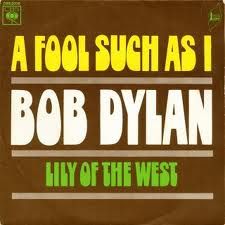
In the interests of writing something about each and every Dylan single, I have to return to his cover of “A Fool Such As I”, which Columbia released against his wishes as the only single from Dylan.

Written in 1952, this was a hit for Hank Snow when Dylan was young, and that is quite possibly where Dylan would have first heard it. Of course, it was a huge hit for Elvis in 1959, so he could not have possibly been unaware of that version.

He recorded a sort of lame version of the song as part of The Basement Tapes (which can be found on A Tree With Roots), and then again in April 1969 as part of the recording for Nashville Skyline, before Columbia tossed it onto Dylan four years later.

This is a smooth, poppy, over-produced version of Dylan with horns and back-up singers. It would be a good version of the song for someone, but that someone is not Bob Dylan. In some ways it anticipates his work from the late-1970s and even mid-1980s. That’s not necessarily a good thing.

In Europe, Dylan was released as Dylan – A Fool Such As I, which probably accurately reflected Dylan’s attitude for not locking down his rights better and allowing his former label to abuse him as it did by putting this out.

The song peaked at number fifty-five on the US charts. That was probably higher than I would have guessed. Even the sleeve for the single was hideous. “Lily of the Valley” is also a pretty cruel joke a b-side.

Here’s the great Hank Snow: