“Silvio” marked Dylan’s return to the pop charts in 1988. The song, co-written with The Grateful Dead’s Robert Hunter, peaked at #5. It was the only single off the album Down in the Groove. I recall that it further cemented my growing break with Dylan.
Down in the Groove was released at the end of May 1988. I graduated from high school in June of that year. I dutifully bought Down in the Groove, and found it even more lacking than Knocked Out Loaded (nothing even close to the quality of “Brownsville Girl”). I was pretty out of touch with top forty music at the time, but I was aware that “Silvio” was receiving air play. I had no idea that it was as popular as it was until Wikipedia told me so.
“Silvio” is quite the ear worm of the Dylan song. The chorus:
Silvio
Silver and gold
Won’t buy back the beat of a heart grown cold
Silvio
I gotta go
Find out something only dead men know
is pretty much the only thing that I ever recalled from the song. Even today I didn’t really know any of the lyrics to the verses – they seemed somewhat irrelevant, and they pretty much still do today.
I do recall dismissing this song as sub-standard Dylan partly because it was co-authored with Hunter. I was pretty anti-Grateful Dead at this point in my life, and so I felt the song was contaminated by their involvement with it, which is, of course, utterly nonsensical in retrospect. My attitude was that Dylan didn’t need to be co-writing with inferior talents, which is also bizarre because my favourite Dylan song was co-authored with Sam Shepard, and my favourite album that year was Desire, which is mostly co-written songs. Consistency was not the hallmark of my high school years.
Dylan is clearly a fan of this song. He has played it live 594 times. It entered the repertoire in 1988 and it really didn’t leave for a long time. Bjorner even found it noteworthy to mention concerts where it wasn’t played over the following decades.
Listening it today with fresh ears I don’t like the back-up singers and their “whoop whoops”. I do like the piano. Musically it’s better than most of Dylan’s output in the 1980s, but it still feels really slight to me. It’s not actively offensive or anything, just a sort of blank. This version sort of sounds like the novelty song from Inside Llewyn Davis:
Bob Dylan kicked off 1988 by getting inducted into the Rock and Roll Hall of Fame in Cleveland. He was part of the third class inducted. The first class had been primarily 1950s-era stars (Presley, Holly, Berry, Domino, Little Richard….), while the second class was primarily Motown (The Coasters, Aretha, Marvin Gaye). Dylan was inducted the same year as The Beatles and the Beach Boys, and the Supremes.
I don’t remember watching the show if it was broadcast in Canada. I supposed that it probably was, but I definitely missed it. The Hall itself has uploaded some videos from the evening to YouTube. It seems like they don’t have the broadcast rights, because the videos are all shot from behind, so you can see everyone’s back. They eventually shift to the front, or swish around looking for people in the crowd.
The Dylan segment was kind of painful. Bruce Springsteen, clearly nervous, did the induction. He does, at best, a mixed job of it. I thought it was nice of him to praise Dylan’s contemporary work, but he didn’t really get the point across. He does seem to be at a loss as a public speaker. I’ve certainly seen him do much better later in his career.
Dylan’s speech is a big nothing. He gives what seems to be genuine thanks to Little Richard, makes a jab about, presumably, another speech that went awry, and that’s about all there is to it. It does not seem to have been an important night in the life of Bob Dylan.
At the end of the show they got everyone up on stage and they played “All Along the Watchtower”. Strong contender for worst ever version of this particular song. Just so half-hearted and unprepared.
It seems to me that the Hall of Fame shows eventually got a lot better, but this is pretty much strictly amateur hour. I’ve never been to the Hall of Fame (nor to Cleveland generally). I’m not sure that these clips really help sell me on its importance….
Sometimes you get to the point with something like a Bob Dylan blog where your faith is genuinely tested. Case in point: last night I watched his 1987 film Hearts of Fire. Midway through my wife quite literally begged me to stop watching. No can do. To quote the constant refrain of the characters: “Fuck ‘em if they can’t take a joke”.
I’m going to start by summarizing Hearts of Fire, because it is unlikely that anyone reading this has actually watched it. Filmed in late-summer and early-fall 1986 in London and Hamilton, ON, the film stars Bob Dylan as Billy Parker, a former rock star who has opted to hang it all up and become a chicken farmer. He meets Fiona (billed with only one name), who plays aspiring rock star Molly McGuire and begins to mentor her because he has a creepy sexual attraction to her (she’s 18, he’s 45). Together they go to London where he performs at an oldies concert (alongside Richie Havens, who gets fourth billing but who has only two or three lines). While there they meet James Colt, a reclusive new wave star (his hit single is “Tainted Love”) played by Rupert Everett in a mullet and balloon pants. He takes the same interest in Molly that Billy has, producing her record and sleeping with her. James and Molly go on tour in the US: Chicago, Pittsburgh, Dunston, PA (her home town). At the second show, one of Colt’s mega-fans, a blind woman, kills herself in front of him, ending the tour. Molly goes on to play the final show in her home town alone, but during the first song first Billy and then James join her on stage for her triumphant homecoming since, while they both know that the price of fame isn’t worth it, hey, if she wants, who are we to stand in her way? It’s an odd moment. The film ends with Billy proposing to Molly, who rejects him. He gives her a guitar, but she steals his motorcycle. She then rejects James too, and rides off on the motorcycle into the sunset.
Let’s be clear: this is not a good film. Written by Joe Eszterhas and directed by Richard Marquand (Return of the Jedi), there is almost no drama here. Most of the film is musical performances and a half-hearted love triangle. Characters are almost completely one-dimensional, and some are even less developed than that. It is very slowly paced and pretty dull. There are some interesting touches – the movie theatre when Billy is first hanging out with Molly is showing Pat Garrett and Billy the Kid, and Ron Wood plays the role of an incompetent guitarist at a rehearsal in London. I became inordinately fascinated by the character of Nico, a muscle-bound drummer who looks like the wrestler HHH. Dylan also wears the worst jacket of all time, a denim thing with random patches of fabric sewn to it. I can’t find a picture to share with you – you’ll have to trust me.
(Not the worst Dylan outfit of the film)
The major problem is, as my wife says, “this is the worst part of the 1980s”. The clothes, sure, but the music. Molly is presented as a kind of Bonnie Tyler-esque wannabe, belting out ridiculous lyrics with no subtlety or nuance or charm at all. She’s all Patty Smyth and not one bit Patti Smith. When she sings the title track, I actually cringed.
The film features three Dylan songs. Apparently he was contracted for four, but, you know, Dylan. Actually, one of them isn’t even his. When Molly first meets Billy she tells him she has all of his albums and loves his song “The Usual”, which he then performs with her in a grimy bar the next night. That song, of course, is by John Hiatt. At the throwback concert, Billy introduces “Had a Dream About You, Baby”, a song that he would re-record, and include on his next studio album, Down in the Groove. “Night After Night” is so over-produced and awful that the less said about it the better. He also sings a song titled “A Couple More Years” to Fiona in a hayloft when he is trying to seduce her. It’s not on the soundtrack, but it is, by far, the best thing in the film from a musical perspective. So I guess that’s the fourth song. None of these songs have been released officially by Dylan except on the film soundtrack, which apparently has made the soundtrack somewhat collectible. Trust me, you can live without it. It is interesting, though, that he has completely disowned this material – his contribution to The Wonder Boys soundtrack is on the Complete Album Collection, for example, so this is a very deliberate omission.
It’s a shame that this movie is so bad, because Dylan isn’t that bad in it. He’s not going to win an Oscar, but this is his best screen performance to date. It doesn’t hurt that he’s essentially playing a version of himself – the mysterious, mercurial old musical superstar. There are line that are so clearly written especially for him (“I guess I always knew I was one of those rock and roll singers who was never going to win any Nobel Prize”, which will be excavated and run on the evening news if he ever does win (which I doubt)). The only really good line in the whole film is when Billy is trying to talk Molly out of being a rock star so that she can be chicken farmer with him. Speaking of her infatuation with James Colt, Billy says: “You think he’s a big star, but there’s no such thing as a big star. You look up in the sky, you know you see starlight, that’s all you see. Those stars died a billion years ago. Those stars are dead.” That’s a ridiculously Dylan-esque line and he delivers it in a brilliantly Dylan-esque fashion. Dylan is the only reason to watch this thing, and he’s only in it for about twenty minutes.
The film itself was never released in theatres in the United States, and it had only a two week run in the UK. You can find some foreign-language posters for it on the internet, so it must have played a little bit around Europe. It went straight to VHS in the US, but was never on DVD. iTunes sells it, but since the one time I ever bought a movie from iTunes it crashed and Apple refuses to refund me, I don’t deal with iTunes for anything for any reason. I watched it streaming on this site. It’s there if you want it.
A final note: I remember that my friends and I were all very aware that Dylan was filming this movie in and around Hamilton (whose steel mills allow it to stand in for Pittsburgh) at the time. We even knew where the bar was – though I now forget – and at one time even thought about trying to find Dylan and the crew. We never did though. It was enough to know that he was out there – close by – making a horrible film.
1987 found Dylan back in his sideman role for the first time in quite a while. It is interesting that both in the early-1970s and in the late-1980s when Dylan seemed to have lost a step in terms of songwriting he did two things: a) recorded a large amount of covers, and b) played on other people’s records. Here are three that he did in 1987.
Warren Zevon, “The Factory”
Dylan played harmonica on Warren Zevon’s song, “The Factory”, from the 1987 album, Sentimental Education. You can hear him here at 0:46 and 1:25 in particular. It’s a good performance on a song that I don’t rate that highly. I certainly don’t like the chorus, which is something that demonstrates that Dylan wasn’t the only singer-songwriter making odd choices in production at this point in time. Dylan doesn’t seem to be much more than a hired hand on this one, which is typically Zevon-esque.
Ringo Starr, “Wish I Knew Now (What I Knew Then)
Bjorner lists that as potentially a Dylan written song, given to Ringo Starr and recorded with him in Memphis on April 15, 1987. The song has never been officially released, but here it is on Soundcloud. It is pretty bad. Ringo, never a great singer, gives a lacklustre performance and the Dylan vocals don’t help matters much. This probably would have required a lot of work to get cleaned up enough for release, but lyrically the song doesn’t really merit it at all. The title is clever, but that’s about it. It should’ve been repurposed into a better song. I think that the relationship between Dylan and Starr is kind of interesting – Ringo is just sort of always hanging around, at The Last Waltz and at Dylan shows. They didn’t do much together, particularly relative to Dylan’s relationship to George Harrison, but they did seem to be quite friendly.
U2, “Love Rescue Me”
By far the best of the collaborations. Dylan co-wrote and recorded this song with U2 in June 1987, but it was released on U2’s 1988 album Rattle and Hum. Dylan had performed with Bono in Ireland in 1986, and then appeared with the band on stage in Los Angeles on April 20, 1987, performing “I Shall Be Released” and “Knockin’ On Heaven’s Door”. Bjorner lists these as available on half a dozen bootlegs that I don’t have, and I’m sure that they’re on an even greater number of U2 bootlegs, but I don’t have any of those either. If anyone has a lead, I’d be curious to hear that performance.
“Love Rescue Me” is a pretty good song. I really hated Rattle and Hum when it was released. I wasn’t a huge U2 fan prior to that, but that album left me pretty cold. Listening to this now, I kind of like it, and would probably speak up for this one. Dylan performs a role similar to that of B.B. King on “When Love Comes to Town”, certifying and Americanizing the Irish band. That bugged me then, but I’m a lot more sympathetic to it today. It doesn’t hurt that it is a pretty good song.
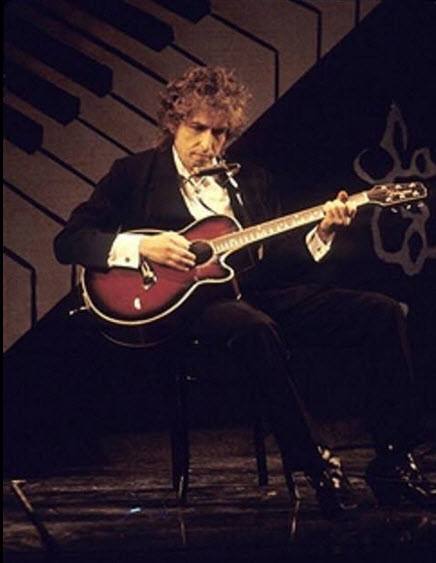
One of the oddest of Dylan oddities is his performance on March 11, 1987 at the Brooklyn Academy of Music in the celebration of the fiftieth anniversary of the death of George Gershwin. Dylan performs the song “Soon” from the musical Strike Up the Band on acoustic guitar and with harmonica. The performance was broadcast in Germany (the YouTube clip here includes a German announcer) and, at the end of the year, on PBS.
This is a nice performance by Dylan. He actually sings the song, he doesn’t do the Dylan vocals thing, and the harmonica playing is quite lovely. Other performers at the event included Chita Rivera and Liza Minnelli, so Dylan’s appearance on stage must have seemed a bit out of place.
Dylan, of course, more than most American singer-songwriters, has always been open to the music of the first part of the twentieth-century, so from a certain perspective his appearance here makes absolute sense. Performing Gershwin is perhaps a precursor to the next few years, where Dylan will move back into covering older songs and focus less on his own songwriting.
One of the most important American songwriters of the twentieth-century celebrating the work of one of the most important American songwriters of the twentieth-century. What could be more natural?
Let’s bring the Bob Dylan – Sam Shepard relationship to a close. In July 1987 Shepard published an “interview” with Dylan in Esquire under the title “True Dylan”. Written in the form of a one-act play, the piece was later anthologized as “Short Life of Trouble” in Shepard’s 2012 book Fifteen One-Act Plays.
I’m not sure what Esquire might have made of this interview, so let’s credit them for the fact that they even ran it. The play opens with a character named “Sam” visiting the home of a musician named “Bob”, with a tape recorder and a six-pack of beer. Bob spends a good portion of the play on the phone trying to get the area code for Tulsa, and trying to decide if he is going to attend some unspecified party or event. When Bob is on the phone Sam plays back the recording of their conversation, only to find it gone – replaced by the piano music of Jimmy Yancey. There are two car accidents during the play, though neither of them is noticed by either of the characters. They talk of polka music, James Dean, and angels.
To me, this is the best interview with Dylan that I’ve yet read. As I’ve noted now twice, Shepard seems to get Dylan in a way that others don’t – or at least his myth-making of Dylan matches closely with my own. We don’t learn much about Dylan here that we don’t already know about his relationship to Woody Guthrie, or his taste in music (Hank Williams, of course!), but Shepard has an incredible ear for dialogue, for phrasing, for the pauses that seem to characterize Dylan’s way of speaking and thinking. It seems to me that Shepard captures this exceptionally well.
The piece ends with a beautiful moment – with Dylan reflecting on his motorcycle crash. The two talk at length about the deaths of James Dean (Dylan brings it up very early in the conversation, that he’d just been out to that spot in Paso Robles) and Hank Williams (Shepard noting that he’d seen the car that Williams died in), before Shepard asks about the mythical motorcycle crash. It’s worth quoting Dylan at length about his recuperation:
“Spent a week in the hospital, then they moved me to this doctor’s house in town. In his attic. Had a bed up there in the attic with a window looking’ out. Sarah stayed there with me. I just remember how bad I wanted to see my kids. I started thinking’ about the short life of trouble. How short life is. I’d just lay there listening’ to birds chirping. Kids playing in the neighbour’s yard or rain falling by the window. I realized how much I’d missed. Then I’d hear the fire engine roar, and I could feel the steady thrust of death that had been constantly looking over its should at me. (Pause) Then I’d just go back to sleep.”
That’s the best thing I’ve read about Dylan’s transformation in the late-1960s, and it is a beautiful evocative piece. I’m not certain that Dylan said it – Bob clearly tells Sam that he’s free to make up anything that he wants in the play – but I hope that he did.
I can’t access an actual copy of the Esquire piece, so I don’t know how it was illustrated. That photo above is from 1975 – Dylan, Shepard and Allen Ginsberg at Jack Kerouac’s grave.
Bob Dylan’s 1986 album, Knocked Out Loaded, would be a surefire pick for his worst album ever were it not for one bizarre fact: it includes what may actually be the best song that he ever wrote. I know that is an extreme suggestion given the unbelievable heights that he scaled in the 1960s and 1970s, but “Brownsville Girl” is an exceptional song. Let’s see if we can build this case.
I was in Denver a couple of weekends ago, having drinks with my friend Charles (who has thrown a lot of remarks into the comments section of this blog over the past six months). Charles mentioned to me that he’d recently heard this song, “this eleven-minute epic about a Gregory Peck movie”, that was the most surreally bizarre thing that he’d ever heard. Did I know it? Yes. Absolutely.
I remember the first time that I heard this song. I’d been disappointed by Knocked Out Loaded for a few days, and had played the first side a few times but not the second. I’m not sure why I didn’t flip it over. Finally I played “Brownsville Girl” for the first time and it literally blew me away. Here was the most improbable gem ever. Every single element of “the bad 1980s Dylan” could be found on this song – the horns, the back-up singers – but it just all seemed to work. It was this miraculous thing where Dylan keeps producing songs and wrecking them for years with all this unnecessary extra stuff, and then, suddenly, everything just falls into place. It’s as if all the disastrous mixes of the past few albums were just preparation for this incredible epic thing. The most Dylan song of all Dylan songs.
My wife reminds me that I played this for her on one of our first dates. I’m not sure why. I wasn’t that much of a Dylan fan at that point, but it seems that I was still a fan of this song. It is one of her favourites as well, and I’m sure that’s part of why we’re still together after twenty years – I can’t imagine that I could be with someone who wasn’t fascinated by this song.
I’ve played “Brownsville Girl” for dozens of people over the years. Many quit on it. They get bored. It’s too long. They don’t engage with the story. Those are people that I don’t play music for any longer. I’m really only interested in the people who hear this and who lean into it wondering “what in the world can this song possibly be about?”. I’m still wondering.
—
I can’t get WordPress to embed the song because it’s not hosted on a site that they like. Click through to a new window to listen to this song if you’ve never heard it.
—
“Brownsville Girl” is one of Dylan’s co-authored songs, something that he hadn’t done much of in a decade since collaborating with Jacques Levy on much of Desire. This one is co-written with the great American playwright Sam Shepard. It is seamless. Read Shepard. Listen to Dylan. Play “Brownsville Girl” and tell me that one line or another is definitely the work of one of these men. It’s impossible to do so, the integration of their points-of-view is complete.
Shepard, of course, toured with Dylan during the Rolling Thunder Revue, and wrote a book about it. They were at least friendly, if not friends. Shepard, it seems to me, gets Dylan. He has better insights – insights that seem truer to me – than almost any other writer I have read on Dylan this year. This is from Rolling Thunder Logbook:
“One thing that gets me about Dylan’s songs is how they conjure up images, whole scenes that are being played out in full colour as you listen. He’s an instant filmmaker. Probably not the same scenes occur in the same way to everyone listening tot he same song, but I’d like to know if anyone sees the same small, rainy, green park and the same bench and the same yellow light and the same pair of people as I do all coming from “A Simple Twist of Fate”. Or the same beach in “Sara” or the same bar in “Hurricane” or the same cabin in “Hollis Brown” or same window in “It Ain’t Me” or the same table and the same ashtray in “Hattie Carroll” or same valley in “One More Cup of Coffee”. How do pictures become words? Or how do words become pictures? And how do they cause you to feel something? That’s a miracle.”
Reading this I was struck by how consistent the mental images are that I have for some Dylan songs. In “Hattie Carroll”, to use on of Shepard’s examples, I always see that ashtray in a dimly lit bar in an open space on the second floor of a hotel, with stairs going down that run parallel to the bar. I see the initial action in “Hurricane” from a bird’s eye point-of-view, from a walkway that circumnavigates the bar like the saloon in a western. I don’t know about you – but I always see it the exact same way, no matter what Dylan does the song musically. I’d never noticed that before.
Shepard, of course, is exactly correct. Dylan is an incredibly imagistic songwriter. “Brownsville Girl” is one of the most imagistic of all of his songs. For me, this song is an “instant film”, to use Shepard’s term. It’s a Ridley Scott film. It’s Thelma and Louise, but with Dylan as the male lead. Take these lines, for example.
I can still see the day that you came to me on the painted desert
In your busted down Ford and your platform heels
(I see a dusty low-angle shot with nothing but pale blue sky in the top half of the movie frame. The Ford, of course, a pick-up truck from the 1960s. Blue and rust.)
Ruby was in the backyard hanging clothes, she had her red hair tied back. She saw us come rolling up in a trail of dust
She said, “Henry ain’t here but you can come on in, he’ll be back in a little while”
(Ruby wears jeans and a white shirt with holes in it. Here eyes are wrinkled and her skin is tanned. This is shot from behind the arriving car, with a reverse point-of-view shot from Ruby)
Well, they were looking for somebody with a pompadour
I was crossin’ the street when shots rang out
(It’s the pompadour that sells it. Small Texas border town that hasn’t changed at all since the 1950s. You could film a remake of The Last Picture Show there.)
Well, I’m standin’ in line in the rain to see a movie starring Gregory Peck
Yeah, but you know it’s not the one that I had in mind
(More Scorsese now than Ridley Scott. Night, wet hair, no umbrella, a leather jacket with the collar turned up.)
The whole song is this way. It may be the most visual thing that Dylan has ever written because it is so incredibly mythic. The quick shifts from iconic images (“rolling up in a trail of dust”) to the incredibly specific (“a pompadour”) allow us to build the images quickly. To tell the story.
—
Bob Dylan isn’t simply an imagistic writer, though. He has a habit of writing some of the most aphoristic lines in the history of popular music. If you wanted to get a Dylan line tattooed on yourself, this song gives you the most choices. It’s Dylan’s Hamlet, an incredibly rich source of quotable lines. For instance, the most fatalistic line in any rock song ever has to be: “Even the swap meets around here are getting pretty corrupt”.
Of the seventeen (!) verses of this song, two play no part in driving the plot of the song, but simply outline a philosophy about life
Now I’ve always been the kind of person that doesn’t like to trespass
But sometimes you just find yourself over the line
Oh if there’s an original thought out there, I could use it right now
You know, I feel pretty good, but that ain’t sayin’ much. I could feel a whole lot better
If you were just here by my side to show me how
That line, “If there’s an original thought out there, I could use it right now”, is, by a wide margin, my single favourite Dylan line. I quote that, aloud and in my head, more than anything else he has ever written, particularly on those days when I am convinced that there is, indeed, no space left for original thinking. Then there’s this:
Strange how people who suffer together have stronger connections than people who are most content
I don’t have any regrets, they can talk about me plenty when I’m gone
You always said people don’t do what they believe in, they just do what’s most convenient, then they repent
And I always said, “Hang on to me, baby, and let’s hope that the roof stays on”
What an incredible verse that is. Both the first and third lines are exceptional statements of a Dylanesque philosophy. Indeed, Dylan made on-stage remarks akin to the convenience line while on tour in 1986 – you can tell that he was working this through.
When I was in high school the two writers that I was most interested in were Bob Dylan and e. e. cummings. I filled the end papers of my calculus book with Dylan quotes and my trig textbook with quotes by cummings (“they did not stop to think they died instead”). I was a pretentious kid, obviously. Yet all these years later I still recognize the beauty of some of these phrases. If I had a textbook, I’d write them into it.
—
I was going to write that this is the best Dylan story song, but I’m not one hundred per cent convinced that it actually tells a story. It is an epic, sure, but the story is fleeting and fragmentary.
The song has seventeen verses, and the chorus is sung four times. The first section includes six verses before the chorus (indeed, on first listening, you sort of assume that there will be no chorus). The second and third sections include four verses each. The final section is only three. The chorus, with all of its amazing power coming from the Queens of Rhythm, accelerates in frequency and velocity as the song goes along. The memory of the Brownsville girl, to whom the song is sung, increases in ferocity every time – it cannot be held back. The performance by Dylan’s back-up here is incredible. Intense. Moving. The three-part howl that they let out is blood-curdling. It gets me every time. On no other song does he use his support even half as well. They are a Greek chorus here, even dropping in their own commentary on the action (“Oh yeah?”).
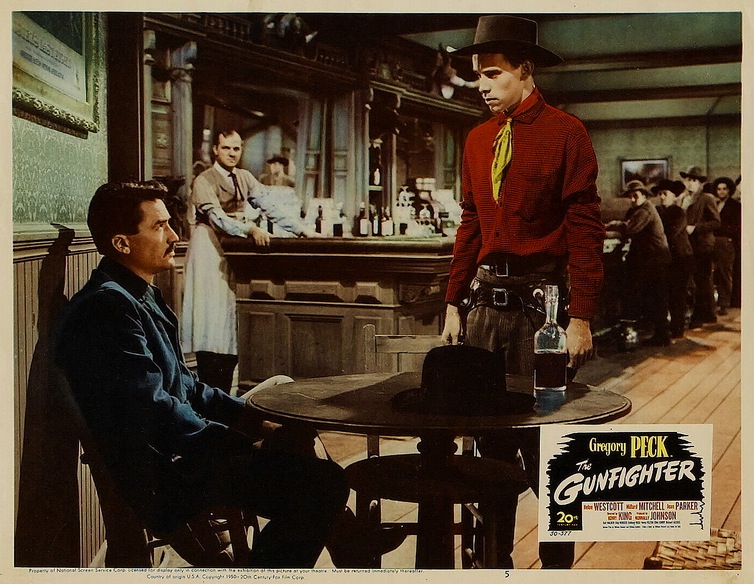
Of the seventeen verses, six of them are about Gregory Peck and, specifically, his 1950 western The Gunfighter. The plot of the film is detailed exactly in the first three verses, particularly the conclusion in which gunfighter Jimmy Ringo is shot down by the cowardly Hunt Bromley.
The Gunfighter isn’t a great western – it is really only passable – but Shepard and Dylan make it positively mythic. Not only is the conclusion – in which Ringo insists that the town let Bromley go so that he too can meet his doom at the hands of “hungry kid trying to make a name for himself” – completely grandiose, but the narrator repeatedly sells the memory of the film (“I keep seeing this stuff and it just comes a-rolling in / And you know it blows right through me like a ball and chain”). The segue from the film is directly to the Brownsville girl (“You know I can’t believe we’ve lived so long and are still so far apart / The memory of you keeps callin’ after me like a rollin’ train”) and the relationship itself is established as akin to the Peck film – a betrayal on a grand scale.
As for the plot, what is there is clear but sketchy. It’s an easier thing to piece together than “Tangled Up in Blue”, but the details are not always set.
The couple meet in the painted desert. The travel to San Antonio and sleep at the Alamo. In Mexico, something happens that requires a doctor, and she disappears while he is trapped as a wanted man.
In the second section, the narrator travels with his new girlfriend to the home of Henry Porter, whom they never meet. They talk to Ruby.
In the third section the narrator is arrested for a crime that he didn’t commit (“I didn’t know whether to duck or to run, so I ran” – what an incredible line). His ex sees his picture in the Corpus Christi Tribune and she perjures herself to save him from prison.
The narrator stands in line to see a movie starring Gregory Peck.
That’s it. That’s the story. It’s not even entirely clear where the second section fits. I say he travels with his new girl, but it’s not exactly certain that that is true. Who is Henry Porter? We never learn (“The only thing we knew for sure about Henry Porter is that his name wasn’t Henry Porter” – one of the best lines ever). Who is Ruby? We don’t know. Who is the Brownsville girl? After eleven minutes, we really don’t have much of an idea. I’m sure my Brownsville girl isn’t the same as yours anyway.
—
“Brownsville Girl” didn’t start life as “Brownsville Girl”. An earlier version of the song, then called “New Danville Girl”, was recorded during the sessions for Empire Burlesque, but given up on. Here’s that version:
That title, of course, refers to the Woody Guthrie song, “Danville Girl”.
Guthrie’s song is about a girl and a train. The key lyrics, at least as they relate to “Brownsville Girl”, are:
I rode her down to Danville town, got stuck on a Danville girl,
Bet your life she was a pearl, she wore that Danville curl.
She wore her hat on the back of her head like high tone people all do,
Very next train come down that track, I bid that gal adieu.
I bid that gal adieu, poor boys, I bid that gal adieu,
The very next train come down that track, I bid that gal adieu.
Shepard and Dylan borrow a fair bit from Guthrie here – specifically the curl/pearl rhyme – and the disappearance. Nothing in “Brownsville Girl” suggests that the woman is “high tone”, but imagining it does lend the song a certain nuance.
—
“New Danville Girl” isn’t as good as “Brownsville Girl”. It’s more stripped down. There are back-up singers, yes, but they’re not fierce and vocal and active. They don’t talk back. Dylan’t singing isn’t as strong, and the things that usually ruin a Dylan song – like the horns – are missed.
You can learn a lot about Dylan’s revisions from listening to the two versions back to back. Only two of the seventeen verses are exactly the same in the two versions, although a handful of them have only minor changes. I would argue that there isn’t a single verse in “New Danville Girl” that is superior to “Brownsville Girl” though, every single alteration is an improvement, some of them massive.
“Brownsville Girl” opens with a perfect phrase: “Well, there was this movie I seen one time”, where “New Danville Girl” stumbles out of the gate: “I wish I could remember that movie just a little bit better”. One is mythic, the other is faulting.
Some of the verses in the “New Danville Girl” version of the song are actually kind of awful, which makes me wonder why they were recorded. Compare these, with the “Brownville” version first:
Well, we drove that car all night into San Antone
And we slept near the Alamo, your skin was so tender and soft
Way down in Mexico you went out to find a doctor and you never came back
I would have gone on after you but I didn’t feel like letting my head get blown off
That version is haunting and dark and threatening, with just an interesting little bit of hesitation and cowardice. It builds a lot of character for the narrator. Now “New Danville”:
We drove that car all night into San Anton’
And we slept near the Alamo, we fell out under the stars
Way down in Mexico you went out to see a doctor and you never came back
I stayed there a while til the whole place started feeling like Mars
This version is terrible – it lacks all of the poetry, and I have no idea what is meant by a place that starts to feel like Mars. I’m not sure Dylan and Shepard do either.
Even very minor changes make enormously huge differences. In “New Danville Girl” the location of Ruby is changed: “We could see Ruby in the window as we came rolling up in a trail of dust”. The mental image that is painted isn’t half as compelling as the woman hanging laundry. Other shifts in phrasing carry a lot of weight. For instance, the difference between “It was the best acting I saw anybody do” and “It was the best acting I ever saw you do” fills a vast expanse.
There is one entire verse from “New Danville Girl” that is absent from the later version. Where in “Brownsville Girl” we get the verse about Henry Porter not being named Henry Porter, in “New Danville Girl” Dylan and Shepard initially wrote:
It’s funny how people just want to believe what’s convenient
Nothing happens on purpose, it’s an accident if it happens at all
And everything that’s happening to us feels like it’s happening without our consent
While we’re busy talking back and forth to our shadows on an old stone wall
That’s not nearly as good a verse, but the one line (“Nothing happens on purpose”) has a real mystical charm to it.
—
One of the odd synchronicities of this blog is that I’ve been listening to this song all week, just when Dylan’s lyrics for “Like a Rolling Stone” have been auctioned for $2 million. The original version of “New Danville Girl” lacks the brilliant last line of “Brownsville Girl” (“Seems like a long time ago, long before the stars were torn down” – maybe the best line in a song that is filled with nothing but great lines). The original ends rather flatly, rhyming “what part I played” with:
But that was a long time ago and it was made in the shade
Awful. Funnily, though, the phrase “you got it made in the shade” appears in the original hand-written lyrics for “Like a Rolling Stone”. It seems Dylan has been trying to use that line for two decades.
Of course, he rhymes “made” and “shade” in “Tombstone Blues”.
—
“Brownsville Girl” has been my favourite Dylan song for almost thirty years. Is it the best? Well, it’s my favourite. If I could have only one, this is the one that I would keep. For years I sort of dreamed about a live version of it. So imagine my surprise when I learned by doing this project that one exists. At his show on August 6, 1986 in Paso Robles, CA Dylan and The Heartbreakers played “Brownsville Girl”. I got a sort of anxiety attack knowing that this existed, and then dutifully tracked it down on a bootleg of Dylan live rarities. I since found that it exists on YouTube. Here it is:
Isn’t that just the saddest thing ever? I almost cried. He omits not just a verse or two, but ALL SEVENTEEN VERSES! It’s just the chorus, chanted over and over. Heartbreaking.
—
Recently my sister-in-law forwarded me an article from the Telegraph. It is a provocative piece that argues that based on only his 1980s output Bob Dylan would still be one of the greatest singer-songwriters ever. A gutsy argument, and one that I can find some sympathy for. The writer, Neil McCormick, picks the ten best Dylan songs from the decade: “Every Grain of Sand”, “Dark Eyes”, “Series of Dreams”. No arguments from me. But he omits “Brownsville Girl”. It is astonishing. I feel like it invalidates everything else that he writes in the article.
For me, “Brownsville Girl” has everything that I love about Dylan all in one song, and even the things that I don’t love about Dylan I love when they’re in this song. It shouldn’t work. It’s an eleven minute epic about lost love and Gregor Peck. With horns. And yet, I think it sums up every single thing that I care about when I care about Dylan, from the Guthrie references, to the vivid imagery, to the vaguely potent philosophical sentiments. His vocal performance is powerful and grows stronger with every minute.
The first Bob Dylan concert for which I bought tickets was not the first Bob Dylan show that I ever saw. Instead of seeing Dylan, Tom Petty and the Grateful Dead I had my ticket confiscated by the police, and, eventually, got beaten up over it. Ahh, high school.
On July 4, 1986 Bob Dylan played a big show at Rich Stadium in Buffalo, NY. This was one of the four large stadium shows that he did that month backed by Tom Petty and the Heartbreakers, and with The Grateful Dead opening the show. Additionally, this particular show coincided with the second Farm Aid, and so would be partially simulcast to that venue in Texas. Growing up outside of Toronto, I made plans to attend the show with my good friend Jake, who was a Grateful Dead fan.
Back in the pre-Ticketmaster days, you could buy tickets for such shows at your local record store. Since all the tickets at the show were going to be rush seating, we planned to do just that – not bothering to line up, since it was impossible that the show would sell out. At lunch one day in high school we were discussing driving out to get the tickets, when we were overheard by someone with a locker close to us. He offered to get us the tickets because he “knew a guy”. We said sure, whatever, if he got them by the end of the day we’d gladly pay him instead.
Now, our benefactor was not one of our friends. He was one of the school’s drug dealers, selling pot and hash behind the gym in an Iron Maiden t-shirt. You know the guy, I’m sure you had several in your school as well. In Etobicoke they all grew up to be city councillors.
Anyway, by the end of the day we had our tickets ($25) and he had his money and all was well with the world. We began making plans to go to Buffalo.
A few days later another friend of mine asked where I had gotten my tickets. He was friendly with the owner of the store where we had planned to buy them, and apparently, someone had stolen all the tickets from the store. We didn’t tell him where we got them, but we knew that this wasn’t going to be good.
Not six hours later, a police officer was at my door. It just so happened that Jake was there as well. He interviewed us about the tickets, confirmed from the serial numbers that we were in possession of stolen property, he took the tickets and told us we might be called to testify in court. That was no good.
Probably our worst decision in all of this was the one where we decided to try to get our money back from the person from whom we’d bought the tickets. Not only were Jake and I not an intimidating pair of toughs, but it directed attention our way. Not only did we not get the money, but the gang of guys who controlled the small-scale crime at our school decided that we were responsible for their friend getting caught. They eventually caught up with Jake at a party and beat him up until the police arrived to save him, and, almost a year, later the same happened to me.
So, no Dylan tickets, out $25, caught a beating for it all, and we weren’t even the people who told the cops! Sometimes there is no justice in high school.
After all this went down, by the way, and the police took our tickets from us, my parents said “What made you think you were going to be allowed to go to Buffalo anyway?” I told them our plan to drive down in my car and they told me their plan to never allow my car to go to a place like Rich Stadium. Poor Buffalo, they get no love. So it is likely that I wouldn’t have seen the show even if we did get tickets legally.
Fortunately, today the internet exists. I have a partial bootleg of the show, and can listen to the Dead set on ListenToTheDead.com. I have no idea why the Dylan bootleg (Rich for Poor) omits the final third of the show other than the fact that many bootleggers are bad at their jobs. It seems like it wasn’t such a bad show – there are some lively songs, and Dylan and The Heartbreakers were definitely working better together than they were in Sydney for Hard to Handle.
Three of the songs from the show are on YouTube because they were simulcast to FarmAid. You can imagine that I would have been there in the crowd shots at the end of each of the songs. But I wasn’t. My first Dylan-related tragedy.
The version of “Seeing the Real You at Last” here is vastly superior to the one on Empire Burlesque.
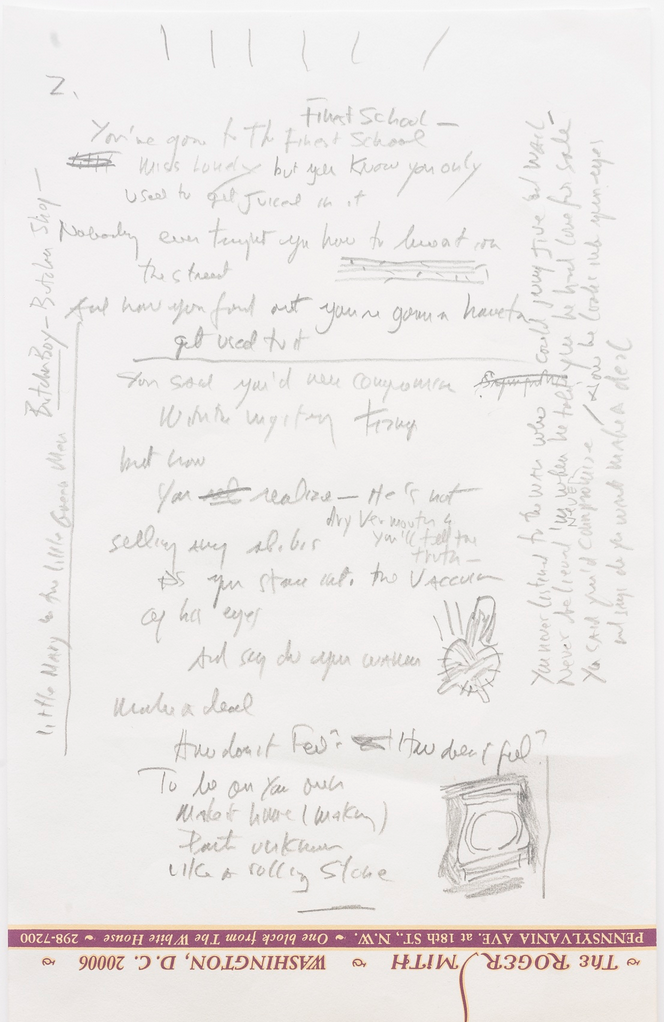
In case you didn’t hear, Sotheby’s auctioned off what they are claiming are the original hand-written lyrics to “Like a Rolling Stone” this week for just over $2 million (including buyer’s premium). This strikes me as at least somewhat bizarre, since Dylan has been so perfectly clear that the song was culled from a ten-page typed rant, so it would seem to me that this is the hand-written second draft. I’m sure some exceptionally rich person isn’t that concerned about that.
You can see the pages at Sotheby’s site, and click through to enlarge them. I would even think that you could just print out your own copies for a lot less than $2 million. It makes an excellent craft project now that the kids are out of school for the summer!
The Guardian has a good write up of some of the marginalia here – I presume that they blew their copy up too.
Bob Dylan’s relationship with The Grateful Dead has been a long, involved and convoluted one. The earliest intersection that I’ve come across this year was the 1969 Dylan interview by Jann Wenner in Rolling Stone where Dylan does little more than acknowledge that he’s aware of the San Francisco bands of the period, including the Dead. Of course, Jerry Garcia released an album of Dylan covers in 2005 with performances culled from as far back as 1973. And Garcia joined Dylan on stage in San Francisco in November 1980.
In the summer of 1986 Dylan and The Grateful Dead performed four shows together, with Dylan headlining three and the Dead headlining one. Those shows were in Akron, Oh (July 2), Buffalo, NY (July 4) and Washington, DC (July 6 & 7). The Buffalo show was the first Dylan concert that I ever bought a ticket to. More on that tomorrow.
Dylan and The Dead played six songs together according to Bjorner – three in Akron and three at the second show at RFK Stadium in Washington. Because Grateful Dead bootlegs are so incredibly available, I direct you here: ListenToTheDead.com
Click on the year, the show, and then the song to hear it. This archive, by the way, is just the most amazing thing I have ever seen. It makes me want to be a Grateful Dead fan.
Oh, yes, I’m not a Grateful Dead fan. At all. I mean, I could name maybe three of their songs. Just could never get into them at all. Have had many Dead fans try to convert me. It has never worked, not even a little bit. I think I even went to a Dead show at Canada’s Wonderland (with someone else paying for my ticket) and I left to ride the roller coasters. I just do not care about them.
So, I sat down to listen to these appearances. Both of them occur during the Dead sets, with Dylan joining them. Bjorner indicates that it was during the encores, but that doesn’t seem to be the case, at least as the concerts are presented on ListenToTheDead.
Let’s start with Akron. Dylan opened this show, so the Dead were playing after him. Bjorner has him playing guitar on “Little Red Rooster”. You can definitely hear a lot of cheering from the crowd about one minute in, and it seems unrelated to what the band is playing, so I assume that is when Dylan strode on. You’d have to be a much better blogger than I am to note the extent of his contribution, which seems to be guitar. This is followed by two Dylan songs. The first, “Don’t Think Twice, It’s Alright” is, I think, the best collaboration that will take place. I genuinely like this – Dylan belts out his lyrics and the Dead add a lot to the song musically. This is a really strong performance of a very good song. The duet that follows, “It’s All Over Now, Baby Blue”, is not nearly as good. Dueting with Dylan is a fool’s errand, as Joan Baez can probably tell you, and this just doesn’t work at all. The Dead have their way of working and Dylan has his, and they seem to clash here.
Five days later, in Washington, they try it again. This version of “It’s All Over Now, Baby Blue” is much worse. Dylan seems to join midway through, and you first hear him sing at about the 4:00 minute mark. This is full of clanging guitars and sounds sort of out of tune. This is exactly what I don’t like about the Dead in a nutshell. “Desolation Row” isn’t that much better. They’re not in sync with the lyrics, they’re sort of randomly rotating parts, and it is just an unholy mess. Bjorner indicates that Dylan also played on the version of “Satisfaction” that ended the show, but you can’t make him out. He certainly could be there.
That’s it. To my ear, one good song out of six. Everything else sounds like people stepping on each other’s toes.
Dylan will tour with The Dead again in 1987, and that will result in a live album widely regarded to be both the worst Dylan album and the worst Dead album – quite the accomplishment. Not something to look forward after this little taste.
Here’s that version of “Satisfaction” from RFK Stadium, which is the only one of the songs that I can find on YouTube:







 LongAndWastedYear