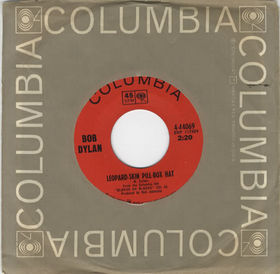
Nobody writes spiteful songs as well as Bob Dylan. One of his better ones is “Leopard-Skin Pill-Box Hat”, a rare pop song with two hyphenated words in its title. Recorded in 1966 for Blonde on Blonde, the song was released as a single in March 1967, a few weeks before the release of his first Greatest Hits album (which doesn’t include this song – strange marketing, that).
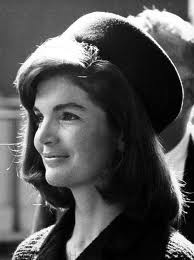
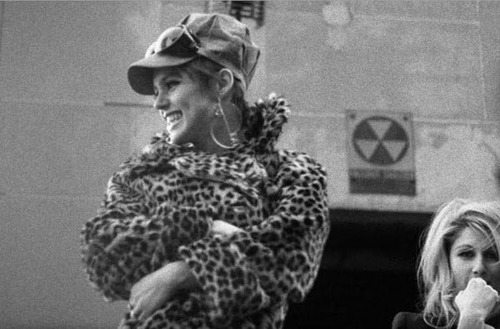
The song combines an interest in the already then out-of-style pill-box hat made famous by Jackie Kennedy, with leopard-skin, which was no more classy in 1967 than it is today. It’s a classic Dylan put down song:
Well, I see you got a new boyfriend
You know, I never seen him before
Well, I saw him
Makin’ love to you
You forgot to close the garage door
You might think he loves you for your money
But I know what he really loves you for
It’s your brand new leopard-skin pill-box hat
Wikipedia and other sources claim that the song is about Edie Sedgwick. Could be – I couldn’t tell you. That claim is part of a larger concern among Dylanologists to determine what every reference in every lyric could possibly mean. I have to say, these concerns are not generally mine. I don’t really care who Dylan was singing about – I don’t even care if it was a single person that inspired a song like this one. For me it’s much more the fact of the vitriol, and even if this song is a pale shade of something like “Positively 4th Street”, I am still amused by the bitterness that Dylan enabled to fill the pop charts.
This was Dylan’s only single released in the US in 1967. John Wesley Harding came out in the last week of December, and its singles (“Drifter’s Escape” and “All Along the Watchtower” came out in 1968). It’s a pretty minor effort all things considered.
Here’s a good version from London at the end of the 1966 tour:
I’ll be moving on tomorrow with 1967 in Bob Dylan weeks – a year that saw the release of his first Greatest Hits collection, the studio album John Wesley Harding, and the recording of dozens of songs that came to be known as the Basement Tapes. This is a whole new era for me – I never owned a copy of John Wesley Harding, and so I only know a few of the songs. I listened to it twice today, and it’s too early for me to say much about it (though I already hate one of the songs – stay tuned!). Basically, all of the albums between Blonde on Blonde and Blood on the Tracks are a bit of a blank slate for me, so it will be an interesting couple of months
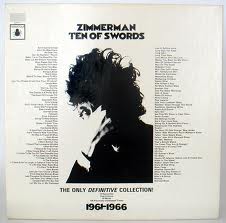
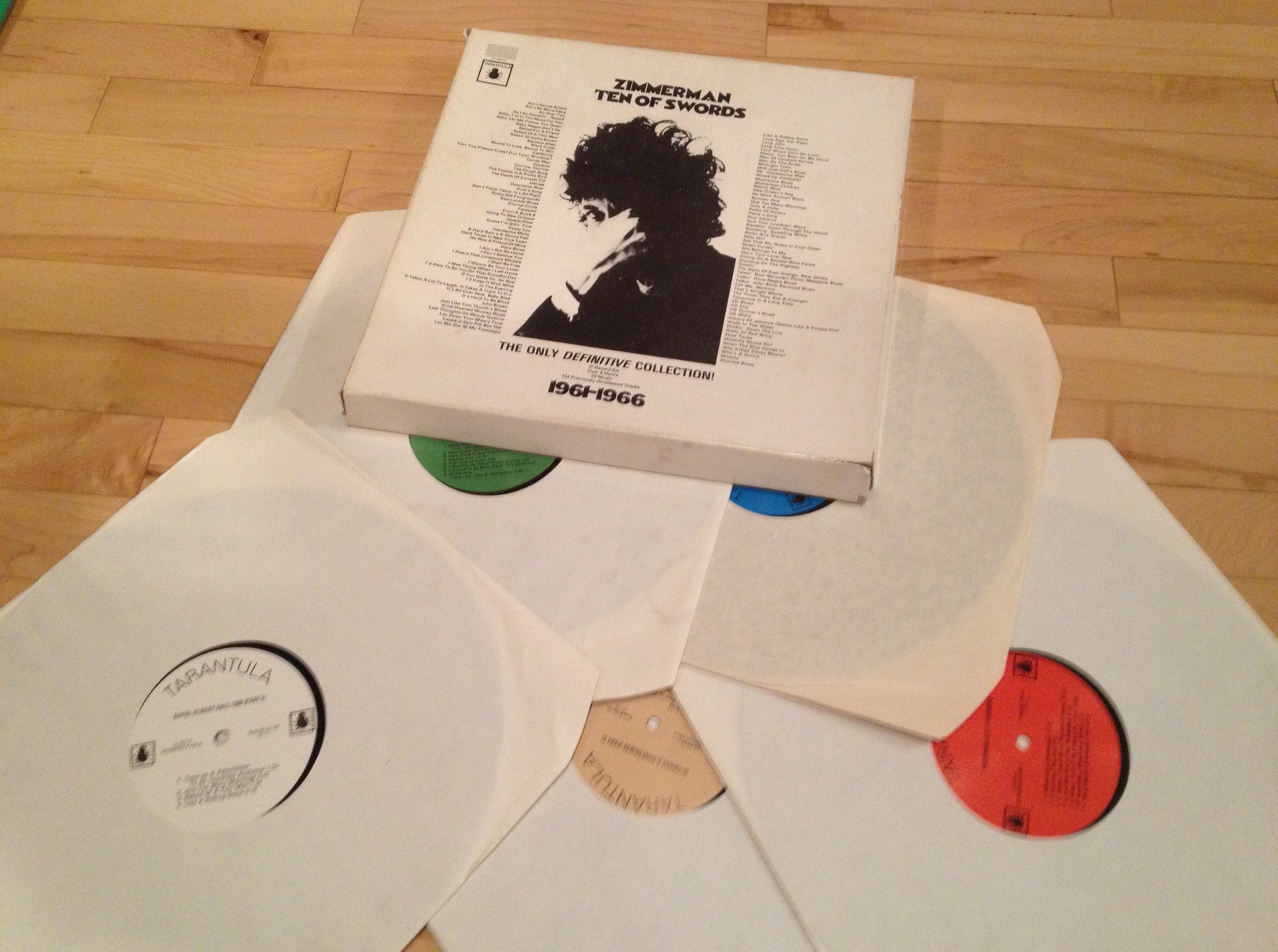
Today, though, I just wanted to say good-bye to Zimmerman: Ten of Swords. I’ve been reading a bit about that bootleg today and trying to retrace my own Dylan steps. It seems that it was released in 1985. Here’s a review of it from the Philadelphia Inquirer in 1986. It’s a well-curated collection of material from a wide variety of sources: The Witmark Demos, the Minnesota Hotel tapes, the Gaslight, Town Hall, and the “Royal Albert Hall” concert among them. All ten of the discs were pressed on very high quality vinyl, with professionally produced labels. Released by Tarantula Records, whose label cleverly mimics that of Columbia Records.
I asked the other day if anyone knew any good histories of album bootlegging, and I got an email referring me to Clinton Heylin’s book Bootleg. I haven’t started reading it yet (probably next week, actually) but it looks interesting.
I know that I first discovered bootlegs at a record store in Hamilton, Ontario on King Street. It was a used record store, across from the Silver Snail comics shop. For the life of me I cannot pull the name from the recesses of my memory. They had some vinyl bootlegs on the wall behind the cash and a lot of tapes with handmade covers (on construction paper!) that they sold for $10. That was quite a racket, because I assume he was just recording the bootleg vinyl that he was selling to create a secondary market. I still have those tapes somewhere and am going to try to dig them out.
Learning about bootlegs was a big game changer for me. It seemed very illicit, very adult. It wasn’t like buying drugs, but there was certainly a sense that it was against the law. More importantly, it was difficult to know what was going to be good and what was going to be bad in those pre-internet days. I now know that there existed a large network of fans who traded this information through fanzines and printed guides, but at fifteen or sixteen I had no clue at all. The guy would say “that’s a good one” and I’d look at the track list, and I’d take a shot. I guess it was sort of like buying drugs.
The ethics of bootlegging were also interesting. Dylan, of course, has long been critical of them – this caused a rift when he toured with the Grateful Dead – and this is one reason that I’ve been reluctant to actually post any here. I’ve been half-assing it by linking to other people posting them. Probably ethically dubious, but I sleep nights. That said, I have a lot of Dylan on my desk at the moment, including every album he ever put out in a nice new box, and if Columbia doesn’t want this stuff bootlegged they can always release it. I’m certain that Bootleg Series 4 killed the market for the “Royal Albert Hall” bootlegs absolutely dead.
I see now that the bootleg itself has become valuable. Here’s one copy that sold for $549 some time ago. Mine isn’t in as good shape. The discs are probably near mint, but the box got stepped on and so all four corners need to be repaired. I do have the booklet, but it’s not mint any longer.
Zimmerman: Ten of Swords was an album that I listened to over and over for years. I think that if I were to sell all my albums, I would probably keep it (well, for $549 you can probably have it). I bought it at a store in Burlington, Ontario – on the east side of Brant, not too far up from Lakeshore, across from City Hall moreorless, also don’t remember the name of that store and I don’t think it lasted all that long. A friend told me that they had it, and I spent my Christmas money on it. December 1985, probably. Maybe 1986. The appeal of “The Only Definitive Collection” was too much for me – I had to have it. It covered the period that I thought was key – 1961 to 1966 – and so I just ignored everything after it. I skipped John Wesley Harding, Nashville Skyline, Self Portrait, New Morning, Pat Garret & Billy the Kid, Dylan, and Planet Waves. Strangely I then owned a run of his next six albums from Blood on the Tracks through At Budokan. Then another gap (Christian period) and then some of the 1980s material.
The gap was probably the combination of three things: I knew that this was supposed to be the fallow period, and I didn’t know which were the actually good albums (if any); Biograph covered the most important songs from albums like John Wesley Harding (“Dear Landlord”, “I’ll Be Your Baby Tonight”, “All Along the Watchtower”), and, most importantly, Zimmerman: Ten of Swords taught me that this was the essential, undiluted stuff. It was literally era defining. Released twenty-five years into his career, it told me all I needed to know: the only great years were the first six.
Now I’m trying to find out if they lied to be all along, which, I guess, is the whole point of this blog.
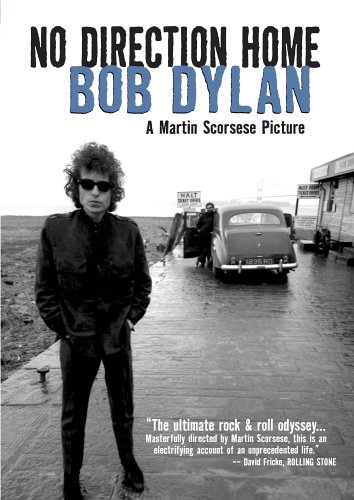
Dylan’s 1966 world tour with The Hawks is one of the most legendary moments in the history of rock music. Immortalized in Martin Scorsese’s No Direction Home, each show opened with Dylan playing a solo acoustic set for the first half, and then, after a short intermission, re-emerging with The Hawks for a rock set. To say that this didn’t go well would be an incredible understatement. Particularly in England, the crowd reacted to the drums, organ and electrified guitars with sheer horror. They abused Dylan and his band, they walked out, they interrupted, they tried to throw the band off rhythm by clapping off-beat.
In his book about “Like A Rolling Stone”, Greil Marcus insists that there was organized Stalinist resistance to the Dylan shows. He notes that the British Communist party-controlled folk clubs across the UK had an approved repertoire of songs that would ennoble the folk, and that Dylan had crossed them by abandoning folk, protest and topical songs. Marcus suggests that these clubs sent people to the shows, seating them strategically through the halls to rabble rouse, complain, and clap off rhythm. I have absolutely no idea if this is true or not, but watching Eat the Document and No Direction Home this week it certainly seems believable that these raging young men standing outside his shows were Stalinists. They were obviously true believers in something, and that something wasn’t particularly Bob Dylan.
A number of shows on the 1966 tour were recorded, in varying quality. It is clear from what I’ve heard from Sheffield, London (the last night of the tour), Liverpool and elsewhere that the reactions were fairly consistent over the course of the month. More importantly, it is clear that musically and vocally Dylan had never been better in his life. In No Direction Home he says something to the effect of “whatever they were booing, it wasn’t what they were hearing from the stage” and he’s absolutely right. Many of the songs performed on this tour are the best I’ve heard so far this year.
Yes, it is true that Dylan didn’t sing the protest stuff, even in the acoustic set. He commonly did “Baby Let Me Follow You Down” from his first album, but a rock version. Freewheelin’ and The Times They Are A-Changin’ were almost completely overlooked. But the fact is on most of the shows at the end of the tour the acoustic set was this:
She Belongs To Me
Fourth Time Around
Visions of Johanna
It’s All Over Now, Baby Blue
Desolation Row
Just Like a Woman
Mr. Tambourine Man
Seriously, that is an epic song list. That’s several of his best ever songs all lined up in a row. Now, of course, this isn’t the stuff that was getting booed. But Dylan was giving the crowd tight, focused, definitive versions of some of his best songs – I defy you to find a better version of “Leopard-Skin Pill-Box Hat” than the one that he did in Manchester – and they were still outraged. Remarkable.
Good shows abounded on this tour. There is a tremendous bootleg of the acoustic half of the final show (27 May 1966) at the Royal Albert Hall in London, where the version of “It’s All Over Now, Baby Blue” just slays me. The Sheffield show may have been recorded for a planned live album – the sound quality is impeccable.
The pinnacle of the whole tour, arguably the greatest single audience-performer interaction in the history of rock, took place on 17 May 1966 at the Free Trade Hall in Manchester. It was the sixth show from the end of the tour, and it is one of the most bootlegged shows of all time. Erroneously identified by those bootleggers as one of the two Royal Albert Hall shows that concluded the tour, it was released under that name as Bootleg Series 4. If I could only have one Bob Dylan album on a desert island, there is no doubt in my mind that it would be this one.
The Manchester show has no faults at all. You get both sides of Dylan, both at their absolute peak. You get a remarkable set list. And you get the most triumphant version of “Like A Rolling Stone” imaginable.
The second half of this show plays out a bit like a war between Dylan and the crowd. “Tell Me Momma”, the first song with the band, does not have any evidence of the booing – though the applause is markedly more muted than it was in the first half of the show. Dylan then introduces “I Don’t Believe You” by saying “It used to go like that, but now it goes like this”, which is a (good) line that he’d used earlier on the tour as well. Again, solid applause but also a few catcalls, and these grow as Dylan tunes his guitar and plays a little harmonica. Then the clapping starts. It’s a slow, distracting mean-spirited Stalinist clapping that Dylan drowns out with his harmonica and then the band comes in for “Baby Let Me Follow You Down”.
“Just Like Tom Thumb’s Blues” (awesome version, by the way) receives solid applause but more of the slow-clapping, but then Dylan interrupts it by talking over it. The crowd keeps quiet if they think he is going to say something to them – they’re like sheep that way. When the band takes too long to start the song, the clapping and booing grows overwhelming until Mickey Jones’s drumming leads them to drown it out. “Leopard-Skin Pill-Box Hat” follows, and this is a near-perfect version of this song – might be the best ever. Then comes the turning point.
The crowd loses patience as they band tunes again – and there is more clapping and stamping of feet. Dylan is brilliant here – just brilliant. He steps up to the mic and begins to mumble nonsense into it. Eventually the crowd stops trying to upset him long enough to listen to what he might have to say. Which is this: “If you only just wouldn’t clap so hard”. This generates a mixture of applause and boos, demonstrating the strength of the split in the crowd.
Of course, the pinnacle of the entire scene takes place after “Ballad of a Thin Man”. The most famous crowd interaction in pop music history begins with a bunch of people yelling things at the stage that are incomprehensible. Then someone yells “Judas!” at him. It’s as clear as day.
This is how the liner notes for the bootleg Zimmerman: Ten of Swords (which concludes with a recording of the electric part of this show) explained the situation to me when I was sixteen or seventeen: “It would appear that it is in answer to the “Judas” accusation that Dylan responds, “I don’t be-leeeve you…You’re a LIAR… [moving back from the microphone] … you’re a FUCKING LIAR!”.
For decades this is how I heard this exchange. The calls from the crowd are hard to make out if they’re more than a few words, and this made sense. Dylan’s final expletive could have been that. No Direction Home shows that he yelled it not at the audience but to the band – his back is to the crowd. It is also demonstrates that it’s not the “Judas” that draws the “I don’t believe you”, though it certainly might have been what crossed the line. On Ten of Swords you could hear that someone else yells something but it was never clear what it is. Bootleg Series 4 and No Direction Home make the whole scene much more precise:
“Judas!” draws no immediate response although part of the crowd laughs and claps, but then someone else in the crowd yells “I’m never listening to you again, ever!”. This is the man Dylan calls a liar (probably correctly), and then he turns his back on them and tells the band “Play it fucking loud!”. Which they certainly do.
Dylan spits the lyrics of “Like A Rolling Stone” at them. It’s an accusation. It is them that he’s singing to: “Once upon you dressed so fine, you threw the bum a dime, in your prime. Didn’t you?” The music thunders, and Dylan vents his spleen all over the Manchester audience as Jones thumps out a machine gun style drum line.
I was asked the other day if I’m going to make something like a Dylan Top 100 Songs at the end of this. I certainly am. Not just a list of the best songs, but the best versions of the best songs. I can’t imagine that “Like A Rolling Stone” won’t be at the top. I can’t imagine that it won’t be this version of that song. It’s perfection.
The best part of the whole exchange? Listen to the crowd at the end of the song. Long, loud, sustained applause. No booing. No catcalls.
Martin Scorsese made me nostalgic for three weeks ago!
Over the past three nights I’ve watched No Direction Home, the almost three-hour documentary about Bob Dylan’s life up to mid-1966. It is a brilliant documentary – I would recommend it even to people who are not fans of Bob Dylan. Yes, it is hagiographic, but that is the brief of projects like this one, so it’s hard to blame it for that. The speed with which Dylan arrived on the scene, became a star, took over, and then betrayed it is rather breathtaking, particularly when it is reduced to three hours. It’s sometimes hard to comprehend over the five weeks I’ve been doing this. I will say, watching him sing – in crisp clear film – some of his earlier material made me wish I was listening again to 1963 and 1964. I miss them already! Oh well, onward.
Scorsese hooks the documentary around Dylan’s 1966 tour of Europe, which was mostly England, but also stops in Sweden, Denmark, Ireland, and France. This tour was filmed by D. A. Pennebaker for a sequel to Dont Look Back, which wound up being Eat the Document, which wound up never being released (though you can watch it on YouTube, as I pointed out the other day). Scorsese rescues all of this footage, and repurposes it for the film that Pennebaker probably should have made forty-five years ago. He also borrows heavily on Murray Lerner’s Festival, which is the basis for The Other Side of the Mirror. Basically, Scorsese is able to cut two previous films together to make this film, and then he adds a lot of great archival footage, plus new interviews with Dylan, Joan Baez, Dave Van Ronk, Peter Yarrow, Pete Seeger, Maria Muldaur, Suze Rotolo, you get the idea.
One of the most remarkable things about this film is how much footage of Dylan exists. He is one of the first important artists of the era of the handheld movie camera, and he was just so thoroughly documented from 1963 onward. There is no film footage of the coffee house Dylan, but almost everything after that is out there to be seen – not simply everything he ever sang at Newport over a three year period, but so much of his tours in 1965 and 1966. There is a vast mountain of Dylan footage for Scorsese to cull from, and he does so extremely well.
The portrait of Dylan is very thorough. Scorsese isn’t afraid to take his time. He doesn’t even land a record deal until 70 minutes into the film – they spend a lot of time on his early life, his time in Minneapolis, and early days in New York. The footage of Greenwich Village really helped make that history more clear in my mind, even as there were some details that were rushed (including Dylan’s break with the organized political left, which is a much more elaborate story than is told here). The film is very much about the public Dylan. While two of his former lovers give current interviews (Rotolo and Baez), I don’t think Rotolo is identified as his ex- except in passing, and Baez barely talks about their relationship (she calls him “a special friend” at one point). Sara Lownds, Dylan’s first wife, is not mentioned at all – you would have no sense from the film that he was married during his UK tour in 1966.
The film constantly moves back and forth between a chronological march through Dylan’s career and footage from the 1966 tour. How brutal that must have been. While Dylan and the Hawks were playing the best music he had ever produced up to that point in his life, the crowds were absolutely terrible. It is one thing to read about the booing, but another again to witness its ferocity. The hostility was overwhelming, and Dylan was clearly crumbling. Some of the footage in the final minutes showing a completely strung out Dylan virtually begging to go home are tough to watch. This is a man who had been through an emotional wringer. He was twenty-five years old, he’d just had his first child, his crowds were fighting him, and he looked absolutely mentally and physically exhausted. A few months later, as the film notes, he would crash his motorcycle and retreat from public view, not touring for eight years (which is really going to cut down on my bootleg listening for the next two months, I can assure you).
One of the highlights of the film is the contemporary interview with Dylan. He seems honest, or about as honest as you expect Dylan might be able to be. He’s reflective, and he’s not playing games any longer.
The other highlight, for me, was the film footage of the “Royal Albert Hall” version of “Like a Rolling Stone”. I’ll write more about this later today, but let me just say that I watched this documentary when it aired on PBS in 2005. At that time I had no idea that that footage existed and it literally gave me goosebumps. It did again last night.
Ok, fine. I admit it. It’s a pretty great album. You’re right. I missed out. I should have given it more of a chance all these years.
Blonde on Blonde, ranked by Rolling Stone as the ninth best album of all time (and the second best by Dylan after Highway 61 Revisited), is really really good. It’s true.
I’ve listened to this album about twenty times this week, or at least most of it. Every single time (except the first) I skipped “Rainy Day Women #12 & 35”. I’m listening to it right now, and I just hit the next button on my phone as it looped around again. I just can’t stand that song.
Here’s how it breaks down:
Side One: One awful song (“Rainy Day Women”), two that are fine (“Pledging My Time”, “One Of Us Must Know”) and one all-time great (“Visions of Johanna”).
Side Two: One okay song (“I Want You”) and three great songs (“Stuck Inside of Mobile”, “Leopard-Skin Pill-Box Hat” (one of the best ever), and “Just Like a Woman”)
Side Three: Everything is good: “Most Likely You Go Your Way”, “Temporary Like Achilles”, “Absolutely Sweet Marie”, “4th Time Around”, “Obviously Five Believers”. Of these, “4th Time Around” was the biggest revelation to me on the whole album. This is a sort of response to John Lennon’s “Norwegian Wood” (which it imitates musically quite convincingly). I play “Norwegian Wood” on the banjo (sometimes even passably…) and I could probably play this too without only very slight modifications. Apparently Lennon took this song as a warning from Dylan not to appropriate his cryptic lyrics. I also really love “Obviously Five Believers”, which is just a great honky-tonk song.
Side Four: “Sad-Eyed Lady of the Lowlands”. Not great, not bad, sort of glad that it’s there, but not something that I listen to every time through.
Basically, if you took sides two and three, threw on “Visions of Johanna” instead of “I Want You” and deleted everything else, this would be Dylan’s greatest album.
What is really amazing is that there were six other songs finished for this album but which weren’t used. Of those, “I’ll Keep it With Mine” is fantastic, “She’s Your Lover Now” is very good, and “I Wanna Be Your Lover” is at least good. Throw “I’ll Keep it With Mine” on an album with the second and third sides and you’ve got an album that is likely much better than Highway 61.
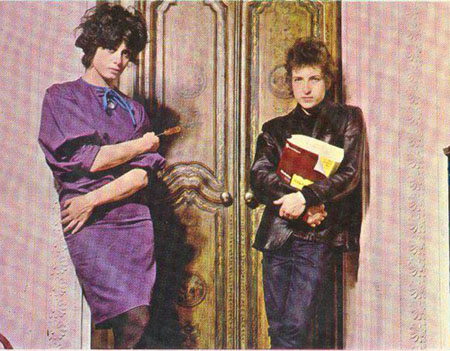
More interesting are the photos on the inside of the gatefold. The image of the man who is not Dylan is photographer Jerry Schatzberg. The woman in the solo picture is Claudia Cardinale, from 1963, a photo that Schatzberg had in his studio and that Dylan liked and so included. Later (1968 onwards) pressings of the album omit this photo as they had not secured Cardinale’s permission. Apparently this makes the ones with Cardinale more collectible. Luckily, that is the one that I have!
Original:
Post 1968:
But…. I just pulled my vinyl copy out of its sleeve because I wanted to see the exact breakdown of songs per side, and I discovered that one of the disks was a copy of Highway 61 Revisited. So I checked my copy of that, and it is also a copy of that album. So somehow I have two copies of Highway 61 and only the second vinyl disk of Blonde on Blonde. If I actually owned a turntable this would be a bigger problem, admittedly. I guess this means that my collectible copy of Blonde on Blonde is valueless. Alas.
Here’s “4th Time Around” in Dublin from the 1966 tour.
Certainly one of my mental stumbling blocks about Blonde on Blonde has to have been “Sad-Eyed Lady of the Lowlands”, which comprises the entire fourth side. This epic, which is said to have inspired Roger Waters to push Pink Floyd towards album-length songs, is a bit of a slog.
While there is a lot of speculation about who certain of Dylan’s songs are about (Edie Sedgwick seems to be the best guess for several of them!), this one is not in doubt: Dylan had recently married Sara Lownds, her last name is not that dissimilar to Lowlands, and, later in the song “Sara” (from Desire) about their divorce he writes the lyrics “Staying up late in the Chelsea Hotel, writing ‘Sad-Eyed Lady of the Lowlands’ for you”. So that’s pretty clear (Dylan and Lowndes lived in separate rooms in the Chelsea while they were dating to make it even more clear).
Of course, “Sara” is a bit of a stretch of the truth, because all the reports indicate that Dylan wrote this at the keyboard in a studio in Nashville all day while his back-up musicians dozed, smoked, and generally waited around. By his own admission the thing got a little out of control – the lyrics just keep coming and coming and coming.
This is the greatest use of the word “and” in the history of song. Nineteen times the word appears in the verses. He just keeps stringing her characteristics together in a list, one after another. He sure did have a lot to say!
Musically there’s not much to this one in comparison to a lot of the other songs on the album – it’s quite repetitive. This was essentially a one-take recording, the other takes are all rehearsals or interrupted. There doesn’t seem to have been much practice. The drummer noted how the second chorus builds to a crescendo because the band thought they were wrapping, but then there’s six more minutes of song left.
Not his best lyrics, not his best music. He never played this song live. It would have been interesting to see if he could remember all of the words. I do like some of Dylan’s epics – “Desolation Row”, and, as we will see in a few months, “Brownsville Girl” – but this one has its reach exceed its grasp.
What makes this song most interesting to me is the fact that Joan Baez covered it on Any Day Now, her album of Dylan covers. It’s not just that her version is so much better (though it is that), it’s just so bizarre for Dylan’s former lover to be singing the song that he wrote for his wife and the mother of his children. Their relationship continues to confound me.
Bit of crossed purposes: I had a plan to discuss all of Dylan’s singles this year, but then I found that I really didn’t have much of anything to say about “I Want You”, the first single from Blonde on Blonde. For me this was always the closest that Dylan came to writing a boring pop song. The chorus:
I want you, I want you
I want you so bad
Honey, I want you.
Not exactly Shakespeare.
Sure, there are good lines. It starts well: “The guilty undertaker sighs, the lonesome organ grinder cries”, but it’s all downhill from there. I planned to skip it.
But this morning on the drive to work (-27C this morning, you ride your bike) Rebecca noted when it came on that this was one of her favourite Dylan songs. That seems impossible to me, and I asked why.
For Rebecca this isn’t a Dylan song so much as it is a Dylan song that Bruce Springsteen covered at the Main Point in 1975, a bootleg that circulated in her house among the seven children. Rebecca explains that Springsteen understood far better than Dylan that this is not an uptempo number, but a song of desperation.
So for Rebecca and her siblings, here’s The Boss breathing life into one of Dylan’s lesser numbers.
(Also, that single cover is just about the worst photo of Bob Dylan I’ve ever seen – certainly the worst up to this point).
A strong contender for my choice of best Bob Dylan song of all time is “Visions of Johanna”. The third song on the first side of Blonde on Blonde, it is the first good song on the album. The lead track, “Rainy Day Women #12 & 35” is, as we have already established, just plain awful. The second, “Pledging My Time” is not a whole lot better, truth be told. It is this combo that always made me a little reluctant about this album.
“Visions of Johanna” is a song that I know a lot better from Biograph than from Blonde on Blonde. The Biograph version is a live recording from London in 1966, one of the two last concerts that Dylan performed before his hiatus. I could probably make an argument that it is the peak of public performing in the 1960s if I really wanted to push it – the harmonica solo is tremendous and it is a really pained and soulful rendition of the song.
By contrast, the version on Blonde on Blonde (an album I’ve listened to only sporadically in the past, but a lot in the last couple of days) seems so very different. The key to Blonde on Blonde is that it combined the skill sets of Nashville’s top studio musicians with Dylan’s poetry. For people who think it’s his best album, this is one of the primary selling points. I’m beginning to be won around to this way of thinking. This version of “Johanna” throws me a little, but always in a good way. There are very nice musical fills at the end of a lot of the lines, and it really heightens some of the musical limitations of his earlier recordings.
Poetically, this is, for me, Dylan at his absolute peak. Some of the maniacal nonsense lyrics of Highway 61 Revisited can be grating when he goes too far. Here he’s just a little bit off kilter in his metaphors and they all work so much better. “The ghost of electricity howls in the bones of her face” may be my favourite song lyric of all time, and the following verse is also near perfection for me:
Now, little boy lost, he takes himself so seriously
He brags of his misery, he likes to live dangerously
And when bringing her name up
He speaks of a farewell kiss to me
He’s sure got a lotta gall to be so useless and all
Muttering small talk at the wall while I’m in the hall
Oh, how can I explain ?
It’s so hard to get on
And these visions of Johanna they kept me up past the dawn.
Even over the course of a couple of decades of not actively listening to Dylan, I would still occasionally recall the entirety of this song, and I can get the whole thing stuck in my head rather than just a simple phrase.
This week the line that has been absolutely killing me is: “See the primitive wallflower freeze When the jelly-faced women all sneeze”. There’s just something about the word “jelly-faced” that has set me off every time.
This is a version from Sheffield, a few days before the Biograph version. It’s not far off the quality. It may even be better:
Some day Jean-Luc Godard will be held to account for the sins of the filmmakers who followed in his wake. Eat the Document, the never released Bob Dylan tour documentary shot by D. A. Pennebaker but edited by Dylan himself, is one such sin. It leaps and jumps all around the tour, apparently in an effort to provoke. Commissioned by ABC television, it never aired. It would have been impossible for it to air. The opening, with Dylan sort of freaking out while playing piano in a hotel, would probably be enough to make most people turn the channel for good.
Watching Eat the Document, which you can do in its entirety thanks to the glories of YouTube (see below), is like watching someone’s travel home movies, if your friend taking the trip is heavily narcotized and on the verge of a nervous breakdown. The opening minutes are very hard to take – just a lot of footage of Dylan and The Hawks (as they were still called at the time) on buses and trains. Indeed, there may be more footage of trains in this film than of Dylan on stage. There are also many shots of dogs, a parade/protest, and Dylan sitting around sulking.
There are moments in this film that are really rather incredible. The long pan near the end of that features everyone else eating and enjoying themselves, and Dylan looking like death warmed over is so telling. The 1966 tour of Europe was Dylan’s last tour for eight years – indeed, for the rest of the 1960s he only played live on a small handful of occasions. While the shows on the continent seemed to be going alright (it’s hard to tell given how fragmentary the scenes are), it is clear that the shows in England were not. The booing was there. Dylan escapes at one point in his car yelling about one of the fans who he accuses of having booed. Pennebaker shoots a lot of post-concert footage with articulate and bitter young men who explain in great detail why and how Dylan has betrayed them. Scorsese would repurpose a lot of this material for his own documentary.
Dylan turned twenty-five during this tour (at the show in Paris, actually), and he looks much older than that. He is clearly someone who has had it. The stresses have led him to burn out. The most famous scene in the film is the one where Dylan and John Lennon drive through London in the back of a car. Lennon is hilarious: “Do you suffer from sore eyes, groovy forehead, or curly hair? Take Zimdawn!…Come, come, boy, it’s only a film. Pull yourself together.” Dylan just hangs his head in his hands, waiting for it all to be over.
Eat the Document does have some interesting scenes. There are a lot of moments where you want to just say, “Hold it! Stop! Go back! Show me more!”. From out of nowhere there’s Johnny Cash leaning on a piano as the duo sings “I Still Miss Someone” and you think “this is the greatest thing ever!” and then as quick as it started, it’s gone. The same with Lennon. A whole film could be made about that car ride, and we get about ten seconds (come to think of it, Todd Haynes does make a whole film out of that car ride in 2008….).
The concert footage is often good. I’ll have more to say about these shows later this week, but the band was really coming together by the end of this tour. Had Dylan been able to keep it together, they would have done even more amazing things. But it was also clear that he was trapped – “We can’t even leave the hotel” he tells someone. Eat the Document is much the same – it’s a film that can’t leave the hotel, and it can’t leave Dylan’s head either. At some point near the end I found myself thinking “this film is brilliant!” for its depiction of the nervous breakdown of a star from his own perspective. Five minutes later I wasn’t sure. It’s either phenomenally under-rated or a phenomenal waste of time. Probably it’s both.
Here’s the whole film (don’t worry – that annoying clicking goes away immediately, replaced by the annoying film):







 LongAndWastedYear