“End of the Line”, the second Traveling Wilburys single, was released at the end of January 1989, about a month after the death of Roy Orbison. It’s a quite poignant song because of that fact. The lyrics are written for middle-aged men in a retrospective mode, and it’s easy-going sensibilities point to the value of accepting life (and death) as it comes:
Well it’s all right, even if you’re old and gray
Well it’s all right, you still got something to say
Well it’s all right, remember to live and let live
Well it’s all right, the best you can do is forgive
Both of the Wilburys singles from their first album were very obviously singles. The songs open and close the album, and they are the only ones on which most of the band has a featured vocal part. “End of the Line”, actually, does not feature a Dylan vocal; Harrison, Lynne, and Orbison take turns singing the chorus while Petty sings all of the verses. Dylan can be heard harmonizing on the one line (“End of the Line”) throughout. Many of the other songs on the album are fairly straight solo songs by the songwriter with the rest of the act serving as guest stars, but this and “Handle Me With Care” are the clear showcases for the group as a group.
The video is pretty basic – the four men play guitar around an empty chair that holds Orbison’t guitar on a set made to look like a moving train. Simple and straightforward. A tasteful tribute to the late, great Roy Orbison.
One thing that I’ve learned by studiously following the constraint of this blog – I listen to one year of Bob Dylan’s output each week, and only listen to that year that week – is that some years are a lot more interesting than others. There have been a few years where Dylan essentially retired from public life, and those have left me listening to a few dribs and drabs over and over. And there are years where Dylan was so ridiculously prolific that I’ve been scrambling to cover everything. 1988 has been one of those years.
In 1988 Dylan released Down in the Groove, his twenty-fifth studio album, and also Traveling Wilburys volume 1, his biggest ever hit album. He also performed seventy-one live shows, two of which I attended. This was an ill-timed week for me to have houseguests and be on the road. If I could have a do over, I would take one for 1988 so that I could listen to the Wilburys outtakes (never got to that) and to the New York concerts that are so heavily praised. No time left. Dont Look Back, to borrow a title.
So, here’s Down in the Groove just before midnight on the final night of my week. This is one of the albums that I have listened to the least, and it is probably the one that I listened to the fewest times (so far) this year. In doing this project I was stunned – and I mean stunned – to learn that I owned this on vinyl. I have absolutely no recollection of purchasing it or ever listening to it in the 1980s. Did someone give it to me? Possibly. I mean, I have no memory of acquiring it.
Down in the Groove is one of Dylan’s least admired albums. It’s short (32 minutes), it has only four new Dylan songs (two co-written with Robert Hunter) and it seems just sort of pointless. I don’t believe that it was a contractual obligation album, but it kind of comes off as one. The album was recorded over a long period of time with guest stars ranging from The Grateful Dead to Eric Clapton, and it seems clear that he was at a bit of a loss. As in the days of Self-Portrait, he retreats into cover songs when his mojo runs out, which seems to have happened here. Rolling Stone called this his worst album, and he has a few legitimate contenders for that title.
I don’t think it’s his worst album. For one thing, it’s not actively bad – it’s just sort of unnecessary. On CD the album breaks into three parts – it opens with three covers, goes into the Dylan originals, then finishes with three more covers. Only the middle section sucks, but, of course, that’s the section that most people were buying it for.
The first section is highlighted by the cover of “Let’s Stick Together”, which has been done by everyone from Bryan Ferry to Canned Heat. I actually love this version of this song, particularly Dylan’s phrasing. To my mind it’s the highlight of the whole album. “When Did You Leave Heaven?”, which was nominated for an Academy Award in the 1930s when it was used in the movie Sing, Baby Sing is sort of awful. “Sally Sue Brown” is a pretty standard Dylan country cover that doesn’t add much to the song.
While “Silvio” is the best known Dylan song from the album (and the only one to be used on future anthologies), my belief is that “Death Is Not the End” is the best original song on the album (produced by the returning Mark Knopfler). But it’s not that good – probably not even a top 50 Dylan song. He’s never done it live. “Had a Dream About You Baby” is pretty much a nothing. The two songs with The Grateful Dead don’t thrill me at all.
“Ninety Miles an Hour Down a Dead End Street”, the Hank Snow song, is one of the better things here, but, again, inessential. “Shenandoah” is pretty good – nice little harmonica piece at the beginning and I like the way that he sings here, and he uses the back-up singers nicely. Finally, “Rank Strangers to Me” is one that I like, but that may be because I really like the Stanley Brothers version of this Albert Brumley song. This is a good vocal performance by Dylan, and a nicely minimalist production.
So that’s four songs that I would keep, but, sadly, none written by Dylan. That said, if you threw this album away I’m not sure that I would entirely miss it. Again, there is nothing truly awful here, but nothing essential. (Of course, as soon as I type that “Let’s Stick Together” comes back around at the top and now I’m starting to think that I love this version of this song!)
Perhaps the saddest thing about this album is something I just learned the other day. The original album cover for this was drawn by the underground cartoonist Rick Griffin (below). That would have been the greatest Bob Dylan cover of all time and THEY DIDN’T USE IT! Instead the album covers with the most boring photo of Bob Dylan ever (above). What. The. Hell?! Griffin, of course, was better known as a rock poster artist than as a contributor to Zap Comix, and Dylan probably was put onto him by the Grateful Dead (for whom he did a ton of work), although he too was a born again Christian, so perhaps there was another connection. Griffin died in a motorcycle accident in 1991, and this cover would have been one of his last major works. What a waste
Since I can’t find any Dylan songs from this album on the internet, let’s go with a Nick Cave cover. Always a good option!
Amazingly, Traveling Wilburys v.1 was the first Bob Dylan album to sell two million copies. The absolute peak of his commercial appeal came in the super-group that he formed semi-accidentally with George Harrison, Roy Orbison, Jeff Lynne and Tom Petty. It is pretty easy to make the argument that the album fundamentally shifted Dylan’s approach to record-making, not only snapping him out of a period of relative creative doldrums, but finally (FINALLY!) impressing the importance of production upon him.
What I know about the Traveling Wilburys I know because I read Wikipedia. Here is that story for the record: Harrison wanted to record a b-side for his single “This is Love” and mentioned this at a dinner with Lynne and Orbison. It was suggested that they record at Dylan’s house, since he had his own studio. Petty got involved when Harrison went to Petty’s house to retrieve a guitar he’d left over there. “Handle With Care” was written and recorded in five hours. The studio then decided that it shouldn’t be a b-side, and the five men opted to cut an album using goofy pseudonyms. They recorded the rest of the album at the home of Dave Stewart of The Eurhythmics. It went triple-platinum and won the Grammy for Best Rock Performance by a Duo or Group in 1989. Orbison passed away in December 1988, before “End of the Line” was released as a single.
There are a few general things to say about this album. First, it is clearly a bunch of very famous and very talented men goofing off. This is not an album that seeks to make a major statement, it is a collection of songs put together quickly and for no real purpose other than for the sheer pleasure of doing it. None of them really needed any money, and there was no intention of touring. They were just sort of in-between projects. Bored, I guess. Second, particularly for a Dylan album, the production, by Jeff Lynne, is superbly polished. Lynne is a notorious over-producer, and Dylan notoriously doesn’t seem to care much about production at all. Dylan has remarked many times in interviews that he didn’t get what bands like The Beatles were doing in studio, and he felt lost by all of that so he moreorless let it all go and didn’t even try to compete. Coming out of this experience, Dylan will fundamentally alter this approach to studio recording for the next two and a half decades. Thanks for that, Jeff.
(When I came inside tonight at my parents’s house, the tv was on The 1960s documentary and I walked in on Brian Wilson using the studio “like an instrument”, which then cuts to Ringo explaining the Beatles’s studio set-up and a segue into Sgt. Pepper’s. Dylan never had any part in that particular movement)
The writing credits on Traveling Wilburys v. 1 were all joint, which makes it a bit of an effort to determine what parts are the Dylan parts from the point-of-view of this blog. Fortunately, Wikipedia (again) notes that the songs were copyrighted by their main writers (Harrison copyrighted “Handle With Care”, for example). Dylan’s own company, Special Rider Music, copyrighted “Dirty World”, “Congratulations”, “Tweeter and the Monkey Man”, and “Like a Ship” (which is on the bootlegs and also on the 2007 Rhino Records box set of the two Wilburys albums).
So, on that front:
“Dirty World”. This could have been a straight up goofball Dylan song. He sings all of the key lyrics, with contributions from the back-up singers. It has that 80s Dylan horn line, but the Lynne production is far superior to most of what Dylan put out earlier in the decade. Dylan doesn’t usually do straight up ‘sexy’ or ‘dirty’ songs (well, not since “If You Gotta Go, Go Now”) and this song fulfills both criteria.
“Congratulations” is a bit of a split for me. I like the verses, but the chorus is a bit dour. It’s a semi-dumb break-up song, and pretty minor. It seems like the most Dylan-like thing on the album, and that’s not necessarily a good thing.
“Tweeter and the Monkey Man”. This is the song I used to make fun of from this album when my father bought it. The title made it sound so self-evidently ludicrous that I don’t think that I ever actually listened to it. Another epic Dylan story song, this is probably the song that falls flattest on the whole album. My attention tends to wander when I listen to this one. Someone described it recently as Dylan doing a Bruce Springsteen parody. That piqued my interest. Sure, I guess, it has a lot of references to New Jersey and cops and driving cars, but it doesn’t really make it that good. This video is somewhat fascinating as it includes a lot of ‘backstage’ material, including Dylan reading his own lyrics, and recording them while reading from a yellow legal pad.
It’s not difficult to see why “Like a Ship” didn’t make the cut for the album. It starts off fine, but when it gets to the verses it all just falls apart and becomes overwrought and overproduced. It’s not much of a bonus for people seeking to upgrade their CDs with the Rhino release.
The rest of the album, the non-Dylan written songs, are generally quite good. I’ve never been much of a Jeff Lynne fan (and ELO not one little bit), but “Rattled” is a fun little Jerry Lee Lewis song. Tom Petty’s reggae song, “Last Night”, has a certain Jimmy Buffet vibe to it, but that is entirely intended. “Not Alone Anymore” is certainly the last great song in a long career of them for Roy Orbison. “Heading for the Light” sounds very typical of Harrison of this period, but that’s not really a complaint either.
As an album, Traveling Wilburys v1 may hang together better than any single Dylan album of the 1980s other than Infidels, even if the Dylan parts are not always the best parts. It’s probably one of the best albums ever put together by a bunch of middle aged men for no good reason. And that’s a good thing.
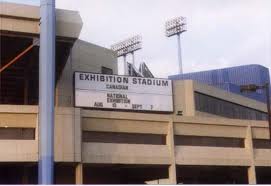
I have far less confusion about the second Bob Dylan concert that I saw than I do about the first. On August 29 1988 Dylan returned to Ontario to play the Canadian National Exhibition.
One of the things that I sort of always liked about growing up in the Toronto area were the CNE concerts. I never really did the CNE much at all as a kid because my family owned a cottage so we were never around at the end of August to go. By the time I was in university, I was always working in the summer, so I was around for a bit of it. The CNE is just a big state fair equivalent – midway rides, try to win a stuffed animal – but they always had a series of big name concerts each night, and admission to the Ex, as it was called, was free with a ticket. A list of shows, from 1948 to 1994, can be found here.
As I say, I didn’t go to many of these as I would have been away every summer through 1986. In 1987 I saw The Cult show there, and I am reasonably certain that that was the show at which Guns ’n Roses opened and were booed off the stage. A few months later their first album would break and they became the biggest band in the world, but that audience despised them that night. I definitely saw one of the David Bowie shows that year, and the New Order show (awful) and the Echo and the Bunnymen/Gene Loves Jezebel show (also pretty bad).
In 1988 I saw Bryan Ferry and also Bob Dylan. I remember that I had no solid plans to see the Dylan show because I went with my girlfriend of the time and we had no tickets. Since you had to pay admission to the fair unless you had a ticket, I think I paid to go in to the box-office with the plan of bringing the tickets back, so that we would save money. I remember that someone sold me tickets while I was standing in line, with the logic that the tickets (not marked up) would be better than what I could get day of at the box office. So I paid for those and it turned out we sat about six rows from the stage, dead centre. There were two seats empty next to us, or a couple of seats away from us, during the opening act, and when that ended that act – Timbuk3 – came and sat with us. At the time it was sort of cool – hey! rock stars are sitting right next to us to watch Dylan – and sort of uncool – hey! Timbuk3 sort of suck! – at the same time. Regardless, the seats were awesome.
Other things I remember: it was kind of cold and I didn’t have a jacket. The sound system was typically bad (an outdoor football/baseball stadium, the Ex was always a terrible venue) but we were so close to the stage that it was almost alright. Dylan still wasn’t talking to the audience. I thought it was a better show than Hamilton the month before.
I have a bootleg of this show and it is quite similar (though the quality of the bootleg is superior). Here was the setlist:
Subterranean Homesick Blues
Absolutely Sweet Marie
Masters of War
Simple Twist of Fate
Shelter From the Storm
Highway 61 Revisited
Girl From the North Country
Don’t Think Twice, It’s Alright
One Too Many Morning
Barbara Allen
I Shall Be Released
Silvio
Like a Rolling Stone
It Ain’t Me, Babe
All Along the Watchtower
Knockin’ on Heaven’s Door
To my ears, that’s a better setlist than the Hamilton show, although it has fewer “hits”. Other than “Silvio”, nothing later than the mid-1970s. This was a real classics tour. This may have been one of the best Dylan shows that I ever saw live.
In 1989 I saw only one show at the Ex (The Cure and Love and Rockets). In 1990 I didn’t live in the Toronto area for the summer, so I saw none. In 1991 there was nothing I wanted to see. Since then I haven’t lived around Toronto. Now I’m kind of curious as to what shows they have this year….
A minor note on Bob Dylan and Woody Guthrie: In 1988, Folkways Records released a tribute album, A Vision Shared: A Tribute to Woody Guthrie and Leadbelly. This album featured leading folk and rock singers (John Mellencamp, U2, Bruce Springsteen (twice), Brian Wilson, Pete Seeger, Willie Nelson, Emmylou Harris…) covering songs by the forefathers of American folk music. The second song on the album is Dylan’s cover of Guthrie’s “Pretty Boy Floyd”.
This is a song that Dylan had recorded and performed way back in 1961. Apparently there is a tape of him playing this at Gerde’s Folk City in 1961, but I don’t have a copy of that. He returned to it more than a quarter century later, and he only played the song live on one occasion: during his final concert of 1988, a benefit for the Bridge School in Oakland (Tom Petty also played this show, acoustic and without The Heartbreakers). There is a video of Dylan (with G. E. Smith, but not with the rest of his band) performing the song here.
This has caused me some minor frustration this morning since I would love to be able to compare the two live versions of this song, but, alas, I don’t have both. This caused some frantic and, so far, unsuccessful web-searching this morning. The vastness of this Dylan project still impresses me sometimes.
The first Bob Dylan concert that I ever attended took place on June 11, 1988 at Copps Coliseum in Hamilton (a large hockey arena built by the city to attract an NHL hockey team that the Toronto Maple Leafs made certain would never be placed there; it’s now known as the FirstOntario Centre). Copps was a fairly new building at the time (opened in 1985), and I recall that its acoustics were superior to those of Maple Leaf Gardens, the venue that Dylan had been regularly playing in Toronto in the 1960s.
I remember that I went with five friends from high school, which had just ended for me a few weeks before. One of those five was the girlfriend who had broken up with me on my eighteenth birthday three weeks earlier, so that was fun. I guess that’s the problem with buying tickets in advance. I know that one of the others was my friend Marc, who was very interested and knowledgeable about music, but not at all a Dylan fan. For some reason I can’t actively remember who the other people there were. Probably friends of the ex-girlfriend. I know that none of them were particularly Dylan fans. I kind of remember that they all thought the show was lousy, but they were happy to see The Jam, who opened the show.
This was a relatively early show on what is now known as the Never-Ending Tour, which began in June 1988 (Bjorner says it was show #22). Dylan was supported by a band led by G.E. Smith, the guitarist for Saturday Night Live who was famous for leering into the camera as that show went to commercial. Dylan’s earlier tour that year had featured Neil Young on guitar (Young was in a similar career slump at the time).
Things I remember: Dylan wore a leather vest and leather pants. The mix was somewhat awkward. He played an awful lot of hits. My friends felt that he hadn’t played enough of his hits and that he was an old man. I remember thinking that the show was pretty damn good.
I now have a (very poor quality) bootleg of that show. I can confirm that he wore leather pants and a leather vest (if the cover photo is actually from that show, which is not always the case with bootlegs). I can confirm that the mix was awkward (or the tape mic was hidden in someone’s armpit, which may be even more likely). I can confirm that he played a lot of hits. Indeed, as a line-up of Dylan songs this one is very difficult to beat:
Subterranean Homesick Blues
Absolutely Sweet Marie
Stuck Inside of Mobile
Ballad of a Thin Man
Simple Twist of Fate
All Along the Watchtower
To Ramona
Mr. Tambourine Man
I Shall Be Released
Silvio
Like a Rolling Stone
Hard Rain’s a-Gonna Fall
Gotta Serve Somebody
Maggie’s Farm
Seriously, that is as close as you can get to an all Dylan hits show. Obviously, the addition of “Blowin’ in the Wind” would’ve pushed it even further, but he only did three non-1960s songs, and one of those was on the pop charts at the time. Some people are never happy.
Re-listening to the show today, I don’t like it that much – I have a lot of 1980s bootlegs that I greatly prefer. I’ve never recalled this as one of the best Dylan shows that I saw, probably because I went with an ex-girlfriend and a bunch of people who complained the whole time. Just another Dylan disappointment.
I do have to say, though, the most interesting thing that I’ve learned from doing this project and reading through the accounts of Dylan’s extensive touring is that I have seen Dylan far fewer times than I always thought that I had. There has seemingly been a great expansion in my mind on this subject. For instance, I would have been certain that I saw Dylan prior to 1988, but I now know that I didn’t. People keep asking me how often I’ve seen Dylan, and I thought it was dozens of times, but now I don’t think it is even a dozen in reality. There is something about my memory that is really playing tricks on me when I cross-check it against the historical record. I definitely would have placed this show earlier in my own personal musical biography.
I couldn’t find any video from this show, so instead here’s The Lumineers doing “Subterranean Homesick Blues” in the very same venue twenty-five years later:
—
On edit: I graduated from high school in June 1987, not 1988. So my ex- would have been a full year’s ex- by this point. So now I can’t figure out why we were there together at all. The mystery deepens.
—
On edit: The Jam broke up in 1982. Who the hell opened this show?
—
On edit: It has been suggested to me that The Alarm opened numerous shows for Dylan in 1988. But who would confuse The Alarm for The Jam even a quarter century later? Also, I have now come to believe that I was at this show with an entirely different group of friends, but that they still didn’t like the show.
In 1988 Bob Dylan changed his name to Lucky Wilbury and released an album with his four brothers, Nelson, Otis, Lefty and Charlie T. Their first single, which hit number two on the pop charts, was “Handle With Care”. This was a revitalization of Dylan’s career. I was completely certain that it was a sign of the apocalypse.
How bad was “Handle With Care” to the eighteen year old me? It was so bad that my father bought the album on CD (one of the first CDs ever to come into our home – I didn’t buy my first until three or four years later, I was convinced that the whole thing was a complete scam by the record companies). For me, the Traveling Wilburies were, literally, your father’s Dylan, and I wanted absolutely nothing to do with it. I remember that I sort of actively sought to shun the song and to avoid listening to it.
The problem was that the song was popular, the album was popular, and, dispassionately, it is a far superior single to “Silvio” (which, of course, I also didn’t like). The Dylan renaissance was beginning all around me and I wanted nothing to do with it. I had become a cranky young man railing about Dylan selling out! Dylan, who had disappointed his fans in, at least, 1966, 1969, 1972, 1979, and 1982, had finally disappointed me. Ironically, what drove me from him was the decision to release a well-produced album.
I was a bit dim when I was eighteen, but so are most people at that age, so it wasn’t my fault.
Listening to the song, it’s actually pretty good. Roy Orbison is certainly the highlight, but the whole supergroup thing works well because it doesn’t seem like a cluster of egos and clashing notions. The whole Wilbury’s project only sometimes works, but this is an example of it gelling.
There is an extended version (by about two minutes) that was included with the CD single (alongside the b-side, “Margarita”). It is quite the step down in terms of production. It adds about a minute of the guitar part at the beginning and then seems to sample the chorus with bizarre over-production that makes it sound like the song is being recorded in an echo chamber. This version also really foregrounds the drums more than the single does, presumably to make it more club friendly. It’s quite the disaster – phasing synth noises have been added to the bridges, for example. It’s not better in any way, it’s just more, and this is not a song that needed “more”.
“Silvio” marked Dylan’s return to the pop charts in 1988. The song, co-written with The Grateful Dead’s Robert Hunter, peaked at #5. It was the only single off the album Down in the Groove. I recall that it further cemented my growing break with Dylan.
Down in the Groove was released at the end of May 1988. I graduated from high school in June of that year. I dutifully bought Down in the Groove, and found it even more lacking than Knocked Out Loaded (nothing even close to the quality of “Brownsville Girl”). I was pretty out of touch with top forty music at the time, but I was aware that “Silvio” was receiving air play. I had no idea that it was as popular as it was until Wikipedia told me so.
“Silvio” is quite the ear worm of the Dylan song. The chorus:
Silvio
Silver and gold
Won’t buy back the beat of a heart grown cold
Silvio
I gotta go
Find out something only dead men know
is pretty much the only thing that I ever recalled from the song. Even today I didn’t really know any of the lyrics to the verses – they seemed somewhat irrelevant, and they pretty much still do today.
I do recall dismissing this song as sub-standard Dylan partly because it was co-authored with Hunter. I was pretty anti-Grateful Dead at this point in my life, and so I felt the song was contaminated by their involvement with it, which is, of course, utterly nonsensical in retrospect. My attitude was that Dylan didn’t need to be co-writing with inferior talents, which is also bizarre because my favourite Dylan song was co-authored with Sam Shepard, and my favourite album that year was Desire, which is mostly co-written songs. Consistency was not the hallmark of my high school years.
Dylan is clearly a fan of this song. He has played it live 594 times. It entered the repertoire in 1988 and it really didn’t leave for a long time. Bjorner even found it noteworthy to mention concerts where it wasn’t played over the following decades.
Listening it today with fresh ears I don’t like the back-up singers and their “whoop whoops”. I do like the piano. Musically it’s better than most of Dylan’s output in the 1980s, but it still feels really slight to me. It’s not actively offensive or anything, just a sort of blank. This version sort of sounds like the novelty song from Inside Llewyn Davis:
Bob Dylan kicked off 1988 by getting inducted into the Rock and Roll Hall of Fame in Cleveland. He was part of the third class inducted. The first class had been primarily 1950s-era stars (Presley, Holly, Berry, Domino, Little Richard….), while the second class was primarily Motown (The Coasters, Aretha, Marvin Gaye). Dylan was inducted the same year as The Beatles and the Beach Boys, and the Supremes.
I don’t remember watching the show if it was broadcast in Canada. I supposed that it probably was, but I definitely missed it. The Hall itself has uploaded some videos from the evening to YouTube. It seems like they don’t have the broadcast rights, because the videos are all shot from behind, so you can see everyone’s back. They eventually shift to the front, or swish around looking for people in the crowd.
The Dylan segment was kind of painful. Bruce Springsteen, clearly nervous, did the induction. He does, at best, a mixed job of it. I thought it was nice of him to praise Dylan’s contemporary work, but he didn’t really get the point across. He does seem to be at a loss as a public speaker. I’ve certainly seen him do much better later in his career.
Dylan’s speech is a big nothing. He gives what seems to be genuine thanks to Little Richard, makes a jab about, presumably, another speech that went awry, and that’s about all there is to it. It does not seem to have been an important night in the life of Bob Dylan.
At the end of the show they got everyone up on stage and they played “All Along the Watchtower”. Strong contender for worst ever version of this particular song. Just so half-hearted and unprepared.
It seems to me that the Hall of Fame shows eventually got a lot better, but this is pretty much strictly amateur hour. I’ve never been to the Hall of Fame (nor to Cleveland generally). I’m not sure that these clips really help sell me on its importance….
Sometimes you get to the point with something like a Bob Dylan blog where your faith is genuinely tested. Case in point: last night I watched his 1987 film Hearts of Fire. Midway through my wife quite literally begged me to stop watching. No can do. To quote the constant refrain of the characters: “Fuck ‘em if they can’t take a joke”.
I’m going to start by summarizing Hearts of Fire, because it is unlikely that anyone reading this has actually watched it. Filmed in late-summer and early-fall 1986 in London and Hamilton, ON, the film stars Bob Dylan as Billy Parker, a former rock star who has opted to hang it all up and become a chicken farmer. He meets Fiona (billed with only one name), who plays aspiring rock star Molly McGuire and begins to mentor her because he has a creepy sexual attraction to her (she’s 18, he’s 45). Together they go to London where he performs at an oldies concert (alongside Richie Havens, who gets fourth billing but who has only two or three lines). While there they meet James Colt, a reclusive new wave star (his hit single is “Tainted Love”) played by Rupert Everett in a mullet and balloon pants. He takes the same interest in Molly that Billy has, producing her record and sleeping with her. James and Molly go on tour in the US: Chicago, Pittsburgh, Dunston, PA (her home town). At the second show, one of Colt’s mega-fans, a blind woman, kills herself in front of him, ending the tour. Molly goes on to play the final show in her home town alone, but during the first song first Billy and then James join her on stage for her triumphant homecoming since, while they both know that the price of fame isn’t worth it, hey, if she wants, who are we to stand in her way? It’s an odd moment. The film ends with Billy proposing to Molly, who rejects him. He gives her a guitar, but she steals his motorcycle. She then rejects James too, and rides off on the motorcycle into the sunset.
Let’s be clear: this is not a good film. Written by Joe Eszterhas and directed by Richard Marquand (Return of the Jedi), there is almost no drama here. Most of the film is musical performances and a half-hearted love triangle. Characters are almost completely one-dimensional, and some are even less developed than that. It is very slowly paced and pretty dull. There are some interesting touches – the movie theatre when Billy is first hanging out with Molly is showing Pat Garrett and Billy the Kid, and Ron Wood plays the role of an incompetent guitarist at a rehearsal in London. I became inordinately fascinated by the character of Nico, a muscle-bound drummer who looks like the wrestler HHH. Dylan also wears the worst jacket of all time, a denim thing with random patches of fabric sewn to it. I can’t find a picture to share with you – you’ll have to trust me.
(Not the worst Dylan outfit of the film)
The major problem is, as my wife says, “this is the worst part of the 1980s”. The clothes, sure, but the music. Molly is presented as a kind of Bonnie Tyler-esque wannabe, belting out ridiculous lyrics with no subtlety or nuance or charm at all. She’s all Patty Smyth and not one bit Patti Smith. When she sings the title track, I actually cringed.
The film features three Dylan songs. Apparently he was contracted for four, but, you know, Dylan. Actually, one of them isn’t even his. When Molly first meets Billy she tells him she has all of his albums and loves his song “The Usual”, which he then performs with her in a grimy bar the next night. That song, of course, is by John Hiatt. At the throwback concert, Billy introduces “Had a Dream About You, Baby”, a song that he would re-record, and include on his next studio album, Down in the Groove. “Night After Night” is so over-produced and awful that the less said about it the better. He also sings a song titled “A Couple More Years” to Fiona in a hayloft when he is trying to seduce her. It’s not on the soundtrack, but it is, by far, the best thing in the film from a musical perspective. So I guess that’s the fourth song. None of these songs have been released officially by Dylan except on the film soundtrack, which apparently has made the soundtrack somewhat collectible. Trust me, you can live without it. It is interesting, though, that he has completely disowned this material – his contribution to The Wonder Boys soundtrack is on the Complete Album Collection, for example, so this is a very deliberate omission.
It’s a shame that this movie is so bad, because Dylan isn’t that bad in it. He’s not going to win an Oscar, but this is his best screen performance to date. It doesn’t hurt that he’s essentially playing a version of himself – the mysterious, mercurial old musical superstar. There are line that are so clearly written especially for him (“I guess I always knew I was one of those rock and roll singers who was never going to win any Nobel Prize”, which will be excavated and run on the evening news if he ever does win (which I doubt)). The only really good line in the whole film is when Billy is trying to talk Molly out of being a rock star so that she can be chicken farmer with him. Speaking of her infatuation with James Colt, Billy says: “You think he’s a big star, but there’s no such thing as a big star. You look up in the sky, you know you see starlight, that’s all you see. Those stars died a billion years ago. Those stars are dead.” That’s a ridiculously Dylan-esque line and he delivers it in a brilliantly Dylan-esque fashion. Dylan is the only reason to watch this thing, and he’s only in it for about twenty minutes.
The film itself was never released in theatres in the United States, and it had only a two week run in the UK. You can find some foreign-language posters for it on the internet, so it must have played a little bit around Europe. It went straight to VHS in the US, but was never on DVD. iTunes sells it, but since the one time I ever bought a movie from iTunes it crashed and Apple refuses to refund me, I don’t deal with iTunes for anything for any reason. I watched it streaming on this site. It’s there if you want it.
A final note: I remember that my friends and I were all very aware that Dylan was filming this movie in and around Hamilton (whose steel mills allow it to stand in for Pittsburgh) at the time. We even knew where the bar was – though I now forget – and at one time even thought about trying to find Dylan and the crew. We never did though. It was enough to know that he was out there – close by – making a horrible film.






 LongAndWastedYear