In his Rolling Stone review of Bob Dylan’s best album in two decades, Time Out of Mind, critic Greg Kot calls “Make You Feel My Love”: “a spare ballad undermined by greeting card lyrics that breaks the album’s spell”. Harsh, dude. I don’t agree, necessarily, but there is something a little “greeting card” about this song. How do I know? Well, it has been covered by a lot of greeting card singers. Let’s break them down (in order from worst to, um, slightly better than worst).
1. Billy Joel. Recorded for his Greatest Hits v3 (seriously, I did not know that he had that many hits!). This is sort of a pounding piano performance of the type that Joel does best. Piano, some drums, and he belts parts of it out. Throw in some harmonica and a little organ. What a mess. Joel’s version was released as a single two months before Dylan’s album was released, and it hit #50 on the charts.
2. Kelly Clarkson. All piano and production and hitting notes with a mechanical precision. I can’t get all the way through this version. This is the type of thing that people sing on American Idol, which is why I don’t watch American Idol.
3. Taylor Hicks. Speaking of which. Here’s another one, from the season five winner.
4. Josh Kelley. I’m not even sure who he is. This is from the soundtrack of A Cinderella Story. Completely over-produced. Gets awful about 1:00 in.
5. Garth Brooks. Brooks also goes the piano route here. It’s better than Joel’s version, but that’s not saying a whole lot. His version was used on the soundtrack for the much derided Sandra Bullock film, Hope Floats. I only like Brooks when he is being a douchebag (“Friends in Low Places”), so this earnest version is no good. This a real greeting card version of this one.
6. Trisha Yearwood. From the same soundtrack as the Brooks version (Hope Floats), this is helping to establish this as a showpiece for vocal pyrotechnics. Minimal organ and some strings and a whole lot of Trisha.
7. Joan Osborne. From her 2000 album Righteous Love. All vocals and drums. At least she does something different with it. I don’t much care for her vocals though.
8. Bryan Ferry. Aging new wave star singing treacly love song. This one is pretty lifeless. Ferry also recorded “The Times They Are a-Changin’”, so he has a long connection to Dylan covers. He also did “Let’s Stick Together”, which Dylan also covered.
9. Neil Diamond. He’s the best, isn’t he? Who doesn’t love Neil Diamond? This is actually pretty good. Neil sounds like he gets this one on the level that Dylan wrote it. Almost no music at first – all Diamond, baby.
10. Adele. Adele recorded this on her first album, and it was released as the fifth single. Again, keyboards and vocals. She makes this work a lot better than the men do. Here she does a live version dedicated to Amy Winehouse that actually turns it into a semi-tragic anthem.
Wikipedia cites about two dozen additional covers of this song, but a lot of them are by people I’ve never even heard of and life is short. Prince apparently covers this live, but I didn’t find a good video of it.
I would have thought that the ultimate sign of the greeting card-ifcation of this song would be in its relentless use on daytime soap operas or the fact that American Airlines used it as the muzak on their inflight systems this year, but that would be wrong. Here it is a tribute to Cory Monteith on Glee:
It’s a tear-jerker, I guess.
Of all the great songs on Time Out of Mind, the most-remembered, by far, seems like it will be one of the slightest. Oh well, that’s showbiz.
This has been probably the most interesting week of the year for my ridiculous Dylan blogging project. 1997. I would not have guessed that.
It’s been four weeks since there has been a new Dylan album (not counting the live MTV Unplugged or Greatest Hits compilations). It has been seven weeks since we have heard new songs from him. It was seven years in real time. Then, suddenly, Time Out of Mind, his most heralded recording since at least Blood on the Tracks.
Despite the fact that it won the Grammy for Album of the Year in 1998, and for best male vocal performance (“Cold Irons Bound”), I had never listened to this album before this week. Never. I knew a few of the songs (“Love Sick”, “Cold Irons Bound”. “Tryin’ to Get to Heaven”) but I never bought this album, and had just never heard it at all.
What a revelation.
I listened to it for the first time last Sunday on a bike ride and I didn’t really like it. My initial reaction was that it all sounded too much the same – rhythms and tempos were all pretty similar, and it had a layer of Daniel Lanois-esque production on top of it. I was disappointed. It didn’t live up to the hype. Listening to it for a second time that night I thought it was better than my initial listen but only a bit. On Monday morning it got a bit better. Monday afternoon, riding home from work in the midst of a summer blizzard (hey, that’s life in the mountains), it started to sound good to me. It was that night that my reaction shifted gears.
This is Dylan’s longest album since Self-Portrait, and only his third double album (on vinyl, it’s a single CD). One of the effects of that is that I didn’t always listen to the whole thing all the way through in one sitting. At almost 73 minutes long, if I turned it on at lunch in my office I would generally turn it off at almost an hour. I think that the first four times that I deliberately sat down to hear the album I turned it off at the end of “Can’t Wait”. I think it was Tuesday before I actually listened to the last song, “Highlands”, and then this whole thing made sense.
I don’t think that “Highlands” is the best song on Time Out of Mind in the same way that “Brownsville Girl” is the only great song on Knocked Out Loaded, but they serve similar ends. “Highlands” is the longest song that Dylan had yet recorded – 16:31 – and it is astonishing. The version on the album is the rundown – musically it’s just the same thing over and over and over and over forever, with Dylan talking/singing over top. Initially when I heard it I could barely keep my focus on it. It sort of drifts in and out, and the imagery in the opening about Scotland is very general. For me, the song roars to life about 6:00 minutes in, with an extended centrepiece featuring Dylan and a waitress in a Boston diner (“She got a pretty face and long white shiny nails”). It is a remarkable, cinematic piece of script-writing. By the time he sings:
Then she says, “You don’t read women authors, do you?”
Least that’s what I think I hear her say
I knew that we were in some pretty special territory. “Highlands” is 864 words long. In comparison, “Brownsville Girl” is 1117 and “Desolation Row” is a mere 660. It’s an epic. Funnily, I do think that I will tire of “Highlands” more quickly than the other two epics. I still like “Desolation Row” and I absolutely adore “Brownville Girl”. The revelations of “Highlands” seem smaller and more intimate and may fade over time, but I’ve loved this song this week. Dylan has played it nine times in concert (mostly in 1999 and 2001) and I’ll be curious to hear that – there is a lot of room in this song for extended improvisation and lyrical changes.
Okay, so the rest of this album. In general, of the eleven songs, I like ten of them. Actually, I even like the one that I don’t like, but I just don’t think it fits thematically on this album. Almost everything is long – six songs longer than five and a half minutes, three longer than seven minutes. This is an epic’s epic.
The opening track, “Love Sick”, which was also the second single from the album, really does set the agenda for the whole album to come. Moody, atmospheric, Lanois-esque, the whole thing driven by the sounds of the organ and Dylan’s razor-like voice with the those cutting occasional guitar chords (one of the least guitar-driven songs Dylan has ever recorded). The organ playing recalls Ray Manzarek of The Doors at times, while Dylan is moving towards Tom Waits as a vocal stylist. Dylan was 56 when he recorded this plaintive wail of a song. It is typically dark and anti-love, but, of course, ends with the sort of sad admission: “I don’t know what to do/I don’t anything to be with you”. The White Stripes covered this one. Great song.
“Dirt Road Blues”, the second song, is the only one that I don’t really like. It’s not that it’s a bad song – it’s perfectly fine – but it just seems out of place. Generic. You could put this song on so many Dylan albums after Blonde on Blonde and it would feel absolutely like it belonged there. Put it on Nashville Skyline and you’d think “Yup, that fits”. Same with Under the Red Sky. There is a continuity here of Dylan’s interests that makes it undeniably Dylan-esque. But it doesn’t really add anything here. It’s a change of pace song that arrives too early – the pace hasn’t been set yet. Funnily, when I was first listening to this album my complaints were that it was all too much the same in terms of tempos and keys, but by the end of the week it was the one song that varies those things that I liked least. Go figure. Also, I don’t like the crude way that Lanois fades this one out. There are a couple of hackneyed fade outs on this album (probably to keep it to the length of one CD – they really move up to the boundary on this album – but it bothers me).
“Standing in the Doorway” seems like the most typical song here, in that it has a walking tempo, the organ, some slide guitar, and it’s sad. It is one of the songs with the clearest Christian content (by the way, to all of those people who argue that Dylan reverted from his Christianity, how are we reconciling songs like this one?). This is a beautiful song of reconciling with the inevitability of death:
Last night I danced with a stranger
But she just reminded me you were the one
You left me standing in the doorway crying
In the dark land of the sun
I think this has the best musicianship on the album and some of Dylan’s best singing here too. The vocals are really full and up front. Lovely.
“Million Miles” is near the bottom for me on this album. The jazz parts just seem too self-consciously jazzy – the drum flourishes and vamping of the organ are almost parodies of jazz stylings. This is one of those pieces where I think that the song itself is better than the recording of it on this album. Probably would fall into the ten spot out of eleven songs. Let’s move on. Not a whole lot to see here.
“Tryin’ to Get To Heaven” explores the same themes as “Standing in the Doorway”, but probably even more explicitly. This is a well-recorded song, with a lot of Dylan up front and some minimalist musicianship in the back. It’s the only song on the album where he plays harmonica, but that isn’t a very showy part of the song – almost tentative. I love the last verse here way more than I probably should:
Some trains don’t pull no gamblers
No midnight ramblers like they did before
I been to Sugar Town, I shook the sugar down
Now I’m trying to get to heaven before they close the door
It’s the Sugar Town/sugar down rhyme that gets me every time, particularly the way that Dylan speeds his way through it. I love this one.
“Til I Fell In Love With You”. I hate to keep harping on this, but to the people who want to say that this is a post-Christian Dylan: “I know God is my shield and he won’t lead me astray”. Seriously, people. This is another pretty good song. This one sounds like it could have gone on Oh Mercy, the previous collaboration with Lanois. Another one with a slow tempo, but it has a little bit of funk to it.
A pretty strong argument can be made for “Not Dark Yet” as the best song on this album, and one of his best in two decades at least. This is one of his best expressions of Christian faith (it was used on the soundtrack for The Passion of the Christ (which was a collection of songs that weren’t used in the Mel Gibson movie)). Whatever one might want to say about Lanois, the production on this is just exemplary. Every single time Dylan sings the refrain, “It’s not dark yet, but it’s getting there”, it gets to me. This one is a mini-masterpiece.
Here is a terrible quality music video for it:
Dylan won a Grammy for singing “Cold Irons Bound”. Seriously, a singing Grammy (again!). It’s another strong contender for best song on this album. Another dying love song, with biting guitar. The vocals are interesting – they seem a little distant, as if they were echoing forward from somewhere else, though there isn’t anything so obvious as an echo effect. Like “Love Sick”, this is a dark, moody, haunting song with a touch of bitterness to it. The central image from the title “twenty miles out of town in cold irons bound” is tremendous – that little shift in the word order makes the phrase seem slightly alien. I always find it a tiny tongue-twister – the plural of irons get me every time. Dylan has used every song (but “Highlands”) on this album in his live sets, but this is up there at the top – more than 400 performances. It is truly a mature rock song.
“Make You Feel My Love” is near the bottom of my list for songs on this album, and some critics dismiss it outright. I’m going to write a separate post about this one later today.
“Can’t Wait”, the penultimate song, is one of the thinner ones. This one probably falls into the “fine” category. It would seem better if the rest of the album wasn’t so much better than it is – I think it is only minor in comparison.
So, Time Out of Mind. Incredible album. This is the kind of mature, late-50s, been all around the world, lived, loved and lost, found God, lost my talent, found it again album that only someone like Dylan probably could have written. Remarkable album. Dylan apparently isn’t that fond of it as an album, having problems with the Lanois sound (notably he has produced all of his own albums since this one), and though it does at times sound like a Lanois album, that’s not really that bad a thing.
It’s funny, I haven’t been that down on Dylan for the past few weeks. I really thoroughly enjoyed his 1995, and even though 1996 seemed to be a bit of “more of the same” I thought he was doing well. It takes something like Time Out of Mind, though, to remind me of how much higher he could go.
Dylan seems to like the songs from this album. All of these songs are played frequently now, which is something that hasn’t been the case since the 1970s. Generally Dylan will only use a few songs from any new album in his sets, but on this one he has played most of the songs hundreds of times. It seems clear that this album was the start of something new for him. Because it arrived in stores just after his first major health scare – chest pains in May had led to the cancellation of his European tour. The album was widely reviewed as Dylan coming to terms with his own mortality, even though it was recorded before he fell ill. I think at the time it was feared that it might be the last major Dylan project, although, of course, it was far from that.
It really is the best Dylan thing in months. Certainly the best album since Infidels, maybe the best since Desire. It might even be a top five contender. I’m not ready to turn the page into 1998 at midnight!
I can’t let 1997 draw to a close without noting that it was the year that Bob Dylan (or his people, to be more precise) launched BobDylan.com. I have had that website open as one of my the tabs in my browser every single day of 2014 so far, and I can’t imagine that I will close it before this project has wrapped up – it is an indispensable, if sometimes frustrating, resource.
The 2014 version of BobDylan.com has six main parts, only a few of which are genuinely useful. The News section, for instance, currently lists absolutely no news – it’s essentially a dead link. There is plenty of Dylan news – new album coming out, new US tour – but this is not where you will find that information. The News Archive is only slightly better. Strangely, every once in a while the site will accidentally reset its news archive and roll out news that is a few years old. No idea why. Hype is an area that is barely used – only once in the entire year so far.
The second section, Music, is the one that I use on an almost daily basis. You can sort by Album and by Song, searching by lyrics and so on. Every time I cut and paste Dylan lyrics, I do so from this site – even though it is occasionally wrong (i.e. for the songs on Pat Garrett and Billy the Kid). You can also click on a tab that will give you a list of every time Dylan has played any given song – that is incredibly awesome. I can imagine someday in the future where we’ll then be able to click on the performance and hear that version – they’re almost all out there digitally – but that will be long after Dylan is gone, if ever.
The Tour section is helpful – I got tickets through it for his upcoming show in Cleveland – the set lists is similarly helpful. They are updated extremely promptly. In cases of discrepancy between this and Bjorner, I usually credit Bjorner – super-fans are super-fans for a reason.
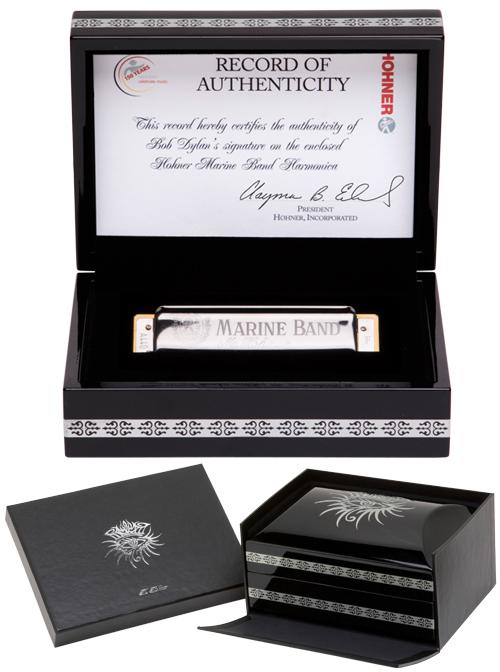
Bob Dylan 101 and Books are sort of dead ends. The Fine Art section leads to sales of his prints, which I don’t care for that much. The Shop section is remarkably bad, actually. I did buy a Rolling Thunder Revue shirt through the Shop (good quality cotton too, comfortable shirt!), but that’s about it. If people want to take up a collection and buy me the “Individually Hand Signed Harp in a Carved Ebony Box” for $5,000, I’ll take it, even if I’d prefer it in G.
The internet wayback machine helpfully provides us with a glimpse of the way the site used to look. This is from January 1998, which is the earliest image available. Remember when the web used to look like this?
Dylan seems to have embraced the internet earlier than a lot of other musicians, making a lot of material available from the site for a long time. In 1997 we were all still on dial-up, so downloading a whole song was a major undertaking. He was well ahead of the game at the time, but in a lot of ways the site could probably use an overhaul (certainly in the hype department).
This year I have gotten so used to the site, that I am still thrilled when it changes in a big way, as when “Full Moon and Empty Arms” debuted. One thing that I’ve noted this year, though, is that I am not the type who ever otherwise goes to the sites of musicians that I like unless someone sends me there directly. I don’t have that kind of relationship to music anymore – I guess with the exception of Dylan.
On December 7, 1997 Bob Dylan received the Kennedy Center Honors Lifetime Achievement Award, which earned him the right to wear a tuxedo and sit in a balcony with Bill and Hillary Clinton (and, more importantly, Lauren Bacall) while watching others sing his praises.
The Kennedy Center Honors are a bit of a strange thing insofar as the recipients don’t give a speech and, when they’re musicians, don’t perform. They sit and nod and, in Dylan’s case, fidget an awful lot. There are cutaways to them looking on appreciatively while they are talked about, and you get to watch the president and the first lady gaze over at them appreciatively.
This was the second big meet-up of the Clintons with Dylan, who, of course, also sang at Bill’s first inauguration celebration. I actually don’t know if the president is involved at all in choosing these things (I doubt it), but it is the apt culmination of the Clinton administration on its last legs, honouring the voice of the sixties, even if Dylan shed that label a long time before.
Dylan was the last person to be honoured during the three hour show. The other nominees were the awesome Lauren Bacall, the horrible gun nut Charlton Heston, singer Jessye Norman, and dancer Edward Villella. Bit of a mixed bag.
Dylan was introduced by Gregory Peck. That is infinitely cooler than sitting with the president, I have to think. Peck misquotes the epic “Brownsville Girl” during the introduction, but the sentiment is a good one. They then play a pretty terrible video package that, of course, focuses almost entirely on Dylan’s output in the 1960s, which is probably not what he would have wanted, but that’s what you’re going to get.
You can watch a VHS dub of that whole part here – the sound is kind of out of synch though:
Three were three performances of Dylan songs that evening. The first is pretty predictable – Bruce Springsteen arrives on stage in a nice suit with a guitar and a harmonica rack and some genuinely nice words about “The Times They Are A-Changin’”. He then utterly and completely fucks up the moment by, I don’t even know, singing a parody of Dylan? It’s not a Springsteen performance and it is not a fitting tribute to Dylan at all, except perhaps to the Dylan who always shits the bed in the big televised spotlight. It’s really awful. Springsteen, by this time, had grabbed the role of the rock star who explains Dylan to the kids – he did it at the Rock and Roll Hall of Fame too – but here he comes across as a jerk. Dylan, to his credit, sort of stares him down. Hillary, to her credit, does too. Watch her glare at the end of this video:
The Kennedy Center, unfortunately, has not posted the other two songs to YouTube, which is sad because apparently they were both much better. There is pretty much universal acclaim for the version of “Don’t Think Twice” that David Ball produced with the backing of longtime Dylan guitarist GE Smith. Apparently there is a shot of Bill Clinton joyfully singing along to this – singing it, in fact, to Hillary. Bill, it is not a love song. Well, the Clintons have always had a different kind of relationship.
The final song of the night was Shirley Caesar doing “Gotta Serve Somebody”. This isn’t on YouTube but it is on DailyMotion (which WordPress doesn’t get along with). You mustclick through this and watch her sing this song. Incredible. That is the way that you honour Bob Dylan – he’s the first to stand to give her a standing ovation. I hope Springsteen felt awful.
So, seventeen years ago – Bob Dylan officially proclaimed a living monument to Americana by the President of the United States.
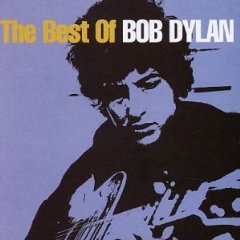
I wasn’t going to even note this one, but then I saw that it was missing. The Best of Bob Dylan, that is.
Released in June 1997, this CD was only available in parts of the Commonwealth – the UK, Canada, Australia and New Zealand. I didn’t know that. It’s the type of thing that you see regularly in Canada when you flip through the Dylan CDs at a chain record store (when you can find one of those) and I had no idea that it wasn’t available in the US until I was looking at Dylan’s site and didn’t see it there. See for yourself:
Not there!
I’m not sure that there’s much to say about this album. It’s a greatest hits collection that covers most of the bases that you would expect a 72 minute greatest hits collection to cover. Sixteen songs cover 1963 to 1979, two take care of the next eighteen years. Re-examining the Dylan of the 1980s was apparently not yet fully in vogue.
The strangest selection on the CD is the inclusion of “Oh, Sister” as the selection from Desire. I’m not sure if that had appeared on any previous Dylan greatest hits collections, but it is certainly an outlier here. The best thing on it is probably the version of “Shelter from the Storm” that was used the previous year on the Jerry Maguire soundtrack.
Here’s a bit of that again:
Pretty terrible album cover, by the way. There are a thousand Dylan bootlegs that did a better job.
Bob Dylan made a career out of disappointing his fans by doing whatever he wanted. In 1997 he got the opportunity to disappoint the pope.
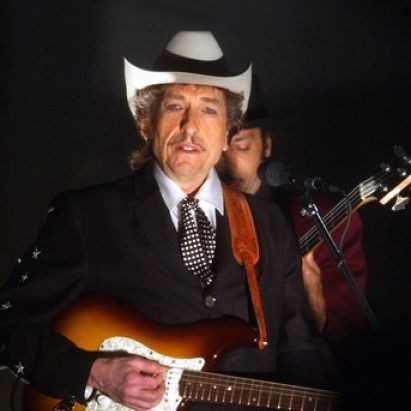
On September 27, 1997, three days before the release of Time Out of Mind, Dylan and his band performed three songs at the 23rd World Eucharistic Congress in Bologna, Italy in the presence of Pope John Paul II, who sat on a dais off to the side of the stage. It was a strange scene, with the pope and his entourage watching Dylan in his cowboy hat and western wear, and his touring band on stage (Bucky Baxter, still rocking that slide guitar!). This wasn’t part of a major Dylan tour – he had played the US that summer – rather it was a papal invitation. Dylan, being Dylan, tacked on a few shows in the UK on the way home.
The scene was more than a little bizarre. 300,000 young Catholics gathered to listen to the pope, who based at least part of his sermon on Dylan’s lyrics. Dylan performed two songs – “Knockin’ on Heaven’s Door” (the title is apt, though probably not the lyrics generally) and “A Hard Rain’s a-Gonna Fall” before the pope spoke. You can see both of those songs here (the whole event aired on RAI UNO in Italy):
After Dylan met him, John Paul spoke to the crowd, basing at least part of his sermon on Dylan’s lyrics:
A representative of yours has just said on your behalf that the answer to the questions of your life “is blowing in the wind”. It is true! But not in the wind which blows everything away in empty whirls, but the wind which is the breath and voice of the Spirit, a voice that calls and says: “come!” (cf. Jn 3:8; Rv 22:17).
You asked me: How many roads must a man walk down before you call him a man? I answer you: one! There is only one road for man and it is Christ, who said: “I am the way” (Jn 14:6). He is the road of truth, the way of life.
And, of course, speaking after the pope himself (tough act to follow), Dylan didn’t actually sing the requested and referenced song, instead closing the whole event with “Forever Young”. Sure, it’s got “May God bless and keep you always…” but Dylan certainly has written a lot of songs that would have been more appropriate. If you’re going to turn the request of the pope at a command performance, I mean that’s marching to your own drummer!
(According to Bjorner’s site, he didn’t even rehearse “Blowin’” at the soundcheck – though he did do “Maggie’s Farm” and “With God On Our Side”. What I wouldn’t give for a video of Bob Dylan singing “With God On Our Side” while the pope watched!)
Pope Benedict, then Cardinal Ratzinger, must have been at the sound check, because in his memoir of his predecessor he wrote that he didn’t want Dylan there. About the event:
The pope appeared tired, exhausted. At that very moment the stars arrived, Bob Dylan and others whose names I do not remember. They had a completely different message from the one which the pope had. There was reason to be skeptical I was, and in some ways I still am over whether it was really right to allow this type of ‘prophet’ to appear.
Wow. You probably have to live a pretty special life to play for one pope while another calls you a “prophet” with full-on scare quotes.
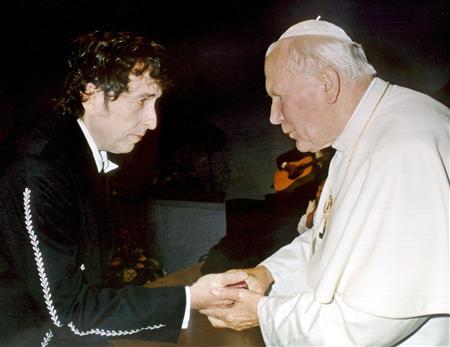
Here’s the video of Dylan actually meeting John Paul II (it isn’t included in the video up top). I wonder who was more impressed with the other? Actually, if you check at 5:34 of the video up top, you can tell that John Paul lacked enthusiasm for the whole thing.
I let 1996 Dylan slide a little bit because there wasn’t a lot going on except more and more and more of the Never Ending Tour. I thought about posting something about Dylan’s show at the 1996 Summer Olympic games in Atlanta but I couldn’t really find much to say about the show except for “Hey! Dylan! At the Olympics! Isn’t that sort of strange?”. A lot of that show is on YouTube, so you can check it out for yourself. Here he is doing “All Along the Watchtower”.
One of the fascinating things about Dylan at this point, now that I’m in 1997, is that things like another live version of “All Along the Watchtower” have become like white noise to me. I don’t actually skip the song if I’m listening to a live show, but I don’t actually listen to it either, if you know what I mean. It’s just sort of there.
One of the notable things about 1997 is that the show from April 7 (his only ever show in Fredericton, NB – so far) contained, as its third song. What was out of the ordinary was the fact that this was the one thousandth time that Dylan had performed this song live. 1,000 times. It sort of boggles my mind.
Actually, what is even more amazing is that, as of this writing, Dylan has now performed the song 2,243 times, including three times last week in Sydney.
If my counting is correct, there are seven songs that Dylan has performed live more than 1,000 times (in order):
All Along the Watchtower 2,243
Like a Rolling Stone 2,011
Highway 61 Revisited 1,783
Tangled Up in Blue 1,408
Ballad of a Thin Man 1,103
Blowin’ In the Wind 1,242
Maggie’s Farm 1,055
There are another half dozen that will cross that threshold this year or next at his current pace of touring.
I’ve listened to that 1,000th “Watchtower”. There’s nothing unusual about it at all. If Dylan knew if was his 1,000th (I highly doubt that he did), he did nothing to note that fact. It has the same sped up lyrical phrasing that he’d been singing for a while.
What is noteworthy is simply the sheer scope of what Dylan has done by this time as a touring act and, further, the fact that he would just continue to do it.
My favourite moment in the generally under-rated movie Funny People is when Seth Rogen asks James Taylor if he ever gets tired of singing the same songs over and over. I think I like that moment because that is exactly the question I’d like to ask. Don’t you just get bored of it? I feel like I would.
Dylan, of course, changes his songs so frequently and so dramatically that maybe it keeps him from getting tired of it all. He just keeps marching ever forward. Tonight, Fredericton. Tomorrow St. John. Then on to Bangor and Portland, Durham and Waltham. Two riders were approaching, the wind began to howl.
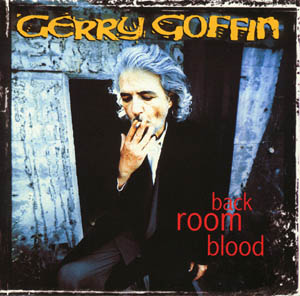
Here’s an odd one. In 1996, a rare year in which no new Dylan album came out, he collaborated on two songs on a Dylanesque album by Gerry Goffin, Back Room Blood. Goffin, of course, was the songwriter who co-wrote fifty top forty hits, many with his first wife Carole King. These included “Will You Love Me Tomorrow”, “The Loco-Motion”, “(You Make Me Feel Like) A Natural Woman”, “Up On the Roof” and many, many others. He was one of the great rock songwriters, particularly when he worked with King. The two of them were inducted into the Rock and Roll Hall of Fame in 1990.
Dylan worked with King a few times – she sang back-up on “Like a Rolling Stone” on the Letterman Tenth Anniversary show, and also sang back-up during some encores on a couple of his 1995 shows. The two clearly had a good relationship. With Goffin things seem a little more mysterious. Goffin, who passed away in June of this year, wasn’t known much as a performer. He recorded an album in 1973, and Back Room Blood was only his second ever. He wasn’t much of a singer – Dylan, even at his scratchiest, has a more melodious voice. But for whatever reason they decided to get together and put down a couple of songs.
“Masquerade”, apparently, was mostly written by Dylan in the mid-1980s around the time of Knocked Out Loaded. There is speculation that Goffin altered some of the lyrics, but the music is from Dylan’s tapes and he is credited as co-producer of the song.
“Tragedy of the Trade” was the more genuine collaboration, with Dylan approaching Goffin with a title and parts of the first verse. Goffin wrote the rest of the song and the music was written by Barry Goldberg when Dylan didn’t have time to work on it (perpetual touring and all). Dylan is credited with playing on the recording but that seems unlikely.
Neither of the songs strike me as offering much in the way of lyrics. “Tragedy of the Trade” is slightly better. It begins with a typically dark Dylan image of a young woman dead in the gutter, and then goes on from there. It’s a lament about the changing times:
The world’s been run with Backroom Blood
Long before the time of the flood
And it’s you who are betrayed
The tragedy of the trade
“Masquerade” name drops Ronald Reagan, which is something that Dylan seemed unlikely to do, and just sort of rambles. It’s easy to see why he might have given that one away.
Goffin isn’t a big enough name, apparently, to have people posting his music to YouTube for me to embed here. You can hear samples of both songs on places like AllMusic here.
Let’s send him out with something a little better than the Dylan collaboration. This is The Shirelles:
The first new Dylan music in a couple of years appeared in a venue so obscure that I don’t think I even knew it existed until yesterday. Dylan’s cover of the Johnny Cash hit “Ring of Fire” appeared on the soundtrack of the 1996 “romantic comedy” Feeling Minnesota. I put “romantic comedy” in scare quotes there because I’ve never seen the film, and since the wikipedia plot description begins with Cameron Diaz’s character being sold into sex slavery, well, colour me skeptical.
I’m not sure how or why the song is used in the film because I’m not going to watch a Keanu Reeves/Cameron Diaz film from twenty years ago to find out. Here is the trailer:
So, yeah, not watching that. I like how the voice over tells us it is a film “by Steven Baigelman” as if that should mean something. This was both the first film that he wrote and directed, so he wasn’t exactly a household name – and he hasn’t gone on to much acclaim either.
The trailer uses the Johnny Cash version of “Ring of Fire” rather than the Dylan one, so maybe they didn’t think Dylan was a selling point. The soundtrack doesn’t include the Cash version, so it is likely that it isn’t even in the film itself.
Dylan’s version here, you can hear it in this YouTube clip, is perfectly fine. “Ring of Fire” is so absolutely associated with Cash that it can seem almost pointless to bother covering it; everything is liable to feel thin in comparison. There’s nothing wrong with this version at all, but neither is particularly new or noteworthy. I guess I like the drumming here, but not the back-up singers.
Dylan had recorded “Ring of Fire” once before, in 1969 in sessions with Cash that led to the inclusion of “Girl From the North Country” on Nashville Skyline. That version, with Dylan’s crooner voice, trades phrases with Cash and is more interesting for the duet, although the band is so totally doing the Cash guitar work that is almost distracting.
This is it for new Dylan songs for this week, so you’d better enjoy this while you have a chance!
As I’ve already mentioned, 1995 was an epic year for the touring Bob Dylan – 116 shows in five distinct tours. I have absolutely no ability to sort out that sort of volume of material (though every single show is out there as a bootleg if you actually wanted to try to bring order to it all). There are certain sites that I use as signposts – Bjorner and Bob’s Boots are both very opinionated and will signal some excellent material – but, of course, that requires a certain outsourcing of my own critical judgments. I wish this wasn’t so, but the fact remains that there aren’t enough hours in the day to do this kind of thing in a single week.
Dylan fans have done remarkable work in terms of making his tours available. Probably every single show after 1974 is available in full somewhere. Better, are some of the curated bootlegs. One of the greatest, for example, is Jewels and Binoculars, which lovingly collects every single recording from 1966 – radio interviews, the Denver Hotel tapes, and live performances from the US, Australia, and Europe (including the fateful UK tour) – into a single 26 CD box set. The thing is astonishing, and you can listen to the entire output of a year like 1966 in a single week.
A similar 1995 set would probably run to about 180 CDs as a guess – a lot of his concerts ran about a CD and a half in length. Thankfully some kind souls have gathered greatest hits packages. One that I benefited from this week was the 5 CD European Tour Anthology. This offers a single complete show (Prague) and then fills it in with the best versions of a lot of songs from that tour, or with the one-offs. Even this captures only the best parts of one of his five tours that year, but it is still a huge headstart.
I have to say, I quite love this 5 CD set. I enjoyed live Dylan in 1995 more than I’ve liked live Dylan since about 1980. I know that this isn’t widely regarded as the peak of the Never Ending Tour, but I thought that there were a ton of great performances throughout the year. That said, I’m less attracted to entire shows. Bjorner particularly singles out the Philadelphia shows of June 21 and 22 as among the best ever from the NET, but I don’t hear it. Yes, they’re good, but, for me, no better than the London shows, or the Prague show. It is true that Dylan works a lot better in 1995 in smaller venues (Philadelphia was in the Theater of the Living Arts – an 800 person venue; London was at the Brixton Academy). Venues that don’t require the band to try to fill in all that space. Basically, I like the 1995 Dylan when you can follow the slide guitar playing of Bucky Baxter.
The other way to approach such a major body of touring material is to highlight the one-offs. Dueting with the Rolling Stones, for example, even when it’s not good. On the first European tour Elvis Costello opened for Dylan on a number of nights, and he also joined him onstage during a few encores (March 30, and March 31 with Carole King and Chrissie Hynde). These break up the routine of the shows, and give something new to focus on. Here’s Dylan and Costello doing “I Shall Be Released”.
To my ear the even better collaboration came at the end of the year. Dylan normally ended his touring year at Thanksgiving, but for whatever reason in 1995 he did a ten date tour in December with Patti Smith as the opening act. Dylan requested that Smith tour with him, then didn’t even bother to meet her for the first three shows. The last seven, however, contain duets during the acoustic portion of the Dylan set, with Smith joining him on “Dark Eyes”, a completely under-rated mid-1980s song from Empire Burlesque. Here they are from the Beacon Theatre in New York. I would’ve loved to have been at this show.
Dylan will “only” do three tours and 83 shows in 1996 (US, Europe, US). Same band for most of the tour (they change drummers after the European leg). I’ll probably write mostly the same post again next week, but instead of Elvis and Patti you get guest stars like Jewel and Aimee Mann. Times change.






 LongAndWastedYear