Live at the Gaslight 1962

Standard
Bob_Dylan_-_Live_at_The_Gaslight_1962
Do you remember record stores? I almost do, through the hazy mists of time. Way back in 2005 people still went to record stores (though, even then, their days were beginning to seem numbered). Napster had come and gone, but BitTorrent was on the rise, and the record store was looking for a way forward.
In Canada, the last remaining large chain of record stores is HMV. Most of the malls around here have one of them, and they increasingly don’t sell music. 2005 is probably around the time that they began a definitive shift towards DVD retailing, and most of the stores that I was aware of began to give more floorspace to movies and television box sets than to music CDs. These days, with the rise of Netflix, even that seems like a bad business model, and the stores sell a lot of Sons of Anarchy shot glasses, toys, and t-shirts. Whenever I go in a HMV now, it seems sort of sad.
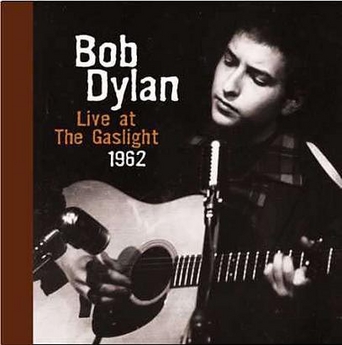
In 2005 HMV made some noise when they pulled all of Bob Dylan’s albums from their store shelves. The cause of the dispute? Dylan and Columbia released an album exclusively through Starbucks. This, for many, was another sign that the post-Victoria’s Secret ad Dylan had lost his way, and that he was a thoroughly corrupted sellout. The album, Live at the Gaslight 1962, was a natural for the coffee chain – connect themselves to the legacy of one of Greenwich Village’s most famous coffee houses. It’s a no-brainer for them. But for HMV the eighteen-month exclusivity was a slap in the face, and so they pulled all of Dylan’s albums for that period (I do recall that they left in dividers where the CDs should have been noting the reasoning, and also noting that they would special order his material if you were unable to simply order it from Amazon like a normal person would do).
Today, all of the HMVs around me have about seven Dylan CDs in them – a lot of greatest hits collections, and usually a random couple of albums. The whole model is crumbling away. The appeal of an HMV to me today is the ability to walk in and pick up the physical copy of Bootleg Series 11 for the booklets that accompany it – a bonus serious enough for me to turn my back on iTunes. But, of course, Amazon spammed me months ago based on all the Dylan books I’ve been buying, and one-click – you can’t beat it.
As for Live at the Gaslight 1962, well, that’s a blast from the past. First week of January to be precise! This material is well circulated in Dylan tape trading circles. It was recorded in October 1962 on a reel to reel run through the PA system, so the sound is really quite good given the technology of the period. The bootleg known as “The Second Gaslight Tape” tape is seventeen tracks, ten of which appear here (there is some dispute about the second and third Gaslight tapes – I can’t sort that out, I leave that to my betters. Actually, check that. Go here for a good breakdown of the tapes: It seems that this album combines performances from two different sets). It’s great material – a couple of original songs as they’re beginning to take shape (“A Hard Rain’s A-Gonna Fall”, “John Brown”, and “Don’t Think Twice, It’s Alright”) – and then some traditional folk music like “Barbara Allen” and “Handsome Molly”. It’s a very intimate recording – when there is applause it always sounds like there are about eight people there. In fact, it is so intimate that on “Hard Rain” you can hear someone singing along. I don’t think that’s a backup singer – I think it’s someone in the audience! It’s a very solid sampling of the proto-Dylan just before he would hit the big time.
Strangely, this album is not listed by BobDylan.com as one of his albums (also strangely, they list both versions of Bootleg Series 11 as separate albums). I’m not sure why that is at all. It’s not included in the Complete Album Collection, and it isn’t part of the Bootleg Series. Seems like a strange orphaned thing, but I have no idea why that is. Also, it is no longer in print. Amazon.ca has it for sale at $130 and Amazon.com for $88.
If you don’t have that kind of money sitting around, you can hear the entire album here.

Bootleg Series 7

Standard
Bob_Dylan_-_The_Bootleg_Series,_Volume_7
I’ve previously written about the 2005 Martin Scorsese documentary, No Direction Home, in February and I’m not going to re-watch that documentary this week. I will say that it was the project that was probably most responsible for bringing me back towards Dylan in my adulthood. Having gone at least a decade without much thinking about him, I can recall watching both nights of the documentary when it aired on PBS. That was as much to do with Scorsese as it was with Dylan. I thought it was tremendous then, and still do. The intervening months this year have probably only raised my esteem for it.
Before this week I had never listened to the soundtrack all the way through in one sitting. I listened to a lot of the individual tracks when I was writing about the early-Dylan era at the beginning of the year, but I have never sat down to just listen to it as an album.
Long story short: This is one of my favourite Dylan albums.
It is a really rich collection of material. There isn’t anything on here that I wouldn’t want to have, and even some of the songs that I don’t much care for (“Mr Tambourine Man” with Jack Elliott) are things that I am thrilled to have. They’ve done a great job of cleaning some of this material up for commercial release (Dylan’s teen-aged home recordings, for example). The vast majority of the material is stuff that I have on other albums or bootlegs, but it is still a remarkable journey through about a decade in Dylan’s life, from Minnesota to the motorcycle crash. It is stitched together almost (but not quite) completely chronologically, and it provides a tremendous sense of Dylan’s evolution. A lot of the alternate versions of the songs are just as interesting – even mores – than the ones that became the official versions. There’s a lot of process in this set, which is a good thing.
It’s a bit of a strange album insofar as I’m not sure that I would ever recommend it to a Dylan novice (Biograph would still get my nod in that category). There’s a lot of great material here, but so much of the greatness depends on its difference from the better known versions. It’s tough to tell someone “You don’t know Dylan well? You should check out this collection of songs that he almost released”. At the same time, it’s not an album for the hardest of the hardcore, who may well be familiar with a lot of this material. It’s a bit of an outlier in the Bootleg Series from that standpoint – somewhat akin to the Rolling Thunder set, which also cherrypicked key pieces from a much larger archive that would be well known to the bootleg collectors.
For where I’ve wound up – fully cognizant of the fact that I’m not yet a Dylan hardcore, but much further along the continuum than the typical listener – it hits me right in the wheelhouse. I was listening to this on my bike road home from work tonight (possibly one of the last warm rides of the season given the forecasts) and I extended my ride because I was enjoying it so much. There are versions of songs here that I think are really great – “Leopard-Skin Pill-Box Hat” and “Stuck Inside of Mobile With the Memphis Blues Again” – are both versions that I find more interesting than the standard versions. “When the Ship Comes In”, from Carnegie Hall in 1963, I liked better today than ever before.
I have a feeling that this is a collection that will hit heavy rotation with me once I wrap this whole project up.

2004 Odds and Ends

Standard

101_0120

Some good days, some bad days. That’s Dylan in 2004. He can make you think that all of the talent is lost on one occasion and then, on another, he can remind you that he can still find the top range of his game.

In between touring in 2004, Dylan made a few notable appearances, playing a few songs for benefits and friends. Let’s take a look, in order from worst to best.

1. May 5. Dylan performs “You Win Again” with Willie Nelson. This will later air on one of Nelson’s television specials, Willie Nelson and Friends: Outlaws and Angels. Nelson seems in much better form here than Dylan, who, at best, seems to know the words to the song. He can’t reach some of the notes that Nelson can, and, to his credit, he doesn’t even try. This is a pretty hardcore Dylan croak on this one, and the two don’t harmonize well at all. A disappointment to be sure. Nelson toured with Dylan this summer through all of August and a little bit of September, and they played a few things together on stage (with Nelson’s sons on occasion as well). There’s a great friendship in there, but you don’t get much sense of it from this clip. Dylan starts at about 3:15 of this clip. You might want to turn it off before Kid Rock takes the stage after him.

2. 28 March. Dylan and his band play one song at the Apollo Theater for the television special, Apollo at 70: A Hot Night in Harlem, which is broadcast in June on NBC. They do a cover of Sam Cooke’s “A Change is Gonna Come”. This is better, but it’s still not essential by any means. It’s terribly shot, for one thing, almost annoyingly so. It is mostly interesting for Dylan being in this role of elder statesman at the Apollo. Dylan has been doing this elder statesman thing for a few years now, but this would not have been one of the places that I’d have thought to find him.

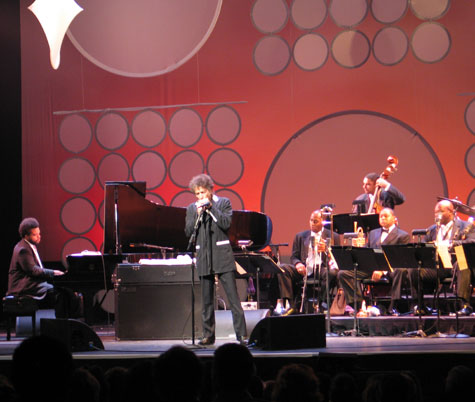
3. June 7. This one seems even less likely. Back once again at The Apollo (I’m not sure that Dylan had even played that venue before 2004, and here he’s played it twice in four months), Dylan performed with The Wynton Marsalis Septet at the third annual Jazz at Lincoln Center fundraiser (you can see pictures of rich people in the society pages here). This wasn’t broadcast, but some kind soul has put the audio on YouTube along with a picture from the event, and, bizarrely, a picture from 1981 of Dylan playing the saxophone (badly)). I went into these trepidatioulsy, but I’m going to give them full-throated support – you should listen to both of them. First is “It Takes a Lot To Laugh, It Takes a Train To Cry”:

I didn’t like that at first, but by the end, by the harmonica part, I really enjoyed it. Now try “Don’t Think Twice (It’s Alright)”:

These are great. Dylan, more than any other performer in the history of rock music, constantly reinvents his own compositions – often quite radically – and here he finds new ways to perform two songs that are among his most familiarly tried-and-true. His voice seems totally in control, as if he has suddenly remembered that it is his most important instrument. Dylan has had some bad outings with jazz in the past, but this is really fantastic. He actually gets me to hear these songs entirely afresh, and that’s something.

I know I can’t say much about it due to chronology issues here, but now that it has been revealed that Dylan’s next album will be entirely Frank Sinatra covers, I’m hoping that it will just a little bit of this sound.

So, a couple of duds, a couple of hits. That’s pretty good.

Bootleg Series v6

Standard
Bob_Dylan_-_The_Bootleg_Series,_Volume_6
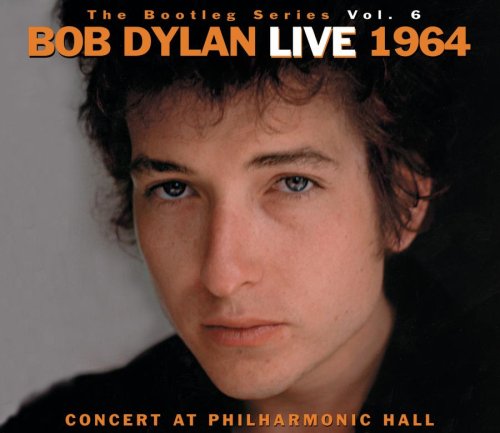
Clinton Heylin sort of spoiled Bootleg Series v6 for me. On the Wikipedia page for this 2004 release, Heylin is quoted as saying: “I’ve never rated [the Halloween show] as a performance. Dylan is very focused when he comes to doing the new songs…But the old material, he’s completely and totally bored with. It’s not a good performance. He’s clearly stoned…The concert was a real landmark, not in the positive sense, but in the negative sense because it looked at the time like Dylan was going off the rails”.
I re-listened to this album, which captures a Dylan show from 1964, for the first time in forty weeks because it was the only Dylan release of 2004. My first thoughts were that it is a pretty remarkable show for a twenty-three year old just on the cusp of becoming a superstar, and that the variations on some of the then unrecorded material makes for some fascinating listening. I was struck by the different relationship of Dylan to his audience – here he jokes around quite a bit and makes some goofy comments, while the more contemporary Dylan can go years without directly addressing his listeners (though he still retains a penchant for dumb jokes from the stage when he does talk). But Heylin’s comment: “He’s clearly stoned” stuck with me. Those three words just jabbed right into my brain. You can’t unhear them.
The problem is that now when I listen to the introduction of “Who Killed Davey Moore?”, where Dylan just rambles and rambles like, well, like someone who is clearly stoned, all I can hear is the pot talking. So thanks for that, Mr. Heylin.
Implicit in Heylin’s comments is the idea that there were better concerts in 1964, and, possibly, that there are better shows out there for the collector. If there are, I don’t have them. I have only two complete or semi-complete shows from 1964 (San Francisco and San Jose, both from late November – a month after this show). I can’t really compare them to this because the sound quality is so poor (on one of them, the bootlegger – or someone close to him – starts to sing “To Ramona” with Dylan, but, fortunately, stops himself). Here’s the thing: those might be better shows, but the recording technologies of 1964 being what they were, you’d never ever know it.
One of the things that is great about Bootleg Series 6 is that the sound is terrific. In balancing releases like this Sony is torn between the best shows and the recordings of shows. When I was digging through Springsteen bootleg sites and discussion boards last week, I ran across a thread discussing the best sounding Springsteen shows – not the best performances, but the best job that people had done at capturing the sound. It was a really interesting discussion – someone posted a list of about 100 bootlegs arranged by year as well. I could totally relate, as now I’ve become quite picky about recording quality as well. I’d rather listen to a good Dylan show well recorded than a great one that has a lot of audience noise, for example.
What you get on Bootleg Series 6 is a truly superior recording. Maybe it’s not the best Dylan show of that year – I can believe that – but it’s still a good show (sorry, Heylin, it is). I just need to fast forward past the rambling that precedes “Davey Moore”. Of the six Bootleg Series releases so far this one is my least favourite, but I’m happy to have it.
Here’s Dylan from 1964 to remind you of how great he was so early on. This is the song that he told Ed Bradley that he wouldn’t have been able to write in 2004:

The Simpsons

Standard

250px-Bob_Dylan

In the same year that Bob Dylan appeared for the first time on 60 Minutes, he also appeared for the first time on The Simpsons. Sort of. Interviewed by Chloe Talbot, Dylan (voiced by Dan Castellaneta) tells the world what religion he is converting to next:

According to this site, Dylan was actually asked to be on The Simpsons playing the role of Homer’s spirit guide. The role went to Johnny Cash instead. He’s great in that, so it was probably for the best.

60 Minutes

Standard


bradley-739461

The way that YouTube serves up a sidebar of recommended videos on the right side of the page means that I’ve seen a link for “Bob Dylan Interview and a very revealing one at that” at least once per day every day this year. Seriously. When you troll YouTube looking for clips long enough, this is what eventually winds up at the top. I’m not sure why – though it has 1.2 million views I’m not sure that it’s the most watched Dylan clip on the site (probably close though, given how fast official Dylan material seems to evaporate). Must be a popularity-based algorithm.

For whatever reason I never clicked on it – not once. I could tell it was late-era Dylan by the lines on his face, and the title made it sound unenlightening – it seemed to be promising too much. Plus it’s a bit long. I figured it would roll around at some point.

As it turns out, when I searched the site for Bob Dylan + Ed Bradley, to find Dylan’s one and only appearance on 60 Minutes, there it was. Hiding in plain sight all this time!

Until I got to 2004, it never seemed odd to me that Dylan hadn’t been profiled on 60 Minutes, but as soon as I heard Ed Bradley’s voice it surely did. We didn’t go to church much in my family, but every Sunday we watched 60 Minutes after football. Every Sunday. It was – and still is – my father’s favourite show, the only one that he makes an effort not to miss. Bradley, Wallace, Reasoner, I watched these guys every week for most of my youth, and, actually, I’m grateful, because despite its flaws 60 Minutes at least aspired to present television news that was insightful, investigative, and engaged.

Not so much with their celebrity profiles, however, which was always one of the show’s flaws. This interview is not really typical of the 60 Minutes format, which generally has to include at least one shot of the interviewee leading the interviewee around his property. This is clearly a hotel room – Dylan surely was not about to let any tv crew into his house.

The piece also suffers from the 60 Minutes way of arranging the story – all of those cut-ins of old Dylan footage that just serve to interrupt the flow of the piece. It seems clumsy, probably more clumsy than is typical of the show. Ham-fisted.

As for the interview itself, I’m not sure that I would call it “revealing”. I don’t think it lifts away any part of the Dylan mask – indeed, it cements ever so much more firmly in place. At first I wasn’t sure that I could even get through it – the discussion of “Blowin’ in the Wind” and Dylan’s taciturn answers put me off. I think that the most interesting part might be his admission that he can’t write the way he once did – and that perhaps no one can. That’s self-mystifying, sure, but it’s also self-pitying in a way that few stars ever really are. The sense at the end of the interview that he is still worried that things might be taken away from him – that all the fame is transitory – might be what the YouTuber uploader found revealing. It is an interest moment that almost seems unguarded, but may just well be another form of put on.

Dylan was appearing on the show – seemingly under some form of duress given his performance – as a way of promoting Chronicles, which is referenced by Bradley a few times. I’ll have more to say about that book later this week, though I think I may have already written about each of its chapters individually.

I thin that in my mind the combination of two important elements of my youth – Dylan and 60 Minutes – would have been much more magical than this was. A disappointment, to be sure.

I will say, though, that I always thought Ed Bradley was the best part of that show.

Victoria’s Secret Ad

Standard
Way back in January, the whole world (well, people on Twitter) got really upset that Bob Dylan appeared in a Chrysler ad during the Super Bowl. He’d sold his soul! A betrayal! Won’t somebody please think of the children?! How could he do this to us? It was all very alarming. And, of course, it all happened once before.
In 2004 Dylan appeared in an ad for Victoria’s Secret, who were selling a new type of underwear. The ad only ran for three weeks, but it was one of the most talked about ads of the year. It generated op-ed pieces in USA Today, in Entertainment Weekly, and, horribly, in Slate (click through for their embarrassing headline – I won’t even dignify it by putting it here). If there had been a Twitter, I’m sure that it would have exploded.
I’m not really sure what to say about this ad. I’ve included the longer version here (there is also a 30 second edit). I like this video because someone has tagged a famous section of his San Francisco press conference (December 1965) to it in a charming fashion. Oh the irony!
So, yeah, it’s an ad for underwear. It features a model in angel wings and underwear. Dylan’s role is to sort of leer at her. They play “Love Sick”. There’s not really any way to make that come across as not creepy. It is sort of creepy. That’s advertising pretty much in a nutshell. Creepy.
A lot of the discussion at the time – and probably still today – focuses on motive. Why would Dylan do this? For the money? Does he really need the money that badly? He tours all the time – he must be making money. For the free trip to Venice? I’m sure Dylan can afford a trip to Venice (his website is acting up – I can’t look up how often he has played there). To ogle a semi-clad model? I’m sure he’s had more than his fair share of those opportunities. To mess with his fans? That would be my own guess, but the fact of the matter is that I have no idea why Dylan does almost anything that he does. This is no more or less odd to me than his appearance on Dharma and Greg, or his beard at Newport. Dylan’s brain doesn’t seem to work in a way that I understand.
So, this is his first ad for a product, and it is for lingerie. It’s a weird piece of the puzzle that is his life.

Stumped by Springsteen

Standard
sm_dylan
I fell behind on 2003 Dylan for the most frustrating reason – I finally discovered something that I wanted to write about that I couldn’t find a copy of!
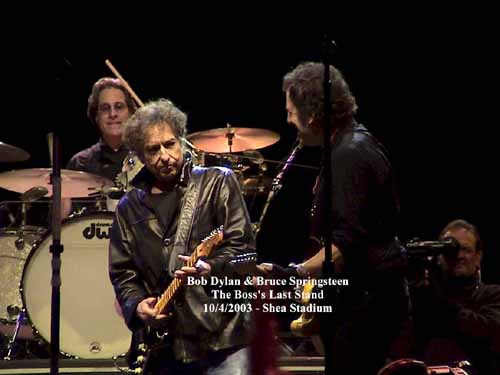
Dylan’s touring in 2003 included several shows where he opened for The Grateful Dead and a couple where he opened for Tom Petty and the Heartbreakers. He played a bit with each, but that’s material that I’ve already covered in weeks past. What was new this year was Dylan joining Bruce Springsteen on stage at one of his shows. Specifically, the final show of Springsteen’s The Rising tour, at Shea Stadium in New York on October 4, 2003. Springsteen and Dylan sang “Highway 61”.
Given the fact that each man has an extensive bootlegging culture around him, and given the fact that the show was in New York, you’d figure that the audio and video would be all over the place. Indeed, there is an incredibly poor quality video of the prior evening’s show on YouTube. So if you can get that whole thing, it should be easy to get this one song. Right? Right?
Yeah, not so fast. Everywhere I’ve turned all week – and I spent about an hour on this yesterday, and about the same again today – I get this:
Screen Shot 2014-10-26 at 6.42.30 PM
l can find accounts written by people who were there, but for the life of me I can’t find the video.
That’s okay – I’ve had to write about things where I didn’t have the video previously, but this case is unusual in that I also can’t find the audio. There are Springsteen bootlegs out there (here’s a video of the concert, for instance), but I’m not interested in paying that to hear one song. I tried dipping into the online world of Springsteen bootleggers, but I had no luck in that regard, finding only the commercial bootleg dealers.
It might seem logical that this song would be widely anthologized across Dylan and Springsteen fandoms, but my sense right now is that it isn’t at all. It seems that there was a problem with Dylan’s mic on the first verse that negatively impacted the song, and that might account for the lack of interest in sharing it – not many anthologizers are going to bother to include a partial recording or a poor performance, even if it does have a touch of history about it.
So, this has been one of my few straight failures. Generally I’ve been able to come by almost everything that I’ve wanted (I couldn’t find some of Dylan’s earliest ads), but this time I’ve come up blank. If you’re a Springsteen enthusiast with a deep bootleg collection, let me know. I’ve become fixated on this one.

“Cross the Green Mountain”

Standard

Gods_and_generals_poster

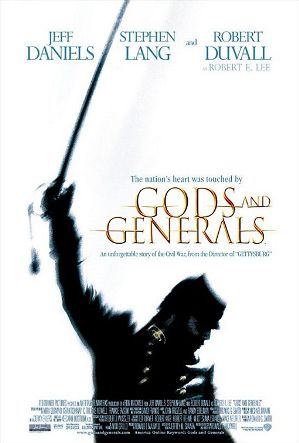
A strong contender for “best hidden Dylan song”, “Cross the Green Mountain” was written and recorded for the film Gods and Generals. I had forgotten that this film even existed. This is a Civil War film that was entirely financed by Ted Turner as a personal pet project. It was then nearly universally loathed by critics and faded into oblivion. I don’t think that I have ever so much as heard someone mention it. I’ve never seen it, I don’t think I’ve ever really had the opportunity to see it, and I can’t imagine that I will ever see it.

However. It has an eight-minute Dylan epic on it. A Dylan epic with fiddle! This is a really simple song, musically repetitive with Dylan sing-talking a long story. It’s nearly a perfect use of his talents by this point in his career. I am sure it must be the best thing in the film (my guess is that it likely plays over the end credits). Seems like it may have been a bid for a second Oscar, but for that to happen some one in the Academy probably has to watch the film. So no luck on that.

Dylan included this song on Bootleg Series v8: Tell Tale Signs, which is where I first heard it. Had he done so, it might have been forgotten by all but the most hardcore (actually, it probably still is – my guess would be that that is the least purchased part of the entire Bootleg Series to date). It really is too bad, because this one ranks among his best epic songs. It should be far better known than it is.

Here is a sadly abbreviated version that was used as the official music video. It will give you a taste, but you want the whole thing.