Just a quick announcement. I have moved on from Self Portrait to New Morning, Dylan’s other 1970 release, for the rest of the week. It’s a short album at only 35 minutes long, and, having listened through it twice at lunch, I have to say that I will NOT be listening to “If Dogs Run Free” again this week. I will be hitting “Next” every single time. This is a serious contender for worst Dylan song of all time and I just can’t take it anymore.
If I wanted to listen to beatnik poetry I’d listen to this:
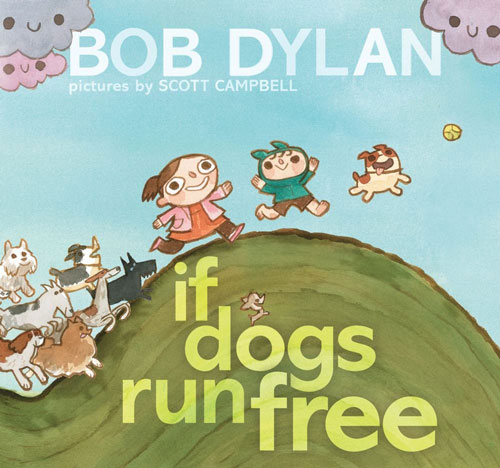
Also, I had no idea that this song had been turned into a children’s book. I hope it didn’t include a CD.
Everyone loves a cover song. My social networks were filled all last weekend with people posting links to Bruce Springsteen covering “Royals” and “Stayin’ Alive” while on tour in Australia and New Zealand. The idea of seeing someone like Springsteen doing live versions of songs so outside his traditional wheelhouse has a ton of appeal, and the YouTube clicks piled up.
Everyone hates a cover song. Especially when it’s Bob Dylan doing the cover version. Self Portrait, as I have mentioned over the past several days, has four types of songs: live versions of earlier recordings; Dylan versions of established traditional songs; new compositions; and, Dylan’s version of contemporary pop songs. It’s this last group that makes Self Portrait such a despised album.
Dylan had been doing covers for a while. A Tree With Roots has quite a number of them, from “People Get Ready” to “Folsom Prison Blues”. It’s not surprising – these are the types of things that musicians do when they’re hanging out, when they’re jamming, when they’re testing the sound set-up of a recording studio. It’s fun. But no one seemed to find the covers on Self Portrait fun, except, just maybe, Dylan himself.
While Self Portrait isn’t nearly as bad as its harshest detractors say that it is, it is clearly the worst thing that Dylan has released up to this point in time. It’s often sloppy, there are no exemplary songs, and some of it is just plain loopy. The pop covers are, generally, the worst part of the whole album.
I’ve come to agree one hundred per cent with the theory that this was Dylan’s attempt to meet the bootleggers head on. First, it is absolutely clear that Dylan hates bootlegging. You’ll have noticed that I often do not link to an album version of Dylan’s songs when I am writing about them. That’s because he and his record company seem to always have them pulled from YouTube, even though there are ways to monetize that exposure now. If he won’t have things on YouTube, where he can earn money from it, imagine how much he dislikes the actual bootlegs. He’s always been clear on that front.
The success of Great White Wonder must have been a mystery and an annoyance to him. In interviews from the period he has expressed his disdain for people releasing material that he would not have released himself, and he has wondered why people wanted work that he considered unfinished. Self Portrait has that feel – not just in the duplication of songs and in the selections from the Isle of Wight – but in the overall tone of “Dylan rehearsing, and playing around”. It doesn’t sound like a serious album. Indeed, it is virtually impossible to imagine that Dylan or anyone at Columbia thought his version of Simon and Garfunkel’s “The Boxer” was a good recording. It is, by any professional measure, awful. But it is the type of thing that would have been bootlegged, so Dylan bootlegged it himself.
This is the only way that I can make sense of Self Portrait as an album. There are individual tracks that make sense to me, but the whole package only works in comparison to hotel room recordings. Seen from that angle, it’s sometimes better than that material. Seen as a well thought out album – it’s inconceivable. Given the fact that the earliest songs on this album were recorded almost a year before the later ones (the sessions were in April and May 1969 and then again in March 1970), and given the fact that the 1969 tracks included the pop covers “I Forgot More Than You’ll Ever Know”, “Let It Be Me”, “Take a Message to Mary”, and “Blue Moon” (plus “Ring of Fire” and “Folsom Prison Blues”, which haven’t been commercially released even after Another Self Portrait), it seems believable that Dylan released this material simply because it seemed that if he didn’t someone else would.
To my ears, virtually every pop cover is dispensable, with the possible exception of “Copper Kettle” and “Take a Message to Mary”. The version of “Copper Kettle” without the overdubs on Another Self Portrait is actually pretty great – they definitely should not have missed with that. That one is absolutely a keeper.
The lowlight is a toss-up. Dylan’s version of “Blue Moon” is probably the single song that, more than anything else, doomed this album. Such a square song, and so artlessly done. But for me the worst offender has to be “The Boxer”. The fact that this was released on an album from a major recording company is pretty astonishing. I’m not sure who is singing with Dylan on this – the session information at bjorner.com doesn’t say, although it indicates only that on 3 March 1970 the only two people in the studio with him were David Bromberg and Al Kooper. I don’t know their voices well enough to venture a guess. Whichever it was, he didn’t know the words to this song and he sings along just slightly behind Dylan. This is the same way I sing along in my car – you know, where you fill in what you don’t know by mumbling and then belting out the parts that you do know. This is the most lost version of this song you can possibly imagine, and had it been unearthed as a bizarre curiosity on one of the Bootleg Series albums it would be heard a few times and forgotten. On a serious release, though? You can’t be serious.
So, to sum up, Self Portrait: Not as absolutely awful as some people say it is, but I still feel a bit like I may have wasted four days thinking about it. “Alberta #2” and “Days of 49” and “Copper Kettle” are all not terrible, but that’s about the best that I can say about it. Oh, and I don’t care who knows it: I like “All the Tired Horses” too.
Tomorrow I’m diving into New Morning, Dylan’s comeback from his first bad album.
Bob Dylan’s much derided 1970 album, Self Portrait, contains only five new compositions. Indeed, this may be at the heart of many of the complaints about the album, which has less new Dylan – to this point – than any album other than his first. It is clear that Self Portrait was not the album that a lot of his fans wanted, and the original compositions help explain why.
Of the five new songs, only three of them even featured Dylan singing. “Living the Blues” was one of the first songs recorded for the album (24 April 1969), and is among the earliest songs that he recorded using female backing vocals. This is a pretty straightforward and stripped down blues song. There is nothing particularly memorable in it, though it wouldn’t have felt terribly out of place on Nashville Skyline at all. It sounds a bit like a demo for other artists than anything else.
“Quinn the Eskimo (The Mighty Quinn)” was one of the tracks recorded during the Basement Tapes sessions, and the version found here was from the Isle of Wight festival live recordings. This wouldn’t have been considered a new song per se, as Manfred Mann had made it a hit in 1968. It had also been unofficially released on Great White Wonder. I’ve never been much of a fan of this song, and the version on Self Portrait is pretty sloppy in places.
“Woogie Boogie” is not much of a song at all. It’s just over two minutes of driving, rhythmic piano and guitar noodling, and, late in the song, saxophone. It’s a boogie number just like the title tells you. Like many of the songs on Self Portrait, only one take was recorded and that is the one that was used (Dylan did fourteen songs on 3 March 1970 and only one, the traditional tune “Pretty Saro”, received multiple takes – and it is one of the few that wasn’t released until the recent Bootleg Series). There’s not much memorable in this one either.
“Wigwam” was another one take song, but the horns were added as overdubs later in the year. This was released as a single, and actually became a hit in a number of places (not in the US). Almost hard to believe. It is the least Dylan-ish single of all time. The lyrics are “La da da dee” over and over and over. Another Self Portrait has the original version, with just Dylan, David Bromberg (guitar) and Al Kooper (piano). It’s actually not as good – the horns really do add quite a bit of the song’s mariachi-like texture. “Wigwam” may be best recalled now for its use in The Royal Tennenbaums. I like it, but it is definitely odd.
Finally, the opening track on the album, “All the Tired Horses”, is another bizarre Dylan composition. Dylan’s website credits the lyrics thusly:
All the tired horses in the sun
How’m I supposed to get any ridin’ done? Hmm.
It’s the “Hmm” that really seals it. I have to imagine that this is the song that Greil Marcus was listening to when he famously wrote as the opening of his review of the album: “What is this shit?” This is a truly bizarre way for Dylan to have opened an album – a slick production of his back-up singers singing this one refrain again and again. In all honesty, I think that it is both beautiful and hypnotic. It’s one of my favourite things on the whole album, though I agree that it is difficult to imagine as a Bob Dylan song. It’s probably the most radical departure that he had yet made. It’s like a chant. I find it very calming.
So of the five original songs on Self Portrait, I only credit “Wigwam” and “All the Tired Horses” as good, though as a song “Quinn the Eskimo” isn’t terrible, and, really, of those three the one that I like best is the one that many Dylan fans would find most troublesome.
Oh, and as for “Wigwam”, Dylan’s site credits it as an instrumental – apparently “La da da dee” don’t count as actual lyrics in the Dylanverse. Hmm.
For many, Self Portrait was the beginning of the end of Bob Dylan. A self-indulgent mess of a double-album (which is packaged as a single CD in the Complete Album Collection, which I mention for no real reason other than to note that Blonde on Blonde was two discs), apparently it has been ranked as one of the worst albums of all time.
So, first, that seems nuts to me. I’ve been listening to it for a couple of days now and I still like the four live tracks from Isle of Wight (my affection for “Minstrel Boy” is starting to fade…), and I’m not sure how any album could be a “worst of all kind” contender if it has at least four good songs on it. So that’s four of twenty-four – let’s see what we can add to the total.
The album also includes seven covers of “traditional” songs or “folk songs”. Dylan hadn’t been doing covers since his very first album and the home recorded tapes that appeared around the same time. This was a harkening back to his roots from the twenty-nine year old songwriter, and not necessarily what people expected from him or wanted from him. Ironically, covers of traditional songs is one of the hallmarks of the basement tapes as they appear on A Tree With Roots (though not on the material from those sessions that was circulating in 1969 and 1970), and also on GWW. The bootlegs proved that there was still a strong demand for Dylan covering traditional music. Funnily, the same Rolling Stone critics who adored GWW were the ones who also crapped all over Self Portrait.
The fact is that not all of these covers are good, but, in all honesty, they’re at least as good as the material on A Tree With Roots, and generally better than that on GWW. And, yes, that doesn’t make them good in an absolute sense.
One of the real oddities of Self Portrait is that Dylan included two songs twice. “Alberta #1” and “Alberta #2” are different takes on the same song originally made famous by Lead Belly. The second one is the stronger version, with better guitar and harmonica, although the back-up vocals don’t really add that much to it. There is an “Alberta #3” on Another Self Portrait that also has a nice harmonica opening, and which is much more spare. It’s probably the best of the three versions, because it is the least produced. It’s no Lead Belly, but it’s listenable.
Similarly, “Little Sadie” shows up twice on the album (once as “In the Search of Little Sadie”). This is one of my favourite banjo tunes – I have more than thirty different recordings of this currently on my phone, most featuring only banjo and fiddle. It’s a song that I can play this pretty passably. When we would play this as a class at my banjo class we would always annoy our instructor by singing it the way Dylan does, which is, frankly, insane. The first version of the song on the album is fine, but “In the Search of” version is just quite terrible. There is a stripped down cut of the latter on Another Self Portrait – it doesn’t improve it much at all. This is pretty close to everything that annoyed me about the worst parts of A Tree With Roots. So no points for these two.
Of the others, “Days of 49” is actually pretty good. This version sounds like it comes from later in his career by about a decade – if this had been on one of the Christian albums it would have seemed more at home. It trails off somewhat bizarrely at the end, but I’d have to count this as a pretty good version of this.
“Belle Isle” doesn’t have very much to recommend it – it is literally “fine”. “It Hurts Me Too” is another dud.
Hmm. That doesn’t strike me as a very good record of quality. I’d keep “Alberta #2” (#3 if I can take tracks from the Bootleg Series) and “Days of 49” and probably jettison the rest. What is interesting, though, is that pretty much of all this (well, maybe not “In the Search of”) is just as good, if not better, than the basement material that people were scrambling to get. It has been suggested that Dylan saw Self Portrait as his authorized bootleg – like A Tree With Roots it combines traditional covers, covers of pop hits, and some new compositions. I’m not sure if that’s correct, but the traditional songs on this are pretty akin to the others he was doing at the time, and all are better produced.
Now the pop covers, that’s an entirely different matter….
Try Clarence Ashley on “Little Sadie” – this is near perfection (seriously, this could not be improved one little bit):
Standard
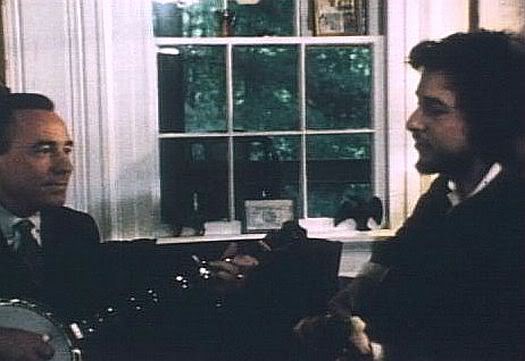
There’s not much video of Bob Dylan from 1970, because he barely appeared in public, with the exception of receiving an honorary doctorate from Princeton in June. He played no shows at all, and the only real document of his playing that year other than his two albums (and the recently released Bootleg Series album) is his appearance in a documentary about the great banjo player, Earl Scruggs.
Dylan recorded two songs with Earl and two of Earl’s sons in December 1970, and the film was released in 1972. It’s available on YouTube (below) and the whole thing is really worth watching. The Dylan parts – “East Virginia Blues”, a traditional tune, and “Nashville Skyline Rag” – are the first two things on the video if you only want to see his part. Of course if you turn it right off you’re missing out on Scruggs at the home of Doc Boggs, and it really just gets better from there.
Scruggs was an amazing musician and his influence on banjo may be stronger than any other musician’s influence on the playing of any other instrument. To say that almost all bluegrass banjo players fashion their playing style after Scruggs is an understatement. The first time I attended American Banjo Camp, which has more bluegrass players than clawhammer players (the style I play), I innocently asked someone at lunch why all the bluegrass players use two metal finger picks and a plastic thumb pick (why aren’t they all metal?). He stared at me dumfoundedly and said “that’s what Earl uses”, like I had just fallen off the back of a turnip truck. “That’s what Earl does” was all the reason any banjo player needed for any decision they made, and the desire to achieve the Scruggs sound is powerful among amateur players.
For much of the 1960s Scruggs and Dylan would have been seen as occupying enemy camps, and indeed many might see them as such even today. Their playing here is great, even if on his own composition Dylan has an intimidated look in his eyes that says “man, this guy is a real player!”.
I woke up this morning at 3:00am, or, as my body clock knew it, 6:00pm Singapore time. To pass the time with the rest of the household asleep, I caught up with Robert Shelton’s biography of Dylan, No Direction Home. Yesterday I said that he largely ignored the Isle of Wight concert – that was incorrect. He actually does give it four or five pages, and notes that he was there, watching from the back about a quarter mile away. That said, he didn’t like it much.
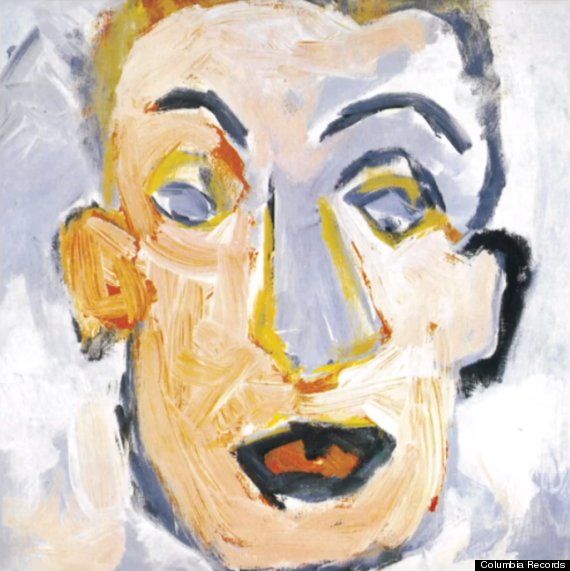
Shelton also didn’t much like Self Portrait, but then again nobody else seems to have either. Actually, the album sold quite well (peaking at #7 on the charts), but it was reviled by the critics. When I posted the album cover as my Facebook avatar last night it immediately generated a discussion about how terrible this album is.
Self Portrait is, in many ways, the album that inspired this particular project. I downloaded Bootleg Series 10: Another Self Portrait when it came out last year, and listened to it a few times and thought it was pretty good. That album made me acutely aware of how little I knew of Self Portrait and New Morning, Dylan’s two 1970 albums, other than the fact that one was detested and one adored, and that they were recorded in quite close proximity to each other. I thought maybe I should sort that out, and that in turn led to this year long project.
When I was done with the Shelton (well, not done, but I’m up to the 1974 chapter and don’t want to read ahead), I turned to Dylan’s own autobiography, Chronicles v. 1. He has a shortish chapter in that about New Morning, although the chapter is almost as much about Self Portrait. It’s a great chapter in a great book. Dylan’s concerns are voiced in his own words very convincingly: after Woodstock became Woodstock ™ his “fans” and people who wanted things from him began to descend on the town where he lived with his five children, showing up on his property (he says on his roof). He acquired guns to protect his kids, and, finally, was forced to flee the town for New York. There he had to deal with people like A. J. Weberman leading protests against him in front of his house. Weberman felt that he’d sold out. Dylan is very eloquent about one thing: He didn’t want to be the spokesman for this generation, or any other one. I guess when a group like The Weathermen name themselves for something you wrote and then start blowing people up, you might want to just spend more time with your children too.
Dylan writes in Chronicles that he was aware that Herman Melville died almost forgotten. Moby Dick pushed the limits and nothing else he ever wrote was paid the attention that it was. He aspired in 1969/1970 to Melville’s status: kill the beast. Just disappear. Don’t tour. Don’t perform. Just escape into obscurity. He argues that Self Portrait was his effort to dump his fame.
It didn’t work, of course, but it did upset a lot of people. Greil Marcus famously opened his (insanely long) Rolling Stone review with “What is this shit?” before going on for about twenty pages about the album’s highs and lows. Marcus’s distaste is funny to me in retrospect, given that he wrote a whole book about The Basement Tapes, which are far more uneven (Marcus’s review is the second chapter in his collection Bob Dylan: Writings 1968-2010, and his New York Times review of New Morning is the third). Look, Self Portrait is uneven, but it isn’t a complete disaster.
The whole of Self Portrait is too long, too contradictory, too fascinating to deal with in one post. I already dealt with four of the songs, all of which are from the Isle of Wight concert. I’m going to write three other posts breaking the album into sections: pop song covers, traditional songs, and new Dylan songs.
In the meantime I’m going to have a nap. Did I mention that I’m still on Singapore time?
Bob Dylan sort of famously didn’t play Woodstock, a concert that was held not far from where he was actually living in 1969, but did play the Isle of Wight Festival two weeks later. It was his first complete concert in just over three years, and only his second live performance in that time (the other being at the Woody Guthrie Memorial shows). The festival attracted 150,000 people, and Dylan headlined the final night. Robert Shelton, in his biography of Dylan, basically downplays the entire thing, devoting only a couple of sentences to it, while other fans note that it was a widely bootlegged performance. Wikipedia makes it out to be quite the party, with a VIP booth near the front of the stage that included three of the Beatles (not Paul), three of the Rolling Stones, Eric Clapton, Liz Taylor and Richard Burton, Jane Fonda, Elton John, Syd Barrett and others. The show drew considerably larger crowd than the previous year, partly based on the rumours that the Beatles were going to join Dylan on stage and not just at the after party (where, apparently, they played an early acetate of Abbey Road).
Dylan’s set was only an hour. He reportedly had another eight to ten songs rehearsed and would have played them if the audience had seemed to want it. The British press reported that he was semi-chased off the stage by an audience that (once again) didn’t get what he was doing, but other reports indicate that Dylan thought the whole thing went really well and that he was in a good mood after it, but that he performed for just an hour because the crowed seemed burned out. They do seem a little tired. They respond well to (the remarkably awesome version of) “She Belongs To Me”, the first song of the show, but their enthusiasm noticeably tails off as the evening progresses.
The whole show was released last year as a bonus disc on the triple CD Another Self-Portrait. The recording is excellent, but it’s hard to gauge the audience response. The way that it is recorded it sounds like a small, appreciative crowed – certainly not 150,000 people. They react tremendously well to the older material like “Mr. Tambourine Man”, but seem a bit lost at the country versions of some of the material.
While this wasn’t the first time that Dylan had performed new arrangements of established hits – something that has been his hallmark as a live performer for the past forty years – many of these versions are quite different than the recorded versions. “Like A Rolling Stone” is unrecognizable to the crowd from its musical intro – no one claps until the end of the first line as it is clear that they don’t see the song coming. Dylan messes up the lyrics, which is probably a function of the three year hiatus. I really like this version, but it is clear that the crowd doesn’t. I do laugh every time Dylan and Robbie Robertson forget the lyrics to the chorus.
Speaking of Robertson, The Band is really great here, and it’s another example of how unfortunate it is that Dylan wasn’t regularly touring for this eight year period. Musically, this is a very strong show, and given that almost every Dylan tour begins with a fairly weak show but gets stronger as it goes on (although some of them then burn out by the end), one can only imagine how good this group would have been had they done a dozen or more shows.
The show featured a lot of recent Dylan from the John Wesley Harding and Nashville Skyline era, material that otherwise didn’t get a lot of live performances, plus very unusual versions of “Maggie’s Farm” and “Highway 61 Revisited”. Three songs from the show wound up on Self-Portrait, including “Minstrel Boy”, which received its public debut at this show.
I’m a fan of this show. I wish that he had done the other eight songs. I wish that it had been the launch of a tour. I wish that we didn’t have to wait until 1974 for more live Dylan with The Band, and that we didn’t have to wait for Planet Waves for a full album by Dylan and The Band. The collaboration between Dylan and The Band has another six years (weeks) to run, but this is that rare glimpse of how great things could have been. How good is it? It’s so good that I even listen to the version of “Rainy Day Women #12 & 35” that ends the set!
—
A few words on this video. First, I have no idea where it came from or what its purpose was. It’s an almost twelve minute documentary from French television about people going to the festival. It spends more time filming people on the ferry than it does on anything else. Second, I have no idea why they use the insanely dramatic music to show hippies getting off of a ferry! Third, I like the fact that the voice-of-god narrator calls Dylan “their pope”. Talk about dramatic over-statement. Fourth, the bongo playing! Fifth, footage of people sleeping through The Who’s set (they performed the entirety of Tommy, I’d have slept through it too), which indicates that maybe the crowd was truly dead by end of the weekend for Dylan. Finally, they devote twelve long minutes to Dylan’s comeback show, and then the only footage of him they use (beginning at 10:30 if you want to jump directly to it) is of “The Mighty Quinn”? Really? “The Mighty Quinn”?!?! I guess it was a hit at the time for Manfred Mann…
—
A word on the second video. Colour footage (though no sound) of Dylan performing as seen from the VIP box to the side of the stage. You get to see all three of The Beatles in this clip (what the hell is on Yoko Ono’s forehead?), but not the other celebrities. Sort of a bizarre thing, but there you have it.
—
A word on the third video. Handheld footage from close to the stage of “I Threw It All Away” credited to Bobby Dylanski, presumably in an effort to end run Columbia’s lawyers trolling through YouTube. Then the sound drops out and you can watch Dylan perform “Maggie’s Farm” without hearing it. You can sync it with your recording if you really try. Then the sound comes back for “Highway 61 Revisited”, “One Too Many Mornings” (sound quality is brutal here), “I Pity the Poor Immigrant” . I do wish the bootlegger would have invested in a tripod….
It’s been a rough week for blogging, what with a trip to Singapore, jet lag and a conference taking up most of my time, and then a trip back from Singapore. I haven’t had as much time to think about Dylan as I would have liked. Fortunately, Nashville Skyline is a really short album.
How short? Just 28 minutes, with no song longer than 3:43. Throw in the fact that the album contains Dylan’s first instrumental release (“Nashville Skyline Rag”, which is one of the longer songs on the album) and it’s just under 25 minutes of songs (if we want to hold to the song/tune division). Throw in the fact that the lead track is a cover of an earlier song (“Girl from the North Country”) and now we’re down to about 21 minutes of new material to consider. Hell, it’s almost an EP.
I listened to Nashville Skyline a few dozen times this week, mostly at departure lounges. Unlike John Wesley Harding, with which I was generally unfamiliar, this is an album that I knew reasonably well, and it’s one that I have long enjoyed. After a string of albums with songs that I began to skip every time I would play the album, there is nothing on Nashville Skyline that deserves to be skipped. If there are no songs that I would rank as all time greats, there are also none that I actually dislike. It’s a really solid effort that helped usher in the country-rock genre. It may have seemed odd from Dylan at the time, particularly given how many of his contemporaries were turning towards psychedelia, but it was also a hit, and one of his best-selling albums.
I’ve covered a few of the songs already, including “Girl From the North Country”, “Tonight I’ll Be Staying Here With You”, “Lay Lady Lay” and “To Be Alone With You”. That doesn’t leave an awful lot still to discuss. “Nashville Skyline Rag” is fine. Given his prominence as a lyricist and songwriter, this is an odd inclusion for any album, but it a solid enough piece. “I Threw It All Away” was the first single from the album (and the only one that I didn’t bother to write about as a single), with its heavy organ tones and slowly methodical crooning. It’s a really simple, but effective, song about loss and regret – one of the few downbeat songs on an album that is otherwise a statement about a man who is content with his life at the time.
“Peggy Day” is a song that gets very little attention, but is probably the one that I enjoyed most this week – “Peggy night makes my future look so bright”. Everything works well on this exceedingly slight love song from the piano to the guitars. It’s the type of song that sounds like it was written in the 1920s, and I mean that as a compliment.
“One More Night” is a hyper-country song, particularly with the guitar picking. This song desperately called out for a banjo. “Tell Me That It Isn’t True” is another classic country song, this time a cheating song. Kris Kristofferson was a Nashville studio janitor at the time Dylan recorded this, and this is the kind of thing that you could have imagined him writing. Finally, “County Pie”, the shortest song on the album and one of the shortest that Dylan ever officially released, is, by far, the slightest thing not only on the album but one of the least significant things Dylan ever recorded. It’s not really good, but it’s so short that you can’t really object to it, and the guitar playing is good.
So: good album. Not in the “greatest of all time” category, but almost completely devoid of bad songs. Better than John Wesley Harding, but it’s not a blow-out or anything. Starting tomorrow I’ll be shifting to the two 1970s albums – the disastrously received Self-Portrait and the return to form New Morning – neither of which I’m expecting to enjoy as much as this one.
Here’s “I Threw It All Away” from the Johnny Cash Show, June of 1969 (two weeks before I was born!):
In his Rolling Stone interview with Jann Wenner in November 1969, Dylan said about “To Be Alone With You”, from Nashville Skyline: “I wrote it for Jerry Lee Lewis. The one on “Nashville Skyline.” (Laughter.) He was down there when we were listening to the playbacks, and he came in. He was recording an album next door. He listened to it… I think we sent him a dub.”
I have absolutely no idea if Dylan is telling the truth here – the interview is chock full of obvious mistruths – but it at least sounds plausible.
This is a very slight swinging song of the kind that Lewis made famous more than a decade earlier, full of little piano fills and simple, lively lyrics: “They say the night time is the right time to be with the one you love”. It doesn’t get any more sophisticated than that, and neither did Lewis.
The only unusual bit in this brief little nothing is the voice of the producer coming across at the beginning, asking “Is it rolling, Bob?”, an, at the time, unusual remnant of the human process of the recording process that gives the song a tossed-off feeling.
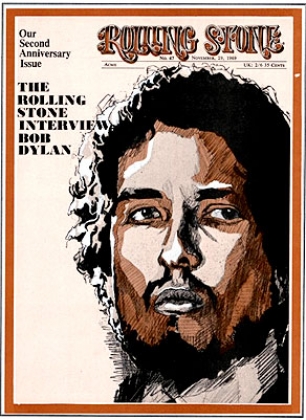
I don’t think that interviewing Bob Dylan in 1969 was any more fun that it was when he was tormenting his interviewers in 1965. Jann Wenner, founder of Rolling Stone, scored the coveted “major interview with the reclusive Bob Dylan” as the cover feature of the second anniversary issue of his magazine in November 1969, and it is just a horrible read.
The best part of the interview comes near the end:
WENNER: That’s the awkwardness of this interview.
DYLAN: Well, I don’t find anything awkward about it. I think it’s going real great.
Does he? Does he really think that it’s going great?
At this point Dylan’s relationship with his manager, Albert Grossman, was disintegrating, and he was contemplating leaving Columbia Records (which he would do), although he doesn’t really want to talk to Wenner about either of those things. Wenner asks him about touring and he suggests that he’ll go on the road shortly, but it would be another four years before Dylan would tour again (he did play Isle of Wight between the time this interview was recorded and when it was published). So he lies about the one topic, and just dissembles about the others. This is going great?
One of the most interesting things is that Wenner, who comes across as the nerdiest of nerds here, wants to talk about the specifics of Dylan’s work and Dylan sometimes can’t even remember what songs are on what albums. Either he just didn’t care about this interview (likely) or he has a very unusual relationship to his creativity (possible).
One of the best answers for why he was taking so many drugs while touring in 1965 and 1966:
“My songs were long, long songs. But that’s why I had to start dealing with a lot of different methods of keeping myself awake, alert… because I had to remember all the words to those songs.” If you consider how short most of the songs on John Wesley Harding and Nashville Skyline are, I’m sort of tempted to believe that this might actually be a genuine answer.
The interview does have Dylan explaining that the change in his voice, which is at its most notable on Nashville Skyline, was a result of his decision to stop smoking. This could also be true (apparently Dylan still smokes to this day, and when he tours he often has to stay in low end hotels because they allow smoking). His comment, “I tell you, you stop smoking those cigarettes … and you’ll be able to sing like Caruso.” is probably the high point of the interview.
A lot of the rest of it is Wenner asking Dylan his opinion on other bands of the period, which was probably of interest to the editor of a music magazine (and maybe the readers) but not so much to me. It is interesting when Dylan notes that he doesn’t really know the music of The Grateful Dead, given that they will later tour and record together. This interview does paint a picture of a man who is pretty cut off from the scene he helped generate though.
My take away from all this was that in 1969 Wenner seemed to know a lot more about Dylan than Dylan knew about Dylan, or at least about the public part of his life. Clearly, people spend more time thinking about Dylan than Dylan does. I guess that now includes me.



 LongAndWastedYear