Tarantula (editions)

Standard

Screen Shot 2014-03-15 at 5.03.06 PM

You can buy Bob Dylan’s “novel”, Tarantula, on AbeBooks for $1.10 (plus shipping). You can also buy it on AbeBooks for $9,500. The latter copy is the first hardback edition from 1971, and it is signed to John Carter, a music industry A&R man. The book is probably worth something that falls in between those two prices.

Dylan memorabilia can be ridiculously expensive. AbeBooks has signed copies as “inexpensively” as $700. Signed copies hold no lustre for me at all, unless I was the person to get it signed, so this is not something that I’d ever think of shelling out for (I would also be extremely wary about forgeries with someone like Dylan – not that I am accusing any of the dealers on AbeBooks, but it is something that I would always worry about).

Interestingly, not all of the most expensive copies on AbeBooks are signed editions – many of them are bootleg editions. Dylan wrote Tarantula in the mid-1960s – the book has all the hallmarks of his speedy writing from that period and is in line with his lyrics from the Highway 61 era, as well as the liner notes from those albums. He published it only reluctantly, and possibly only because he had been paid a large advance. It was endlessly delayed, and he felt a need to go back and improve it. Because it had gotten to the page proof stage, bootlegs (early Xeroxes, re-typed versions) circulated for years before it actually was released. Some of these are extremely costly (with the obvious note that just because a price is asked for a book there is no guarantee that anyone will actually buy it for that price).
Screen Shot 2014-03-15 at 4.44.16 PM

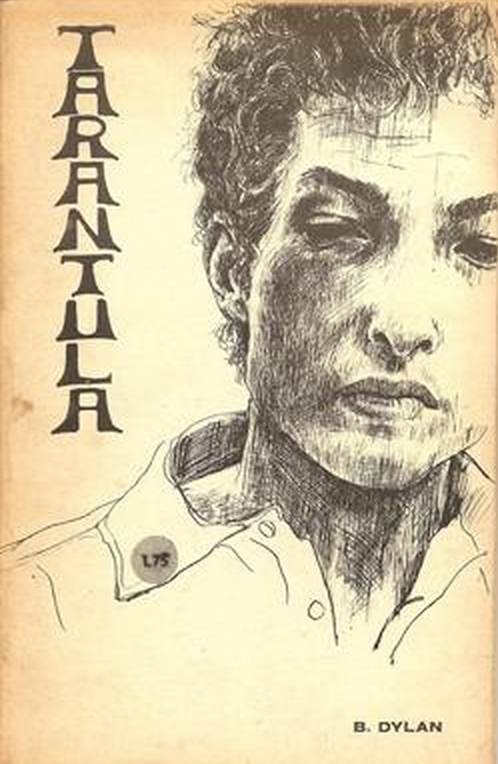
The most expensive Tarantula bootleg on AbeBooks today is $1,250. This is an edition published in Madison, WI. The notes on a $700 copy of the same edition says that the money made from selling these went to support local writers (which is, come to think of it, true of almost any book published by anyone).
Screen Shot 2014-03-15 at 4.46.06 PM

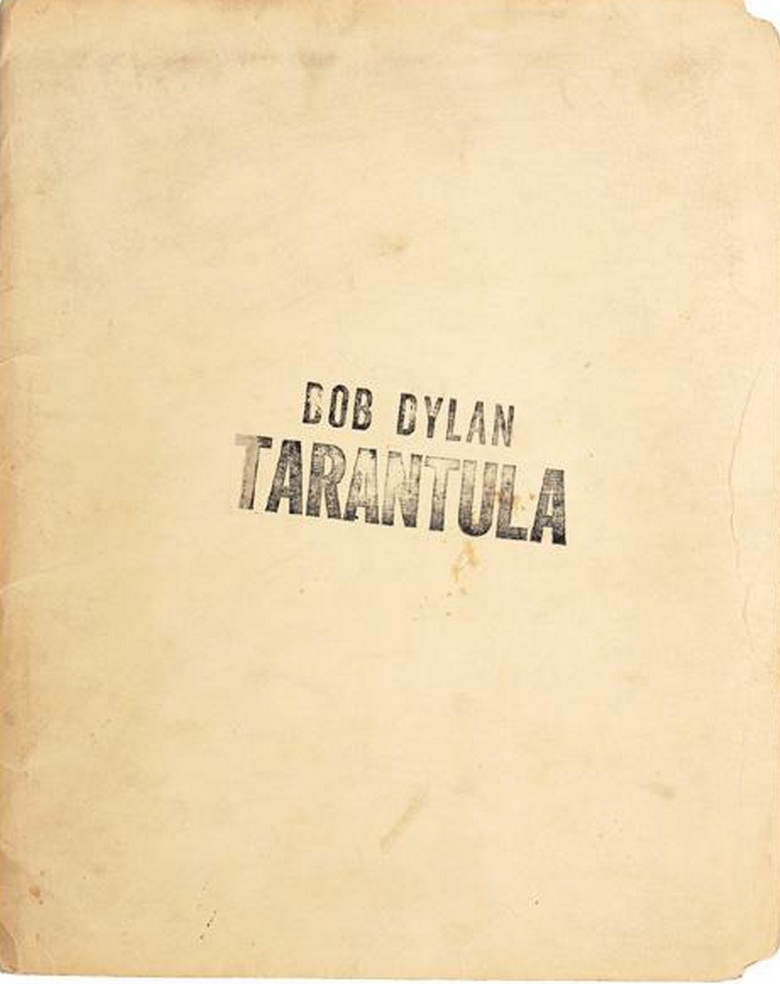
For $686.08 (an odd number – a conversion from British pounds) you can get a pirated edition in a file folder. This one is only 36 loose leaf pages, so it is not entirely clear to me that it would be the whole book, but possibly.

$T2eC16F,!)!E9s2f!GR-BSDsu)f)KQ~~60_57

Another interesting one (same price – $686.08) is the AJ Weberman produced edition with covers by underground cartoonist S. Clay Wilson. This is the edition, if I was going to have one, I would most want, because of the Wilson cover.

For $400 you can get a tabloid edition of Vancouver’s still extant newspaper, The Georgia Strait, which gave over an entire issue to printing Dylan’s prose. That would be a nice, rare one. $279.06 gets you the UK rip off from Wriptoff Press. For $200 the edition from The Wimp Press in Hibbing, MN who gave their proceeds to the Caladan Free School, whatever that was. The French edition (presumably licensed, published in 1973) is $70.03, and notes that it has been “adapted from the American”.

Such a curious book for a book that was so little loved and admired. I’ve bought two copies in my life – one that arrived a few weeks ago from Amazon.ca (for about $11.00, if I recall correctly) and one (possibly the 1977 paperback edition?) that I bought from City Lights Books in London, Ontario when I was doing my undergraduate degree at the University of Western Ontario. City Lights was a classically, stereotypically jam-packed used bookstore near where I lived off campus (and across from the rep cinema, so I was there all the time) owned by Marc Emery, who is now best known as an imprisoned pot legalization crusader. He was a libertarian rabble-rouser at the time that I knew him. That copy of Tarantula sat on a shelf for a few years before I actually bought it. I don’t think I ever made it all the way through that copy (I sold it when I sold almost all of my old books before we moved from Montreal). I’ve been struggling all week to get through it now.

I promised a friend that I would read and write about Tarantula, but it’s going to take a few more days. I will get this thing swallowed all the way down, even if it kills me. Until then, enjoy browsing for bootleg copies.

Greatest Hits Volume 2

Standard

Bob+Dylan+-+Bob+Dylan's+Greatest+Hits+Vol.+II+-+DOUBLE+LP-421574

Had I been a hardcore Bob Dylan in 1971, the release of Greatest Hits v2 would have absolutely driven me over the edge. The double album contains fifteen songs from earlier Dylan albums and six new ones not available anywhere else. So for the price of a double album you get, essentially, one new side. If you don’t buy the double album, you can’t, in 1971, get the six songs (legally) anywhere. These were infuriating days in the record industry, filled with executives who would soak a fan for any little advantage that they could get. No wonder bootlegs began to seem so appealing.

Today, of course, you can download individual tracks, or, as I did, get these songs on the bonus discs of The Complete Album Collection. They are varying quality, but generally pretty good. Most of them are from The Basement Tapes period, but were re-recorded by Dylan (with Happy Traum) at the end of September 1971. This version of “You Ain’t Goin’ Nowhere” is, I sort of think, the earliest Dylan song to feature banjo accompaniment, which makes it a new favourite of mine.

The album opens with “Watching the River Flow”, which had been released earlier in the year as a single. This was a song that I didn’t know well at all until this week, and which I quite like, with its rollicking piano. The whole slowing the band down to a false stop thing works for me. The rest of the first side, the second and third are just filled with songs from Dylan’s earlier albums dating all the way back to Freewheelin’. There is actually only one song each from Self Portrait and New Morning, indicative of their relative newness and lack of esteem, I suppose.

All of the new music – music that would have been found on the bootlegs of Great White Wonder  – appears at the end of the fourth side, and includes an unreleased live version of “Tomorrow Is A Long Time” (from 1963), and then the new recordings of “When I Paint My Masterpiece”, “I Shall Be Released”, “You Ain’t Goin’ Nowhere”, and “Down in the Flood”. Of these last four, all date from the Basement Tapes period, but in these redone – banjo-fied – versions, I really like them much better than I do on The Basement Tapes themselves (where they were overdubbed by The Band) or on A Tree With Roots, where they are a little more ragged. None of these are among my favourite Dylan songs, but these are my favourite versions of these particular songs – at least so far.

Still, it is a nightmare of marketing to put these on a double album like this filled with material that many of his fans would already own. This will become an increasing trend with Dylan and Columbia Records as time moves forward: the constant slow release of material in ways that obligate fans to continuously re-buy older material. Even The Complete Album Collection is not a complete collection of Dylan albums, after all, since it doesn’t include this very album! For that, perhaps, you’ll have to wait for Bob Dylan The Complete Complete Collection, coming soon from Columbia Records.

“George Jackson”

Standard

bd_george_jackson_2_0

Bob Dylan’s recorded “George Jackson”, released as a single but never on an album, on November 4, 1971 and it was released eight days later. Jackson was killed in Soledad Prison on August 21 of that same year. Like Crosby, Stills, Nash and Young’s “Ohio”, the song was a quick turnaround on an issue of contemporary importance – Jackson’s killing was one of the sparks of the Attica Prison riots.

The circumstances of Jackson’s death are complicated, and it would seem almost inconceivable that a song like “George Jackson” would be recorded today. Jackson was sentenced at eighteen years of age to a year to life in prison for robbing a gas station, and in prison he became radicalized, turning to Marxism, Maoism, and eventually becoming a member of the Black Panthers. He wrote extensive letters to people outside of prison, and those letters were collected into well-received books. I read “Soledad Brother” when I was about twenty and when I was fascinated by the fragmentation of the counter-culture into increasingly militant organizations, but I have to admit that I don’t have any really clear memories of it today.

Jackson was shot by guards during a confrontation that led to the deaths of three guards and two prisoners just days before he was to go on trial for the murder of a different guard. The facts of the case are wildly disputed, with many arguing that he was set up for assassination, and others noting that he was in possession of a handgun in the prison and that he may have killed several guards. Clearly he was a much more divisive figure than someone like Reuben Carter, a prisoner about whom Dylan would also write later in the 1970s, who was clearly a much more conventionally sympathetic figure. For his return to topical songwriting Dylan did not pick an easy topic upon which there would be unanimity.

The song itself, I just learned today actually, was released in two versions. There was a full band version with back-up singers as the A-side, and a solo acoustic version was the B-side. I’ve been listening to the B-side all week as that is the one that is included on the CDs of non-album bits in The Complete Album Collection. You can hear the full version here.

I greatly prefer the stripped down acoustic version, as the other one sounds sort of needlessly over-produced to my ears. The song is a bit odd in its construction by Dylan terms, with the very short two line verses and the repeated two line choruses. I also have to wonder if this was the first song to break into the US Top 40 (it peaked at #33) that uses a clearly enunciated word “shit”? I don’t know the answer to that at the moment.

The most interesting thing about the song is that it marked a full-blown return by Dylan to political and topical song-writing, six years after he gave that up. I’d be curious to know if playing The Concert for Bangladesh played any role in that, or if it’s a mere coincidence. Having listened to the acoustic version all week, I was surprised that the song hadn’t ever received more attention, particularly among fans who felt he’d betrayed the topical song movement. Now that I understand that that was the B-side it makes more sense, because while the A-side is topical, it’s also so highly produced that it would be hard for the remaining folkies to get into it.

Here’s Joan Baez doing a very folk version, as she always does:


The 100th Post

Standard

bob_dylan_elliott_landy

This is the one hundredth post on LongAndWastedYear.com. It’s also the seventy-first day of the year. I will admit that when I paid for this domain, a large part of me thought that we’d never make it this far, and I never expected to posting at the rate of more than once per day. But Bob works in mysterious ways, and I still have quite a few things to say about 1971 this week.

Before that, however, I felt that we should note the centennial post. It is my plan, when this is all wrapped up, to produce a list for myself of the 100 Best Bob Dylan Songs (and Versions). That is, not just a list that says “Like a Rolling Stone” is better than “Mr. Tambourine Man” (which it is), but that says “Like a Rolling Stone” is the best Dylan song and his version of it from “The Royal Albert Hall” show is the best version of it. This particular list will likely drive me insane.

I haven’t been keeping very careful notes for that project in recent weeks (aided by the fact that Dylan hasn’t been touring, so there have been few alternate versions to listen to), but tonight I decided I should at least begin taking thorough notes. So I made a list of what I think are contenders for the Top 100 through 1971. That list was 68 songs, which leaves lots of room for the next four decades to fill things in.

I then gave each song on that list a score from 1 to 5, with 1 meaning that it would be nice if it made it onto the final list (“Let Me Die in My Footsteps”, “Wicked Messenger”) and 5 being “this song is absolutely essential”. It turned out, not surprisingly, that there was a huge bulge of 4s and 5s around 1964-1966, and that they tapered off from there. These were all just simple gut level reactions, mind you, not well thought out positions. I basically looked at the title, heard the song in my mind, and gave it a score. Since these will change so much over the course of the year because of live versions, I’m not sharing the lower parts of this list. But I will share the top ten as it exists this very second. I could edit this in an hour. Who knows?

I have to say this. My first gut reaction (which would likely change tomorrow if I’m in a different mood) generated eleven songs that I gave five stars to. Pushing one out of the top ten was BRUTAL. I felt so bad for it. The process is only going to get worse as it goes along – Blood on the Tracks and Desire alone have about five songs that I put at such elevated heights. This is why they pay me the big blogging bucks, I guess.

First Attempt at a Bob Dylan Top Ten

10. A Hard Rain’s A-Gonna Fall (Bootleg Series 9: The Witmark Demos)

9. It’s All Over Now, Baby Blue (Newport Folk Festival 1965)

8. Song to Woody (Bob Dylan)

7. It’s Alright Ma (I’m Only Bleeding) (Manchester Free Trade Hall 1965)

6. Went to See the Gypsy (New Morning)

5. Don’t Think Twice, It’s All Right (Newport Folk Festival 1964)

4. Positively Fourth Street (single version)

3. Girl From the North Country (Oscar Brand Radio Show 1963)

2. Visions of Johanna (London 1966)

1. Like A Rolling Stone (London 1966)

Yeah, that’s right – I put two songs from the same show in the top two spots. Oh well, that show is just that damned good. Make your own list if you don’t think so!

Dylan and George Harrison

Standard

tumblr_n13szym2sR1rc6vmmo1_500

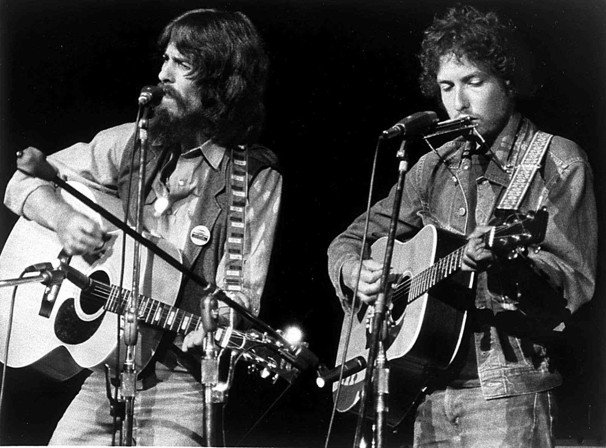
After I posted some comments about The Concert for Bangladesh a little earlier, I stumbled accidentally across this gem, which is in some ways better than anything from the actual film. It’s Bob Dylan and George Harrison singing “If Not For You” from the rehearsal for the show (the song didn’t make it actually into the live performances).

On the one hand, the video documents what Joan Baez and others had already proven – singing a duet with Dylan is tough, because his phrasing can be pretty variable. Indeed, it might be one of the reasons that this wasn’t done live – you don’t want to have two of the biggest stars on the planet sort of faltering through a song in front of 20,000 people.

On the other, I like this video because it seems to point to something simple – that two of the biggest stars on the planet can just be friends. Dylan and Harrison seemed to really understand each other. They performed each other’s songs, and they even will form a band together. It was always evident that of all The Beatles, George was the one that Dylan connected with most (Paul seemingly least). By all reports, they hung out a lot around this period, and you can see that a bit here.

Walking the dog tonight I re-listened to the recordings that Dylan and Harrison produced on May 1, 1970. Bjorner reports thirty-seven tracks were recorded on that day. I have twenty of those, but there were also multiple takes of “Sign on the Window” and “Time Passes Slowly” for New Morning, and probably some false starts.

It’s not a great bootleg because George doesn’t sing, except on “Your True Love” (the Carl Perkins song), which would be the primary appeal of hearing them record together. Harrison mostly just plays guitar and the two of them (and bassist Charlie Daniels and drummer Russ Kunkel) are just jamming (“Your True Love” ends with laughing and Dylan says “That’s an oldie”, as if he’s surprised to have remembered it, and they are just dredging things out of their minds). They cover a number of Dylan tunes, possibly at Harrison’s request (you can hear Dylan explain that he can’t remember the chords for “Please Crawl Out Your Window”), and one Beatles song (“Yesterday”, a song Dylan was definitely not born to sing). They even cover, lamely, “Da Doo Ron Ron Ron”.

The best thing to come out of the session, I guess, is “Working on a Guru”, a loopy Basement Tapes sounding piece that gently mocks Harrison’s connections to the Hare Krishnas. It was released on Another Self Portrait. It’s an inessential, but fun, tune.

The Dylan/Harrison sessions took place one month after The Beatles broke up, and before Harrison began working on All Things Must Pass. The visit apparently inspired Harrison’s “Behind That Locked Door”, his country-Hawaiian song that is read as a tribute to Dylan (who was seen to be hiding his talent by doing all of the covers that appeared on Self Portrait (and will soon appear on Dylan)). I have to say, I had never heard this theory before tonight. I always thought that song was just romantic mush (though with awesome steel guitar). Judge for yourself if Harrison is writing about Dylan:

Concert for Bangladesh

Standard

220px-MSG_box-office_sign_for_Concert_for_Bangladesh

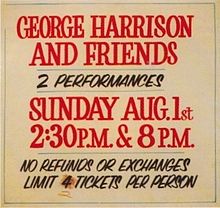
“I’d like to bring you all a friend to us all, Mr. Bob Dylan”. With those words, George Harrison surprised the sold-out matinee crowd at Madison Square Garden during the Concert for Bangladesh. Actually two concerts (afternoon and evening), The Concert, held on 1 August 1971, was one of the first rock benefits of this size and scope, and laid the foundation for numerous charity rock shows in the decades that followed.

Organized by George Harrison, the shows featured fellow Beatle Ringo Starr (John Lennon pulled out a few days before the event, apparently when Yoko Ono was upset that she was not invited; Paul McCartney was never going to appear because he was sulking about the legal dramas from the break-up of the band), Eric Clapton (in severe heroin withdrawal), Billy Preston, Leon Russell and Ravi Shankar and Ali Akbar Khan. It raised $250,000 for Bangladeshi relief, administered by UNICEF, and continued to raise money through the film and soundtrack.

The two shows were Dylan’s first significant stage show in two years, since the Isle of Wight, and he’d been finished touring for five years at this point. The story is that he almost failed to appear, showing up at the sound check the night before and panicking at playing for such a large crowd. In the film, you can see Dylan’s afternoon set (well, four of the five songs) beginning at 1:09, and just before he introduces him Harrison clearly goes to check to see if Dylan is actually come out on stage.

BobDylan

Dylan did five songs backed by Harrison, Starr (on tambourine), and Leon Russell: “A Hard Rain’s A-Gonna Fall”, “Blowin’ in the Wind”, “It Takes a Lot To Laugh, It Takes a Train to Cry”, “Love Minus Zero/No Limit”, and “Just Like a Woman”. “Love Minus Zero” didn’t make the film or the album, but of the others it’s probably “Just Like a Woman” that receives the best version. In the evening show “Mr Tambourine Man” replaced “Love Minus Zero”, but that also doesn’t show up on the recordings of the show.

This is some of the earliest really high quality video recording of Dylan. Yes, he can be found in the Newport Festival footage of Murray Lerner, and in footage from his two British tours, but this is the kind of  well shot, close to the action camera work that would become quite common only later. There is a bit of a sense of being on stage with Dylan here, and he definitely seems like a much different performer than he did five years earlier.

The entirety of the Concert for Bangladesh film is online on Vimeo (I still haven’t bothered how to embed Vimeo clips, just click through), but here’s a YouTube clip of “Just Like a Woman”. The entire concert is really worth watching if you have an hour and a half. Clapton really isn’t that good, but it’s interesting to hear Harrison doing some of the late Beatles material live for the first time. Also, UNICEF was promoting the fortieth anniversary of the show two years ago, so if you do watch it on Vimeo rather than buying it, you might want to make a donation. Sadly, forty years later and the problems UNICEF deals with are no less acute.

Bob Dylan, Fact-checker

Standard

image002

One of the more bizarre Dylan bootlegs is a recording of a phone call between the singer and the infamous “Dylanologist” AJ Weberman from January 1971. I listened to this a couple of years ago while driving to Fernie, BC after it hit the web on OpenCulture.com, and I thought it was fascinatingly weird (I can’t find that link, but the whole thing is on YouTube). I didn’t know who Weberman was at the time – I’d never heard of him. I listened to it as a) a bizarre experience of copy-editing/fact-checking as Dylan disputes a number of statements attributed to him in an article Weberman was writing about him, and b) an interesting look at a certain kind of disappointed Dylan fan and Dylan’s interaction with him.

Weberman spends a good chunk of the discussion complaining that Dylan has sold out – that his newest albums, Self Portrait and Nashville Skyline, lack the political bite of Dylan’s older material, and of the material produced by contemporary songwriters. He slags Johnny Cash (whom Dylan defends) and urges Dylan to use his wealth and power for good rather than contentedly singing country songs about how happy he is. It’s a point of view, I guess, even if it’s not really one that I share.

Listening again to it today, having read about Weberman, it strikes a much different tone. I now know that Weberman is the guy who rifled through Dylan’s garbage to do “research” on him, that Dylan accused him of harassing his children, and that Weberman protested in front of Dylan’s Greenwich Village home. He has published a number of essays about Dylan, arguing that he is a Nazi sympathizer and Holocaust denier. With this awareness, hearing him talk about the hidden messages that Dylan has hidden in his albums (you can hear them when you play it backwards!), and his accusations that Dylan is just a reactionary capitalist fall a little flat, to say the least. Weberman seems to think that most of Dylan’s songs are written about Weberman, and has taken his obsessions to somewhat disturbing rhetorical lengths.

Two moments stand out for me from the recording. First, the discussion at about 39:00 in about who are better songwriters than Dylan. Weberman suggests Credence Clearwater Revival, to which Dylan simply replies “Bullshit”. Gordon Lightfoot is, Dylan says, “alright”, while John Lennon gets a “no, no” and George Harrison gets a thoughtful “maybe”. It’s a funny little exchange.

The second is at the end. After spending almost an hour on the phone with a man that he once physically assaulted, and who he accused of stalking his family, you have to wonder why Dylan gave him his phone number. And then you really have to wonder why Dylan would say to the man he has repeatedly called “a pig” throughout the hour, “see you Monday”. There’s a lot going on here, but I think most of it is probably best left undiscovered.

Weberman’s website was apparently seized when he lost a defamation case, which says a lot. Here he is from 1969 rifling through Dylan’s garbage on YouTube. No, really.


New Morning

Standard

url

Dylan’s 1970 sort of did me in – two albums, one of them a double-album, was just a tad too much for me in what was, by far, the busiest week of my term at work. So before I flip the switch over to 1971, a mildly belated final word on New Morning, Dylan’s “come back” album from the Self Portrait (which my friend Rusty, in one of the comments, called “the first passive-agressive concept album”, a comment so good we need to move it to the front page for all the world to see).

New Morning is a whole order of magnitude better than Self Portrait. It might be fun to play the role of contrarian and make an elaborate argument that the received wisdom isn’t so, but I would find that disingenuous. New Morning really is a lot better. It’s far from perfect – indeed, it may have his worst song so far (“If Dogs Run Free”) – but it has really genuine highs.

New Morning actually begins incredibly strong. “If Not For You” is one of Dylan’s great romantic masterpieces, and this is a lovely version of it. “Day of the Locusts” is quite different – a cynical report of accepting an honorary degree in music from Princeton: 

I put down my robe, picked up my diploma

Took hold of my sweetheart and away we did drive

Straight for the hills, the black hills of Dakota

Sure was glad to get out of there alive

 This is one of the songs that I didn’t know well (it seems that Dylan has never performed it live), but that I really like. It’s got a feel that really anticipates albums like Desire, particularly a song like “Isis”, which is a period that I really enjoy. This one foreshadows a really great period for Dylan. This is then followed by “Went to See the Gypsy”, which is the best thing on the album. So everything is clicking along wonderfully.

And then we hit the brick wall, hard. “Winterlude” is, I suppose, meant to be funny. It’s just annoying rather than goofy. The closing lyrics:

Come out tonight, ev’rything will be tight

Winterlude, this dude thinks you’re grand

 Are some of the worst of all time. And it’s still downhill – “If Dogs Run Free” ends the side. There is another version of this on Another Self Portrait, by the way, without the scatting, which is only not good, rather than actively awful. Still, this version is just terrible.

Side two opens with the title track, and it’s a pretty good one. I like the way Dylan sings this very slight but extremely happy little ditty. It’s probably my second favourite thing on the album. 

“Sign on the Window” is the song from this album that I had the most difficulty getting a handle on. It’s not a song that sticks in my mind, so it sounds new to me every time I hear it. I don’t like the bridge at all – with the piano it sounds like something from Elton John or Billy Joel. “The Man in Me” I’ve already written about. It’s fine. Like side one, the second side sort of runs out of gas. “Three Angels” and “Father of Night” don’t have a ton to recommend them. “Three Angels” is actually a bit of a nothing. Recorded on June 1, 1970, it was produced on the same day as “If Dogs Run Free” and “Winterlude” (and “The Man in Me”), likely one of the least best days for Dylan in the studio ever.

So, overall there’s quite a bit to like on this album. It’s literally half good – I think that exactly half of the songs are really good, and half I’d jettison. Still, that’s a pretty good ratio, all things considered.


“The Man in Me”

Standard

The_Big_Lebowski_-_The_Dude-Funko-Pop_Vinyl-Funko-trampt-119564m

When I used to teach Film Studies at the University of Calgary, my favourite class to teach was the one I did three times on The Coen Brothers. It’s really the only class that I feel like I ever mastered, and it always went incredibly well. After a while I developed an off-shoot of the class, and I taught a course on The Big Lebowski. We watched that film thirteen times during the semester (we also watched things that it is playing off like The Big Sleep and Robert Altman’s The Long Good-bye). My students were initially wary but I consider it one of my great triumphs that, a week after the class ended, The Plaza Theatre here in Calgary had a screening of the film as a fundraiser for the local food bank (not sure of the connection, to be honest) and every one of my students showed up to see it a fourteenth time, most with their friends in tow. They had all become obsessed with this film.

If you watch The Big Lebowski every week for three months, you cannot hear “The Man in Me” as anything other than the soundtrack to a bowling montage. T Bone Burnett, credited as the “musical archivist” on this film, picks a relatively obscure Dylan song as a near perfect encapsulation of the film’s themes.

I’m not sure that I would like this song as much as I do if I didn’t love this film, but as I say, I cannot hear it any other way. I listen to the CD in my car and I can actually see in my mind’s eye the celebrating bowlers as the chords change. It has been absolutely repurposed for me.

“Went to See the Gypsy”

Standard

Went+To+See+The+Gypsy

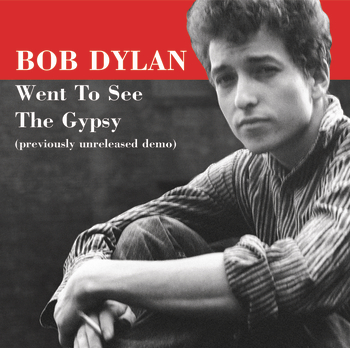
“Went to See the Gypsy” is the best song on New Morning, and, I have decided in the last couple of days, one of the best songs Dylan ever wrote. I can’t get enough of this one – it’s utterly fantastic. Nonetheless, here’s my problem with it:

Am I required to believe Bob Dylan?

I haven’t spent a lot of time on this project thinking about who specifically Dylan was writing about on any of his songs. You tell me that “Leopard Skin Pill Box Hat” is about Edie Sedgwick? Ok, fine. “She Belongs to Me” is about Joan Baez? Sure, if you say so. I don’t want to know who Mr. Jones is. These aren’t the questions that keep me up at night.

The one thing that I know in my heart of hearts, however, is that “Went to See the Gypsy” is about Bob Dylan meeting Elvis Presley. Clinton Heylin mentions this fact in his notes in The Complete Album Collection. Actually, he uses the word “allegedly inspired by” but he also gives the date of the meeting as having occurred in January (1970). I mean, it has to be about Elvis, right? Here’s the first verse – substitute “Elvis” for “The Gypsy” and read it:

Went to see the gypsy

Staying in a big hotel

He smiled when he saw me coming

And he said, “Well, well, well”

His room was dark and crowded

Lights were low and dim

“How are you” he said to me

I said it back to him.

How else do you think that the meeting of America’s most important singer from the 1950s meeting America’s most important singer for the 1960s is going to go? Have you been to Graceland? Elvis liked dark and crowded, lights that were low and dim!

The second verse makes it even more clear:

I went down to the lobby

To make a small call out

A pretty dancing girl was there

And she began to shout

“Go on back to see the gypsy

He can move you from the rear

Drive you from your fear

Bring you through the mirror

He did it in Las Vegas

And he can do it here”.

“He did it in Las Vegas!” Elvis’s legendary run at the International Hotel in Vegas began in July 1969, shattering all Vegas records, and then it resumed in 1970. And it had dancing girls!

Bridge:

Outside the lights were shining

On the river of tears

I watched them from the distance

With the music in my ears.

“The music in my ears” confirms it.

Final verse:

I went back to see the gypsy

It was nearly early dawn

The gypsy’s door was open wide

But the gypsy was gone

And that pretty dancing girl

She could not be found

So I watched that sun come rising

From that little Minnesota town.

And that’s what makes this among the best Dylan songs ever – the way that he sings “that little Minnesota town”, his first direct invocation of life in Hibbing, where he grew up listening to Elvis, who was rising like a sun over America. It’s a song of lament – of missing out on his idol – but also of self-assessment. It’s a great, great song.

Except.

Bob Dylan told Rolling Stone’s Douglas Brinkley in 2009:

“I never met Elvis, because I didn’t want to meet Elvis… I know The Beatles went to see him, and he just played with their heads.”

What the fuck?!

“Elvis was truly some sort of American king. Two or three times we were up in Hollywood, and he had sent some of the Memphis Mafia down to where we were to bring us up to see Elvis. But none of us went… I don’t know if I would have wanted to see Elvis like that. I wanted to see the powerful mystical Elvis that had crash-landed from a burning star onto American soil.”

Again: WHAT THE FUCK?! Are you kidding me? Dylan never met Elvis? How is that even theoretically possible? I mean, he WROTE A SONG ABOUT IT!

I can’t unhear Elvis in this song – I really can’t. That is what this song is about. Period. End of discussion. And if that means I have to assume Bob Dylan is lying to me (and to Rolling Stone), well, it wouldn’t be the first time, now would it?

Al Kooper played on the original and also covered it. He’s never lied to me, so here’s his version: