Dylan

Standard

Bob_Dylan_-_Dylan_(1973_album)

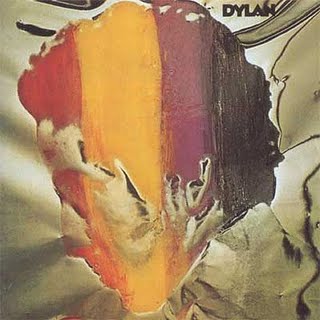
Let’s try to focus for a minute on the positive. I sort of like the cover art. I actually don’t like the covers to most of Dylan’s albums (looking at them all right now, I would almost amend that to say that I don’t like any of his album covers), but this one is kind of goofily above average for a Dylan cover.

After that, I think I’m done.

Dylan is an album that I had never listened to before this week, and it is one that I may never listen to again, in all honesty. I’ll note that AllMusic.com gives it one star out of five (even Self Portrait got two stars), a ranking that is only matched by 1989’s Dylan and The Dead (the album that ended my initial love affair with Dylan a quarter century ago). I’m guessing that AllMusic doesn’t give it out scores below one star?

This is not just a bad album, but it is a legendarily bad album. Perhaps even a purposefully bad album. Released in mid-November, six weeks before Planet Waves, the album was packaged by Columbia out of spite. Dylan had signed with Asylum Records earlier in the year (he will release two albums with them in 1974 before going back to Columbia) and they literally put out an album in an attempt to thwart the sales of the other album. That is pretty incredible if you stop for a moment to think about it.

I have to say, I have never paid that much attention to musicians who protest their record labels, from Prince to the Dixie Chicks. I assume that they probably have some legitimate issues, but I never know what they are, exactly, and I have never really cared enough to follow it. I do have to say, though, that when a record company releases a collection of bad recordings of one of their major stars just in an effort to hurt that person, well, maybe record companies are as awful as they’re depicted as being.

Almost all of the material on Dylan was recorded for New Morning, although two of the songs date from Self-Portrait. None are originals, and none of them are any good. Many of them are songs that Dylan was recording just to experiment with studio set-up – practice material, essentially. Everything was three or four years old at the time and Dylan had made a deliberate choice to bury it all. Notably, when he came back to Columbia this wasn’t released on CD, though it is included on the Complete Album Collection.

Most of the material is kind of disastrous. “Lily of the West” is not awful – that is, until the back-up singers chime in. If you stripped them out this was be an inoffensive number. Not important or memorable, just not awful.

“Can’t Help Falling in Love” is just dreadful. Nothing should be said about this song. “The Ballad of Ira Hayes” is also pretty bad. I kept trying to like this. I have a nice version of this by Peter La Farge on The Best of Broadside. This does not compare to that. “Mr. Bojangles” actually, for a very short moment, sounded to me like a Dylan song once this week. Just the sadness, the circus, something about it. Then it went away and I’ve never managed to get it back. Pretty awful. Joni Mitchell’s “Big Yellow Taxi” is one of those frequently covered songs that never sound as good as when Mitchell sings it, so what’s the point? “A Fool Such As I” and “Spanish is the Loving Tongue” both add up to nothing.

There are two songs that I don’t despise here. “Mary Ann” sounds like a rehearsal song. It’s not a bad traditional song. The guitar part is nice, the back-up singers aren’t terrible. It’s probably the best thing here. The other is “Sarah Jane”. My wife thinks that this alternately sounds like something that The Partridge Family would’ve recorded, or that the Muppets should perform (with all the “La la la la las”). I think that this song is just so derangedly goofy that I sort of have to like it. I like to picture Dylan dressed in an Elvis jumpsuit performing this in Las Vegas.

Really, this album is so bad, and the Pat Garrett & Billy the Kid soundtrack is so thin, that I almost skipped ahead to 1974 early today. I was able to restrain myself, but I’ve had Dylan playing in my office all afternoon I am about to lose my mind.

Here’s Peter La Farge doing “The Ballad of Ira Hayes” as an antidote:

And Joni:

Pat Garrett & Billy the Kid (film)

Standard

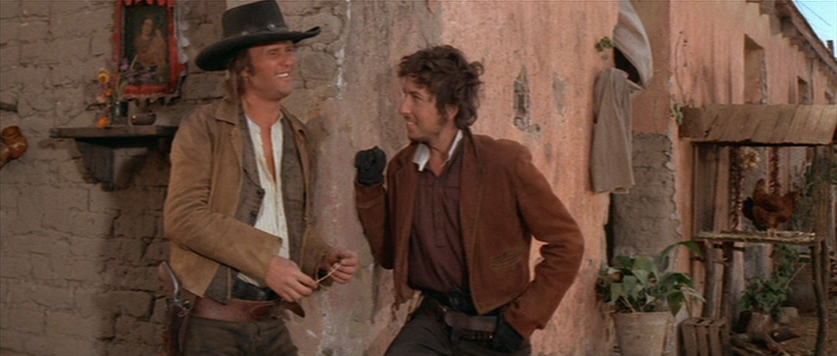
Dylan as Alias, Pat Garrett & Billy the Kid, 1973

So, it’s not much of a film. It’s not actively terrible, because it’s not that hard to watch. But it surely isn’t good either. Sam Peckinpah doesn’t put much stock in character, plot, or dialogue at the best of times, and this one is just a strung together set of incidents. But it looks pretty.

Pat Garrett & Billy the Kid is one of the simplest westerns ever. There are some ranchers, and they want William Bonny gone. Pat Garrett, a former outlaw, signs on to become sheriff and rid New Mexico of the vexatious Billy. He warns him in the first scene, arrests him in the second, and Billy escapes in the third. Almost every scene winds up with someone getting shot. Indeed, characters are only introduced to be shot. When Dylan’s character, Alias, hooks up with Billy it is only after three other gunmen are gunned down (Dylan gets to throw a knife through one of their necks!). Who were they? What did they want? It doesn’t matter at all.

Dylan as an actor is, at best, fine. He has remarkably little screen presence in this. You get a sort of “Hey! That’s Bob Dylan” moment of excitement when he first shows up, but by the time James Coburn has him reading out the labels on canned food you have the sense that something has gone pretty much off track in this thing.

pat-garrett-and-billy-the-kid

Dylan as a soundtrack artist is another thing entirely. The soundtrack plays much better on the screen than it does on CD, and Dylan lends the film some of its only memorable moments. Probably the best part of the film is when Slim Pickens’s gut shot sheriff goes off to die. We can’t truly care about the passing of this character, since he was only introduced about five minutes before he was shot and I honestly have no idea what his name was other than Slim Pickens Sheriff Guy, but the use of “Knockin’ on Heaven’s Door” gives the scene sufficient heft that allows us to fill in enough blanks in the stereotype that Pickens plays so that we can feel something if we want to. The song then gets re-used when Billy shoots the deputy in front of his wife and kids, but just the refrain this time. What was more surprising to me was all the various versions of “Billy”. I had wrongly assumed that the ones on the soundtrack after the final theme were outtakes, but they show up here. But now that I think about it, I just watched the 2005 cut of this, so maybe they were outtakes in the 1973 version. If they were, the film would have been a lot worse.

Ultimately, this one is very much the product of its time and of Peckinpah’s severe limitations as a filmmaker. There’s hardly a woman in this who doesn’t get raped or slapped, and there’s a hardly a man who has even second dimension to his psychology. The ending drags on forever, and the villain is an unseen cattleman who’s never dealt with. Memo to filmmakers: just because your character sits around pensively after he’s shot someone, that’s not an adequate substitute for characterization and dialogue.

Essentially, it looks good. Peckinpah’s film are pretty as postcards, and this one has Kris Kristofferson (who should be forced to wear a beard at all times – this clean-shaven thing was freaking me out a bit) in it. Dylan rides a horse, and I wondered if he learned that just for the movie. I don’t think that I’m even going to remember much of this one in the morning other than the fact that it has two of the best songwriters of their generation dressed as cowboys and shooting rifles. If they’d thrown George Harrison in there they’d have really had something.

Lost on the River

Standard

basementtapes2

A plug for later this fall: Lost on the River: The New Basement Tapes is going to be released later this year. This is a project in which some Dylan lyrics from 1967 are going to be set to music by:

Elvis Costello (of The Attractions)

Marcus Mumford (of And Sons)

Rhiannon Giddens (Carolina Chocolate Drops)

Taylor Goldsmith (Dawes)

and Jim James (My Morning Jacket)

It probably says something about me that the name on that list that most thrills me is Giddens, as CCD is one of my favourite bands to have emerged in the past ten years.

All of this is being put together by producer T Bone Burnett, which gives it an ultra-high pedigree. Plus there will be a documentary about the whole thing on Showtime by Sam Jones, who did the Wilco documentary I Am Trying to Break Your Heart.

Pedigree upon pedigree. Sign me up!

Here’s Giddens playing banjo with CCD:


“Pat Garrett and Billy the Kid” (soundtrack)

Standard

Bob_Dylan_-_Pat_Garrett_&_Billy_the_Kid

I’m not much a soundtrack fan. I mean, I like movie soundtracks while I’m watching movies if they’re good (Inside Llewyn Davis and Gravity being two great, but very different, ones from last year, for example), but I don’t buy the soundtrack albums much, if ever. I’m sort of hard-pressed to think of very many that I own or have owned (since I sold all of my CDs two years ago, I don’t own much of anything any longer). I would guess that the soundtrack for Pat Garrett and Billy the Kid is now one of a very few.

I’m not surprised to read that this was a disappointing release for Dylan fans. For one thing, it’s short. “Main Title Theme” to “”Final Theme” runs only 29 minutes. There are the two extra versions of “Billy” that round it out 36 minutes, but that’s only a minor attraction since there are four different versions of the same song on this album. That’s a lot of repetition. Further, only two songs “Billy” (in three of its versions) and “Knockin’ on Heaven’s Door” have vocals other than the humming/moaning that can be found on “River Theme” (which I actually sort of like). For someone who hadn’t released a full album in three years, this had to annoy the fans. I mean, even Greatest Hits v2 had more new Dylan music on it than this did.

This was Dylan’s first soundtrack, and a lot of it is very ordinary. I still haven’t watched the film yet (tonight! I hope!) but “Cantina Theme”, “Bunkhouse Theme”, and “Turkey Chase” are all pretty conventional for the western genre. The instrumentation is very good to excellent (Bruce Langhorne and Roger McGuinn on guitar will help a lot with that), but it doesn’t attempt to push the boundaries at all.

“Knockin’ on Heaven’s Door” is, I think, an absolutely fantastic version of that particular song. Having listened to it a lot over the past couple of days, I’m starting to think that no one has done it better than it was done here. For such a well-covered song, you’d think someone would be able to make an advance on it, but I’m not sure that anyone actually has.

That leaves us with “Billy” in its many varieties. I had never heard this song before this week, and I’ve really come to love it. I think that this is an underrated gem. “Billy 1”, which is the version used in the film (I take it) sounds like it’s a really great match for a Peckinpah film and the instrumentation matches best with the other instrumentals. My favourite, however, is “Billy 4”, which is considerably longer and has a ton of extra verses.

Dylan is about to move back into his phase of long story songs (“Hurricane”, “Isis”, “Tangled Up in Blue”) and this hints at that. It’s really straight-forward and direct, but it’s also quite evocative. I’m not sure that the best choices of verses was made for “Billy 1” (though the harmonica playing that opens that song is really strong). “Billy 1” uses just the first three of the song’s nine verses, and the lyrics don’t come in until 1:34 of the 3:55 song (they do two verses of harmonica – it’s some of his better playing, and it also ends with a harmonica verse). Interestingly, the lyrics do not exactly match those copyrighted on his website: there’s some changes to the third verse.

“Billy 4” is a fuller version, with an average harmonica piece in the middle. It is far more plaintive, and I like it a lot better as a stand-alone song. If you tacked the opening of “Billy 1” onto “Billy 4” the whole thing would be awesome. The lyrics here differ wildly from the copyrighted version. It swaps the order of verses three and four, uses totally different lyrics in most lines, and skips verse six, using it only at the end.

To my mind the best verse in “Billy” is the fifth:

They say that Pat Garrett’s got your number

So sleep with one eye open when you slumber

Every little sound just might be thunder

Thunder from the barrel of his gun

The eighth is also great:

The businessmen from Taos want you to go down

They’ve hired Pat Garrett to force a showdown

Billy, don’t it make ya feel so low-down

To be shot down by the man who was your friend

Although on “Billy 4” the final line is “To be hunted by a man who was your friend”, which is infinitely superior. On none of the three versions does he sing the lyrics to this verse as they appear on his website.

“Billy 7” is too much a dirge for me. It sounds like a rehearsal track, which it likely was. It begins with verse three (where he adds a “doggone” to the final line. “Doggone” never improves any song), and then jumps to verse five and then finishes with a verse that isn’t in either other version, nor on the copyrighted lyrics.

I think I have to track down “Billy 2, 3, 5, and 6” (at least), because the evolution of this song seems pretty interesting. The official lyrics are, at best, an approximation of some sort of Platonic version of the song that doesn’t seem to have ever been played. I think that the various versions of it make this an interesting album, but I’m not sure I would have loved it in 1973.

Here’s something I don’t do: an out of order video. This is, apparently, from the only time Dylan ever played this song live (Stockholm 2009). My rules don’t allow me to listen to this, but I’m embedding it here so that I will remember to come back and hear it in nine months. You can listen to it now if your own rules allow it:


“Knockin’ on Heaven’s Door”

Standard

Bob_Dylan_-_Knockin_on_Heavens_Door

I plan on coming to the soundtrack album for Pat Garrett and Billy the Kid tomorrow after a few more listens (it’s super short), and then likely the film itself (which I have never seen!) on Tuesday. I thought that I’d kick off 1973 with Dylan’s first single from that year: “Knockin’ On Heaven’s Door”.

Dylan wrote this tune as an additional song for Sam Peckinpah’s film (in which he has a small part). Dylan wasn’t much used to writing for soundtracks, and Peckinpah apparently didn’t care much for the song – he left it out of the first cut of the film. When Peckinpah lost control of the editing of the film to the studio, who reportedly butchered it, the song was put back in, and it was one of the only things that anybody liked about it. Kris Kristofferson, who starred in the film, thought it was one of the best songs ever written for any movie, but noted that Peckinpah had a blind spot in that regard.

Obviously the song went on to be legendary. It’s been covered by just about everyone from Guns ’n Roses to Avril Lavigne. The Grateful Dead used it as a show closer for about a decade in the late-1980s and early-1990s, while Dylan himself has played it live 460 times. It appears on an astonishing five of his live albums. Virtually everyone plays it the same way – as a dour drone. Eric Clapton did a reggae-inspired version, which is certainly the most unusual.

It is one of the simplest songs that Dylan ever wrote – two short verses and a one line (repeated) chorus. It’s a maudlin, fixin’ to die song, but it is a really good one. It’s sad without actually being that sad, if you know what I mean. Sort of an accidental classic, and the best new song Dylan has produced in a number of years at this point in time.

One thing that strikes me as somewhat hilarious is that the song was packaged as a single with a B-side of “Turkey Chase”, which is just about the least notable song on the entire soundtrack. I suppose that had they gone with “Billy”, the only other song from the album with vocals, it probably would have negated the need to buy the album at all.

Here’s the Clapton. I can’t bring myself to link to GNR.


Rock of Ages

Standard

The-Band-Rock-Of-Ages-The-Band-In-Concert-cover-art-1024x10241

“We haven’t played this in, we haven’t played this in how many years? six years?”, Bob Dylan tells the crowd at New York’s Academy of Music. Even though I’m ending the week with this, it was, technically, the first thing that Dylan did in 1972 – his set with The Band was recorded just after midnight on New Year’s Eve. I saved it for the end because it is the only major output from Dylan in 1972, and it was, undoubtedly, the highlight of the year.

Dylan performed live only twice in 1972 – four songs at The Band’s fourth and final show at the Academy of Music from December 28 – 31 (and crossing over into the early minutes of the new year, January 1), and he played harmonica on three songs with John Prine at The Bitter End on September 9. To the best of my knowledge, none of the Prine set exists on tape. Guess you should’ve been there.

The shows with The Band were compiled into a live album, Rock of Ages, that featured music from each of The Band’s first four studio albums. It is a great double album. Recently, though, it was re-released as Live at the Academy of Music 1971: The Rock of Ages Concerts, a four CD box set. Some criticism that I have read notes that release as an over-priced rip-off because it has so much duplicate material that a true fan would already have. As I am not a true fan of The Band, I had none of it, so I’m here to tell you that it is truly great. This is really The Band at the peak of their powers, and it is a remarkable live album. The addition of horns to The Band’s music adds a great deal, and doesn’t overdo it.

Dylan appeared only at the final show, and only for the encore. They did four songs. The first two, “Down in the Flood” and “When I Paint My Masterpiece” were Basement Tapes material that may have been familiar to Dylan aficionados from Greatest Hits v2 (although in non-Band versions), and the third “Don’t You Tell Henry” wouldn’t be released officially for another three years. These are all really good versions of these songs.

The culmination was the song that they hadn’t performed live since the Isle of Wight in 1969, “Like a Rolling Stone”. Not six years ago, but about two and a half. Apparently Dylan forgot about that performance, since he seems to think that the last time these men had played this song someone had yelled “Judas” at him, and they had then absolutely crushed this song. That’s okay, they nail it again here. It’s funny – again, the crowd doesn’t really seem to hear it coming until Dylan sings “Once upon a time”. There’s no applause for the opening chords or the piano part. Anyway, it’s a much better version that the Isle of Wight version, but it’s also a lot closer to the way that it was recorded, except that Robbie Robertson sings along to the chorus.

Before I started this project I was never that much of a fan of The Band. Not sure why. I’d seen The Last Waltz, I’d heard most of their hits and could sing along to many of them, but I had no real love in my heart for them. I have to tell you, my eyes have been opened – maybe even more than they have been by Dylan. This four CD set is the real deal.

Here’s a YouTube playlist claiming to have the whole album, but a number of tracks have been deleted – probably Dylan related deletions:

Backing Doug Sahm (again)

Standard

Dylan26

Apparently I lack basic literacy skills. After I posted some thoughts on Bob Dylan’s contributions to Doug Sahm’s third solo album last night, I received a comment from my friend Rusty (who is wise in all things) that I had neglected to mention “Wallflower”, the song (written by Dylan) of Sahm’s where the Dylan presence is most notable. This sent me scrambling back to my websites to figure out how this could have happened. Simple: I don’t read very thoroughly.

Bob Dylan played not on one day of Sahm’s recording sessions in October 1972, but on four consecutive days (October 9-12). Well, that certainly changes everything. Dylan participated not on four songs, as I erroneously reported yesterday, but on thirteen.

I’m not going to go through all of the remainder today, because a lot of them he’s simply playing harmonica, piano, or guitar and it is tough to pull the Dylan contributions out of the totality of the band’s sound. Still, two songs are particularly worth mentioning:

“Wallflower” is a song that Dylan wrote in 1971, but which wasn’t released officially until the first Bootleg Series record came out. A second, alternate, version of Dylan’t version of the song was released last year on the most recent Bootleg Series, Another Self Portrait. This is a pretty good song, and one that, ironically, I’ve recently associated with the great all-female old time band, Uncle Earl, who recorded it in 2007 for their album Waterloo, Tennessee (highly recommended, by the way). Dylan’s version on Bootleg Series 2 is a slow waltz that isn’t very alive or interesting. The version on Another Self Portrait is actually slightly slower, but, I think, slightly more interesting – less produced (mostly just his voice and slide guitar) and simpler. Not great, but better.

Sahm’s version is similarly paced to the Dylan version, and Dylan sings the chorus with him. Rusty (in his comment) is correct: this is a collaboration much more than is “San Antone”.

The other interesting one is “Blues Stay Away From Me”, which has the feeling of a rehearsal track. You can hear Sahm introduce it, urging the band to stick to the same tempo as a previous take. You can hear someone (Dylan?) coughing in the background. And you can hear Dylan and Sahm singing clearly on this. “Blues Stay Away” has the feel of the Basement Tapes, only a bit slicker. It’s nice.

Hopefully this is the last time I seriously misread Bjorner’s site, which had all of this information laid out for me, and I just ignored it. On the plus side, it gave me one more thing to write about in a week with not a lot going on!

Here’s Uncle Earl shot on someone’s phone:

Backing Doug Sahm

Standard

SahmSanAntone7GerFront

Sorry! I took a couple of days off mid-week because I was busy. That’s okay, though, since Bob Dylan essentially took off the whole year of 1972 and left me almost nothing to write about this week.

The third instalment of our tour of Dylan playing back-up for other artists finds us in the land of Tex Mex music, with Dylan singing, playing guitar and harmonica at one of Doug Sahm’s recording sessions in October. Dylan had praised the Sir Douglas Quintet in the 1960s, and here joins with Sahm on his third album as a solo artist, Doug Sahm and Band. Augie Meyers and Flaco Jimenez, both of whom would join Sahm (and Freddie Fender) as The Texas Tornados in the 1990s, also performed during this session.

Four songs with Dylan were recorded this day, according to Bjorner, including the best known one “(Is Anybody Going to) San Antone”, which was released as the first single from the album in December 1972. The song had already been made famous as a number one hit in 1970 by Charley Pride. It would be hard to dislike this version of the song, just as it would be hard to really pick out Dylan’s voice as one of the back-up singers if I wasn’t telling you that it was him. Much as I like Pride, this version is just an order of magnitude better than the earlier version.

bobdylan_dougsahm

Sahm’s next album, as The Sir Douglas Band, included a second song from this session: Bobby Charles’s “Tennessee Blues”, a slow waltz that has also been recorded by Kris Kristofferson and Rita Coolidge. Dylan plays harmonica here, but it is often hard to make out because of the prevalence of the saxophone – it’s really not much more than a series of fills on his part.

The final two songs, both by Hank Williams, “On the Banks of the Old Ponchartrain” and “Hey Good Looking”, are also nice covers. Dylan plays guitar on these, and so is even more hidden among the band. Both of the songs were only released on the double-album Doug Sahm: The Genuine Texas Groover in 2004, five years after Sahm passed away at the age of 58 from a heart attack.

I have to say that I had never listened to Sahm much at all before getting Genuine Texas Groover (which contains all four of these songs), and that was a mistake on my part. I was much more familiar with Fender and Jimenez, for example, than with Sahm. I’m happy to have had that rectified.

Here’s “San Antone”. Listen closely for Dylan singing harmony (along with Atwood Allen):

Backing Steve Goodman

Standard

IMG_1922

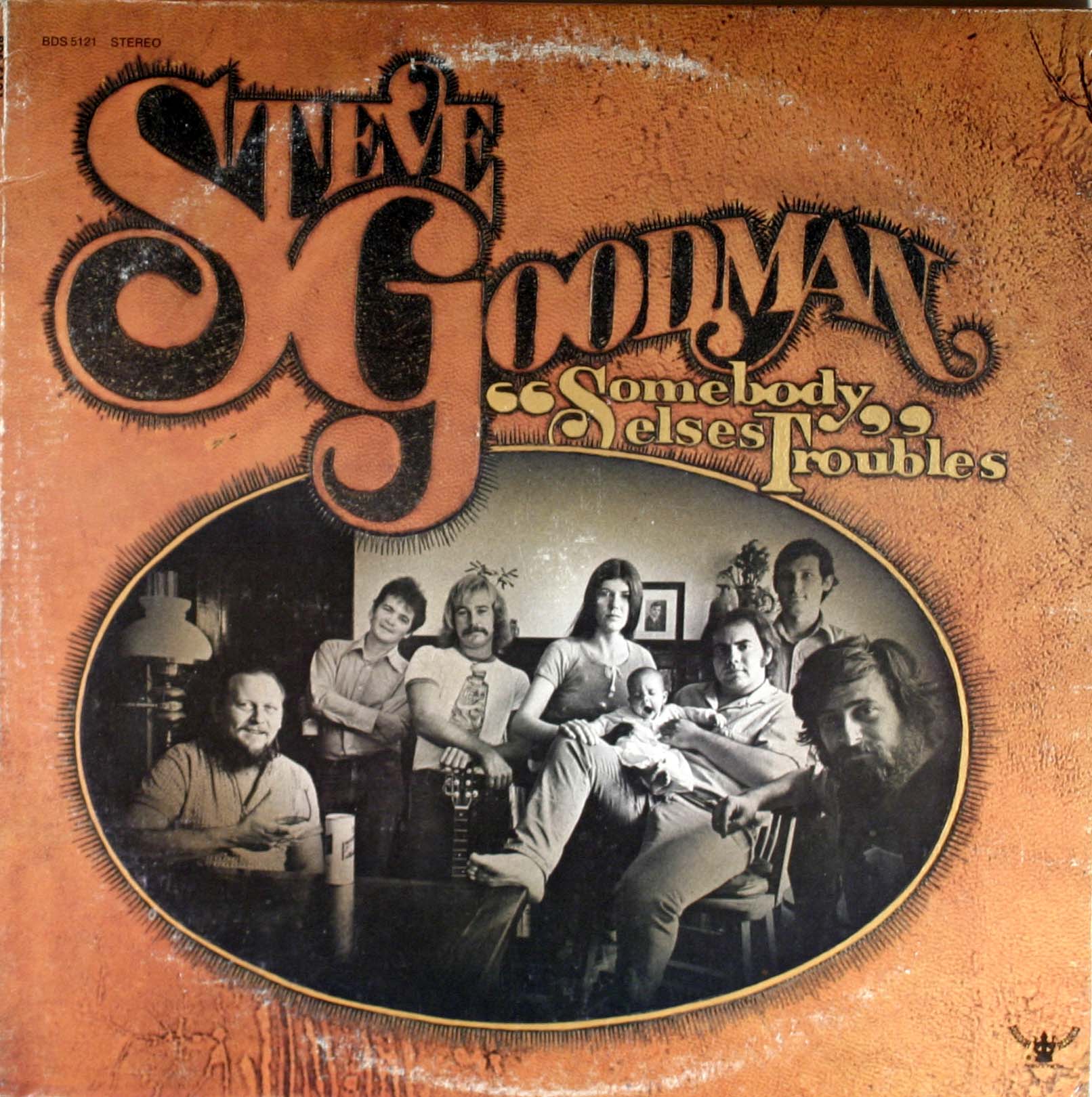
Continuing with our year of Bob Dylan on vacation, in mid-September 1972 Dylan played piano on two songs recorded by Steve Goodman for his third album, Somebody Else’s Troubles. Goodman, of course, was a well-known young country/folk songwriter who won a Grammy for writing “City of New Orleans”, the song made famous by Arlo Guthrie and, later, by Willie Nelson. Goodman was diagnosed with leukaemia while in college, and knew that he would not live a long life. He was only twenty-four when Dylan sat in on his session, and he would pass away at the age of thirty-six.

The two songs that Dylan played piano on are the title track of the album, “Somebody Else’s Troubles” and the minor political satire “Election Year Rag”. Of these, the latter is not particularly notable. The problem with a funny song about elections is that it probably should be genuinely funny, which this is not. This is not a topical song, and it is not a satire insofar as it has no real point of view at all. It is a pox on both their houses, and not even really that, which would give it more credit than it deserves.

“Somebody Else’s Troubles” is a full-on bluegrass tune, but it’s also not a particularly great one. It is a wry song: “As long as Fate is out there busting somebody else’s bubble/Everything’s gonna be alright”, but not a classic by any stretch of the imagination.

Goodman worked a lot with John Prine, with whom Dylan performed on September 9th of this year at The Bitter End, probably right before these sessions. I haven’t read much about Dylan’s relationship to Prine and to Goodman to be able to add much to this story, other than it is kind of interesting to see Dylan in the role of session man here. The record label promoted Dylan’s contributions, even if the songs themselves don’t exactly foreground them. Musically, we’re not going to get much more from Dylan this year.

Backing Roger McGuinn

Standard

51RBoOw2xtL

As we cross over into 1972 listening to Bob Dylan one year per week, there is an enormous problem: Dylan essentially took this entire year off. He released no albums, no singles, no greatest hits. He played no concerts. He published no books. He mostly relaxed, and, at the end of the year, began filming Pat Garrett & Billy the Kid (which we’ll watch next week). So we’re going to picking at crumbs this week.

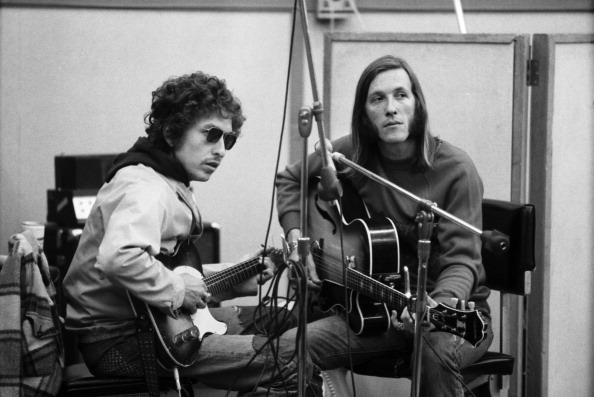
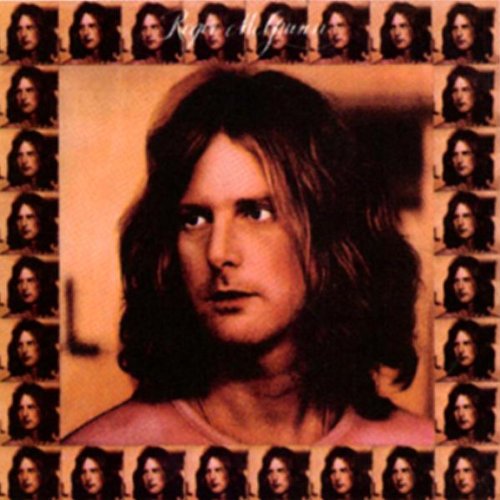
Here’s the first of those: In November 1972, Dylan played harmonica on the first track of Roger McGuinn’s first post-Byrds solo album, boringly titled Roger McGuinn (also, one of the worst covers of all time). The song is at least in part about McGuinn’s relation to Dylan, who is addressed as “Mr. D” in the song. The second verse is about John Lennon, and the third is about Mick Jagger.

Here’s the first verse, just for the record:

Hey Mr.D do you want me to be
A farmer, a cowhand, an old country boy
To get up in the a.m. and tend to the chore
And leave all my troubles behind a locked door
Layin’ with my lady and strummin’ on my toy
Oh I know what you mean and it sounds good to me
But oh Mr.D. I’m so restless

This is a perfectly fine song. There is nothing really wrong with it, and nothing all that memorable about it either. For the first track on a first solo album it makes some sense insofar as it tries to differentiate the singer from the two singers he was most influenced by, and one, Jagger, whose connection I can’t really fathom (but who wouldn’t want to compare themselves to Jagger?)

Dylan’s harmonica playing is fine: perfunctory, even. I’m not really sure what else to say about it. Nice job, Bob. Thanks for coming out.

Though it was recorded in 1972, it didn’t come out until 1973, but I’m putting it here because, as I say, crumbs. It’s going to be a long week, I guess.

Here it is: