Live Aid

Standard

url

I didn’t see Live Aid. It took place on July 13, 1985 from London and Philadelphia, and I was at my cottage where we had no television, so I missed the whole thing. I remember reading about it in the newspaper, and then hearing about it later, but I’d never seen any of it.

These are the things that I knew about it for the past thirty years:

  1. Joan Baez called it the Woodstock of my generation
  2. Mick Jagger ripped off Tina Turner’s skirt
  3. Bob Dylan ruined the whole thing

Fortunately, YouTube exists.

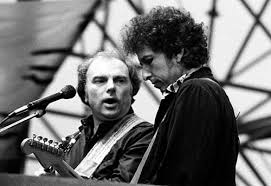
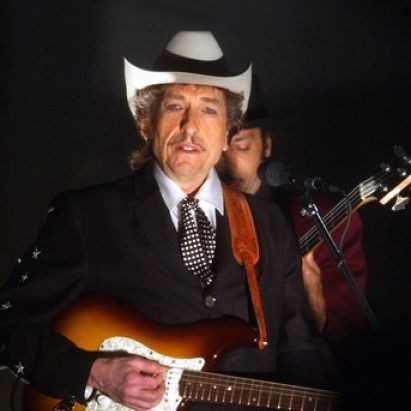
I don’t think that I knew until today, for instance, that Bob Dylan was actually the final act. It obviously makes sense, but I didn’t actually know it. Introduced by Jack Nicholson, Dylan took the stage with Ron Wood and Keith Richards, and the three of them played a trio of early Dylan songs on acoustic guitars. That performance is not as good as that sounds.

I have read today that their monitors were out and that they really couldn’t hear themselves playing. Could well be. Dylan does ask the crowd how it sounds before “Blowing in the Wind”, which seems to indicate that he wasn’t sure himself. He also tosses Wood a knowing glance when Richards does his solo, which I read as saying that he doesn’t think that the set is going very well. Bob Geldof, in his autobiography, notes that a curtain might have fallen on their monitors and that Quincy Jones was not paying attention to the set as he was getting the encore in order backstage. Also, it is clear that, at the very least, the Stones were inebriated.

It is an inexplicable set in many ways. Dylan does two songs from his 1964 album The Times They Are a-Changin’, neither of which would have been expected. He opens with “The Ballad of Hollis Brown”, the doom-laden song of a starving farmer in South Dakota who murders his family and himself. The song is a major downer, and would have been foreign to almost everyone in the multiple audiences watching. There is a bootleg of the trio rehearsing the night before the show (and also the day of) and on that Dylan notes that “no one” will know this song. Richards says that some will, and Dylan corrects him by noting that the few who would are not the type of people who would rush to stand in line to get tickets for an event like this. Given how very few performers attempted to tie their material into the event (It’s not like Madonna and Duran Duran and were playing songs that spoke to the gravity of the situation. Madonna did “Holiday”, for God’s sake), Dylan’s song selection is notable, though it doesn’t come off well on stage (on the rehearsals it sounds good).

His second song, “When the Ship Comes In”, is more celebratory and uplifting, but just as obscure. Dylan seems to be telling a tale with his song selection, but that goes unnoticed. This was only the third ever time that Dylan had performed this song live, so he was clearly making a point by playing it. A large problem is that the song is a bit mysterious, and in this context it was even more so.

Finally, the trio concludes with a rather unconvincing rendition of “Blowin’ in the Wind”, before ceding the stage to the whole cast of performers for “We Are the World”. It is muddied and dour. A massive disappointment right at the conclusion of the show.

The most famous part of the whole set, actually, is Dylan’s comments at the end of “Hollis Brown”, where he suggests that some of the money raised, “a million or two”, might be saved for American farmers struggling to pay their mortgages. Geldof, in his autobiography, is furious about this remark (“it was a crass, stupid, nationalistic thing to say”). I think that the first rule of charitable concerts is that you don’t suggest that there may be better places to give the money. This comment did inspire Neil Young to start Farm Aid, about which more later this week. Geldof, by the way, should never listen to the bootleg of the rehearsals where Richards questions why they’re even playing this show, since none of the money is actually likely to go to Ethiopia anyway!

Given his placement in the concert, given his wide range of songs to choose from, given the enormity of the stage, this could have been the great Dylan comeback moment. All he really had to do was go out there with a band and blow people away with a rollicking “Like a Rolling Stone” with Wood and Richards and everyone would have been thrilled. Instead, Dylan followed his own muse, as he always does, and left people unhappy. As he so often does.
e5ce334ac8e06592dd9e791f523ba129

I guess I didn’t miss much…

“When the Night Comes Falling from the Sky”

Standard

bd_when_the_night_comes

Here’s a great example of a Dylan misstep. “When the Night Comes Falling from the Sky”, the second single from Empire Burlesque, is pretty dreadful. As with “Tight Connection to My Heart”, the primary offender is the synthesizer. This is as close as Dylan would ever come to releasing a straight up dance song. “Disco Bob”, as it were.

What makes it such a shame is that it didn’t have to be this way. Lyrically the song is fine – it sort of a minor cryptic/apocalyptic love song. There are good lines everywhere (“For the love of a lousy buck I watched them die”), although they don’t really add up to much. It’s all a bit of mess with its horns and swirling synths and congas and who knows what else.

But listen to the version on Bootleg Series v3 (which, I’m sorry, I can’t find an embeddable version online). Recorded in New York on February 19, 1985, this version features two members of Bruce Springsteen’s E-Street Band, Steven Van Zandt and Roy Bittan. It is about a thousand times better than the version that made it onto the album.

The Bootleg Series version is all guitars and power chords, but it completely works. Dylan’s vocal is nice in the opening, but it really picks up when the entire band comes in on the second verse, and, in particular, the keyboards pick it up. Dylan seems lifted by the band and he gives one of his strongest vocal performances in years here. Had this been on the album, not only would it have been the best song on Empire Burlesque, but it would be regarded as one of the best things he did all decade.

It’s hard to imagine why he didn’t use it. It does sound a lot like a typical Springsteen song (the piano playing, in particular) and I wonder if he considered it as such. Nonetheless, it’s the highlight of the whole year, and he buried it.

http://www.metrolyrics.com/when-the-night-comes-falling-from-the-sky-bob-dylan-ml-video-w2r.html

As for the video, well, it’s probably the best Dylan music video to date. It opens with Dave Stewart of Eurhythmics getting on a bus with Dylan where they will go to a warehouse to play the song in black and white. That’s about it. One of the advantages is that the video omits two verses, so the whole thing is shorter than the album track. That has to be a good thing.

Also, as a bizarre footnote, in googling “Dave Stewart” in connection to this song I found myself reading Stephanie Wilder-Taylor’s book I’m Kind of a Big Deal: And Other Delusions of Adequacy. Apparently she was one of the crowd members during the video. Sadly, it was not insightful at all. I don’t know who Wilder-Taylor is but she has a strong sense of her own importance.

“Tight Connection to My Heart”

Standard

bd_tight_connection

With “Tight Connection to My Heart”, Bob Dylan’s first single from his 1985 album Empire Burlesque, we catch up with my initial interest. Empire Burlesque was the first new Dylan that I bought. Sadly. What’s even sadder, I bought it on cassette. Also, I no longer have that cassette. I’ll talk more about that cassette when I write about the whole album later this week. Let’s start smaller.

“Tight Connection to My Heart” is a rewritten version of “Someone’s Got A Hold of My Heart”, which was left off of Infidels (but which you can hear on Bootleg Series v3). This version strips out the religious overtones. It’s the first song on the album. Click through to take a look at the lyrics.

These are good lyrics. Some of the lyrics are actually excellent. This is just a great verse:

Well, they’re not showing any lights tonight

And there’s no moon

There’s just a hot-blooded singer

Singing “Memphis in June”

While they’re beatin’ the devil out of a guy

Who’s wearing a powder-blue wig

Later he’ll be shot

For resisting arrest

I can still hear his voice crying

In the wilderness

What looks large from a distance

Close up ain’t never that big

Now watch the video.

See what he’s done there. That is just awful. The back-up singers detract a great deal. The musicianship is mediocre. The singing is, actually, not wholly terrible, but it is fairly uninspired. What absolutely kills this thing, though, and I mean actually murders it dead in its crib, is the keyboards (honestly, it might even be a keytar….). Listen to the first verse. Listen to the high-pitched whimper that ekes out after the word “yet”. It re-occurs at the midpoint of each and every verse. It sounds like a toy. Once you notice it, by the way, you can never unhear it. Every single verse I wince in anticipation of it. I’ve actually gotten to the point this week that I can’t listen to this song because of it, and it’s only Monday.

The problem with this song is that as a song it actually could be quite good. Read the lyrics and you could imagine a really great version of this. The problem is that Dylan hasn’t taken the road suggested by his Letterman performance with The Plugz, instead he is channeling all of the very worst aspects of mid-1980s pop. It’s pretty unbearable. Important note: this is the first album that Dylan produced himself. Bad choice.

Now, a word about this video, which was directed by Paul Schrader. It really only exacerbates the problems. This is one of those “story videos” that were popular in the 1980s for tacking a plot seemingly completely divorced from the actual lyrics of the song onto the whole project. Here there’s something about a threesome in Japan with some gangsters and cops and karaoke singers and a jail with red-white-and-blue bunting on the cell walls. It makes no sense at all. Given how visual the song is (“They’re beating the devil out of a guy wearing a powder-blue wig” – if that doesn’t evoke things for you, I don’t know what will) I just don’t comprehend how you make this as the video, other than to throw up your hands, roll your eyes and sigh. It was the 80s…

Not sure which is the worse look: the Dylan Miami vice jacket or the leather jacket, trucker hat and no shirt.

“We Are the World”

Standard

wearetheworldfoto11

“There’s a choice we’re making / We’re saving our own lives / It’s true we make a brighter day, just you and me”. That’s Bob Dylan’s part on “We Are the World”, the charity mega-hit from 1985. Here’s the video (Bob starts at 3:49):

I had to read all about this song this morning, as I’d pretty much forgotten all about it. I mean, I never forgot it – it got so much radio play when I was about 16 it is probably eternally etched in my head – but I hadn’t heard it in almost thirty years. It is really quite the archive of a certain time and place.

One thing that is striking is just how many of these singers are still incredibly familiar. Yes, some of them went on to have very limited careers (James Ingram and Steve Perry may now be the least famous of the soloists), but for the most part these are 80s icons. It was easier to be an icon in those days. Musical tastes were so much more limited by commercial radio and MTV – it was nearly impossible to escape from a Michael Jackson or Huey Lewis even if you were a punk rock listening kid. They were completely ubiquitous, and “We Are the World” is a cloying celebration of that ubiquity.

Everyone knows that Quincy Martin famously wrote “Check Your Egos at the Door” for this session, but some of the egos needed to be more front and centre. In retrospect it is remarkable that Harry Belafonte, Bette Midler, and Smokey Robinson are all reduced to the chorus, while Kenny Loggins and Daryl Hall get solos. It was a messed up time, the eighties…

The best thing that I found today is this video of Dylan recording his three lines. It runs about nine minutes and you get to hear a somewhat confused Dylan trying it several different ways, and also get to see Jones and Stevie Wonder sort of massaging him through it. It is a really fascinating document about working with big egos in a setting like this. I may not like this song at all, but I do admire the ability of Jones to simply get the thing done with all of those type A personalities in one room.

1985 will be the year of Dylan and the benefit – he will close Live Aid, help launch Farm Aid, and tell the world that he “Ain’t Gonna Play Sun City”. But this is the one that kicks it all off.

The 1984 Tour

Standard

images

The travel itinerary (and bad wifi at the Hyatt Regency in Denver) played havoc with the Dylan schedule this week, so I’m posting some final thoughts on the 1984 tour on the first morning of 1985 – you’ll have to forgive me.

First and foremost, the 1984 tour is fairly well-captured on Real Live. That’s the easiest way to access this material, even if the album is too short to give a real sense of what the band was doing. But it’s a good start.

The tour was 27 dates across Europe with Carlos Santana, and, for a few dates, Joan Baez. Baez would open with about ten songs, and then Santana would play for about ninety minutes. Dylan’s set was pretty consistent: seven songs with his band (including Rolling Stone Mick Taylor on guitar), a song by bassist Gregg Sutton (most of the bootlegs I’ve listened to include Dylan’s introduction of Sutton then cut the song off. Tough to please those bootleggers!), a couple of acoustic songs, then the band returns for about six songs, Dylan introduces them during “Like a Rolling Stone”, they leave, and then a long encore – often up to eight songs, with Santana playing guitar on about half of them. As I mentioned before, lots of hits, lots of 1960s material. What they do is good, but it is also repetitive, so this is not a tour that benefits from having a large number of bootlegs.

A few shows of note: In Hamburg and Munich Baez sang with Dylan in the encore (“Blowin’ In the Wind” on the first show, that and “I Shall Be Released” on the second). It

At the Paris and London shows Van Morrison joined Dylan on “It’s All Over Now, Baby Blue”. Here is a copy of that. I think that this is the Paris version – I don’t have that to hand. It’s definitely not Slane, which is the best Van performance (though Bob gets lost in the lyrics late).

Chrissie Hynde played harmonica and sang back-up on a few songs at the London show. Oh, and some guy named Clapton shows up to play guitar. That’s pretty good.

I think that the best show that I heard is the last one of the tour at Slane Castle in Ireland, where Dylan did 27 songs. Van the Man is back for a rollicking “Baby Blue” and also does “Tupelo Honey”. Later in the encore they are joined by “Bono from U2”, as Dylan introduces him, who sings back-up fills on “Leopard Skin Pill-Box Hat”. The version that they do is sort of suggestive of the collaboration that Dylan will have with U2 during the Rattle and Hum period. U2 were recording The Unforgettable Fire at Slane at the time, so they were just about to break really big. It’s probably one of the last times someone would have needed to add “of U2” to Bono’s introduction. Sadly, that song is not that great – Van Morrison shows him how to jam with Dylan.

Here’s Dylan with Bono doing “Blowin’ In the Wind” at the end of Slane. This is one of the worst versions of this song that you will EVER hear. The Bono verse is just, god, I don’t even know what to say.

Real Live

Standard

bob-dylan-real-live

Real Live, Bob Dylan’s fourth live album, is really not that great. Recorded in London (Wembley Stadium), Newcastle, and Slane, Ireland, it doesn’t really succeed in capturing much of what was interesting about his 1984 summer tour of Europe, and, in fact, that tour itself wasn’t really that interesting.

The tour (27 dates with Carlos Santana opening, and usually joining Dylan on stage during the encores (he plays on “Tombstone Blues” on this album) was more of a nostalgia tour than a promotion of Infidels. Lots of 1960s material included. Seven of the ten songs on Real Live were from the 1960s, one from the 1970s (“Tangled Up In Blue”) and two from Infidels. The album presents just under half of a typical show from the tour (which tended to run about twenty-two songs on average). It skips some of the worst parts (the dreadful call and response versions of “Blowin’ in the Wind”) but also some of the best parts (come back tomorrow).

From what I’ve listened to, the 1984 shows were pretty consistent in terms of song lists and general quality, even stage patter. I find it hard to differentiate the bootlegs when I’m listening to them, and they’ve gotten repetitive on me. Real Live accurately captures the fragment of the tour that it records, and the Slane show in particular is considered one of the better ones (though this album doesn’t include the guest spots from Van Morrison and Bono, which were the highlights, well, at least Van was a highlight). It also includes some pretty bad harmonica playing on “It Ain’t Me, Babe”, which seems to be included just for the people yelling “No no no”, which they did a lot on this tour. I guess that’s fun to yell.

If you want one thing from Real Live it’s the new version of “Tangled Up in Blue”. Download that for 99 cents. Dylan returns it to the third person, and once again radically changes a lot of the lyrics. Indeed, it changes more and more as it goes along. What is fascinating to me is the way that he can make these major changes in each verse without actually changing the meaning of the verse. So, on the album version when the couple breaks up “We’ll meet again one day on the Avenue” and here “That’s alright I love you too”. He shades things, without completely altering them. This is a really great version, and it seems consistent with the versions he played throughout the tour.

Not an essential album by any means.

Late Night with David Letterman

Standard

bob-dylan-at-letterman-1984

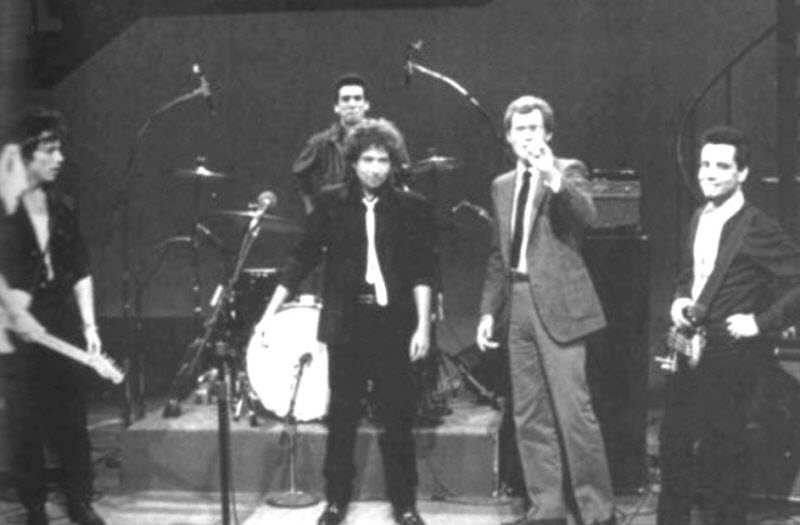
Bob Dylan’s greatest television appearance (so far) has to be May 22, 1984 on Late Night with David Letterman. Dylan, promoting Infidels, refused to be interviewed, so he performed three songs. What makes this so remarkable is that he performed with the Latino new wave band, The Plugz. For one brief moment we got to see what would have happened had Dylan gone new wave. It would have been awesome.

As I mentioned last week, Dylan spent part of his off year 1982 hanging out with his son, who had more adventurous taste in music than did the old man. Dylan showed up at new wave, punk, and post-punk shows and began to become plugged in to that scene. Somewhat unexpectedly, he began jamming regularly with members of The Plugz in Los Angeles. The Plugz were, with The Zeros, among the earliest Latino punk bands (founded in 1977). They may be best remembered by non-Angelenos now for their version of “Secret Agent Man” on the soundtrack for Repo Man.

At the end of their run together (they would break up in 1984), they had their biggest break – performing with Dylan on Letterman. They did three songs. Here they are:

“Don’t Start Me Talkin’”. This is a Sonny Boy Williamson song that, apparently, they had not rehearsed. Dylan enjoyed testing his band by announcing new songs on the fly, and here he did it on live-to-tape national television. Letterman introduces Dylan, waves a copy of Infidels in front of the camera, and he launches into a song that has nothing to do with that album. Okay. He’s looking good (compare to his SNL performance from five years earlier, where he introduced the world to normcore stylings). This first song is mostly carried by guitarist J.J. Holiday. This has to be Dylan’ idea of a joke – refusing an interview but playing “Don’t Start Me Talkin’” by way of explanation.

“License to Kill”. This is just so vastly superior to the Infidels version of this song, especially the harmonica outro. Dylan changes the phrasing considerably, and Holiday’s jangling guitar works a million times better than the album version. Dylan may never have done a more interesting version of this song.

“Jokerman”. This is almost the greatest thing ever. So very very close. As I’ve said, I like “Jokerman” as a song. This is the best version of this song. It should have been sung this way, and it should have been played this way. Dylan all of a sudden sounded at home in the early-1980s. Relevant. In touch. The grand old man of post-punk! Look at those pants! That thin tie! He fit right in! He throws his arms in the air! He’s engaged! But, of course, it sort of falls apart when he tries to find his harmonica. He seems to cycle through about eight of them. From 3:11 to 3:57 the band has to just jam while Bob wanders around, frustrated. The wheels come off and it never quite gels again. I’ve watched this at least a dozen times this week – I just love it.

That was it though. His band for the 1984 summer tour of Europe had guitarist Mick Jones, and it kind of sucked. I’m not sure The Plugz was the type of band to play huge venues with Dylan and Carlos Santana all summer, but I’d have rather heard them try.

I did not see this when it aired. I think I would have remembered it. I was fifteen at the time, and Late Night was too late night for me and we didn’t have a VCR. I think that this would have confirmed my early Dylan love, had I seen it.

In the end, this is a bizarre Dylan oddity. Versions of these songs unlike any he’d do again. A brief glimpse of a Dylan that might have been.

“Sweetheart Like You”

Standard

dylan Bob4175

And, quickly now, we’re on to the second Bob Dylan music video. Also from Infidels, “Sweetheart Like You” is the closest thing that Dylan has had to a top forty hit in thirty years! This one peaked at #55 on the American pop charts, and he has not had even a top 100 chart hit since then. Remarkable, really.

This is a disputed song. Some see it as an allegory (apparently for the church: “They say in your father’s house, there’s many mansions / Each one of them got a fireproof floor”), others see it as misogynist (“You know, a woman like you should be at home / That’s where you belong”). If it’s an allegory, it’s not a particularly sharp one; if it’s sexist, well, he’s sung a lot worse than this one. The song does a few good lines: “In order to deal in this game, got to make the queen disappear / It’s done with a flick of the wrist”, but that’s about it. It’s a fine song, but not one of the great ones.

Now, the video. On the plus side, it’s better than that for “Jokerman”, but, of course, few things aren’t. It also seems pretty typical for the period, with the band playing in an empty club, watched only by a stoic old woman with a mop. The first minute or so of the video dwells on her impassive expression in the face of this kind of mediocre Dylan performance – she’s not exactly selling this as the work of an icon.

The video holds off on showing us Dylan in close-up for almost a minute and half, and then, BAM!, my word: those bangs! Dylan’s beard here is a bit of a mess, but his hair – what has he done to his hair!? The 80s really were a horrible moment in the history of coiffure!

The band, of course, is mostly not the band from Infidels. I don’t know who the blonde woman playing the guitar solo is but it is definitely not Mick Taylor. A bunch of attractive people straight out of central casting.

So, there’s not much to this – a lot of chiaroscuro lighting and a non-plussed woman staring at Dylan’s bangs. At least things are improving, ever so slightly, on the video production front!

“Jokerman”

Standard

m7FIIS1Z2fi1XrKPtoiZgEA

Welcome to MTV, Bob Dylan! With your Miami Vice jacket and t-shirt combination you should fit right in!

Music videos had had a long history before MTV was launched in August 1981, but Bob Dylan avoided them until 1984. With the release of “Jokerman” as a single from Infidels, Dylan produced his first (or second – depending on what was up with that weird footage of “Someone’s Got a Hold of My Heart”). It is, by today’s standards, a very strange relic.

I will admit, at first I had trouble finding this video. I kept seeing it on YouTube and elsewhere and I actually assumed that this was a fan-made video, or what on YouTube tend to get called “lyrics videos”, in which a fan uses iMovie to type the lyrics of a song onto a bunch of photos culled from Google Images. That is precisely what this video looks like at the start, and then, at the chorus, we get Dylan badly lip-syncing. Even a couple of minutes into it I wasn’t certain that this was the actual video (I did recall the Miami Vice jacket, but not the rest). Rebecca assured me that this was exactly how bad this video was thirty years ago.

For the most part, it is a collection of still images of classical statues and modernist paintings, with some low-grade animation thrown in. That animation, straight out of Monty Python, looks less sophisticated than the stuff my eight year old can do on an iPhone app now, but that’s a product of the times. The Ken Burns effect on the still images is annoying too.

The most interesting thing about the video is the selection of images, including a series of photos of Dylan aging from his twenties to his forties as he sings “Shedding off one more layer of skin”. The video sort of self-consciously plays him as a grand old man who’s no longer totally with it by reminding us of “better” versions of Bob from the past. Otherwise it has some odd moments, probably the strangest of which is the inclusion of a photo of Hitler (“you’re a dream twister”, that’s a little on the nose) and one of Ronald Reagan with his fingers in his ears (from the White House News Photographers Dinner in May 1983). The subtle indictment of Reagan here may play havoc with my charge that he’s a Reagan Democrat, though I suppose it’s simple enough to share someone’s politics while discounting the man himself.

All in all, this is a pretty terrible video. That it can be so easily confused for a fan made video probably says a lot about the evolution of this art form over time.

I will say, this video made my entry into Dylan fandom highly problematic. This was probably right around the time that I began listening to Dylan – his first new album that I bought was Empire Burlesque in 1985, and I think I was probably listening to some of the older material at this point. I remember watching this video on the music video shows on CITY-TV (J.D. Roberts!) after school and thinking “this is so unbelievably lame”. Worse, when I did start telling people about Dylan they would immediately start singing “whoa oh oh oh oh oh oh, Jooookerman!” and then laughing uncontrollably. It’s hard to defend someone as a rock icon when something like this is in rotation. Not that it was every much of a hit.

As for the song itself, I’ve come to quite like it. Not necessarily the album version, but even that isn’t too bad. Interestingly, it has become the favourite Dylan song of my son, who proclaimed it thus this week. He loves the chorus, and it is one of the few Dylan songs that he asks after. The phrase “Jokerman dance to the nightingale tune / Bird fly high by the light of the moon” is, in his opinion, Dylan’s best couplet. I agree, that is quite good. The “oh ohs”, though, sound a lot better one on of the unused outtakes. Oh well.

Outfidels Intakes

Standard

tumblr_lq177036RO1qdoq82

Infidels is a pretty good Bob Dylan album, but even a brief review of the supporting material is enough to show that it could have been one of his best ever. While it might never have been the 1980s version of Blood on the Tracks or Blonde on Blonde, this might have been a top five Dylan album had the right choices been made. But they weren’t.

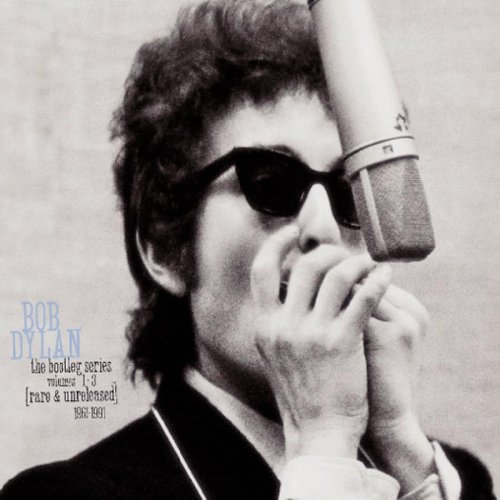
The strength of the Infidels sessions is probably best demonstrated by Bootleg Series Volume 3, on which can be found five – count ‘em – five! outtakes from this album. Each one of those may be better than everything that is actually on the album. If you combined the four good songs (“Jokerman”, “Sweetheart Like You”, “Man of Peace”, “I and I”) on Infidels with the five songs on BSv3 and released it it would have been not just the Bob Dylan album of the 1980s, but one of the best albums of that decade, full stop. Of course, it was not to be.

I’ve written a couple of times about how Dylan doesn’t seem to always be the best judge of what is the best Dylan material, but it is really apparent here. The stories say that the musicians and technicians on Infidels were shocked by his track selection, and, indeed, he seems to have dramatically overhauled it after Mark Knopfler left to tour with Dire Straits. This has led to a lot of “what might have been” scenarios in the bootleg circles.

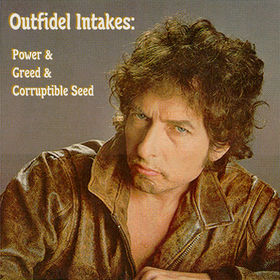
One of the better bootlegs out there is Outfidels Intakes. First of all, to the bootlegger: Well-played on the name. That is awesome. Second: this is a two disc set that attempts to a) recreate the Knopfler version of the album, and b) collect some of the better outtakes (including a collection of “Sweetheart Like You” attempts strung together into one track). This double-CD is significantly better than Infidels. Unbelievably, you can download almost the entire thing here (whomever has posted this has opted not to upload the songs that were used elsewhere on commercial releases).

Bob-Dylan-Bootleg_series_1-3

Let’s move through Outfidels and Bootleg Series 3, then.

First: “Someone’s Got a Hold of My Heart”. This song was cut from Infidels, but then Dylan had a change of heart and re-wrote parts of it and included it on his next studio album, Empire Burlesque, as “Tight Connection to My Heart”. It’s one of the best songs on that album, and would have been a good one here. I actually think “Tight Connection” is better lyrically, though not as good musically (Empire Burlesque is horribly produced). About half the lyrics in the two songs are the same, with the chorus changed from the refrain “Someone’s got a hold of my heart” to “Has anybody seen my love?”. The version that is on the Bootleg Series is superior to the one on Outfidels – it is less produced, more raw, features a nice harmonica section and the acoustic guitars add a lot of warmth. This is a good to great song, and it has always included some of my favourite Dylan lyrics, including “What looks large from a distance / Close up ain’t never that big” and the closing refrain:

Never could learn to drink that blood

And call it wine

Never could learn to hold you, love

And call you mine

Putting this on Infidels would have improved the album, but it also would have made Empire Burlesque that much worse. Sort of a toss-up from that standpoint.

Second: “Tell Me” is a Tex-Mex love song. It’s a better love song than “Don’t Fall Apart On Me Tonight”, although the over-emphasis on the slide guitar would make is seem a bit out of place on the album. Good song, but not essential.

Third: “Lord Protect My Child”. This is one that I love, and it is one of the big discoveries of the week for me. I don’t think that I ever really noticed this on Bootleg Series before, or maybe I only listened to that album before I myself had a child so I didn’t pay attention. The version on Outfidels is longer, and opens with the engineer intoning “Take four” and the song being counted off, but that is not there on Bootleg Series. This is a great Dylan country song, and the slide guitar isn’t so oppressive here as it is on “Tell Me”. Lyrically it’s quite lovely:

As his youth now unfolds

He is centuries old

Just to see him at play makes me smile

No matter what happens to me

No matter what my destiny

Lord, protect my child

Additionally, there are strong remnants of Dylan’s ongoing Christianity in the final verse:

There’ll be a time I hear tell

When all will be well

When God and man will be reconciled

But until men lose their chains

And righteousness reigns

Lord, protect my child

I really think that this is a great song, and it is one that I would like to learn on the banjo.

Fourth: “Foot of Pride”. Ok, this one is totally inexplicable. Apparently it was to be the final song on the album, but it got dropped when Dylan went back to the studio to record “Union Sundown”. Dropping “Foot of Pride” for “Union Sundown” is just baffling. Lyrically this one is prime Dylan, mixing his taste for surrealism with his religious message from the previous three albums:

Yeah, from the stage they’ll be tryin’ to get water outa rocks

A whore will pass the hat, collect a hundred grand and say thanks

They like to take all this money from sin, build big universities to study in

Sing “Amazing Grace” all the way to the Swiss banks

It’s scathing, blistering stuff. This would have easily been the best track on the album, and one of the two or three best songs that Dylan would produce in the decade, but he left it off the album. I really, really don’t get that choice. This one is essential.

Fifth: “Blind Willie McTell”. For a lot of listeners, this is the one that is the key omission from Infidels, and it is one of the most beloved of the outtakes. I think Dylan must know that he made a mistake – he’s played this one in concert 219 times, which may be a record for a non-album song, or at least in contention for that title. This is a pretty straight forward homage to the great blues singer who died in 1959, just before Dylan’s own career got started. The standard reading is that the song expresses Dylan’s own reservations about his reliance on blues traditions and his place in music. The final lines sum this attitude up nicely:

I’m gazing out the window

Of the St. James Hotel

And I know no one can sing the blues

Like Blind Willie McTell

This is another great song, that should never have been bumped off of Infidels.

Outfidels Intakes includes a number of additional outtakes that aren’t included on Bootleg Series 3. One of them I quite like: “Angel Flying Too Close to the Ground”. In some ways you can see why it was abandoned – it seems a bit like a love song that almost anyone could have written, and lacks the Dylanesque touches, but I still think that it is far superior to something like “Don’t Fall Apart on Me Tonight”, which also sounds like anyone could have written it.

The worst track on Outfidels, maybe one of the worst things Dylan ever recorded, is “Julius and Ethel”, a “tribute” to the Rosenbergs. Look, I’m on the side that says that the Rosenbergs probably weren’t guilty, and I definitely do not believe that they should have been executed as spies. That said, the least appropriate tribute possible seems to be a rocking out tune in which Dylan yells “Julius and Ethel” repeatedly as the chorus. Also, some horrible rhymes in this one. Just awful.

So, to sum up: take half of Infidels, add four songs from Bootleg Series 3 (leave off “Someone’s Got a Hold of My Heart” for Empire Burlesque), and you’ve got an unbelievably awesome album. Definitely a top five contender. Instead, he released an album that’s about a B+. Bummer.

Here’s a YouTube version of “Someone’s Got a Hold of My Heart”: