Hard to Handle

Standard

10957649_det

Like all Dylan tours after 1974, the True Confessions tour of 1986 is well bootlegged, and you can probably get at least a halfway decent copy of every single show. The first leg of that tour, which included shows in New Zealand, Australia and Japan, was the subject of an early HBO concert documentary, Hard to Handle. Filmed on February 24 and 25 in Sydney (the fifth and sixth of six shows in that city that month), the film seems to me to be fairly representative of the way that those shows sounded.

The True Confessions tours (the second one took place in summer 1986) used Tom Petty and The Heartbreakers as the supporting band, as well as the now obligatory back-up singers (the Queens of Rhythm). Dylan played with the band, did a few songs solo each night, and also left the stage usually twice during the show so that Tom Petty could perform songs like “Refugee” and “American Girl”. There seems to be a division among bootleggers about how to deal with this:

  1. Present the show in its entirety, including the Tom Petty songs. This pushes most of the bootlegs into a third CD as the shows run close to three hours
  2. Chop the songs by Tom Petty and the Heartbreakers, often bringing the show back onto two CDs
  3. Passive-aggressivly note on the liner notes “Tom Petty song” without even bothering to give a title, even if the song was a huge hit. Dylan fans can be, er, petty.

Hard to Handle falls into the second category. You know that it’s The Heartbreakers up there, but you would never guess that they performed four songs on each of these evenings. It’s a Bob Dylan special, after all. It’s also short, at an hour. Dylan does ten songs, which is just under half of a typical set on this leg of this tour (he actually did 25 and 27 songs at these two shows, which is quite extensive by his standards – I’m sure that there was some talk about getting significant material to work with). About half the songs are taken from each of the shows, and, somewhat bizarrely, the spoken introduction to “In the Garden” is taken from the show on the 25th but the song itself comes from the previous evening.

“In the Garden” is the most striking song on the bootlegs. While riding my bike yesterday I was listening to one of the earlier Sydney shows (very much like this one) and actually pulled over to make a note about Dylan’s spiel before this song, where he talked about heroes (Muhammed Ali, Bruce Springsteen, Michael Jackson (boy, would no one say that now…)), all of whom he disavows before singing a song about his hero, Jesus Christ. Many Dylan sources (i.e. Wikipedia) suggest that Dylan was post-Christian at this point in his career, but as this set piece makes clear, nothing could be further from the truth.

Watching this video is a bit trying for me. In stark contrast to the Newport material from the mid-1960s or the Rolling Thunder video in Renaldo and Clara, there is not much to hold my visual interest here (this is inapt comparison, but we just watched the Katy Perry concert video with our eight year old and I realized how much the idea of a band on a stage performing songs is an antiquated idea now). The show is not that well shot – too much from the same side with the keyboardist – but I’m not sure how visually appealing you could likely make this anyway.

I do think that it is a good representation of the tour as it was in Australia, which is not yet all the way there. The version of “Like a Rolling Stone” is incredibly limp, for example, and the band isn’t adding a great deal to the material. The versions here are less changed than they have been in the past (with The Band) or will be again in the future. It is a bit of a conservative sound. One big advantage of the tour is that they did a lot of material. While the shows often opened in similar ways, a lot of songs got done (Bjorner lists 48, with many of them, from “Mr. Tambourine Man” to “Heart of Mine”, sung only once on the tour). There are compilations of this material out there, and those seem better to me than any of the individual shows – but I certainly haven’t listened to all of the shows, far from it.

Hard to Handle is available with some subtitles here until Dylan and/or HBO’s lawyers get a hold of it. You can probably also get every single song individually on YouTube and piece the whole thing together yourself. Enjoy!

Knocked Out Loaded

Standard

Bob_Dylan_-_Knocked_Out_Loaded

I don’t think that Bob Dylan believed in his 1986 album, Knocked Out Loaded. Of the eight songs on the entire album, he has played them a total of eighteen times. Fourteen of those were live versions of “Driftin’ Too Far From Shore” in 1988 and 1989. Five of the songs he has never played live at all. It seems to have been recorded and released for almost no reason in the midst of his tour with Tom Petty and the Heartbreakers. Dylan played a lot of new music on that tour, and none of it made it onto this.

Released in July 1986, Knocked Out Loaded was the beginning of the end of my initial Bob Dylan phase. It didn’t end it by any means, but the damage was significant. Armed with my new stereo in my new room (we had moved to a new house), I can distinctly recall listening to the first side with a “what is the shit?” expression on my face. I think that days went by before I listened to the (much stronger) second side. I remember that I got this album right around the time I got my first Patti Smith album – I had begun to move on to the post-Dylan artists and this album gave me very little reason to look back.

url

Most of this album is completely forgettable. “You Wanna Ramble”, the opener, is just a rock song – the type of thing that sounds like a decent warm-up, but that could have been written by any of a hundred singer-songwriters in the history of rock. The cover of Kris Kristofferson’s “They Killed Him”, perhaps inspired by Dylan’s participation in the Martin Luther King, Jr. Day celebrations, is so cloyingly saccharine that it is hard to listen to – the gospel back-up, the horns, the children’s choir! Oh, it is awful. “Driftin’ Too Far From Shore” was held over from Empire Burlesque. It’s fine, at best. “Precious Memories” didn’t need this cover version. “Maybe Someday” is okay. This is a song where I find myself reaching to try to like minor moments. For instance, I like the throw-away line “I always liked San Francisco, I was there for a party once”, but my wife assures me that it’s awful. “Got My Mind Made Up”, which was released as a single (though I’m not sure that there’s a video – if there is it may have been expunged from the internet) was produced by Tom Petty, and I really hate it. “Under Your Spell” is actually sort of good as a final song. I like the last verse:

Well the desert is hot, the mountain is cursed

Pray that I don’t die of thirst

Baby, two feet from the well

I would be interested to have heard what Dylan might have done with this song live, but he’s never tried it.

In general, I’d say that Knocked Out Loaded is a strong contender for worst ever Dylan album. It’s even remarkable for its lack of information – the same image on the front and back cover, it doesn’t even come with a track listing. (Though the pulpy cover image is both unusual and kind of good). I would say that it is the worst of Dylan’s albums except for one thing: it includes “Brownsville Girl”. And “Brownsville Girl” may be the best song Dylan ever recorded….

Martin Luther King Day, 1986

Standard

travers-d00ab0e7dd1152b99f8f07709f52ea46d7d39fdf-s6-c30

I’m not sure that it had ever really occurred to me that there was a first Martin Luther King, Jr. Day. It seems such a normal part of the calendar now, that the struggle to get this day of recognition and then have it declared a national holiday is all lost in my memory (that I live in Canada, only exacerbates this amnesia, of course). So imagine my surprise to learn that the first one was in 1986 – during the Reagan presidency.

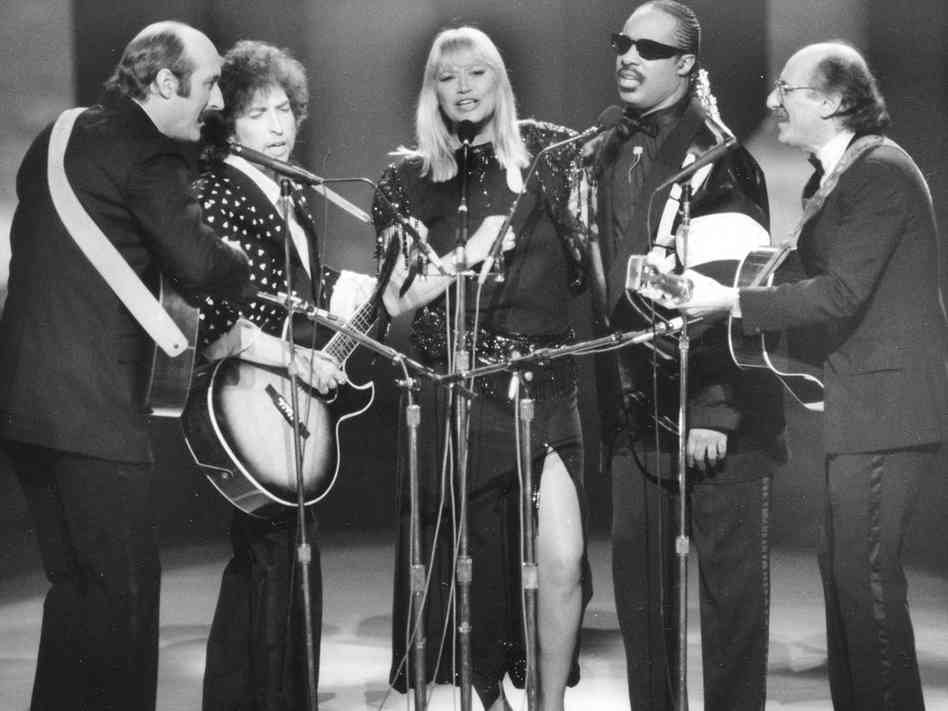
At a concert that evening to celebrate the occasion at the John F. Kennedy Performing Arts Center in Washington, Bob Dylan performed four songs on stage with Stevie Wonder and his band, Wonderlove. I have a bootleg of this, but I find it a little confusing – Dylan is introduced twice, for example. It’s clearly taken from a television broadcast, because people talk over the opening of a couple of the songs. The order that I think makes sense is Dylan singing “The Bells of Freedom” with Wonder, followed by a high-tempo performance of “I Shall Be Released” with Wonderlove. I like this a lot – they give a lot of space to Wonder on the piano, and the crowd certainly gets right into it, clapping along. It’s a nice performance.

This was followed by a version of “Blowin’ in the Wind” where he is accompanied by Wonder, and by Peter, Paul and Mary. This is almost exactly as you would imagine it would be, not that that makes it bad by any means. Hell, Stevie Wonder could sing the phonebook and it would probably be good.

Speaking of which, the whole set ends with Wonder singing “Happy Birthday” to King in a special arrangement by Quincy Jones. Dylan is on-stage for this, along with everyone else who would have been there. I can’t say that I cared for this at all.

This is Icon Bob territory, trotted out for the black tie gala to sing his now anthemic songs. There are worse versions of him.

In trying to find a video from this show, since I know it must be out there, I stumbled across this 1969 video of Wonder performing “Blowin’ in the Wind” with Glen Campbell. Incredible. Watch this:

“Band of the Hand”

Standard

Bob_Dylan_Band_of_the_Hand

A really strong contender for worst Dylan song of all time is his non-album single from 1986, “Band of the Hand (It’s Hell Time Man!)”, the title track to the Michael Mann produced film of the same year. This song is so bad that it isn’t even included on The Complete Album Collection, which does otherwise collect non-album singles. I think this one may have been officially disowned by Dylan. It is absolute and complete dreck.

Lyrically amateurish, musically juvenile, with a music video that is complete crap, I have to assume that this was done for money. I never saw the film for which this was written, but I do recall seeing the video one time at a friend’s house and just thinking “Jesus, Dylan is a shambles now”.

Seriously, these are some of lyrics:

The witchcraft scum exploiting the dumb

Turns children into crooks and slaves

Whose heroes and healers are real stoned dealers

Who should be put in their graves

This one seems to have been done on auto-pilot. It is the first thing that Dylan recorded with the Heartbreakers, and apparently one of the back-up singers is Stevie Nicks. Produced by Tom Petty. That’s a lot of people who should have known better.

Band_of_the_hand_poster

The movie was made as a tv pilot for producer Michael Mann, on top of the world with Miami Vice. It was directed by Paul Michael Glaser, who was Starsky from and Hutch. When the pilot was not picked up they burned it off as a movie. Wikipedia has an insanely detailed plot description in case you’re curious. I didn’t actually read it.

 Nothing to see here. Move along.

On Sam Shepard

Standard

sam shepard with bob dylan during the rolling thunder tour

This is one is belated, but let’s do it anyway.

So back on April 19 I wrote this about The Rolling Thunder Revue:

Sam Shepard appears briefly, hired to bring some order to the script, but I’m not even sure if he stuck around. He’s at a party on page 419, but I don’t know if he had left and then come back or he’d been there all along. It’s possible that even [Larry] Sloman didn’t know.”

Then on May 1 I wrote this:

“(I just learned the other day that Shepard published a book about his experience – I’ve ordered it, but it hasn’t arrived yet).”

So, yeah. That book never arrived (curse you, Abebooks seller – now I need to follow up on that). But I was in the library yesterday to get another piece of Shepard’s on Dylan for next week, and happening to notice this book in among all of his plays and whatnot on the shelves, so I snapped it up. Rolling Thunder Logbook, it’s called, and I read it very quickly – it’s short and well-illustrated.

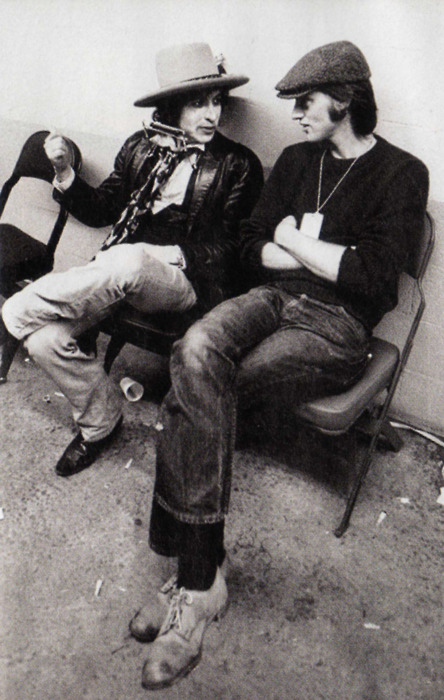
This is a fascinating book, and I will want to get my own copy. Shepard, of course, is an incredible writer and stylist, and he has a bizarre outsider’s take on the Rolling Thunder Revue. His book confirms a lot of what Larry Sloman wrote about – and what Renaldo and Clara depicted – but it is a lot less thorough than Sloman’s book, so it is probably better that I read it second. It’s funny, because Sloman’s book really is the outsider’s perspective (he wasn’t officially a part of the tour, so had limited access, while Shepard was and so had great access), but Shepard just sees things so differently from the rest that it comes across as a very alienated book. On Sloman, Shepard writes: “If Dylan ever wondered how far a fan would go to get tight with him, he’s looking at it in the flesh”.

Shepard has dozens of other great lines like that. One that I wrote down as I was reading:

On Joan Baez: “I never used to think of her as sexy before, but she’s definitely that. No more folksy peace-licking Scottish-folk-ballad stuff. She’s transformed into a short-cropped shit-kicking Mexican disco dancer.”

He’s also very sharp about the man himself:

On the essence of Dylan: “If a mystery is solved, the case is dropped. In this case, in the case of Dylan, the mystery is never solved, so the case keeps on. It keeps coming up again. Over and over the years. Who is the character anyway?”

Again, on the essence of Dylan: “Dylan has invented himself. He’s made himself up from scratch. That is, from the things he had around him and inside him. Dylan is an invention of his own mind. The point isn’t to figure him out but to take him in. He gets into you anyway, so why not just take him in? He’s not the first one to have invented himself, but he’s the first one to have invented Dylan. No one invented him before him. Or after.”

Shepard is a great prose stylist, but these insights into Dylan seem to be something more than style. For half a year now I’ve been thinking that there will be a moment when I “get” Dylan, possibly because I’ve had similar moments about other subjects of my own writing, where suddenly pieces fall into place. Shepard suggests that that is unlikely to happen, and possibly that I shouldn’t want it to happen. He seems like a sage man, and I may have to go with his advice. “Use it as an adventure”, Shepard writes of the invented thing. Of the invented Dylan.

The book ends with Dylan and Sara and some other members of his entourage going to see the American version of Shepard’s play “The Geography of a Horse Dreamer” in New York. It’s off-Broadway and directed by Jacques Levy, who co-wrote many of the songs on Desire. A circle is being closed. Shepard describes it as a nightmare, a stony crowd of press people and Dylan taking notes, getting drunk, and, finally, lashing out at the stage. I don’t know if this happened or it didn’t happen – I think it is somewhat vague in the book – but it is a harrowing final chapter to a harrowing tour. Shepard has seen something in Dylan and understood something in him, and he has to flee from it.

The most interesting thing is that he also comes back. But that is for later this week.

Bob+Dylan+-+Rolling+Thunder+Logbook+-+BOOK-121385

Biograph

Standard

Bob-Dylan-Biograph

The sudden, shocking realization that this entire blogging project is an attempt to understand Christmas Day 1985.

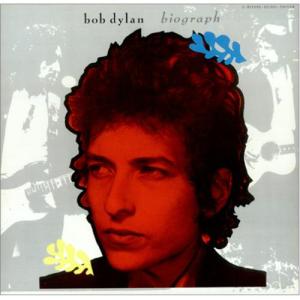
Biograph, the five-album Bob Dylan retrospective, was released on November 7, 1985.  I was sixteen years old when I received it on Christmas day that year from my parents. I also received a stereo – one of those all-in-one things that were mostly plastic but which incorporated a turntable, two cassette decks (dubbing!) and a radio tuner, and external speakers. I no longer had to listen to music on the family turntable, which was one of those huge wooden cabinet things from the 1970s in the living room. Freedom!

We celebrated Christmas in Montreal that year, with my father’s parents. I remember the genuine joy of receiving that stereo (completely unexpected) and Biograph (somewhat expected, I’m sure I would have asked for it – I wanted it but it was expensive-ish for a teenager with no job). I remember assembling the stereo after lunch (well, plugging in the two speakers – not much assembling) and unwrapping and listening to Biograph for three and a half hours while reading the two booklets, one a well-illustrated biography of Dylan and the other a series of reminiscences on the songs via interviews with Dylan conducted by Cameron Crowe (who was still a few years from becoming the filmmaker of Say Anything…). This was a feast for someone like me, who was only somewhat aware of the hits.

I am certain that Christmas Day 1985 was the first time I heard “Lay Lady Lay”, “Baby, Let Me Follow You Down”, “If Not For You” and dozens and dozens of other songs. Indeed, so unaware was I of Dylan’s career that the distinction between released and unreleased songs (18 of the 53 tracks on Biograph were previously unreleased) made no sense to me. I wasn’t hearing familiar songs with some new material – it was almost all new to me. Since I listened to this album hundreds of times in the next couple of years there are still unreleased songs from Biograph that I am shocked to not find on his early albums (“Percy’s Song”, for example, is not on Freewheelin’? That doesn’t make sense to me in 2014. Isn’t it one of the best songs on that album?). There are dozens (well, a dozen and a half) examples just like that. Live versions of things like “Isis” that are far more familiar to me than the album versions ever will be.

Listening through Biograph today for the first time in a long while, what strikes me most of all is how much this project is drawn from the same impulse to write down the “truth” about Bob Dylan and to work out which are the great tracks (released, unreleased, live versions). What is annoying me right now is how much better Biograph is than this little blog project.

Let me say this straight: Biograph is the best Bob Dylan album. Yes, that’s unfair. It’s five albums. It’s heavily curated. It uses dozens of short-cuts and cheats. But if you are going to have one Bob Dylan album, it should be Biograph. It doesn’t have all of his best material, but it is so very close that nothing else is even close.

What is most remarkable, having spent almost half a year listening to nothing but Dylan, is how incredibly well this thing is put together. Not just the selection of live tracks – which is superlative – but the organization of the material. The jumping around in time might not work were it not done so incredibly well. Songs are put in dialogue with each other (to use an annoying art world term) in ways that allow you to hear them afresh. This is basically ten sides of Dylan, some of them repeating. Because that’s who Dylan is.

(Note: Biograph works better on vinyl than on CD/MP3 collection) because it is so self-consciously organized as ten five-song sets, which is how the liner notes are arranged)

Side One: Dylan love songs jumps from the late-1960s back to the beginnings, going from “Lay Lady Lay” to “Baby, Let Me Follow You Down” (the lone song from his first album). The highlight is the unreleased version of “I’ll Keep It With Mine”, which is a remarkable piano performance of a beautiful song.

Side Two: Dylan as protest singer. Four of the songs are from two albums (Times and Freewheelin’), indicating just how short the protest period was (basically not more than two years). Four anthems: “The Times They Are a-Changin’”, “Blowin’ in the Wind”, “Masters of War”, “Hattie Carroll” and then the unreleased “Percy’s Song”, one of the staples of his early concerts. The greatest of the greatest hits collection.

Side Three: Going rock. Two songs from Highway 61 Revisited (“Rolling Stone”, obviously, and “Tombstone Blues”), plus a live version of a song from Blonde on Blonde (“Most Likely You Go Your Way” from Before the Flood). Three pieces of genius in here though: the addition of “Mixed-Up Confusion” Dylan’s first single (quickly pulled by his label), which demonstrates that his rock inclinations were there in 1962 and not a later addition. Historicize! Second, “Groom’s Still Waiting at the Altar”, the B-side non-album song from Shot of Love, which sounds completely at home after “Tombstone Blues” – Dylan doesn’t change that much in fifteen years. Finally, “Jet Pilot”, a tiny little goof of a song that I used to fill the remaining space on mix-tapes for years and years.

Side Four: Continues the mid-1960s by bringing in the rock tour. “Subterranean Homesick Blues” is the anchor here, leading into two live songs from his fateful 1966 tour of the UK (“I Don’t Believe You” from Belfast; “Visions of Johanna” from London – very little he has ever done is better than this version of this song), and then an incredible segue into “Every Grain of Sand”, which sounds so, so, so right after “Visions of Johanna”. Dylan’s text on the latter, by the way, is very telling – he certainly was not post-Christian when he did that interview with Crowe!

Side Five: Surreal Dylan. “Tambourine Man”, “Million Dollar Bash”, “Quinn the Eskimo”. For a long time this was my least favourite side of Dylan, and probably my least favourite side of Biograph. This is the one I’ve listened to the least, in all honesty.

Side Six: Heartbreak Dylan. This may be the one I’ve listened to the most. Anchored by “Tangled Up in Blue”, this side has three unreleased tracks: “You’re a Big Girl Now”, “Abandoned Love” and an incredible “It’s All Over Now, Baby Blue” (Manchester 1966 – the third song from the space of about ten days on that magical 1966 tour). The three mid-1970s tracks really shape the earlier songs (including “To Ramona”) that open and close the side. Best side on the album.

Side Seven: Rarities. Another incredible side. Two non-album singles (“Can You Please Crawl Out You Window?” and “Positively 4th Street”) followed by a live version of “Isis” from the Montreal Rolling Thunder show in 1975 (an incredible version) and outtakes from Shot of Love and Blood on the Tracks. This album just keeps picking up steam!

Side Eight: Dylan wants you, baby! Six songs of lust and desire going right back to an unreleased 1962 version of “Baby, I’m in the Mood for You” and a 1965 version of “I Wanna Be Your Lover”. “I Want You”, “Heart of Mine” (better than the album version) and “Just Like a Woman”. You get the picture. Seductive Dylan.

Side Nine: Exotic Dylan meets Religious Dylan. A live version of “Romance in Durango” from the Rolling Thunder Revue (also the Montreal show) and “Señor”, followed by “Gotta Serve Somebody” and “I Believe in You”, both from Slow Train Coming, before a flashback to New Morning for “Time Passes Slowly”. This is a bit of a misstep right at the end. The religious material probably should have been paired with some of the earlier spiritual material from, say, John Wesley Harding.

Side Ten: The rousing finale. All five songs here have been regularly performed by Dylan in his encores. Crowd pleasers! Jam songs! Bring out the guest stars and do a duet on “I Shall be Released”, “Knockin’ on Heaven’s Door”, “All Along the Watchtower”, “Solid Rock” and “Forever Young”. If that doesn’t leave them wanting more I don’t know what will!

Listening to this album again today has been a bit bizarre. I haven’t been moving backward this year at all. Once I pass a week it is gone from the rotation. This means that there are songs that I’ve heard dozens (hundreds) of times, but they’re generally new versions. I hadn’t heard the album version of “Like A Rolling Stone” since January, but I’ve heard it on bootlegs almost every week that’s he’s had a tour. So much of the 1960s material sounds so strange now. Dylan’s early-1960s voice is gone – I’m used to the mid-1980s version. It’s like being in a pot on the stove – you don’t notice the gradual change in temperature until you step right out.

I love Biograph. I’ve owned three copies of this album. The one that I got for Christmas in 1985 disappeared somewhere along the way. I obviously loaned it to someone (I even suspect that I know who, but it is a high school friend that I haven’t seen in a quarter century – he’s not on Facebook, so how can I ask for it back?). It’s long gone. Sometime in the 1990s while I was in grad school I bought it again on CD at a used record store and I can remember listening to it a few times when I lived in Montreal. We sold all of our CDs a few years ago, however, after burning the ones we wanted to keep. So I have MP3s of that version. A few weeks ago I bought a third copy at a used record store here in Calgary after searching unsuccessfully for the text of the two booklets online. I wanted to be able to read the incredible liner notes, which is how I’ve spent this morning – listening again to the album that made me a short-lived Dylan fan while reading the liner notes just as I did on Christmas Day twenty-nine years ago.

(By the way, this is the 200th post on this blog. You have no idea how difficult it was to arrange that, but I hope you’ll appreciate it!)
Outside the Empire

Standard

bdote

I got the slightest little bit of pushback about my comments about Empire Burlesque on Facebook (ok, it was one comment). In some ways that makes sense, as a lot of my friends are around my age so they too would have experienced that album as among their first Dylan purchases. I want to help those people out.

Throw away Empire Burlesque. Get rid of it. Burn it! Delete it! Ignore it! Shun it! Now, replace it with Outside the Empire*, or one of the many collections of outtakes from the lengthy recording sessions for the album. Empire Burlesque was recorded over a very long period in a number of locations with a number of performers and a number of sounds. It is a sort of cobbled together album that was then overlaid with 1980s synth elements and over-dubs. Go back to the source.

Outside the Empire includes sixteen tracks, six more than Empire Burlesque. It includes a version of every single song on Empire Burlesque except for “Dark Eyes”, which, as I have noted, is the one truly great song on the album (and the only one that isn’t ruined by an awful production job). So when you delete your digital files, keep “Dark Eyes”.

Virtually everything else is improved, at least to some degree.

“Tight Connection to My Heart” is almost the same version of the song as on the album, but the horrendous synth fills haven’t been added yet. I admit, I have Dylan synth PTSD so I keep expecting to hear them in there – I actually flinch while waiting for them. I still don’t think it’s a very good song, but it’s improved. “Seeing the Real You at Last” is very similar – the vocals may even be the exact same – but the sound is cleaned up and simplified.

“I’ll Remember You” is basically just a different, very slightly shorter, take. It’s still the same basic set-up. Not really an improvement. I still like this. “Clean Cut Kid” is fairly significantly different. Dylan clears his throat in the first bar, which always makes me laugh. Still has the back-up singers and whatnot, but the lyrics are slightly different. Still, it’s mostly just piano, guitar and drums here, without all the excess crap. There’s an additional verse:

He went to church on Sunday, he was a boy scout

For his friends he would turn his pockets inside out

That second line doesn’t really scan, so it was probably better left out. Still, this is a major upgrade.

“Never Gonna Be the Same Again” is just a more spare version of the song from the album. “Trust Yourself” falls along similar lines, as is “Emotionally Yours”. The disappointment is that the version of “When the Night Comes Falling From the Sky” is not the one from Bootleg Series 3 but is just a bit more stripped down version of what’s on the album. Finally, “Something’s Burning” has the same drum bits and so suffers from a lot of the same problems.

Basically, the album isn’t that much different from the official release, but it has been stripped of almost all of its gunk. It sounds more like a Bob Dylan album than like a Bob Dylan trying to understand the 1980s album, which is how Empire Burlesque sounds to me. Basically it removes everything that I don’t like from the album. I honestly don’t think I will ever re-listen to Empire Burlesque, but Outside the Empire will go into regular rotation, because, as I said the other day, I do think that a lot of these songs, as songs, are vastly under-rated. These versions are much, much stronger.

As for the outtakes, unlike Outfidels which had literally half a dozen tracks that would have made Infidels one of the great albums of all time, this is not the case here. Two songs from his next studio album, Knocked Out Loaded, appear: “Driftin’ Too Far From Shore” and “New Danville Girl” (which will become “Brownsville Girl”, about which much much more next week). Most of the rest of pretty weak. “Waiting to Get Beat” is sort of awful and should have remained buried forever, while others are just sort of half-baked duds like “Go Away Little Boy” (rasped out here). The one song that I really enjoy is “Straight A’s in Love”, which if I had a garage band of academics I would totally cover and people would think it was great, but as a mid-career Dylan song is kind of embarrassing. I could sing this ironically as the hipster that I am….

So, pick up a bootleg of the Empire Burlesque material. So much better than the album itself.

*Visions of Johanna, a very good Bob Dylan blog, notes that there are multiple versions of the Empire Burlesque outtakes: Clean Cuts was the first, but is mastered at the wrong speed (seriously – do not get this CD). Better are Outside the Empire, Tempest Storm, Tempest Storm (a second bootleg with the same name!), Real Cuts At Last, Empire Burlesque Originals and Outtakes, Empire Burlesque Sessions, and The Naked Empire. Whew. VoJ prefers The Naked Empire – I don’t have that, so I can’t comment on its relative quality.

Farm Aid

Standard

farmaid_5

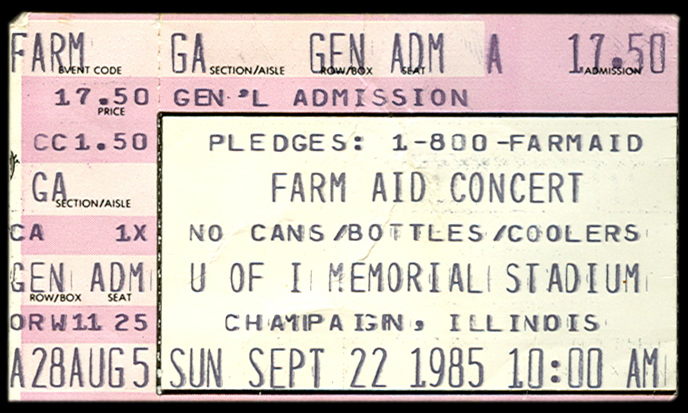
I didn’t see Farm Aid either. Not sure why. It was in September, so I probably wasn’t away. It aired on The Nashville Network, which we may not have received in Canada at that time, and so it is possible that it wasn’t even possible for me to see it. I really have no memory of it at all.

Farm Aid, which has now become an annual event, was initially organized by Willie Nelson, John Mellencamp, and Neil Young after Bob Dylan made an off-hand remark about struggling family farmers at Live Aid in July. The whole thing was brought together quickly in Champaign, IL, and it featured a remarkable list of musicians, most of whom had been left off an event like Live Aid.

1985-09-22 Farm Aid Champaign

Obviously, country acts dominated (Alabama, Johnny Cash, Charlie Daniels Band, John Denver, Vince Gill, Merle Haggard, Emmylou Harris, Waylon Jennings, George Jones, Kris Kristofferson, Loretta Lynn, Roger Miller, Charley Pride, Kenny Rogers, Tanya Tucker, to name but a few), but there were also blues stars (B.B. King!), rock stars (Eddie Van Halen! Sammy Hagar!), pop stars (Billy Joel! Daryl Hall!), and people who you would think had never seen a farm in their entire lives (Lou Reed!). Perhaps most bizarrely, there was LA-based punk band X. There is obviously a connection there that I am unaware of, since they also played Farm Aid II the next year.

I believe that this show marked the first time that Dylan performed live with Tom Petty and the Heartbreakers, with whom he would tour in 1986 and, more impressively, 1987. While I don’t want to get ahead of myself, many argue that those tours were the return of “good Bob”, with him working with a well-established unit for the first time since The Band a decade earlier. We shall see.

The Farm Aid set wasn’t flawless, but it was miles better than Live Aid. It was really the complete opposite of the Live Aid set – a big band sound rather than the acoustic trio; mostly new songs rather than obscure old ones. Dylan performed six songs, and three of them were from Empire Burlesque (“Clean Cut Kid”, “I’ll Remember You”, and “Trust Yourself”). Of those only “Trust Yourself” sounds like a significant upgrade on the album version. He also performed “Shake”, a song that his website claims is his own, but for which no lyrics are provided – I’m not sure where this fits into things. It was possibly a new composition that didn’t get used for anything. “That Lucky Old Sun” is a standard by Beasley Smith and Haven Gillespie that had been covered by the like of Jerry Lee Lewis, Sam Cooke, Ray Charles, Aretha Franklin, and Willie Nelson. I’m not sure where Dylan is borrowing it from, but it could be any of them. I like this version, although like most of the set it is a bit overdone (the combination of Heartbreakers and back-up singers can become overwhelming).

Finally, he ended his set with “Maggie’s Farm”, providing the kind of crowd-pleasing thematically-appropriate hit that he couldn’t bring himself to deliver at Live Aid. This is a nice version – not as powerful as many from the 1970s – but solid and pleasing. The tempo is great.

imgres

Dylan Personal Life Invasion Trivia: The woman Dylan sings “I’ll Remember You” and “Trust Yourself” with in the video above is Madelyn Quebec (formerly a Raelette), who is the mother of one of his back-up singers (Carolyn Dennis). At this show Dennis would have been pregnant with Dylan’s sixth child, and she and Dylan will marry in 1986. So that is Dylan singing with his future mother-in-law.

Empire Burlesque

Standard

5099746784027

My interest in Bob Dylan happened to perfectly coincide with the peak period of Dylan’s lameness. Empire Burlesque was the first new Dylan album that I bought (technically, the first new Dylan cassette – I did not, at the time, have my own turntable). I was fifteen years old.

Here’s one true thing that you could say about Empire Burlesque: no one was ever impressed that you owned a copy of it. For some reason I have a very detailed memory of bringing it to a classmate’s house one day when we were working on a group project. Somehow it got put on. Everyone asked for it to be taken off.

The videos were lame. The songs were lame. The synth overlays were particularly lame. Dylan was someone who had been cool when my parents got married, but in 1985 there was nothing left there. Hang it up, old man.

Perhaps because I had paid for it, I did listen to that album an awful lot. Even though I hadn’t listened to it before this week in at least a quarter century I could still sing along to every song. I know every word, every phrasing. I’m not proud of it, but it’s true.

Trying to listen to it afresh, and not nostalgically, I have to say in all honesty it is not a good album. It has a ton of great moments – or moments that could be great – but almost every little bit is destroyed by the production.

Let’s start at the end, which is the best part. The best song on the album is “Dark Eyes”, the final track. This is just Dylan singing, playing guitar and a nice little bit of harmonica at the opening. It’s a formula that had worked for two decades at this point, and it works here all over again. Simple. This song has some truly beautiful lyrics: “They tell me revenge is sweet / From where they stand I’m sure it is / But I feel nothing for that game / Where beauty goes unrecognized / All I feel is heat and flame / And all I see are dark eyes”. Excellent. It’s beautifully written and well-sung. Years from now Dylan and Patti Smith will perform this as a duet in concert and it will be incredible. Why couldn’t the whole album be this way?

Neither of the two singles, “Tight Connection to My Heart” and “When the Night Comes Falling from the Sky” are worth much of anything. Both are good songs lost in the production. That same thing can be said about most of the tracks here as well. “Seeing The Real You At Last” is a bitter Dylan blow-off with horns and sax slathered all over it. Lyrically, there are gems, including the opening line: “I though that the rain would cool things down, but it looks like it won’t”. That line always makes me think: “This is going to be good”, but it never is.

“Never Gonna Be the Same Again” suffers from both synthesizer and back-up singers. Could’ve been a good love song, but I can barely listen to this one – it is way too far over the top. “Trust Yourself”, one of three songs on the album featuring the return of Sly and Robbie as the rhythm section, is also too much. “Emotionally Yours” is pretty much just a bad song – it’s the type of thing Rod Stewart was doing around this time. The worst song on the album is ‘Something’s Burning, Baby”, with its marching band drums and synthesizer. That one probably can’t be redeemed at all (it is the only song from the album to have never been performed live, so maybe I’m not the only one who thinks this….)

There are also two curious songs on the album. The first is “Clean Cut Kid”, maybe the first pop song about Vietnam War PTSD. This is another where I hate the production, which is clanging and jarring, but the lyrics are actually quite funny. Dylan doesn’t often engage with straight up satire, but this song has a lot of it. Every time I hear this I think I hate it, but by about the midway point (“He was on the baseball team, he was in the marching band / When he was ten years old he had a watermelon stand”) I think I should give it another chance. Then the “whoop whoops” start up from the back-up singers and I have to wonder if Dylan has lost his mind. This is one that I wish were better than it is.

The other interesting song is “I’ll Remember You”. Along with “Dark Eyes”, this is the lone song that isn’t overproduced on the album – just Dylan on piano, plus an understated guitar, bass, drums backing band and a single backing singer (Madelyn Quebec). What surprises me about this song is that it didn’t get released as a single, since it seems like precisely the type of song that gets regularly picked up for big emotional moments. It’s “The Wind Beneath My Wings” but far less cloying. It’s a more contemporary “Forever Young”. It’s the song that you hope gets played at your funeral and everyone starts crying. It really seems like it should be played over the end credits of everyone’s college years:

There’s some people that
You don’t forget
Even though you’ve only seen ’m one time or two
When the roses fade
And I’m in the shade
I’ll remember you

It’s good for what it is, and I’m surprised that it never got picked up in that context and covered.

So, that’s Empire Burlesque. It’s a pretty forgettable album, with a lot of songs that could have been much better than they are here.

I can’t say, however, that it never did anything for me in high school. In point of fact, one of my great high school triumphs is owed to this album: As I may have mentioned at least once this year, all of the English teachers at my high school were Dylan fans. The biggest fan amongst them taught me grade eleven English. He would talk about Dylan frequently. At least once a week. It was a running joke. One day, for reasons that I can not ascertain, he went off on the class. The pretext was an article in that day’s paper about “my generation” and the fact that they didn’t have heroes. He asked us for some examples of heroes and no one offered much up (to be fair, it was a terrible, terrible group of students, they never gave him much to work with – the class had a lot of students who weren’t bound for college). He called us self-interested. So I raised my hand and offered a quote. He told me to go ahead, and turning to the back of my Bob Dylan Collected Lyrics (which, honestly, I had with me…), I said “To quote the great Bob Dylan:

Trust yourself
Trust yourself to do the things that only you know best
Trust yourself
Trust yourself to do what’s right and not be second-guessed
Don’t trust me to show you beauty
When beauty may only turn to rust
If you need somebody you can trust, trust yourself

Mic drop. I think that the class actually whooped. For the rest of the week I was stopped in the hall by people I didn’t even know to ask if it was true that I’d shut down Mr. X with a Dylan quote. Indeed it was. It was probably the smuggest I’ve ever felt in my entire life.

That’s a true story, by the way.

“Sun City”

Standard

imgres

“Sun City” is a vastly superior song to the treacly “We Are the World”, the more famous megastar single from 1985. Put together by Steven Van Zandt, who had left Bruce Springsteen’s E-Street Band the year prior, “Sun City” was the first all-star song with the goal of raising political awareness rather than money for charity.

Bob Dylan was one of the earliest stars to sign up for the project – he had been working with Van Zandt on tracks for Empire Burlesque (tracks that would, sadly, be cut from the album), so the connection is pretty direct and easy to understand. Unlike on “We Are the World”, Dylan doesn’t have a big signature part on this song, and it’s a lot more difficult to pick out his contribution. In the video he’s even more obscured, he basically show up around 4:16 and points his finger at Jackson Browne. They both sing the line “Relocation to phony homelands” at about 4:29 – listening to the song without watching the video he’s tough to pick out, Peter Garrett sort of overwhelms Dylan’s line with his own following one. That’s it. So I’m not really sure what there is to say here from a Dylan perspective.

I like the song a lot, still to this day. Probably to the same degree that I dislike “We Are the World”. The song was only a limited hit. Some radio stations refused to play it because of the line sung by Joey Ramone: “Constructive Engagement is Ronald Reagan’s plan”. No criticisms of Reagan on 80s pop radio, thanks very much. 

Van Zandt has written very interestingly about all of this, and about his engagement with the issue. Warning: Reading this article may cause you to become extremely irritated with Paul Simon!